The Hands-On RiderCourse Texas Requires
Texas’s hands-on OHV RiderCourse can be easy to confuse with a park pass, decal or online safety lesson. The key question is whether your ride requires proof of safety education, and what to do if the rider is under 14 or already holds a certificate from another state. Here’s how to understand the course, prepare for it and verify your paperwork before heading out.
What the Texas RiderCourse requirement means
Texas requires OHV safety education for riding on covered public land. The approved course includes hands-on instruction, so an online lesson by itself may not satisfy the requirement. Check the current course details before enrolling: providers may offer classroom or online material alongside the practical portion, but you need to know which steps count toward the Texas certificate.
An OHV, or off-highway vehicle, includes machines such as ATVs and many side-by-sides. The safety certificate is about the operator’s training; it is not the same as a title, an OHV decal or permission to ride at a particular park. A rider can have one required item and still be missing another. For a broader view of when a sticker is needed, see The Texas OHV Decal Requirement Explained.
The course is not a general qualification to drive on public roads. Texas generally does not make OHVs eligible for ordinary road registration, and a safety certificate does not change that. It also does not grant access to private property or override a park’s own conditions. Before a trip, check the land manager’s rules as well as the state requirements in Texas Rules for Riding Public Land.
The practical value of hands-on instruction is that it gives a rider a structured opportunity to work on basic control before riding a trail. The instructor can cover safe operation and observe the rider’s skills, rather than relying only on a quiz or an online completion record. That matters for beginners, but it is also useful for riders who have been using a machine for years without formal training.
The requirement is easiest to think about as three separate questions:
- Is the place you plan to ride covered by the Texas safety education requirement? Public riding land and private property can be subject to different rules.
- Does the rider need a Texas-recognized certificate, or must the rider be supervised because of age? The answer depends on the rider’s age and circumstances.
- Does the location also require a decal, permit, pass or other proof? Safety education does not replace these items.
When in doubt, contact the course provider or the relevant land manager before you travel. Do not assume that a certificate required at one public riding area will be the only document needed at another.
What happens during the hands-on course
The course combines safety instruction with practical riding activities. The exact lesson plan and enrollment process can vary by approved provider, so use the provider’s current instructions rather than assuming every class follows the same schedule. Ask whether the course includes both the required knowledge instruction and the practical riding evaluation, and how the provider records successful completion.
Practical instruction commonly covers habits that translate directly to trail use: checking the machine before riding, selecting suitable protective equipment, starting and stopping under control, managing speed, turning, and responding to changing terrain. The instructor may also explain how to keep an appropriate following distance, avoid abrupt maneuvers, and ride within the limits of both the machine and the operator.
That is different from simply proving that a machine can move. A controlled practice area lets a rider work through skills at a manageable pace, with coaching available when a technique needs adjustment. It can also reveal a mismatch between the machine and the rider’s experience, strength or comfort level. A rider who cannot comfortably manage a machine in a practice setting should not treat course completion as a reason to push beyond their ability on a trail.
Before signing up, ask the provider:
- Is this course approved for the Texas OHV safety certificate?
- Does it include the hands-on component required for the certificate?
- What must the student complete before arriving?
- Does the student need to bring an OHV, or is one provided?
- What clothing, footwear and protective equipment are required?
- What identification or paperwork should the student bring?
- How does the provider report completion and issue proof?
The answers matter because a provider’s course title may not tell you whether it meets the state requirement. A general online safety course, a dealer orientation or a private riding lesson may be useful, but do not assume it qualifies as the Texas RiderCourse. Confirm that the course is recognized and that you understand each required part before paying or making travel plans.
If you are comparing providers, look beyond the first available date. A course that fits the rider’s age, machine and skill level is more useful than a rushed booking that leaves important questions unanswered. Read the instructions carefully, especially where the provider specifies what to bring, what equipment is supplied and whether a parent or guardian must attend for a minor.
For help finding an appropriate class, start with Where to Take a Texas ATV Safety Course and Texas ATV RiderCourse Locations. If a course listing is unclear, contact the provider directly and confirm that successful completion will satisfy the state certificate requirement. Avoid relying on a search result or an old listing if it does not clearly explain the current course format.
How to book and prepare for class
Treat enrollment as a small checklist rather than a quick purchase. Course availability, required equipment and practical arrangements can differ by provider. Confirm the details before you make a long drive or arrange for a young rider to attend.
- Check the rider’s age and eligibility. Texas does not issue a safety certificate to riders under 14. A younger rider may still be able to ride under the applicable supervision rules, but the course certificate is not a substitute for those rules. Review Texas Minimum Age for a Safety Certificate before enrolling a child.
- Confirm the course is the right one. Ask whether it is approved for Texas OHV certification and includes the required hands-on portion. If the course has an online component, find out whether that is preparation, a required part of the course or the whole offering.
- Ask what machine is used. Some providers may supply equipment; others may require the rider to bring a suitable machine. If you must bring one, ask about size, operating condition and any restrictions. Never assume a child can use an adult-sized ATV just because it is available.
- Check the equipment instructions. A provider may specify an approved helmet, eye protection, gloves, long sleeves, long pants and sturdy footwear. Ask what is provided and what the rider must bring. The course’s equipment rules are the minimum for that class, not a guarantee that the same setup is right for every trail or condition.
- Complete any advance work. If the provider assigns reading or online material, finish it before class. Bring any confirmation or documents the provider requests.
- Plan to arrive ready to participate. A student who arrives late, without required gear or with a machine that cannot be used may not be able to complete the practical exercises. Confirm the arrival time, parking arrangements and whether a parent or guardian needs to stay.
- Keep proof after completion. Ask how the certificate is provided and whether the rider should carry a physical card, digital record or both. Make sure the name and other identifying details are correct, and keep a backup copy at home.
The course can require more preparation than a purely online class because the student has to take part in practical activities. That is a benefit, not a bureaucratic quirk: the rider needs to be prepared to operate a machine safely under instruction. If a student is nervous, inexperienced or unfamiliar with the machine, tell the provider before class. The instructor can explain what the practice will involve and what to expect.
Cost and scheduling depend on the provider, so check directly for current enrollment details. If you are comparing options, compare the full arrangement—not only the advertised course charge. Travel, equipment and the need to bring a machine can affect what a family has to plan for. Do not treat a low-cost online certificate from an unrelated provider as interchangeable with a Texas-approved hands-on course.
A rider who already has substantial experience may wonder whether the practical class is still worthwhile. Familiarity with one machine does not necessarily mean the rider has learned consistent safety habits, and different machines can handle differently. Take the course seriously, follow instructor directions and use the practice time to build repeatable skills rather than trying to demonstrate speed.
Riders under 14 and adult supervision
The age rule is one of the most important points for families. Texas does not issue an OHV safety certificate to a person under 14. That does not mean a younger rider can ignore safety education requirements or ride without an adult. Instead, the applicable rules call for direct supervision by an adult who holds the required certificate.
Direct supervision means more than allowing a child to ride somewhere while an adult is elsewhere on the property. The supervising adult needs to be in a position to oversee the child’s operation and respond if needed. Plan the ride so the adult can maintain meaningful supervision throughout, not just at the start or end. Check the current details in Texas Rules for Riders Under 14 and Texas Supervision Rules for Young Riders.
The supervising adult should be properly prepared, too. A parent or other adult should not assume that age alone satisfies the requirement. Check the certificate rules and make sure the adult’s certificate is valid and available to show if requested. If another adult will supervise, make sure that person understands the child’s ability, the machine’s controls and the location’s rules.
A child’s experience and physical ability should guide machine choice and trail selection. A safety certificate for the supervising adult does not make a machine appropriately sized for a child, and a successful course does not make every route suitable. Before the ride, consider whether the young operator can reach and use the controls, maintain a stable posture, turn and stop reliably, and respond calmly to instructions. If not, choose a smaller machine or a more appropriate setting.
It can help to separate three responsibilities:
| Requirement | What it addresses | What it does not replace |
|---|---|---|
| RiderCourse certificate | Approved safety education for an eligible rider | A park decal, land permission or road-use authorization |
| Direct adult supervision | The rule that applies when a rider is under 14 | Proper machine size, protective gear or safe trail choice |
| Park or public-land requirements | Site-specific access, permits and operating rules | The state safety education requirement |
Do not wait until arriving at a trailhead to sort out a child’s eligibility. Ask the land manager what proof is expected, confirm who will supervise and carry the adult’s certificate. If a child will ride with a group, make sure the person responsible for supervision knows the rules and is not assuming that another adult has handled them.
For families planning a first ride, a course can also be useful preparation for the supervising adult. It gives both the adult and the child a shared framework for safety discussions, even though the child under 14 cannot receive the certificate. Keep expectations realistic: supervised riding is not the same as independent riding, and the adult should be ready to stop the ride if conditions, fatigue or the child’s confidence change.
Out-of-state certificates and proof on the ride
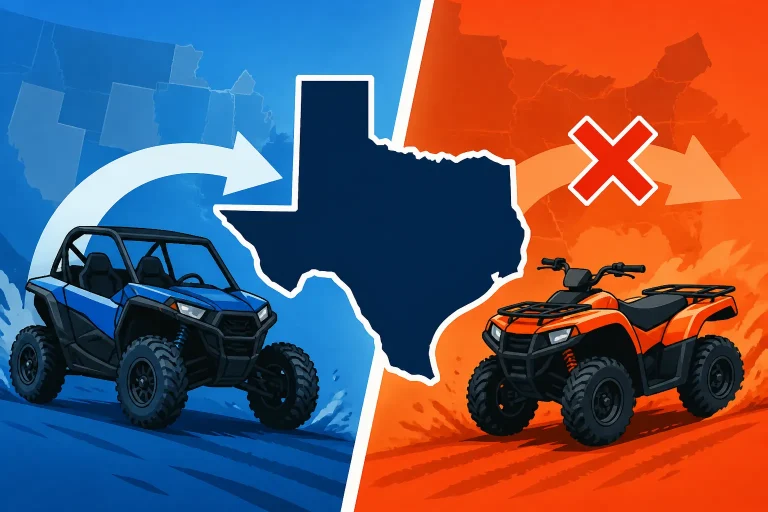
A certificate earned outside Texas may be accepted, but do not assume every card or online completion document qualifies automatically. Check whether the certificate is recognized for Texas OHV safety requirements and whether it identifies a course that meets the state’s standard. If the document is from another state, a nationally offered program or a private provider, confirm acceptance before relying on it at a Texas riding area.
The practical check is straightforward:
- Identify who issued the certificate and what course it represents.
- Confirm that the course included the required training, not just an online quiz.
- Check that the rider’s name and certificate details are readable.
- Contact the relevant Texas authority or the riding-area manager if acceptance is uncertain.
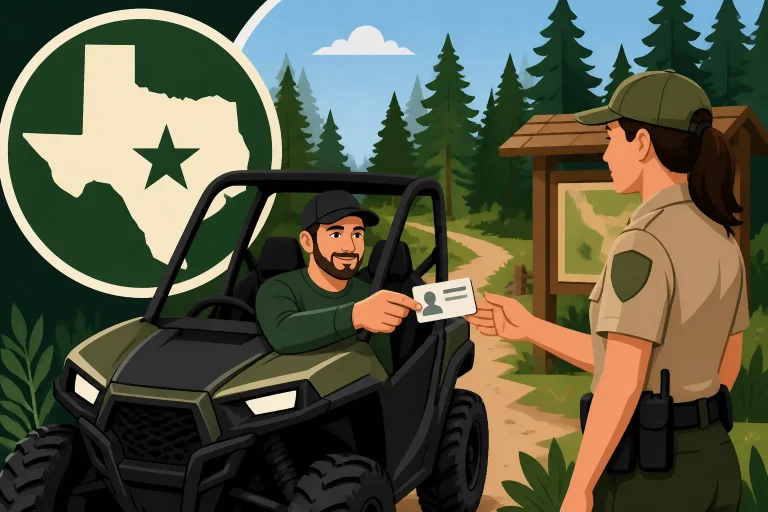
- Carry proof in the form the land manager accepts.
For more detail, see Does Texas Accept an Out-of-State Safety Certificate?. Reciprocity is not a blanket assumption that any credential issued elsewhere automatically meets Texas requirements. A certificate may be valid for one program or location but not establish compliance with a different state’s rule.
Keep the certificate accessible when riding, rather than buried in a file at home. The exact form of acceptable proof can depend on current program procedures, so check whether the rider should carry a card, a digital version or another record. A clear image stored on a phone can be a useful backup, but do not rely on a phone alone if the area requires a physical card or if reception and battery life may be unreliable. Guidance on carrying proof is covered in Carrying the Certificate on a Texas Ride.
The certificate also does not replace other trip documents. A public riding area may require an OHV decal or day-use payment; a particular park may have its own waiver, hours, equipment rules or trail restrictions. Before leaving, check each item separately:
- The rider’s certificate or applicable supervision arrangement
- The machine’s required decal or site permit
- The riding area’s admission and use rules
- Any age, machine-width or equipment restrictions
- Current trail conditions and closures
If you ride in multiple states, keep a record of the course provider and completion date with the certificate. That information can help answer questions if a land manager needs to identify the credential. If a card is lost or damaged, contact the issuer to ask how to get a replacement; do not assume a photo or a receipt is accepted as a permanent substitute.
Finally, remember that course completion is training, not a promise that a rider is prepared for every situation. Apply the skills at a pace that matches the rider, machine and terrain. A safe ride depends on choosing suitable trails, wearing protective equipment, following site rules and turning back when conditions exceed the group’s ability. The RiderCourse is one important part of that preparation, not the whole plan.
Frequently Asked Questions
Is an online ATV safety course enough in Texas?
Not if the course does not include the approved hands-on component required for the Texas certificate. Confirm directly with the provider that the course qualifies and ask what parts must be completed in person.
Can a rider under 14 take the course and get a certificate?
Texas does not issue an OHV safety certificate to riders under 14. A younger rider must follow the applicable supervision rules, including riding under direct supervision of an adult who holds the required certificate. See Why Texas Will Not Certify Below Fourteen.
Does the RiderCourse let me ride on any Texas road?
No. The safety certificate is not road registration or permission to operate an OHV on public roads. Road-use rules are separate, and a few narrow exceptions do not make an OHV generally street legal.
Does a certificate from another state automatically count?
Do not assume so. Verify that the credential is accepted for Texas requirements and that it represents qualifying safety education. Check Certificates Issued by Another State or contact the relevant authority before the trip.
Disclaimer
This article is for general informational purposes only and does not constitute professional advice. Laws, prices and regulations vary by location and change over time. Consult a qualified professional for guidance on your specific situation.