Certificates Issued by Another State
A safety card from home may be enough for riding in Texas, but that does not automatically clear every other requirement at a trailhead. The key is to separate safety certification from decals, fees, age and supervision rules, then confirm what the specific land manager requires before you unload.
Does Texas Accept an OHV Safety Certificate From Another State?
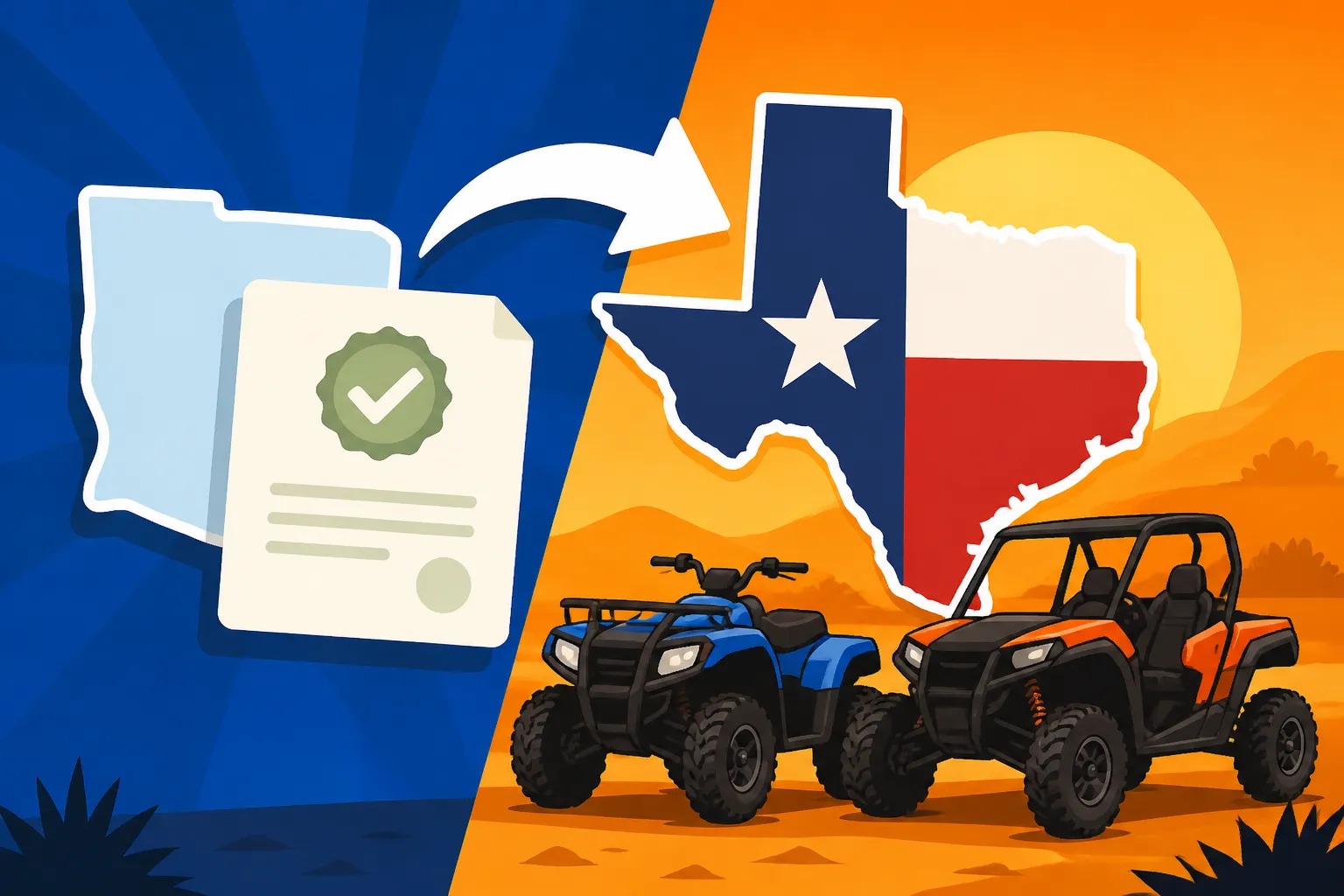
Texas recognizes qualifying off-highway vehicle safety certificates issued by other states. If you completed an approved safety course elsewhere and have proof of certification, you generally do not need to repeat the course just because you are riding in Texas.
That recognition is useful for visitors and people who have moved to Texas with a certificate from their previous state. It is also easy to misunderstand: a certificate is evidence of safety-course completion, not a general permit to ride anywhere. A certificate does not replace the Texas OHV decal when one is required, a park’s entry requirements, or any age and supervision rules that apply to the rider.
Texas’s approach to safety certification is explained in Texas OHV Safety Certificates. The practical point is that another state’s certificate may satisfy the certification part of the requirement, while the ride still has to comply with the rules of the place you are visiting.
Before relying on an out-of-state card, make sure it is actually a safety certificate for off-highway vehicles. A driver’s license, motorcycle endorsement, boating card, online completion receipt, or general youth safety course is not automatically the same thing. If the card does not clearly identify the course or type of certification, contact the issuing agency or the Texas land manager before your trip.
The same caution applies if the certificate is electronic. A digital record can be useful, but riders should have a way to show it when asked. If you have a physical card, bringing it is simple. If you only have an online account or email confirmation, save the record on your phone and consider keeping an accessible backup.
What “accepted” does and does not mean
Acceptance means Texas can recognize an out-of-state safety certificate for the applicable safety-education requirement. It does not mean Texas has adopted every part of the other state’s rules. Texas requirements govern riding in Texas, and a park or land agency can set additional conditions for its property.
A certificate also does not establish that a rider is old enough to operate a particular machine, that a child is properly supervised, or that the machine has the required decal. Those are separate questions.
| What you have or need | What it generally addresses | What it does not replace |
|---|---|---|
| Out-of-state OHV safety certificate | Proof that the rider completed a qualifying safety course | Texas decal, site admission, age limits or supervision |
| Texas OHV decal | The decal requirement for machines used on covered public land | Rider certification or a park’s separate entry fee |
| Park or land-use pass | Access or fee requirements set by the site | A safety certificate or required machine decal |
| Parent or adult supervision | A possible route for a young rider under Texas rules | Site-specific rules or all other legal requirements |
The details can depend on the rider’s age, the kind of land, and the site’s rules. Check Texas Safety Certificate Requirements for the broader certification framework, and review the particular park or land agency’s current instructions before traveling.
What to Check Before Riding in Texas
Treat the certificate as one item in a short compliance check, not as the whole checklist. A rider who has a valid card can still arrive without a required decal, arrive at a site with different access rules, or misunderstand the supervision rule for a child.
Start with the land. Texas public riding areas are not all governed by one uniform set of entry procedures. A state or federal trail, a local park, and a privately operated riding area may have different fees, permits, operating hours, vehicle limits, and proof-of-completion requirements. The site’s current instructions are more useful than a general assumption about what “Texas riding” allows.
Next, check whether the machine needs a Texas OHV decal for the type of land you plan to use. A safety certificate belongs to the rider; the decal is associated with the machine and the applicable riding rules. Do not assume that one covers the other. The Texas OHV Decal Requirement Explained clarifies when the decal question is separate from safety certification.
Then check age and supervision. Texas has special provisions for young riders, including rules about riding with an adult who holds a safety certificate. A child’s out-of-state certificate does not necessarily remove a supervision requirement that applies because of age. Read [What Texas Requires of Riders Under 14] and Direct Supervision by a Texas Certificate Holder if a rider in your group is under 14.
A useful pre-trip sequence is:
- Identify the riding area. Confirm which agency or operator manages the land and whether the trail is open to your kind of machine.
- Check the rider requirement. Ask whether the site requires a safety certificate, what proof it accepts, and whether age affects the rule.
- Confirm the out-of-state certificate. Make sure it is an OHV safety certificate, and bring a card or accessible record showing completion.
- Check the machine requirement. Find out whether the machine needs a Texas OHV decal, and whether the decal must be displayed in a particular way.
- Review extra access conditions. Check for admission fees, permits, width restrictions, operating hours, equipment rules, and any separate site-specific requirements.
- Prepare for inspection. Keep the certificate and other required proof available rather than buried in a trailer or stored in an account you cannot access without cell service.
This order prevents a common mix-up: a rider may be certified but still unable to ride because the machine lacks a required decal or the site is closed. Likewise, a decal on the machine does not prove that the rider has met a safety-course requirement.
For more on the place-based rules, see Texas Rules for Riding Public Land. If you are a visitor and want to separate state requirements from a park’s own charges, What Texas Charges Visitors to Ride can help frame the questions to ask.
Young Riders and Adult Supervision
Out-of-state certification matters most when a family is planning a ride with children. Texas has rules for young riders that do not disappear simply because a child has taken a course in another state. Certification and supervision are related, but they are not interchangeable in every situation.
The main practical distinction is between a rider who can satisfy a course requirement with their own certificate and a younger rider who may need to ride under direct supervision by an appropriately certified adult. Texas does not issue its own safety certificate to children below the program’s minimum age, so the supervision pathway is important for some families. See Texas Minimum Age for a Safety Certificate for the age issue, and check the current Texas requirements before relying on a particular arrangement.
An out-of-state card for a child may be useful proof of training, but it is not safe to assume that it removes an age-based supervision rule. Likewise, an adult’s certificate should not be treated as a blanket authorization for every child in a group. The rider still needs to be supervised in the way Texas requires, and the land manager may impose its own conditions.
“Direct supervision” should be taken seriously. It is not simply having a certified adult somewhere at the park, in another group, or reachable by phone. The responsible adult needs to be able to monitor the young rider and respond if something goes wrong. The exact legal application can depend on the situation, so confirm the current rule rather than relying on a loose interpretation of the phrase.
Before taking a child on a Texas ride, ask these questions:
- Is the child old enough to hold the relevant safety certificate?
- If not, what kind of certified adult supervision is required?
- Does the supervising adult need to be a parent or guardian, or can another authorized adult supervise?
- Does the riding area set a minimum age, machine-size limit, or additional training condition?
- Does the child’s certificate come from an OHV course that Texas recognizes?
Also match the machine to the rider. A certificate does not make a machine appropriate for a child’s size, reach, strength, or experience. The rider must be able to control the vehicle and use its safety equipment correctly. Site rules may further restrict the machines children can operate.
For a family bringing certificates from another state, carry proof for both the young rider and any adult whose certificate is being used to meet a supervision requirement. Keep the documents accessible, and make sure the supervising adult knows the route, the group plan, and the site’s operating rules. More details are available in Riding Under an Adult Who Holds One and Carrying the Certificate on a Texas Ride.
Documents, Verification and Common Problems
A certificate is only helpful at a checkpoint if staff can tell what it is and whose name it belongs to. Before leaving home, check that the card or digital record is legible and includes enough information to identify the rider and the course or issuing authority. If a name has changed or the card is damaged, bring another piece of identification or a supporting record when practical.
Do not assume a screenshot of a course website is equivalent to the actual certificate. It may be enough to help staff locate the record, but acceptance is up to the relevant authority. If you have not received the certificate yet, ask the issuing organization whether its temporary proof is valid for riding, and confirm with the Texas site before making the trip.
A few common snags are avoidable:
- The document is for a different activity. A motorcycle or boating card may not establish completion of an OHV safety course.
- The rider’s name does not match. A card issued under an old name or with a misspelling can slow verification. Bring supporting identification or contact the issuer for a correction.
- The proof is not available offline. Remote riding areas may have weak or no mobile service. Save the record locally or bring a printed copy.
- A certificate is mistaken for a machine decal. Keep the rider’s certificate and the machine’s decal requirement separate in your planning.
- The certificate is assumed to override age rules. A young rider may still need the required adult supervision.
- The group assumes every site follows the same policy. A park operator may have its own admission, equipment, and access requirements in addition to state rules.
If a site attendant questions an out-of-state certificate, stay calm and ask what information is missing or what policy applies. Showing the issuer, course name, rider’s name, and completion record can help clarify the issue. If the attendant cannot verify the card, ask whether the site has a manager or official contact who can confirm the requirement. Do not treat a disagreement at the gate as permission to ride without resolving it.
When there is time before the trip, verify acceptance with the property manager. Give them the certificate’s issuing state and course name, not just a broad description such as “I took an ATV class.” If the certificate was issued many years ago or through an organization whose name has changed, explain that too. The site can tell you whether it needs a card, a transcript, a digital credential, or another form of proof.
Use the same approach for Texas requirements that may have changed. Ask the responsible land manager or consult the relevant Texas agency for current instructions. A park’s site-specific answer is especially important when a trip involves children, a large group, a rental machine, or land with its own permit system.
For a broader overview of how Texas treats certificates from elsewhere, see Why Texas Honors Out-of-State Certificates. Keep the response or any useful confirmation with your trip paperwork so the group is not trying to solve the question at the entrance.
Plan the Ride Without Confusing the Rules
The easiest way to avoid last-minute problems is to plan around four separate checks: rider certification, age and supervision, machine decal, and land access. The out-of-state certificate addresses only the first of those, and sometimes contributes to the supervision question for a young rider. It does not settle the other three.
A simple checklist for a visitor looks like this:
- Certificate: Does each rider who needs one have a qualifying OHV safety certificate, and can they show it?
- Age: Does any rider need direct supervision or have a site-specific age restriction?
- Machine: Does the machine need a Texas decal for the planned riding area?
- Access: Is the trail open, and are separate permits, fees, reservations, or equipment conditions in effect?
- Proof: Can the group show its documents even if phone service is unavailable?
If you are bringing several machines or riders, assign one person to check the documents and another to confirm the site’s current access conditions. Make a short list of which rider’s certificate is in which phone or bag. Keep machine decals visible and in good condition, and do not expect staff to infer compliance from a receipt or an explanation.
For nonresidents, the certificate issue is often easier than the decal and access questions. Texas’s recognition of a certificate from another state does not mean that the other state’s decals, park passes, or vehicle permits transfer to Texas. Those are separate programs. The same is true in reverse: a Texas certificate may be recognized elsewhere only if that state’s rules say so.
If the ride is on private land with the owner’s permission, public-land rules may not apply in the same way, but permission does not cancel safe operation or a property owner’s conditions. If you are unsure which rules govern a particular trail, identify who controls the land and ask directly. A route that crosses or connects different properties may involve more than one set of rules.
The practical takeaway is straightforward: Texas accepts qualifying OHV safety certificates issued by other states, so many riders do not need to retake a course just to ride here. Carry clear proof, follow Texas’s age and supervision rules, and check the decal and access requirements for the specific place you plan to ride.
Frequently Asked Questions
Do I need to retake my OHV safety course when I move to Texas?
Usually, a qualifying safety certificate issued by another state is recognized in Texas. Keep proof of completion and confirm with the riding area if the certificate’s type or issuing organization is unclear.
Does an out-of-state certificate replace the Texas OHV decal?
No. The certificate applies to the rider’s safety-course status; the decal requirement applies separately to the machine and the land being used.
Can a child use an out-of-state certificate instead of riding with a certified adult?
Do not assume so. Texas age and supervision rules may still apply. Check the current requirements for the child’s age and the specific riding area before the trip.
Is a driver’s license or motorcycle endorsement enough?
Not automatically. A driver’s license or endorsement is not necessarily an OHV safety certificate. Bring proof that clearly identifies an OHV safety course or certification.
What if I only have a digital certificate?
Save it for offline access and bring a printed copy if possible. Contact the site before traveling if you are unsure whether its staff can verify that format.
Disclaimer
This article is for general informational purposes only and does not constitute professional advice. Laws, prices and regulations vary by location and change over time. Consult a qualified professional for guidance on your specific situation.