What Texas Charges Visitors to Ride
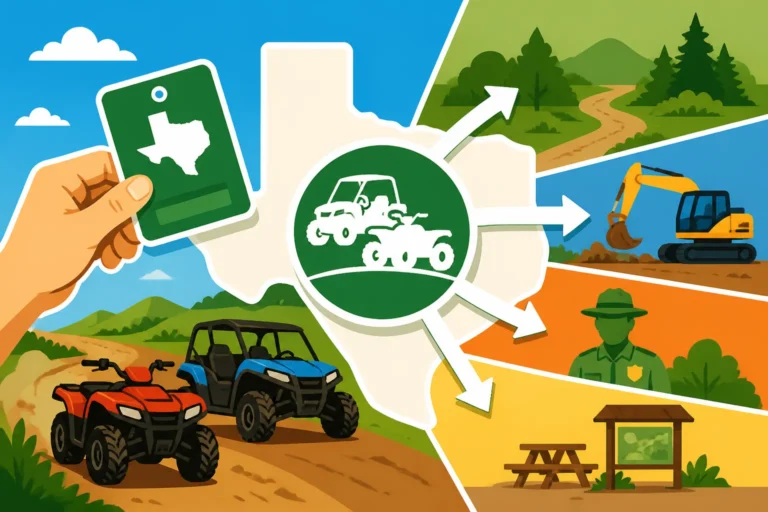
If you’re bringing an ATV or UTV into Texas, the cost of riding is not always just the park’s entrance fee. You may also need a Texas OHV decal, a land-specific permit or day-use pass, and proof of a safety certificate for some riders. This guide explains which charges can apply, what out-of-state visitors should check, and how to avoid paying for the wrong thing.
What visitors may have to pay to ride in Texas
There is no single statewide ticket that covers every Texas trail. Your total depends on where you ride, what kind of machine you bring, and whether you are riding on public or private land.
A visitor’s costs may include:
- A Texas OHV decal for a machine used on covered public land
- An entrance, riding or day-use fee charged by the land manager
- A separate permit, reservation or pass for a specific site
- Rental, camping or other facility charges
- Equipment or administrative costs if you arrive without something the site requires
These charges are separate. Buying an OHV decal does not automatically pay a park’s admission fee. A park ticket does not necessarily take the place of a decal or a required land permit. And a safety certificate is proof of training, not a riding pass.
The first question is therefore not “What does Texas charge?” It is “Which rules apply to this exact place?” A privately operated riding park, a national forest trail, a city facility and a private ranch can all have different payment systems and requirements.
| Charge or document | What it generally covers | Who sets or collects it | What to check |
|---|---|---|---|
| Texas OHV decal | A state decal requirement for covered off-highway riding on public land | Texas Parks and Wildlife or an authorized seller | Whether your machine needs one at the destination and how to display it |
| Site entrance or riding fee | Access to a particular park or riding area | The land manager or operator | Whether the fee is per person, machine, day or visit |
| Day-use fee or pass | Use of a managed public recreation area | The agency managing the site | Whether an annual pass is available and what it includes |
| Special permit or reservation | Access under site-specific rules | The site or land manager | Whether advance booking or a separate permit is required |
| Safety certificate | Proof that a rider completed required safety training | The relevant training or licensing authority | Whether the rider needs a certificate and whether an out-of-state one is accepted |
| Camping or facility charge | Overnight use or amenities | The park, campground or land manager | Whether camping is separate from riding access |
For a broader explanation of where the state decal fits, see The Texas OHV Decal Explained. If you are still choosing a destination, Texas OHV Parks by Region can help you narrow down the kind of place you want to visit before you start checking its individual rules.
The Texas OHV decal: what it is and when it matters
The Texas OHV decal is one of the main state-level costs visitors encounter. It is separate from an entrance ticket and is generally associated with riding an off-highway vehicle on covered public land. It is not a Texas road-registration plate and does not make an ATV or UTV street legal.
A decal applies to the machine, not to each person in your riding group. If several machines are going, check the requirement for each one rather than assuming that one decal covers the trailer or group. A visitor’s home-state registration, plate or sticker also should not be assumed to replace Texas’s OHV decal requirement. Confirm the destination’s current rules before travelling.
Does every Texas riding area require it?
No single answer fits every riding property. The requirement depends on the land and the rules that apply there. Some public riding areas require the Texas decal; a private park may have its own admission rules and may or may not be covered by the same requirement. The fact that a property is open to visitors does not by itself tell you whether it is public land, private land, or subject to a particular OHV program.
Some public properties are tied to the state’s OHV grant program. A site’s relationship to that program can affect whether the decal is required. Ask the land manager directly if the information on its website is unclear. The details in Where a Texas OHV Decal Is Required and How to Tell If a Park Took an OHV Grant can help you understand why the answer can differ between destinations.
On private land, a state decal generally is not the same kind of access requirement as it is on covered public land. But “private land” does not mean “no rules or costs.” The owner can require a fee, waiver, reservation, safety equipment or proof of permission. A private operator can also set conditions for using its trails.
Buy the decal before you travel
Visitors can avoid a frustrating gate conversation by checking how a site wants the decal obtained and displayed. Depending on the current arrangements, a decal may be available through an authorized seller, an online channel or at a riding site. A park’s gate process may be convenient, but do not assume that every location sells one or that purchasing there will be quicker than arranging it ahead of time.
The decal amount and purchase methods can change, so check the current information from Texas Parks and Wildlife or the destination before paying. A gate or retailer may also charge for its own service or sell an admission product alongside the decal. Ask for an itemized explanation if it is not clear which charge is for which purpose.
A decal is not a replacement for a park pass, national forest day-use payment, event ticket or reservation. If the park says that a decal is required, ask whether it also charges a separate riding or entrance fee. Where to Buy a Texas OHV Decal and Texas OHV Decal Cost cover the purchase question in more detail.
Check display instructions
A valid purchase may still cause a delay if the decal is not displayed where staff expect to see it. Follow the current instructions for placement and do not rely on a photo of the decal as proof unless the specific site says that is acceptable. Keep the purchase confirmation accessible until you know the decal is properly attached.
If you need a durable sleeve or a way to protect paperwork from mud and water, you can compare options on Amazon, but use the official display instructions as your guide. A protective accessory should not obscure the decal or change how it is attached.
For visitors bringing a machine they own from another state, the decal question is separate from the title and road-plate question. If you need to understand those differences, see Nonresidents Bringing a Machine to Texas. A Texas OHV decal does not transfer ownership, replace a title, or authorize road use.
Park fees, day-use charges and other site costs
The largest variation for visitors usually comes from the place they choose to ride. A state decal is only one part of the budget. Parks and public-land managers set their own access arrangements, and those may depend on the number of people, machines, days or services involved.
A private riding park might collect an admission charge at the gate, require a waiver and charge separately for camping. A public trail area could have a day-use fee, a parking arrangement or an annual pass. A recreation area may require a free permit even when it does not charge for the permit itself. These are different kinds of rules: “free permit” does not mean “no permit needed.”
Ask what the fee is based on
Before leaving home, find out whether a listed charge is:
- Per rider or per vehicle
- Per machine or per group
- For one day, a weekend or a longer stay
- For trail access only or for other site facilities too
- Separate from camping, parking, reservations or the state decal
Do not assume a fee is per machine just because you are transporting machines, or per person because the park’s visitor information is written for general recreation. If the site’s wording is vague, call or message the operator and describe your group: number of riders, machines, children, and whether you plan to camp.
If you plan to stay overnight, ask whether your riding access includes the campground or whether you need a separate reservation and fee. Texas OHV Parks With Camping and Camping at a Texas OHV Park can help you compare the general arrangements, but the specific park’s current conditions control.
Public land may have more than one payment
Public land can involve separate requirements for riding and general area use. For example, a trail fee or day-use payment may not cover all nearby facilities. A park or forest might also require a permit, pass or proof of payment that is checked at the trailhead.
For a national forest trip, identify the exact riding area and confirm the current fee and access process with the managing agency. A day-use fee, annual pass and Texas OHV decal are not interchangeable. A pass for one type of forest recreation may not cover every trail or machine-related requirement. The practical guide Texas National Forest OHV Fee explains the distinction between a forest payment and the other items a rider may need.
A free permit can still be mandatory. At some sites, the permit helps the land manager track visitors or communicate conditions rather than collect revenue. Do not skip a permit just because the application does not ask for payment. [Texas Rules for Riding Public Land] offers more context on how land rules can vary beyond the price itself.
Events and special arrangements
Organized rides, races, guided tours and commercial activities can involve rules beyond ordinary day access. The organizer may need to arrange permissions, and participants may have to follow event-specific registration or check-in steps. If you are attending an event, ask the organizer what is included in the ticket and what you still need to buy or provide.
A rental operator may bundle some items, such as a machine, safety gear, a waiver or site access. That does not automatically mean the rental covers every state or land-manager requirement. Before paying, ask which fees are included, which are collected separately, and whether the rental machine already has any required decal. For more on this, see Texas OHV Decal for a Rented Machine.
Reciprocity for out-of-state visitors
“Reciprocity” can mean different things in conversations about OHVs. A visitor may be asking whether Texas accepts a safety certificate earned in another state, whether a home-state decal works in Texas, or whether an out-of-state registration changes the Texas rules. Treat each question separately.
Safety certificates are not the same as decals
Texas recognizes qualifying out-of-state OHV safety certificates in the situations covered by its rules. That recognition concerns training proof. It does not mean that a certificate serves as a Texas decal, park admission or public-land permit.
If a rider in your group may need to show a safety certificate, bring the actual card or acceptable proof and make sure the rider’s name and details are legible. A photograph may be convenient, but do not assume every land manager will accept one in place of the required document. The safest approach is to carry the certificate as instructed and ask the destination what it accepts.
The details of certificate recognition and supervision are covered in Does Texas Accept an Out-of-State Safety Certificate? and Certificates Issued by Another State. Texas’s recognition of a qualifying course should not be mistaken for a blanket agreement that every out-of-state OHV decal or land-use pass is valid here.
Do not assume your home-state decal travels with you
A sticker from another state may be meaningful in your home state but still not satisfy the Texas requirement at a covered riding area. Before your trip, ask the destination whether it requires a Texas OHV decal for a nonresident’s machine. If it does, ask whether there is a specific exception that applies to your machine or the property.
A street-legal plate from another state raises a different question from an OHV decal. Some machine types may be treated differently under site rules, but a plate does not automatically override every public-land restriction, facility rule or trail-width limit. If you are relying on a street-legal status to avoid a decal or use a particular route, confirm that exact point with the land manager. See Why a Street-Legal Machine Skips the Texas Decal for more detail on the distinction.
Registration does not grant access
An out-of-state registration document may help identify the machine or show that it is permitted for road use in its home state. It does not give you permission to ride on a private ranch, open a closed trail, or use a site that does not allow your machine. Nor does it generally replace the local fee or permit required by the property.
This matters especially for visitors who assume that “registered” means “good to go.” In Texas, road-use restrictions and off-road access are separate issues. A machine can be titled or plated and still be prohibited from a particular trail or public road. For the road-use question, see Are ATVs Street Legal in Texas?.
Before travelling, write down the destination’s answer to these separate questions:
- Does this machine need a Texas OHV decal here?
- Does the site accept my state’s safety certificate?
- Do I need a separate day-use pass, permit or reservation?
- Does my machine fit the site’s vehicle and trail restrictions?
- What proof do I need to carry or display?
Safety certificates and younger riders
The safety-certificate rule can affect a family’s trip even when it does not add a charge at the trailhead. The state training requirement and the site’s entry fee are separate. A visitor may have already paid for a course in another state, but still need to bring proof that Texas accepts.
Texas rules include age-related requirements for OHV riders on public land. The precise requirement depends on the rider’s age and the circumstances, including whether the rider is operating under the direct supervision of someone who holds the required certificate. Do not rely on a casual understanding of “an adult is with them.” Check whether the adult must hold a certificate and what counts as direct supervision.
For a group with children, confirm the rule before you arrive and make sure the adult who will supervise meets the applicable requirement. If the supervising rider is going to split off, ride a different trail or leave the site, that can change whether the arrangement still meets the rule. The destination may also have its own minimum ages or restrictions for certain trails and machines.
A certificate is not a substitute for a helmet, eye protection or other required safety equipment. Likewise, a park’s own helmet rule may be stricter than what a rider expects from general state rules. Ask about both state requirements and site policy. Useful related guides include [Texas OHV Safety Certificate Requirements], Texas Rules for Riders Under 14 and Texas Helmet Law for ATV Riders.
If a rider completed a course outside Texas, bring the certificate and check that it qualifies before the trip. If a child does not yet meet a certificate requirement, do not assume that being a passenger in a UTV eliminates every age, seating or supervision rule. Texas Rules for a Child in a Side-by-Side explains why age, seating and supervision questions need to be considered together.
A course may have a fee when taken, but that cost is not a visitor entrance charge. If someone in your group needs a course, ask the provider about its current course format, availability and cost. Training requirements and the price of a course can change; check with the relevant authority or school rather than relying on an old listing.
How to check your destination before you go
The best way to avoid surprise charges is to verify the specific property, not just search for “ATV riding in Texas.” A search result might describe a park’s general entry, while the detailed rules for OHVs, permits or seasonal access are on a separate page.
Use this sequence:
- Name the exact riding area. A large recreation complex may include several facilities managed by different organizations. Confirm the trail or designated riding zone, not only the park name.
- Identify who manages it. Check whether it is a private park, public agency, city facility, forest, water-district property or ranch.
- Ask about the Texas OHV decal. Do not assume that your state’s decal or registration is accepted. Ask whether the requirement applies to each machine in your group.
- Separate the fees. Confirm the cost and basis for admission, day use, parking, camping, permits and reservations. Ask which items are included and which are paid separately.
- Check age and safety requirements. Confirm certificate, supervision, helmet, passenger and equipment rules for every rider.
- Check operating conditions. Verify hours, trail closures, vehicle-width limits, seasonal restrictions and whether the site is open to your type of machine.
- Save proof. Keep confirmations, permits and certificate details accessible, and follow the site’s directions for displaying decals or passes.
Calling the operator is often quicker than trying to infer the rule from a general website. Be specific: “We are bringing two out-of-state UTVs and one ATV, with four adults and a child. What do we need to buy, display or carry?” That gives staff enough information to flag machine-based and rider-based requirements.
Check close to departure, especially after rain or during a busy season. A trail can close because of weather or surface conditions even if the site remains open for other uses. A reservation or annual pass does not necessarily guarantee that every route will be open. See Texas Trail Closures to Check First and Texas Trails After Heavy Rain before committing to a long drive.
If you are assembling a travel kit, Amazon may be one place to compare waterproof document sleeves, but check that the holder will not cover a decal or make it hard to inspect. Amazon can also be useful for comparing basic trail supplies, such as a compact first-aid kit or tire-repair tools, but verify that the items suit your machine and the park’s rules. For a required flag or other safety item, confirm the site’s specifications first rather than buying based on a generic listing. An Amazon product description is not a substitute for the land manager’s requirements.
Budgeting a Texas riding trip
A useful trip budget keeps state requirements separate from property charges. Start with the mandatory items, then add the optional parts of the visit. This makes it easier to compare destinations without treating every posted price as if it covers the same thing.
Build the budget in layers
State and machine-related requirements: Check whether each machine needs a Texas OHV decal, whether the decal is already in place, and how the site instructs you to display it. If you are renting, ask whether the machine already meets the requirement or whether you need to arrange anything yourself.
Access to the riding area: Add the park’s entrance or riding fee, public-land day-use charge, permit or reservation cost. Confirm whether the operator charges by person, machine, vehicle or day. Look for separate charges for additional days or re-entry.
Overnight and facility costs: Add camping, cabin, shower, parking or other facility charges if they apply. Verify whether camping includes any riding access, rather than assuming it does.
Rider readiness: Check whether anyone needs a course, certificate, helmet, eye protection, flag or other equipment. Some of these are one-time purchases; others are site-specific. If you need supplies, compare options on Amazon or elsewhere while checking that the product actually meets the stated requirements.
Travel and machine costs: Remember fuel, towing, food, maintenance and possible repairs. These are not Texas permits, but they can outweigh the gate charge on a longer trip. The Yearly Cost of Riding in Texas and What Heat and Dust Add to Maintenance Costs offer more planning detail.
For repeat trips, compare a membership or annual pass with paying for individual visits, but look closely at what the pass covers. A membership to a private park may not cover a different property. A public-land pass may cover only the activity or area described by its terms. If you ride only occasionally, a pass can cost more than individual visits; if you go often, it may be worth comparing. The relevant guides are Texas Park Memberships Versus Day Rates and Who Should Buy a Texas National Forest Annual Pass.
Keep the confirmation and the rules together
Before you leave, keep the following in one place, either printed or available offline:
- The site’s current access and fee information
- Your reservation or permit confirmation
- Proof of payment where required
- Safety certificates for riders who need them
- The destination’s contact information
- Any instructions for decals, passes or check-in
Cell service can be unreliable near trails, and staff may ask for proof at a gate or trailhead. Downloading the information or printing it before the trip is a simple backup.
When in doubt, ask the land manager to distinguish a state requirement from its own charge. A clear question such as “Is this fee for the Texas decal, your entrance charge, or both?” can prevent duplicate purchases. If the answer includes multiple items, ask what each one covers and whether it applies to every machine or every rider.
The practical takeaway is straightforward: visitors should not budget for one all-purpose Texas riding fee. Check the OHV decal requirement for the exact property, confirm any separate access or land-use payments, and carry the right certificate and proof of purchase. That small bit of planning is usually easier than sorting it out at the gate with a trailer full of machines.
Disclaimer
This article is for general informational purposes only and does not constitute professional advice. Laws, prices and regulations vary by location and change over time. Consult a qualified professional for guidance on your specific situation.