Where a Texas OHV Decal Is Required
A common Texas riding-day frustration is reaching a trailhead with a loaded trailer, only to discover that the land manager requires an OHV decal you did not know about. This guide explains where the Texas OHV decal is generally required, when separate permits still apply, and how to avoid confusing a decal with permission to ride.
What the Texas OHV decal does and does not do
The decal is tied to riding on applicable public land
Texas’s OHV decal is associated with operating an off-highway vehicle on public land where the state decal requirement applies. That can include designated public OHV trails and recreation areas, but the word “public” alone is not a reliable shortcut for deciding whether you need one. Land managers administer different properties, and the applicable rules can depend on the specific site and how it is managed.
For riders, the practical approach is to check the rules for the particular riding area before unloading. A place may be publicly owned but not open to OHVs at all. Another site may allow OHVs only on marked trails, require a decal, and also collect a separate entrance or day-use fee. Reading the park’s riding requirements is more useful than assuming that all public land works the same way.
The decal is part of the Texas OHV program, not a general pass that unlocks every trail. To understand how the sticker fits into the broader rules, start with The Texas OHV Decal Explained. The underlying question is not simply, “Is this place public?” It is, “Does this property allow my type of machine, and what does its land manager require?”
A decal is not a riding permit for every property
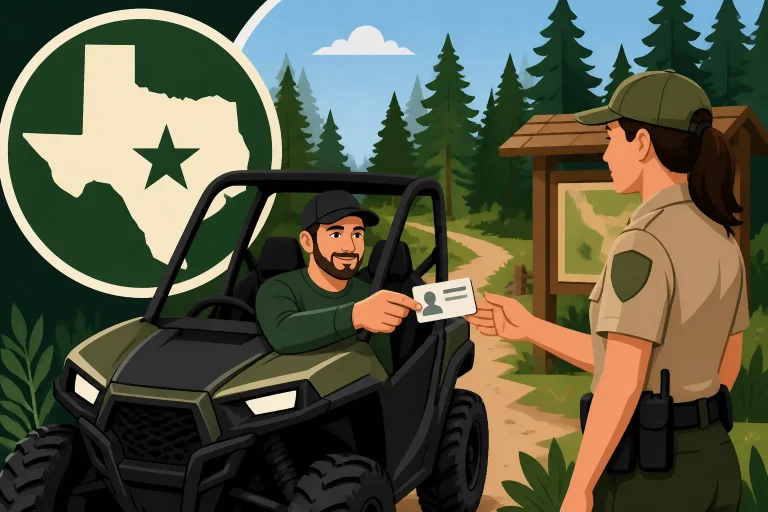
Having the decal does not give you permission to ride wherever you see an open space or dirt track. You still need legal access to the property and must follow its route, hours, vehicle-size, safety, and operating rules. A rider who has the right sticker but crosses a closed gate or leaves a designated route can still be in violation of the property’s rules.
Think of the decal as one item in a set of requirements, rather than as a universal pass. You might need the Texas OHV decal, a park entrance payment, a separate federal day-use permit, and permission to use a particular trail. Those requirements serve different purposes and may be handled by different offices or at different points in the trip.
This distinction matters especially when riding somewhere unfamiliar. A family may see an OHV decal on a machine and assume it covers the entire outing, only to find a separate trail pass is needed at the entrance. Before you travel, check the site’s official instructions for both the decal and any additional access requirements.
The decal is different from a title or road license plate
An OHV decal is not the same thing as an ownership document, title, or license plate. A title is a record of ownership. An OHV plate is a separate Texas title-related item, while the decal addresses a different question: whether the machine meets the applicable decal requirement for off-highway use on certain public land.
That difference can be confusing because riders may hear “plate,” “sticker,” “registration,” and “permit” used casually as if they mean the same thing. They do not. A machine can have a Texas title and still need an OHV decal for a ride where one is required. Conversely, having a decal does not title the machine or make it street legal.
If you are sorting out ownership paperwork as well as trail access, keep those tasks separate. The title process is covered in How to Title an ATV in Texas. For road-use questions, do not treat an OHV decal as proof that an ATV or UTV can be driven on a public road; those rules are distinct.
Where riders are most likely to need the decal
Designated public OHV riding areas
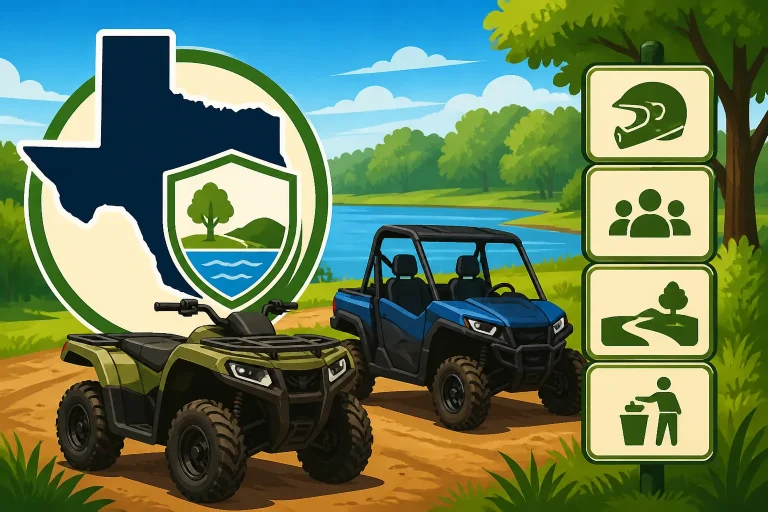
A designated public OHV trail or riding area is the clearest place to check for a Texas OHV decal requirement. Public land managed for off-highway recreation may require each machine to display a valid decal before it enters or uses the riding area. The site may also have its own entry process, operating rules, and trail restrictions.
Rules can differ even among places that look similar on a map. One trail network may be managed by a state or federal agency; another may be run by a local entity or a nonprofit partner. The name of the park, the landowner, and the organization operating the riding area may not all be the same. That is why it helps to read the official page for the exact trailhead or park, rather than relying on a general discussion of Texas riding.
The state’s OHV grant program is also relevant to understanding why decal requirements and public riding areas are discussed together. For context about how public properties and OHV funding fit together, see Texas Lands That Received an OHV Grant. Still, do not infer from a grant-related description alone that a location is open to every machine or that a decal is the only requirement. Confirm the current site-specific instructions.
Federal, state, and locally managed properties
A public riding area may be managed by a federal agency, a state agency, a city, a county, or another public entity. The manager determines what routes are open and what local access steps apply. Texas decal rules may be one part of the picture, while the property manager’s own permits and operating rules add another layer.
For example, riding on a national forest trail is not the same as riding at a privately operated park. The forest may have a designated route system, conditions that affect whether a trail is open, and a day-use requirement separate from the Texas decal. A useful starting point for that distinction is Texas National Forest Permits. Check the relevant forest’s posted trail information before towing out, especially after heavy rain or seasonal closures.
The same care applies to a recreation area beside a reservoir or on land managed by the U.S. Army Corps of Engineers. A water-side location may have multiple recreation zones, and only some may allow OHVs. The rules for one access point do not necessarily apply to every road or trail around the water. For a closer look at that setting, see Texas Rules for Riding Corps of Engineers Land.
| Riding situation | What to check before you go | Common point of confusion |
|---|---|---|
| Designated public OHV trail | Whether the site requires the Texas decal, which machines are allowed, and whether a separate entry pass applies | Assuming the decal alone covers admission |
| National forest trail | Trail status, vehicle limits, any day-use requirement, and decal rules | Treating a state decal as a federal recreation pass |
| Corps of Engineers property | Whether OHVs are allowed in that specific area and which routes are open | Assuming all shoreline or recreation roads are rideable |
| City or county property | Local authorization, designated routes, posted hours, and vehicle rules | Assuming public ownership means OHV access |
| Private ranch or riding park | Permission, admission rules, waivers, and any park-specific requirements | Assuming a Texas decal is needed merely because the land is open to visitors |
| Private land with the owner’s permission | Permission and any applicable site rules | Assuming a public-land decal rule automatically applies to private property |
Public ownership does not always mean OHV access
A public road, public park, utility corridor, public beach, and designated OHV trail are not interchangeable. Public ownership does not mean that an OHV is allowed everywhere on the property. A location may prohibit motorized riding, limit it to specific trails, or allow only certain vehicle types.
This catches riders who see tire tracks or a wide dirt road and assume it is an authorized route. The surface may be a maintenance road, a service access, or a route closed to recreational vehicles. A machine’s ability to travel there does not establish permission. Look for posted signs and maps, and contact the land manager when the permitted route is unclear.
A good habit is to save the riding area’s official rules before leaving home. If a gate attendant or ranger gives a different instruction on arrival, follow the property’s direction. The decal can satisfy a decal requirement, but it cannot override a closure or create access where the land manager has not allowed riding.
When the decal may not be required
Riding on private land with the owner’s permission
A rider on private property generally should not assume that the public-land OHV decal rule applies in the same way it does at a public riding area. The first requirement is permission from the owner or authorized manager. If you are on a ranch, lease, or private riding facility, ask about that property’s own conditions before unloading.
Private land can still have rules that matter to your trip. A commercial park may require an admission payment, a signed waiver, a helmet, or compliance with its own vehicle limits. A hunting lease may have restrictions on where and when you can ride. Those are access and safety conditions, not a substitute for figuring out whether a state decal rule applies to a particular place.
For a fuller explanation of the private-land distinction, see Why Private Land Needs No Texas Decal. The title of that topic should not be read as permission to ride without asking. “Private land” means the owner controls access; it does not mean a visitor can enter simply because the property appears unused or unfenced.
Street-legal vehicles and other exceptions
Some vehicles may fall outside the decal requirement because of their legal status or the way they are used. Street-legal status is one area where riders should be careful: a plate or road-legal designation can affect whether a Texas OHV decal is required, but that does not mean the vehicle can use every off-road trail or that every other permit is waived.
Do not make the decision based only on the presence of lights, mirrors, a windshield, or a license plate. Equipment modifications do not automatically change a vehicle’s legal classification. If you think your machine qualifies for an exception, confirm the rule with the agency or property manager responsible for the land you plan to ride.
The distinction is explained further in Why a Street-Legal Machine Skips the Texas Decal. Keep in mind that a vehicle’s road status, its eligibility for a particular trail, and the park’s entry requirements are separate questions. An exception to one requirement is not an all-purpose exemption from the rest.
Farm and ranch use requires context
People sometimes hear that agricultural use changes the rules and conclude that any ATV used around a ranch is automatically exempt from every riding requirement. That is too broad. The location, purpose, and legal category of the use matter. A machine used for work on private property is not the same situation as a recreational ride on a public trail.
For example, using a quad to check fences on your own property is different from taking that same quad to a public OHV area for weekend recreation. Even if a machine has a genuine work role, do not assume that the work-related status travels with it into every setting. Check the rules that apply to the specific property and activity.
If you expect an agricultural exception to matter, get clarity before the trip rather than trying to explain it at a gate. Keep any relevant documentation with your other machine records, but do not treat a work purpose as a substitute for permission, a site pass, or compliance with posted restrictions.
Who needs a decal and how it applies to the machine
Residents and nonresidents should check the same riding location
Being from outside Texas does not automatically mean you can ride on public land without meeting Texas requirements. A visitor bringing an ATV or UTV from another state should check the Texas rules and the destination’s instructions just as a Texas resident would. A home-state sticker, registration, or proof of ownership may not serve the same purpose as a Texas OHV decal.
This is an easy detail to miss when planning a trip across a state line. A rider may have all the paperwork required at home, tow to Texas, and discover that the local riding site has a separate decal requirement. Before travel, check both the state-level requirements and the park or land manager’s instructions.
For more on the visitor question, see Nonresidents and the Texas Decal. If you are considering whether another state’s decal or permit will be accepted, do not rely on a friend’s experience at a different park. Rules can depend on the destination and the kind of credential involved. The topic Texas Reciprocity and Why It Is One-Sided can help frame why an out-of-state document should not automatically be treated as a Texas substitute.
Each machine needs its own decal when required
The decal is generally associated with the individual OHV, not with the rider, the household, or the trailer. If you bring two machines to a location where the decal is required, do not assume one decal covers both because the same family owns them or the same person is operating them.
This matters when one rider switches between a quad and a side-by-side, or when a group shares a trailer. A vehicle-specific decal does not move from one machine to another just because the rider changes. If you are borrowing a machine, check that the machine itself meets the destination’s requirements rather than assuming your own decal covers it.
The machine-by-machine issue is covered in Texas OHV Decal for Each Rider, which is a useful reminder to distinguish a rider requirement from a vehicle requirement. Confirm how the decal must be displayed and whether the machine’s current decal is acceptable before you reach the trailhead.
Borrowed and rented machines need a quick check
When you borrow a neighbor’s quad, ask whether the machine has the required decal and whether it is still valid for the planned ride. The owner’s personal riding credentials do not necessarily satisfy a requirement tied to the machine. A quick check in the driveway is much easier than sorting it out after a long tow.
Rentals deserve the same attention. A rental company may provide a machine suitable for a particular park, but the renter should still clarify what is included and what the rider must arrange separately. Ask whether the decal is already displayed, whether the rental agreement limits where the machine can be used, and whether the park charges any separate access fee.
For rental-specific questions, see Texas OHV Decal for a Rented Machine. Do not peel, move, or alter a decal on a rented machine unless the rental provider or decal instructions explicitly direct you to do so. A decal’s placement and condition can matter when staff inspect the vehicle at entry.
How to prepare before a ride
Check requirements in a sensible order
A reliable pre-trip check is easier when you separate access questions from vehicle paperwork. Start by identifying the exact property and trailhead, then confirm that the land manager allows your vehicle type on the route you want. After that, check the decal requirement, additional permits or fees, and any conditions such as width limits, closures, or required safety equipment.
For example, a family planning a weekend near a national forest should not stop after seeing that OHV riding is permitted somewhere in the forest. They still need to identify the correct trail system, learn whether it is open, check the machine-size limits, and determine what day-use process applies. The Texas decal is only one part of that checklist.
If the official site gives unclear or conflicting information, contact the land manager before leaving. Ask specifically: “Does this machine need a Texas OHV decal here? Is there a separate day-use or trail permit? Which routes are open to this vehicle?” Those questions tend to get more useful answers than simply asking whether the park is “open.”
Make sure the decal is properly displayed
Follow the decal’s own instructions for placement. A sticker hidden behind a bag, covered by mud, or attached to a removable panel may be difficult for staff to inspect. Before heading out, make sure the decal is visible as directed and has not been damaged or peeled away.
A clean, dry surface helps reduce the chance that a decal lifts during transport or riding. If you wash the machine before a trip, allow the application area to dry before placing a new decal. Avoid putting it somewhere that is routinely scraped, covered by a strap, or blocked by an accessory.
It can also help to keep purchase or renewal confirmation with your trip papers, especially if you have just obtained a decal and have not yet applied it. But paperwork does not necessarily replace a required decal displayed on the vehicle. Follow the official display instructions rather than assuming a receipt will be enough at the entrance.
Keep supporting information accessible
A small, organized document pouch can make a busy trailhead less stressful. Keep relevant ownership papers, purchase confirmation, rental information, and the riding area’s instructions together. If you use a phone for maps and confirmation emails, download key information or take screenshots before heading into an area with weak service.
Some riders use a simple waterproof pouch for printed documents and receipts. Amazon is one place people compare these kinds of basic storage products, but the useful point is not the brand: choose something that stays closed, keeps paper dry, and can be stored securely. Do not carry original documents in a spot where they may fall out during unloading.
Amazon also carries general vehicle organizers and protective cases that can help keep a phone, printed trail map, or emergency contact information together. These items do not satisfy a decal or access requirement; they simply make it easier to find your information when staff ask a question or a ride plan changes. Keep the actual decal on the machine as directed.
Common mistakes that lead to problems at the gate
Assuming every park uses the same rules
A rider’s experience at one park is not proof of the rules at another. Even within Texas, public land can be managed in different ways, and an entrance procedure that worked at one trail network may not apply at a nearby property. Rules may also change when a trail closes, a new operating arrangement begins, or an area limits the types of vehicles it accepts.
This is why group-chat advice can be useful as a prompt but unreliable as the final answer. Someone may say, “I never needed a decal there,” when they actually rode on private land, visited a different section, or went during a period when the site’s process was different. Check the destination’s own published instructions.
A practical habit is to review the official site shortly before the trip and keep a note of the page or phone number. If you are organizing a group ride, share the exact requirements with everyone rather than assuming the lead rider’s paperwork covers the group’s machines.
Treating a decal as proof that a trail is open
A current decal does not mean a trail is open on the day you arrive. Rain, maintenance, fire danger, seasonal conditions, wildlife protections, or land-management decisions can affect access. A machine can be properly decal-equipped and still be turned away from a closed route.
This is especially frustrating after a long drive, so check trail status before loading the trailer. In wet conditions, soft soil can be damaged quickly by repeated vehicle traffic, and some sites close routes to protect them. Respecting a closure helps keep the trail usable and avoids the unpleasant surprise of arriving with no legal route to ride.
Also check whether the site has separate operating hours. A gate might be open for camping while the OHV trail is closed, or a recreation area may allow access only during certain periods. Verify trail access specifically, not just general park access.
Confusing a decal with registration or road permission
A decal does not register an ATV or UTV for ordinary road use. It also does not establish that the vehicle meets road equipment standards or qualifies for a road-use exception. Riders should not assume that a sticker required for off-highway public land changes the rules governing public streets or highways.
This misconception can create a risky situation when riders use a public road to connect two trails or reach a destination. A decal is not a substitute for checking road laws, local restrictions, and the land manager’s route map. If the planned ride involves any road segment, review that segment separately before using it.
Likewise, the absence of a decal does not mean every private ride is unlawful. Requirements depend on the setting. Keep the core distinctions clear: ownership paperwork concerns the machine; the decal concerns certain off-highway public-land use; access permission concerns the property; road legality concerns a separate set of rules.
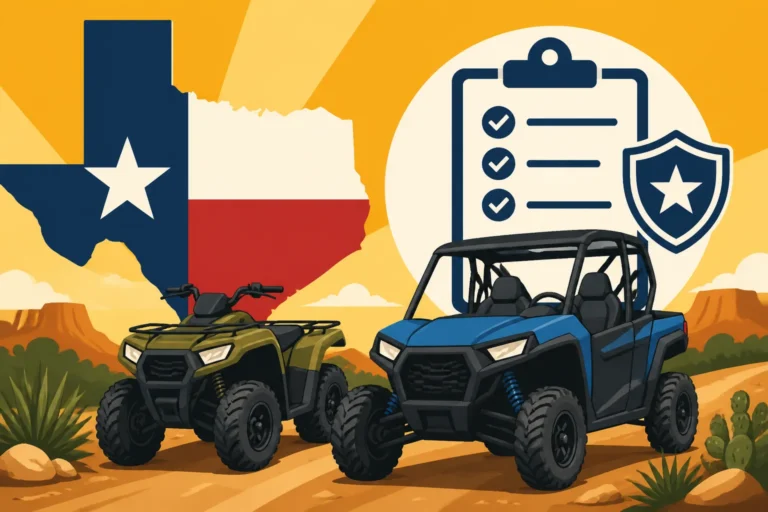
A practical pre-ride checklist
Confirm the land and the route
Before loading your ATV or UTV, write down the exact riding area, entrance, and intended route. Confirm that the land manager allows your vehicle type and that the route is open. If there are multiple access points, make sure you are reading the rules for the one you plan to use rather than a neighboring park or trailhead.
Check whether there are width restrictions, passenger rules, operating-hour limits, or safety equipment requirements. A side-by-side may not be allowed on a route designed for narrower machines, even if the site permits OHV riding generally. If you are taking a youth machine or a rented vehicle, verify that it fits the site’s rules too.
If the route crosses or approaches another land manager’s property, check that segment separately. A trail map can show a continuous line while ownership or operating rules change along the way. Do not assume permission transfers across a boundary.
Confirm the decal and any separate pass
Ask whether the Texas OHV decal is required for the specific property and vehicle. If it is, make sure each machine that needs one has its own decal displayed as instructed. Then check for any additional fee, day-use permit, reservation, or park-specific pass.
Keep the words “decal” and “permit” separate when asking questions. A gate attendant may use “pass” informally, but you need to know whether the requirement is the Texas decal, a local entry payment, or both. If an online booking site is involved, verify whether the park’s instructions treat that booking as an entrance payment only or as a separate permit as well.
Amazon can be useful for ordinary trip-prep items such as a waterproof folder, but it is not a source for deciding whether a particular Texas property requires a decal. For that, rely on the land manager’s official rules and the applicable Texas guidance. Keep convenience purchases separate from compliance decisions.
Pack for a smooth arrival
Before departure, check that the decal is visible, the trailer is secure, and the documents or confirmation details are easy to access. Save the park’s contact information and trail-status page on your phone. If you are traveling with other riders, make sure each person knows the route restrictions and what their machine needs.
On arrival, follow posted signs even if a map or older online description suggests something different. If staff explain a rule that was not clear in advance, ask politely which route or requirement applies, then follow the instruction. A calm conversation at the gate is far better than unloading first and discovering the ride cannot proceed.
If you are unsure whether the decal applies, resolve that question before the trip whenever possible. The simplest reliable rule is to verify the exact riding property, treat the decal as separate from access permission, and never assume that another machine’s sticker or another park’s policy covers your own situation.
Disclaimer
This article is for general informational purposes only and does not constitute professional advice. Laws, prices and regulations vary by location and change over time. Consult a qualified professional for guidance on your specific situation.