Showing ID at a Forest Trailhead
Showing ID at a Forest Trailhead
A ride at Sam Houston National Forest can involve more than arriving with a machine and a helmet. Riders need to know what identification a compliance check may require, and how that differs from an OHV decal or safety certificate. Here’s what to carry, what each document proves, and what to confirm before heading to a Texas forest trailhead.
What showing ID means at Sam Houston National Forest
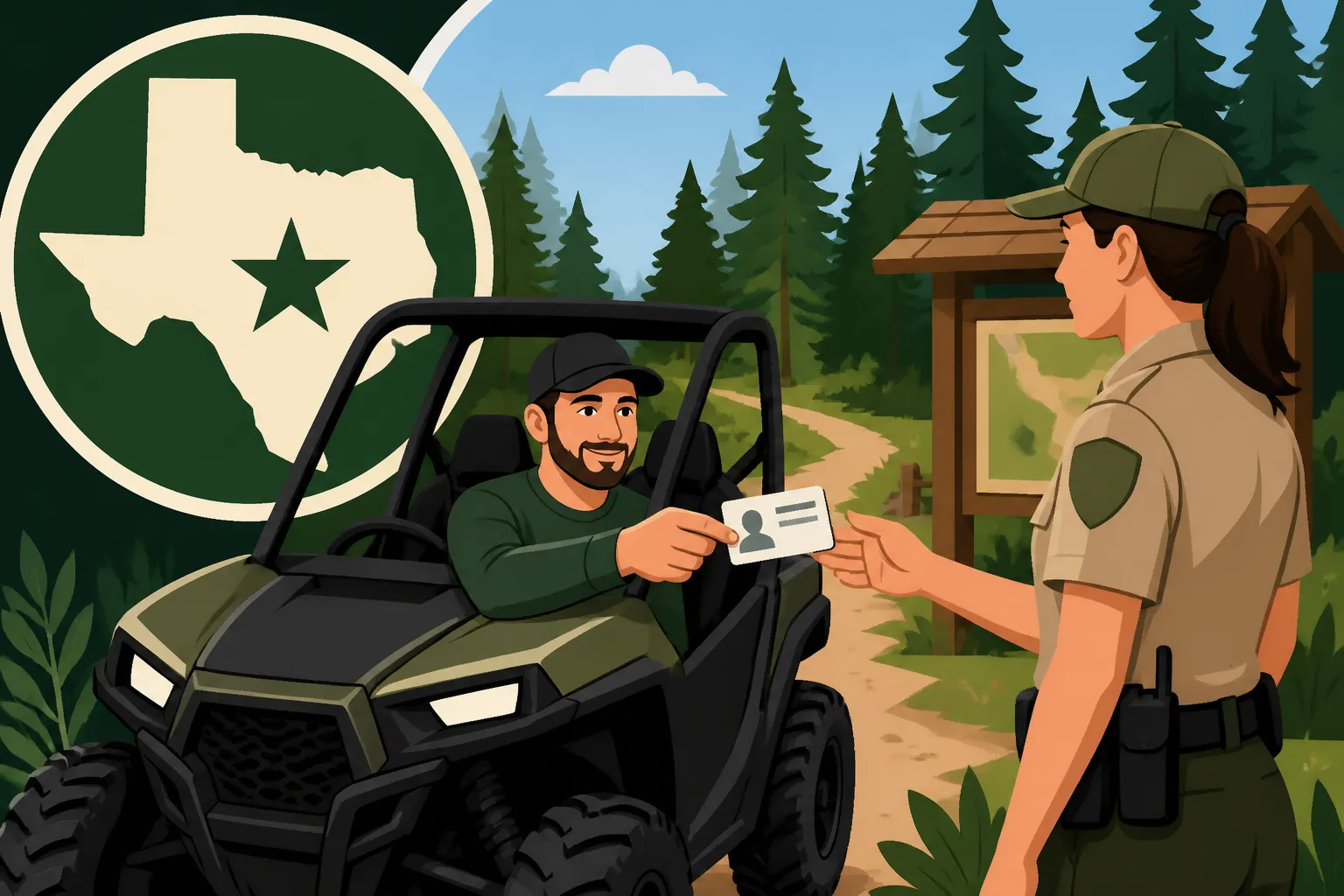
The USDA Forest Service manages the Sam Houston National Forest OHV trail system. According to the USDA Forest Service, OHV operators using its Multiple-Use Trail System must carry valid ID and show it during a law enforcement compliance check.
That requirement is easy to misunderstand. It does not mean that an ID card replaces the documents Texas requires for riding on public land. Identification helps establish who you are during a check; a Texas OHV decal and a safety certificate serve different purposes. Keep each requirement in mind rather than treating one document as proof of everything.
The Forest Service fact does not specify which forms of identification qualify. If you are uncertain whether a particular document will be accepted, confirm with the Forest Service before your trip. Carrying your valid ID with you, rather than leaving it in a vehicle at a distant parking area, is the practical way to be ready if an officer asks to see it.
It can help to think of trailhead checks as having separate questions:
| What may be checked | What it establishes | What to have ready |
|---|---|---|
| Personal identification | Your identity during a compliance check | Valid ID |
| OHV decal | The vehicle’s Texas OHV decal requirement | Decal displayed, or proof of purchase if the decal has not arrived |
| Safety certification | That the operator meets applicable training requirements | Valid safety certificate |
| Trail and machine compliance | Whether the ride and vehicle meet applicable rules | Required equipment and compliance with posted or applicable rules |
The table is a planning aid, not a promise that every check will involve every item. The key point is that identification, decal, and training proof are not interchangeable. For a more focused checklist, see What Texas Riders Must Show at Sam Houston.
Carry the documents that apply to your ride
Valid ID
For Sam Houston’s Multiple-Use Trail System, the Forest Service says OHV operators must carry valid ID and show it during a law enforcement compliance check. The agency does not specify an ID format in the facts available here, so do not assume that a photograph of an ID on a phone will necessarily meet the requirement. If you plan to rely on a particular form, check with the Forest Service in advance.
Keep your ID accessible while riding, but secure it against rain, dust, and loss. A small waterproof document pouch or lanyard can help keep it together with your certification card or decal receipt; retailers such as Amazon sell these kinds of organizers. An organizer is a convenience, not a substitute for having the required documents.
Texas OHV decal or proof of purchase
Texas administers its OHV decal program through the Texas Parks and Wildlife Department. According to Texas Parks and Wildlife Department rules, a rider on public land must have a valid Texas OHV decal displayed on the vehicle. If the decal has not arrived yet, proof of purchase or a receipt must be readily available.
That distinction matters when you have ordered a decal but are still waiting for it. Keep the receipt with you and make sure it is easy to show. A confirmation buried in an email account may be less useful on a trail than a saved copy that you can access without relying on a signal. The rules require readily available proof if the decal has not arrived; they do not make an ID card a substitute.
According to the Texas Parks and Wildlife Department, the decal costs $16.00 per fiscal year as of November 2026. Check the department for the current amount and purchase process before planning around that figure. More detail on when and where the decal applies is in The Texas OHV Decal Requirement Explained.
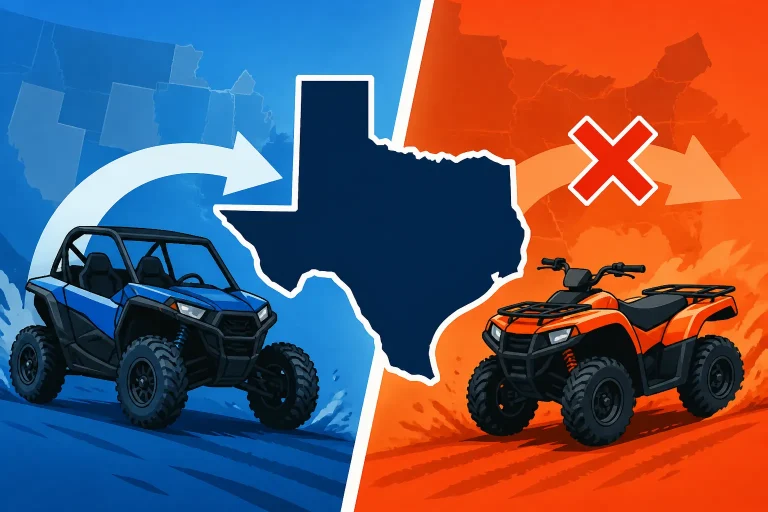
Texas does not require an OHV decal for an ATV or UTV operated exclusively on private property, according to the Texas Parks and Wildlife Department. Public trail use is different: Texas requires a decal when the vehicle is operated on public land or in applicable grant-funded venues. A machine’s registration or title paperwork does not take the place of this trail-use decal.
Safety certificate
A safety certificate is a separate requirement from both ID and the decal. According to the Texas Parks and Wildlife Department, it recognizes successful completion of the ATV Safety Institute’s ATV RiderCourse, including hands-on training, or equivalent safety training issued under the authority of Texas or another state. While riding an OHV on public land, operators must carry a valid certificate and show it upon request.
If you are using a certificate from another state, check that it meets Texas’s requirements rather than assuming that any card, course completion email, or online training record will do. The Texas Parks and Wildlife Department recognizes qualifying certificates issued under another state’s authority, but that does not mean Texas has a reciprocity agreement for OHV decals. For certificate details, see The Texas ATV Safety Certificate Explained and Does Texas Accept an Out-of-State Safety Certificate?.
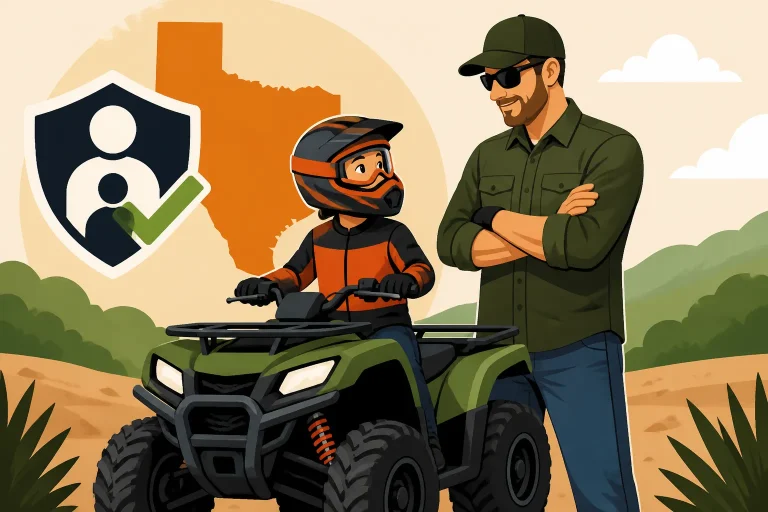
Age and supervision rules also affect who needs a certificate and who must ride with an adult. According to the Texas Legislature, an operator younger than 14 must be accompanied by and under the direct supervision of a parent, guardian, or authorized adult on public land. Operators aged 14 or older may ride without adult supervision if they hold a safety certificate, or they may ride under the direct supervision of a certificate holder. Check the applicable rules for a young rider before the trip; do not assume that carrying the adult’s ID alone satisfies supervision or certification requirements. See Texas Rules for Riders Under 14 for more on that distinction.
Texas permits and out-of-state documents
Sam Houston National Forest is managed by the USDA Forest Service, but a ride there still takes place in Texas. Riders need to distinguish federal forest management from Texas OHV requirements. The Forest Service ID check and Texas decal and certification rules can apply to the same ride because they address different things.
Out-of-state visitors should pay particular attention to the decal. According to the Texas Parks and Wildlife Department, Texas does not offer reciprocity for out-of-state OHV registrations or decals. A visitor who has a registration or decal from another state must still purchase a Texas OHV decal to ride on Texas public lands. A safety certificate issued under another state’s authority may qualify if it meets Texas’s recognition rules, but that certificate is not a substitute for the Texas decal.
Texas residents also need to separate title paperwork from trail permissions. The Texas Department of Motor Vehicles requires residents to title their off-highway vehicles, including ATVs and UTVs, but those vehicles are not eligible for standard motor vehicle registration. A title establishes ownership; it is not the OHV decal required for public-land riding. For the ownership side of the paperwork, see Titling an ATV in Texas.
Before you leave, check that each document is available in a form you can actually show at the trail. Keep the ID and safety certificate with you, and make sure the decal is attached to the vehicle. If you are waiting for the decal to arrive, carry the purchase proof where it can be found quickly. If you are traveling with a group, each operator should be ready to present their own required identification and safety certification; do not assume the driver can provide what another operator needs.
If you are planning a forest ride beyond the ID question, Texas National Forest Permits and Riding the Sam Houston Trail can help you prepare for trail-specific requirements. Confirm current access conditions and requirements with the managing agency before setting out, especially if your plans depend on a particular trail or document being accepted.
Be ready for the rest of the compliance check
Showing ID is only one part of being prepared. Public-land riding rules also address the vehicle, protective equipment, and rider conduct. A check can be a reminder that your papers are in order while the machine still needs to meet the applicable equipment rules.
Texas requires riders and passengers on ATVs on public lands to wear a safety helmet that complies with United States Department of Transportation standards, according to the Texas Parks and Wildlife Department. On public lands, UTV occupants must wear seat belts when the vehicle is equipped with them, also according to the department. If you ride an ATV, the vehicle must not carry a passenger unless the manufacturer designed it to transport one, according to the Texas Legislature.
The machine also needs appropriate safety equipment. According to the Texas Legislature, ATVs and UTVs on public property or public lands must have a United States Forest Service-qualified spark arrester that has not been removed or modified. Texas law also prohibits muffler cutouts, bypasses, and similar devices on motor vehicles operated on public property; OHVs on public OHV lands must maintain an adequate muffler system in good working condition. Keep the machine in its compliant configuration rather than assuming that a modification is acceptable because it is common elsewhere.
According to the Texas Parks and Wildlife Department, ATVs and UTVs on public property must display a lighted headlight and taillight from one-half hour after sunset to one-half hour before sunrise, as well as whenever visibility is reduced. Separate equipment requirements also call for a headlight and taillight on an OHV operated on public OHV land, according to the Texas Department of Motor Vehicles. Check the machine before a ride rather than waiting until poor visibility makes a fault obvious.
Rules can differ by land type. Texas State Parks enforce OHV regulations through state park law enforcement and game wardens, according to the Texas Parks and Wildlife Department. The department also sets a maximum exhaust sound level of 96 decibels for an OHV on a state park trail system. That state-park sound limit is not a reason to assume every forest or other public riding area uses identical rules; check the rules for the place you plan to ride.
Alcohol is another area where carrying the right paperwork will not help if the ride itself violates the rules. The Texas Parks and Wildlife Department prohibits public display or consumption of alcoholic beverages in state parks, including on OHV trail systems, and prohibits operating trail machines while under the influence of alcohol or drugs.
A useful departure check is straightforward: confirm that the ride area is open to your machine, have valid ID on you, carry your safety certification, display the Texas decal or carry proof of purchase if it has not arrived, and inspect the machine’s required equipment. If any point depends on a specific trail’s current status or a document’s acceptance, confirm it with the agency managing that area before driving out. That preparation makes a compliance check less likely to interrupt the ride and helps keep ID from being confused with the other requirements.
Sources
- Texas Legislature — Transportation Code Title 7, Chapter 663. Certain Off-Highway Vehicles (checked November 2, 2026)
- Texas Parks & Wildlife Department — Buy Decals — Texas Parks & Wildlife Department (checked November 2, 2026)
- Texas Parks & Wildlife Department — OHV FAQ — Texas Parks & Wildlife Department (checked November 2, 2026)
- Texas Parks and Wildlife Department — Parks and Wildlife Code Title 3 Chapter 29 OHV and Recreational Area Program (checked November 2, 2026)
- United States Department of Agriculture Forest Service — National Forests and Grasslands in Texas | Sam Houston National Forest – USDA Forest Service (checked November 2, 2026)
- Texas Parks and Wildlife Department — Eisenhower State Park OHV Rules and Regulations (checked November 2, 2026)
- Texas Parks and Wildlife Department — Off-Highway Vehicle Program (OHV) (checked November 2, 2026)
- Texas Parks and Wildlife Department — Off-Highway Vehicle Program (OHV) – Texas Parks and Wildlife (checked November 2, 2026)
Disclaimer
This article is for general informational purposes only and does not constitute professional advice. Laws, prices and regulations vary by location and change over time. Consult a qualified professional for guidance on your specific situation.