Texas Minimum Age for a Safety Certificate
Texas sets a clear age line for OHV safety certificates, but it can be easy to confuse that rule with a minimum age to ride. If you’re planning a public-land ATV or UTV trip with a child, here’s when the child needs a certificate, what supervision means in practice, and what to check before you go.
The minimum age is 14
Fourteen is the minimum age to complete the Texas OHV safety course and earn a safety certificate. A rider younger than 14 cannot replace the certificate requirement by taking the course early. Instead, Texas allows a younger rider on public land only under the required direct supervision of a qualified adult.
This distinction matters: the minimum age for a certificate is not a general minimum age for every child to ride an ATV or UTV. A child’s ability to ride also depends on the machine, the terrain, the land manager’s rules, and the child’s size and skill. The state safety-certificate rule is one part of that decision, not a guarantee that a particular machine or trail is appropriate.
| Rider’s age | Safety-certificate path | What to plan for |
|---|---|---|
| Under 14 | Cannot yet earn the certificate | Ride on public land only with the required direct supervision by a qualified adult |
| 14 or older | May take the recognized safety course and earn a certificate | Confirm whether the rider must carry proof for the specific public riding area |
| Any age on private land | Public-land certificate rules may not apply in the same way | Get the landowner’s permission and check any site-specific requirements |
The certificate is about safety education, not permission to ride any vehicle. It does not establish that a child can handle a full-size side-by-side, nor does it replace a park’s age, passenger, or equipment rules. For a broader explanation of who needs the credential and what it covers, see The Texas ATV Safety Certificate Explained.
The under-14 rule is especially important for parents and guardians. A younger rider should not be treated as independently qualified simply because they have ridden before, can operate the controls, or are accompanied by someone who knows the trails. The supervising adult needs to meet the rule, and supervision must be direct rather than remote or occasional. Texas Rules for Riders Under 14 covers the age-specific requirements in more detail.
What direct supervision means for a younger rider
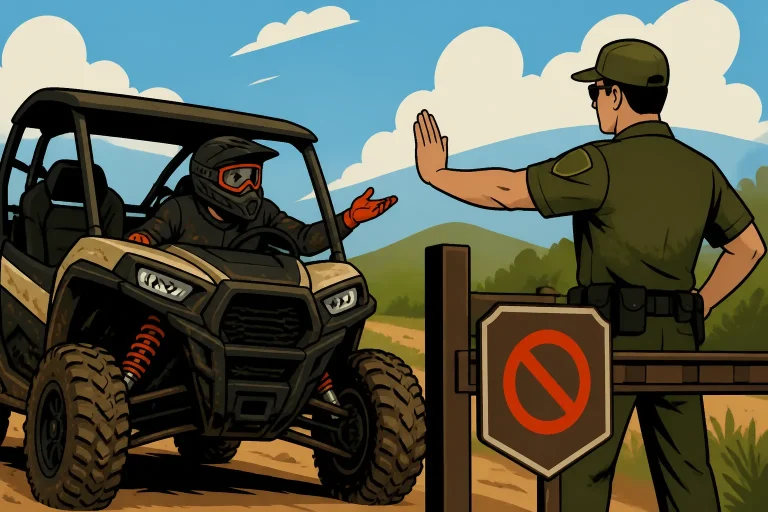
For a rider under 14, supervision is an active responsibility. The adult needs to be present and able to monitor the child’s operation, respond to changing conditions, and intervene if necessary. Following in a separate vehicle far behind, checking in at intervals, or being somewhere else on the property is not a safe substitute for direct supervision.
The supervising person must meet the applicable age and certificate requirements. Plan for the adult to have their own proof of course completion available, rather than assuming a parent’s general riding experience is enough. If another adult will supervise, check that the person qualifies before the trip. Texas Supervision Rules for Young Riders explains this distinction and the role of the supervising adult.
A practical setup is to keep the child and supervising adult together on the same ride, choose terrain within the child’s ability, and agree on simple signals and stopping points before starting. Supervision should not depend on the adult being able to catch up later. Dust, hills, trees, noise, and other riders can quickly make it hard to see or hear a child who has moved too far ahead.
Direct supervision does not make an unsuitable machine suitable. A child can be too small to reach the controls safely or too inexperienced for the speed and terrain, even when a qualified adult is nearby. Follow the machine manufacturer’s age and size guidance, and choose a route where the adult can keep the child in view. On a UTV, check seating and passenger requirements as well as the child’s ability to use the safety equipment properly.
Before setting out, confirm all of the following:
- The child is riding in a machine appropriate for their size and ability.
- The supervising adult meets the applicable age and certificate requirements.
- The adult can maintain direct supervision throughout the ride.
- The riding area permits the machine and rider.
- Required safety equipment, decals, permits, and proof of course completion are ready.
For more detail on what the state expects of younger operators, see What Texas Requires of Riders Under 14. A park or other land manager may add rules, so state compliance alone does not guarantee admission.
Where the certificate rule applies
The age-and-certificate question most often comes up on public land. Texas safety-education requirements and site rules can apply when operating an OHV in a public riding area, but requirements can differ by location and by the land manager. Before traveling, check the rules for the specific park, trail, or public property you plan to use. Texas Rules for Riding Public Land is a useful starting point.
Private land is different, but that does not mean every safety rule disappears. You still need the owner’s permission, and the owner may set conditions for access. A private OHV park may also require a certificate, a waiver, a particular helmet, or other items before allowing a child to ride. Ask the operator directly rather than assuming that a privately managed site has no age restrictions.
The safety certificate is also separate from the Texas OHV decal. A decal is tied to riding areas and requirements that apply to the machine or its use; a safety certificate is proof of a rider’s education. One does not substitute for the other. A child who is properly supervised may still need to ride a machine with the required decal, and an adult’s decal does not serve as a child’s certificate. See The Texas OHV Decal Requirement Explained for the separate decal rules.
Likewise, having a certificate does not make an ATV or UTV street legal. It does not authorize public-road use or replace title paperwork. If your trip involves a road crossing or travel near a public road, check the specific rules for that situation rather than relying on the certificate as permission.
Check the rules before you load up
Requirements can vary among public areas, private parks, and organized events. Confirm the current details with the site operator or relevant state agency before the ride, especially if the child has recently turned 14 or the supervising adult’s certificate is old or difficult to locate.
It is sensible to carry proof of the adult’s certificate when supervising a younger rider and proof of the young rider’s own certificate once they have earned one. Some sites may ask to see documentation at entry or during a ride. Carrying the Certificate on a Texas Ride explains how to prepare for that check.
If the rider completed a course elsewhere, do not assume that any card automatically satisfies the Texas requirement. Check whether Texas recognizes the particular course or certificate before traveling. The details are covered in Does Texas Accept an Out-of-State Safety Certificate?.
How to plan the transition at age 14
Turning 14 changes the rider’s options: they can take the recognized course and earn a certificate instead of relying on the under-14 supervision arrangement. It does not instantly provide the rider with a certificate. Allow time to find an approved course, complete it, and keep the resulting proof available before planning a ride that requires the credential.
Course formats and availability can vary. Check the current requirements and course options with the appropriate state program before booking. Texas ATV RiderCourse Locations can help you understand where to look. If a course is hands-on, plan for the rider to participate rather than treating it as paperwork to complete on the day of the ride.
Use the age transition as a chance to review the child’s readiness, too. A certificate indicates completion of safety education; it does not measure the rider’s judgment on every trail or make them ready for a more powerful machine. Keep the machine and route matched to the rider’s ability, and continue adult oversight when conditions call for it.
A straightforward plan looks like this:
- Identify whether the trip is on public land, private property, or a privately operated park.
- Ask the site what it requires from riders under 14 and from riders who are 14 or older.
- Confirm that the supervising adult meets the applicable requirements and can provide proof.
- If the rider is 14 or older, arrange the recognized course and carry the certificate as directed.
- Check the machine, passenger, helmet, decal, and other site rules separately.
The main point is simple: 14 is the minimum age for earning a Texas OHV safety certificate. Younger riders need the required direct supervision on public land, while older riders can complete the course themselves. In either case, check the riding area’s rules and treat the certificate as one safety requirement among several, not as a substitute for good judgment or suitable equipment.
Disclaimer
This article is for general informational purposes only and does not constitute professional advice. Laws, prices and regulations vary by location and change over time. Consult a qualified professional for guidance on your specific situation.