Texas Decals Sold at a Park Gate
A park gate can be a convenient place to buy a Texas OHV decal, especially if you realize you need one on the way to the trails. But not every park sells decals, and buying one does not necessarily cover admission or other permits. Here’s what a gate purchase does, what to check before you travel, and how to avoid arriving without the right paperwork.
What a Texas OHV decal bought at a park gate covers
A Texas OHV decal is a state off-highway vehicle decal. It is not a park ticket, a vehicle registration sticker, or permission to ride anywhere you choose. It helps satisfy the decal requirement for covered off-highway vehicles used on applicable public land in Texas. The land’s own access rules still apply.
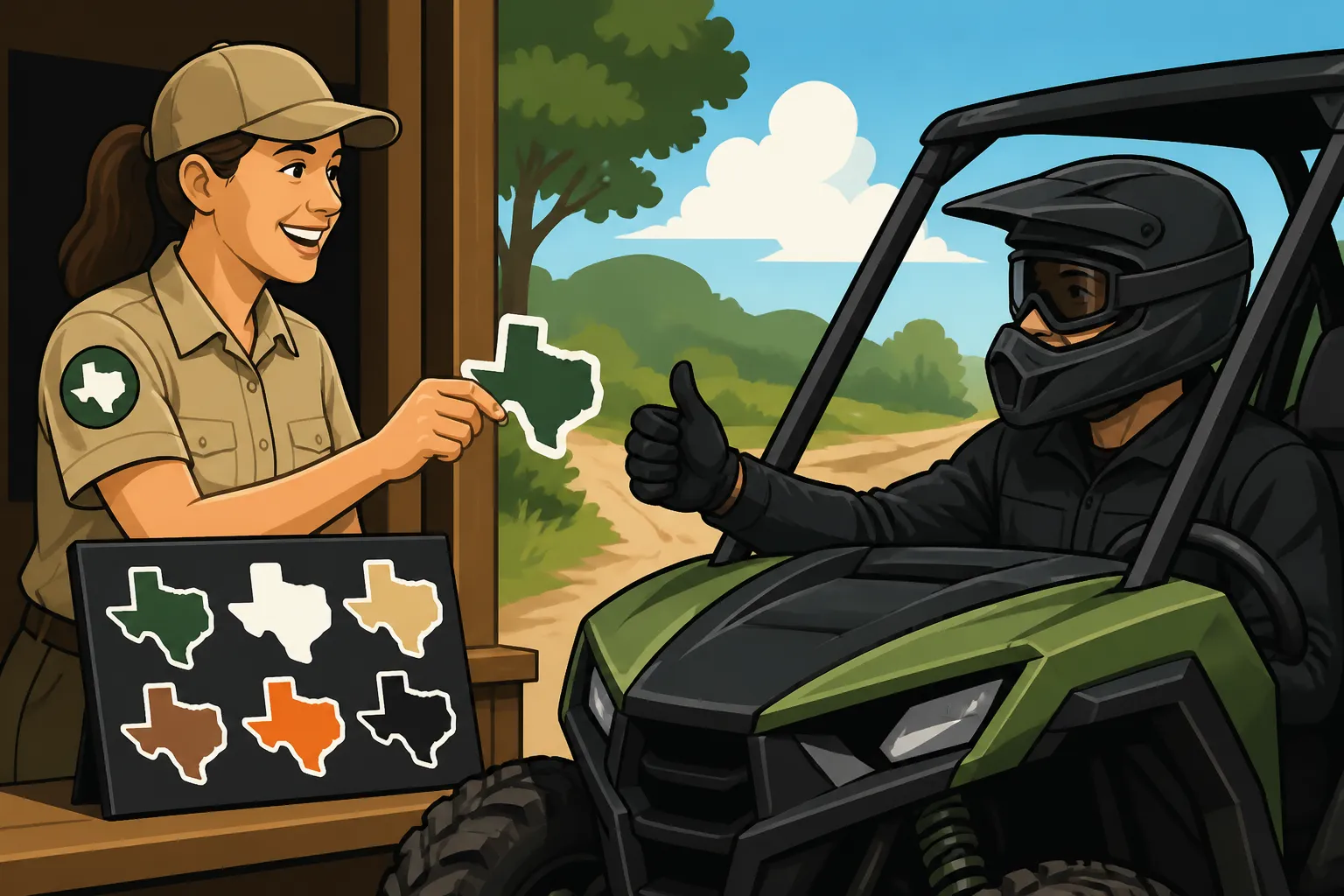
A park gate may sell the decal as a convenience, so riders can obtain it when they arrive rather than making a separate purchase beforehand. That can be useful if you are visiting an unfamiliar riding area or bringing a machine that has not been used on Texas trails before. The key is to check whether the park actually offers decals and whether the sales point will be open when you arrive.
A decal purchase generally applies to the machine, not to every person in your riding group. If several riders bring separate machines, plan on meeting the decal requirement for each covered machine. A family or group should not assume that one decal covers every ATV or UTV in the trailer. See Every Machine in the Group Needs Its Own Decal for more on that distinction.
The decal also does not replace a park’s admission charge. A park can charge its own entry fee, day-use fee, membership fee, camping charge, or other amount under its own rules. Public-land access may have a separate fee or permit requirement as well. A decal bought at the gate should be treated as one part of the ride checklist, not as an all-in-one pass.
It helps to separate the different permissions involved:
| Item | What it generally covers | What it does not automatically cover |
|---|---|---|
| Texas OHV decal | The state decal requirement for a covered OHV used in applicable settings | Park admission, camping, or access to closed routes |
| Park entry or day-use payment | Entry to the specific park under its rules | The state OHV decal or a separate public-land permit |
| Park membership | Access or benefits described by that park | Other parks’ fees or state decal requirements |
| Public-land permit or pass | The access or use covered by the issuing land manager | Every other permit, fee, or machine-specific requirement |
The safest way to understand the decal itself is to start with The Texas OHV Decal Requirement Explained. If your question is specifically where to buy one before a trip, Where to Buy a Texas OHV Decal covers other purchase options.
A decal at the gate can solve a timing problem, but it does not change where you may ride. Private property, public land, and privately operated parks can all have different rules. A park’s decision to sell a state decal does not mean the park is public land or that the decal gives access beyond that park. Likewise, a state decal is not permission to ride on a trail that the land manager has closed.
Whether a park gate sells decals, and what the price means
Do not assume every Texas OHV park has decals for sale. A park may sell them at its entrance, direct riders to a nearby retailer, offer another purchase method, or not handle decal sales at all. Sales can depend on the park, its operating hours, and whether staff are available at the gate.
Before setting out, contact the park or check its current visitor information. Ask a specific question: “Can I buy the Texas OHV decal at the entrance when I arrive?” Then confirm the sales hours and whether the decal is available for the type of machine you are bringing. A vague answer that the park sells “permits” is not enough; parks use that word for different products.
A gate purchase may cost more than buying through a state channel. The park can have its own transaction or handling charge, and the total collected at the entrance may include both the decal and separate park charges. The current amounts can change, so check directly with the park and the state before budgeting. For context on why the final amount may differ, see Why a Park May Charge More Than the State.
Ask the staff to separate each charge on the receipt. You want to know which amount is for the state decal, which is park entry or day use, and whether anything else is included. If the total is higher than you expected, this makes it easier to tell whether you are seeing a gate-sale charge, a park fee, or both.
A park’s gate price does not necessarily mean the park has created a different decal. The state decal remains the state decal; the park is simply a purchase point and may collect its own additional charge. Conversely, paying a park’s entry fee does not prove that you have paid for the decal.
Availability is also not guaranteed just because a park sold decals during a previous visit. Staff, sales arrangements, and opening hours can change. If you are arriving outside normal gate hours, ask whether there is an after-hours process. Do not count on being able to buy the decal from a vending machine, a self-service box, or an unattended office unless the park confirms that option.
If a gate cannot sell the decal, you may still be able to buy it through another authorized channel before riding. Allow enough time to complete the purchase and have the required information available. Buying ahead is especially useful when you have a long drive, are arriving early or late, or are taking a group whose machines all need to be checked.
The practical choice is simple:
- Buy at the gate if the park confirms that sales will be available when you arrive and the convenience is worth any added charge.
- Buy before travel if you want to avoid uncertainty at the entrance or expect to arrive when the sales office may be closed.
- Reconfirm close to the trip if you are relying on a particular location or sales method.
Timing, expiration, and the machine the decal belongs to
A Texas OHV decal is not necessarily valid for a full year from the day you buy it. The decal year follows a set cycle, so a purchase late in the cycle may provide less remaining time than a purchase early in it. Check the expiration period before deciding whether to buy at the gate or earlier. A Texas Decal Year From September to August explains the annual cycle.
That timing matters if you are planning multiple visits. Buying a decal at the entrance can be convenient for a one-off trip, but it may be worth purchasing in advance if you need to confirm the expiration date or coordinate decals for several machines. Do not assume a decal purchased today will remain valid through the same date next year.
The decal is tied to the machine rather than being a personal pass that follows the rider from vehicle to vehicle. Read the current instructions about which machine details are required and how the decal must be displayed. If a decal is damaged, lost, or no longer attached as required, ask the issuing authority or park staff what to do instead of improvising a transfer.
This machine-specific approach affects groups and rentals:
- If you bring multiple covered machines, account for each one separately.
- If you switch machines during a trip, do not assume a decal on one machine covers another.
- If you are renting, ask the rental provider whether the machine already has the required decal and whether the decal remains valid for your ride.
- If you borrow a machine, verify its decal status rather than relying on the owner’s word that the rider has a pass.
Rental companies may handle decal requirements as part of their preparation, but that is not automatic. Ask before you book, and check the machine when you pick it up. [Texas OHV Decal for a Rented Machine] discusses what to confirm when the machine belongs to a rental business.
For an out-of-state visitor, the same planning applies. Do not assume that an OHV sticker or trail permit from another state substitutes for Texas’s decal requirement. Rules for certificates and permits are not always reciprocal, and one type of document does not automatically stand in for another. Check Does a Nonresident Need a Texas OHV Decal? and Texas Reciprocity and Why It Is One-Sided before traveling across state lines.
A valid decal still does not guarantee that a trail is open or that a machine meets the site’s requirements. The park or land manager may set limits based on vehicle width, noise, safety equipment, rider age, weather, or trail conditions. A gate attendant may check some of these items, but the rider remains responsible for understanding the rules that apply on the route.
How to buy a decal at the gate without a last-minute problem
A smooth gate purchase is mostly a matter of confirming the details before you arrive. Use this sequence:
- Identify the land and the machine. Confirm the exact park or riding area, and note whether you are bringing an ATV, UTV, or another type of OHV. A nearby public trail and a private park can have different access requirements.
- Ask whether the decal is sold at the entrance. Contact the park directly rather than relying on an old post or a friend’s past visit. Confirm the location and hours of the sales point.
- Ask what the total covers. Find out whether the quoted amount is for the state decal alone or includes a park entry fee, day-use fee, or other charge. Confirm current figures with the park or state.
- Check the decal period. Ask when the decal expires and whether the purchase is for the current decal year. This is important if you are close to the end of the annual cycle.
- Bring the information needed for purchase. Follow the park or state’s current instructions. If you are buying for more than one machine, have the details for each machine ready.
- Keep the receipt and follow display instructions. Retain proof of purchase until the decal is properly issued and displayed. Follow the supplied instructions rather than attaching or moving it in a way that could make it hard to verify.
- Confirm the park’s other rules. Check admission, operating hours, camping arrangements, vehicle-size limits, and current trail status separately from the decal.
This process prevents a common mix-up: arriving with money for a park ticket but no way to buy the state decal, or paying for a decal while assuming it covers park admission. A quick call can clarify both.
If the entrance is busy, be prepared to tell the attendant which machines need decals and ask for a receipt that distinguishes charges. If something appears wrong, resolve it before entering the riding area. It is easier to correct a purchase at the sales counter than to discover later that the group has been treating one machine’s decal as a group permit.
A gate purchase can also create a documentation issue if you are carrying the decal back to a trailer or campsite before installing it. Keep it with the machine’s paperwork and follow the supplied display instructions promptly. A receipt can help establish that you purchased it, but do not assume a receipt alone replaces any requirement to display the decal.
Do not wait until after riding to sort out an uncertain requirement. If staff are unavailable or the decal stock is gone, stop and ask the park what authorized alternative is available. Riding first and trying to fix the paperwork afterward can turn a minor inconvenience into a preventable violation.
What a gate decal does not authorize
The decal is not a road registration or a way to make an ATV or UTV street legal. It does not override Texas road-use restrictions, local rules, or the road authority’s requirements. If your plan involves riding on a road to reach a trailhead or campground, check that use separately. A state OHV decal is not a substitute for permission to travel on a public road.
It also does not grant access to private land. A property owner’s permission is still necessary, and a decal does not protect a rider from trespass rules. For the distinction between decal obligations and private-property riding, see Do You Need a Texas OHV Decal on Private Land?.
Nor does a state decal replace a land manager’s own permit. National forests and other public areas can have separate day-use payments, passes, trail restrictions, or registration checks. If your trip includes a national forest, confirm that area’s requirements before leaving. Texas National Forest Permits explains why a decal and a forest fee may be separate obligations.
The decal also cannot open a closed route. Weather, maintenance, fire risk, wildlife protection, or other management decisions may close trails even when the park is otherwise open. Check status shortly before the trip and follow closure signs once you arrive. Staying on marked routes matters; a valid decal does not give permission to ride off-trail.
Finally, the decal does not replace rider safety requirements. Depending on the location and rider, there may be safety certificate, helmet, supervision, equipment, or age rules. Those requirements are separate from the purchase of a decal. If a park has stricter rules than the general state requirement, riders must follow the park’s rules while there.
The useful mental model is: the decal addresses one state requirement; the park controls its own admission and site rules; and the land manager controls access to its trails. Treat each as a separate check.
Frequently Asked Questions
Can I buy a Texas OHV decal at every park gate?
No. Some parks may sell decals at the entrance, while others may not offer them or may sell them only at certain times. Confirm availability and hours with the specific park before traveling.
Does the gate price include park admission?
Not necessarily. The decal and park admission are separate items unless the park clearly says they are bundled. Ask for a breakdown of the charges and confirm what each one covers.
Does one decal cover every ATV or UTV in my group?
Do not assume so. The decal requirement is handled by machine, so plan for each covered machine to meet it separately. Ask the seller what information is needed for each machine.
Can I use a decal from another state instead?
Do not assume another state’s sticker or permit qualifies. Check Texas’s current requirements for nonresidents before riding, and distinguish an OHV decal from a safety certificate or a park-specific pass.
If I buy at the gate, can I ride before attaching the decal?
Follow the current issue and display instructions. Keep the receipt, but do not assume it replaces the requirement to display the decal as directed. Ask gate staff if you are unsure before entering the trails.
Disclaimer
This article is for general informational purposes only and does not constitute professional advice. Laws, prices and regulations vary by location and change over time. Consult a qualified professional for guidance on your specific situation.