Turned Away at the Gate for No Decal
A gate attendant asking for an OHV decal can derail a ride before it starts, especially if you are visiting Texas or thought an out-of-state sticker would count. The key is to know when Texas requires its decal, what proof to carry if the sticker has not arrived, and which separate rules can still keep your ATV or UTV off a trail.
Why a Texas riding gate may turn you away
Texas’s Off-Highway Vehicle decal program is administered by the Texas Parks and Wildlife Department (TPWD). The decal is required for riding on public lands and in Texas state parks; private-property-only use is exempt. TPWD also says Texas does not offer reciprocity for out-of-state OHV registrations or decals, so a visitor’s home-state sticker does not replace the Texas decal on a public-land ride.
That can catch riders who assume that a machine already registered or stickered elsewhere is cleared for Texas trails. It is not. If you are coming from another state, plan for the Texas requirement before setting out. For more on how the rule applies to visitors, see Nonresidents and the Texas Decal and Texas Reciprocity and Why It Is One-Sided.
| Where you plan to ride | Texas OHV decal |
|---|---|
| Texas state park OHV trail system | Required |
| Public land or a grant-funded venue | Required for the applicable Texas OHV use |
| Private property only | Not required under the private-property exemption |
| Public land with an out-of-state decal | Texas decal still required; there is no reciprocity |
The table is a practical starting point, not a substitute for checking the specific riding area. Some locations have their own entry procedures, permits, or trail restrictions in addition to the decal. The Sam Houston National Forest OHV trail system, for example, is managed by the USDA Forest Service, so riders should check the Forest Service’s current requirements for that trail system as well as Texas OHV rules. See Texas National Forest Permits for the separate permit question.
The decal itself is not the same as a title or ordinary vehicle registration. Texas residents must title off-highway vehicles through the Texas Department of Motor Vehicles, but ATVs and UTVs are not eligible for standard motor vehicle registration. A title does not take the place of the OHV decal when one is required for a public-land ride. For the distinction between these documents, see Why Texas Titles But Never Registers an OHV.
TPWD lists the decal fee as $16 per fiscal year, as of November 2026. Confirm the current fee and purchase options with TPWD before a trip, rather than relying on an old receipt or an outdated online post. Details on the decal itself are covered in The Texas OHV Decal Explained.
What to do if the decal has not arrived
A missing sticker does not necessarily mean you have no way to document a purchase. TPWD says a rider on Texas public land must display a valid Texas OHV decal, or have proof of purchase or a receipt readily available if the decal has not yet arrived. That distinction matters: the receipt is a temporary way to show the purchase while waiting for the physical decal, not a general substitute for buying one.
Before leaving home, make sure you can show the purchase record without needing a weak phone signal or searching through old email. Save the receipt somewhere accessible offline, and carry a clear copy on your phone or as a paper backup. If the receipt is on your phone, check that it opens without a data connection. If you carry paper, protect it from rain, mud, and fuel. A small waterproof document pouch, including one available from retailers such as Amazon, can keep paperwork together; it does not replace the required decal or receipt.
A practical pre-ride check:
- Confirm that the destination requires a Texas OHV decal and check any venue-specific requirements.
- Purchase the Texas decal through an authorized option listed by TPWD.
- Keep the purchase confirmation or receipt available if the physical decal has not arrived.
- Attach the decal as directed when it is received, and do not assume that an old sticker belongs on a replacement machine.
- Bring the required safety certificate and check that the vehicle meets the riding area’s equipment rules.
If you have paid but cannot find the receipt, contact the seller or TPWD before traveling and ask how to retrieve proof of purchase. Do not assume a bank transaction alone will satisfy a gate or enforcement check; the stated rule is to have proof of purchase or a receipt readily available when the decal has not arrived.
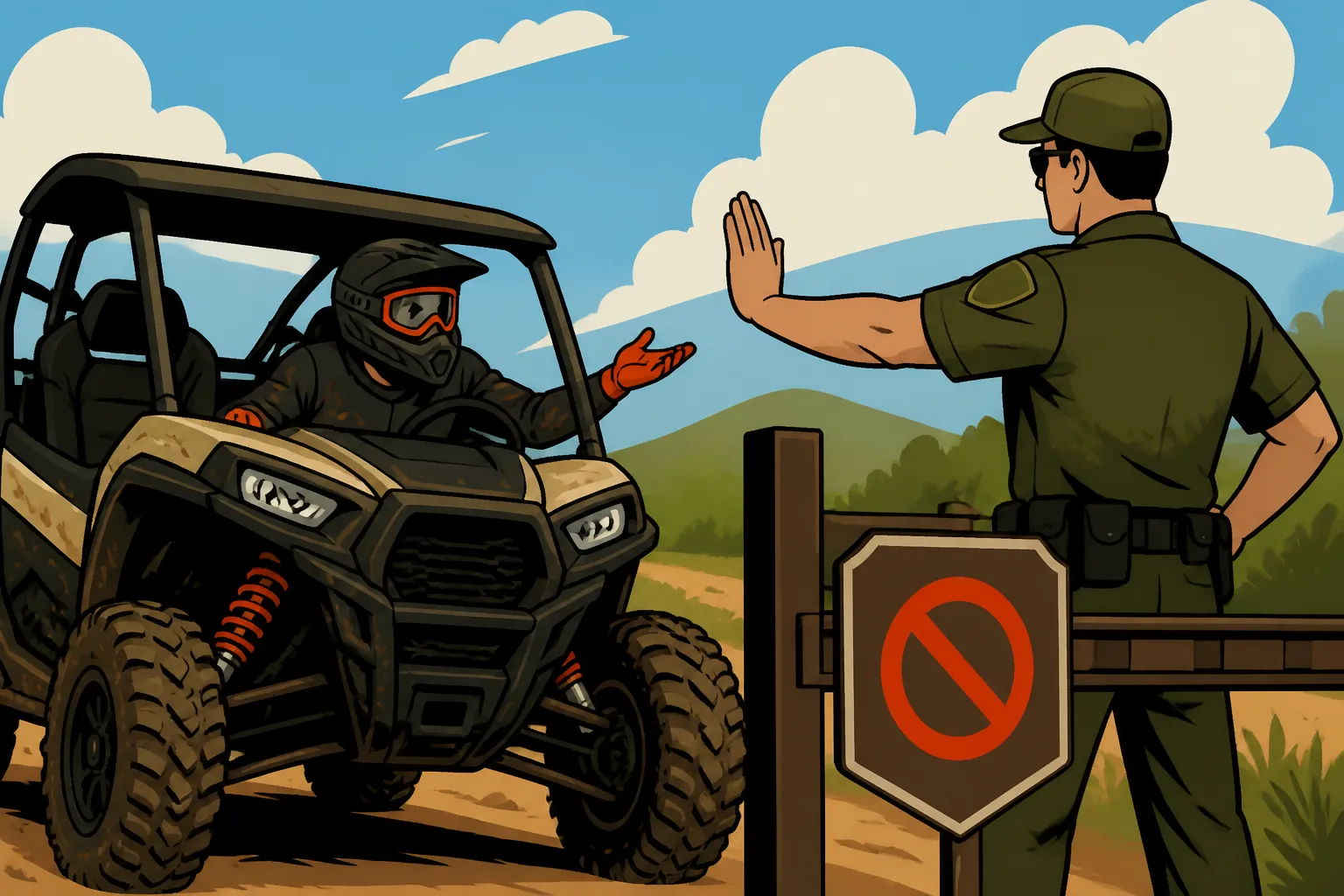
If you are refused entry, keep the exchange calm and ask what documentation or rule is missing. A gate attendant may be enforcing a venue requirement, a state rule, or both. Ask whether the issue is the decal, proof of purchase, a separate land-use permit, or a safety or equipment requirement. If the problem is a missing decal and you have not bought one, do not ride onto the trail hoping to sort it out later. If you believe you have the correct proof, show it and ask what the venue accepts before moving the machine onto public land.
Decal compliance is only one part of a legal ride
A valid decal does not make every ride lawful or every machine trail-ready. Texas has separate safety, age, passenger, equipment, and conduct rules. A rider who arrives with the decal but lacks a required certificate or safety equipment may still be turned away or cited.
Safety certificates and young riders
TPWD recognizes safety certificates showing successful completion of the ATV Safety Institute’s ATV RiderCourse, including hands-on training, or equivalent safety training certificates issued under the authority of Texas or another state. TPWD also says an ATV operator on public land must hold a safety training certificate issued by the Texas Department of Public Safety or an equivalent certificate issued under another state’s authority. Carry the certificate while riding and show it upon request. See Texas OHV Safety Certificate Requirements for more on what documentation counts.
Age and supervision matter too. According to the Texas Legislature, anyone under 14 operating an ATV on public land must be accompanied by and under the direct supervision of a parent, guardian, or authorized adult. Operators aged 14 or older may ride without adult supervision only if they hold a safety certificate or are under the direct supervision of a certificate holder. TPWD likewise states that a person must be at least 14 to operate an ATV on public land without adult supervision, provided they hold a safety certificate.
These requirements concern ATV operation on public land; do not assume that a young rider’s presence with an adult automatically makes every machine, route, or activity acceptable. Check the specific park’s rules for children and vehicle size before arriving.
Helmets, belts, lights, and sound
TPWD requires operators and passengers on ATVs on Texas public lands to wear a helmet that meets United States Department of Transportation standards. For a UTV equipped with seat belts, TPWD says occupants must wear them on public lands. Bring properly fitting protective equipment for the people riding, not just the machine.
Lights and exhaust equipment can also be checked. Texas law requires an ATV or UTV on public property to display a lighted headlight and taillight from one-half hour after sunset until one-half hour before sunrise, and whenever visibility is reduced. TPWD requires the lights to be in working order for those conditions. For more detail on riding after dark, see Texas Lighting Requirements for OHVs.
Texas law also requires a USFS-qualified spark arrester on an OHV operated on public property or public lands, and it must not be removed or modified. On state park trail systems, TPWD sets a maximum exhaust sound level of 96 decibels. Texas law prohibits muffler cutouts, bypasses, and similar devices on motor vehicles, including OHVs on public property; vehicles on public OHV lands must also maintain an adequate muffler system in good working condition. These are not details to leave until a trailhead inspection: check the machine before loading it.
Passengers and conduct
Texas law prohibits an ATV operator on public property from carrying a passenger unless the manufacturer specifically designed the ATV to transport one. This applies regardless of the passenger’s age. Do not assume that a passenger can ride safely or legally just because there is room on the seat or rack.
Alcohol is another reason to stop before reaching the gate. TPWD prohibits the public display or consumption of alcoholic beverages in state parks, including OHV trail systems, and operating a trail machine under the influence of alcohol or drugs is prohibited.
Stay on routes the managing land agency has opened to OHV use. Operating a motor vehicle such as an ATV in protected public natural areas like stream beds is a Class C misdemeanor punishable by a fine of up to $500, and under Texas Parks and Wildlife Department rules a third or subsequent offense increases to a Class B misdemeanor. A decal is permission to meet the applicable OHV decal requirement; it is not permission to ride anywhere on public land.
A gate-ready checklist for visitors and Texas residents
Before you load the trailer, match your paperwork and machine to the destination. A little preparation is usually easier than turning around at the gate, but each requirement comes from a different rule or land manager. Use this checklist as a final review, then confirm details with the venue.
- Decal: If your trip includes Texas public land, a state park OHV trail, or a grant-funded venue covered by the requirement, make sure the vehicle has a valid Texas OHV decal. A decal from another state does not count as Texas reciprocity.
- Receipt: If the Texas decal has been purchased but has not arrived, carry the proof of purchase or receipt in a readily accessible form.
- Certificate: Carry the valid safety certificate required for the rider, and be ready to show it upon request. Check the certificate rules for each rider in the group.
- Age and supervision: For an ATV rider under 14 on public land, arrange direct supervision by a parent, guardian, or authorized adult. Riders aged 14 or older need the required certificate or supervision by a certificate holder to ride without adult supervision.
- Protective equipment: Bring DOT-compliant helmets for ATV operators and passengers. UTV occupants must wear seat belts when the machine has them.
- Machine condition: Check lights, muffler, and spark arrester. Confirm that the spark arrester is USFS-qualified and unmodified.
- Passengers: Do not carry a passenger on an ATV unless the manufacturer designed that vehicle to carry one.
- Destination rules: Check the managing agency’s current trail status, access rules, permits, and restrictions. A Texas OHV decal does not replace a separate permit or override a closure.
If the venue’s rules are unclear, contact the park or land manager before the trip and explain exactly what you have: a physical Texas decal, a purchase receipt while waiting for one, or only an out-of-state sticker. Ask whether the venue needs anything else, such as a separate land-use permit. For state parks, OHV regulations are enforced by state park law enforcement and game wardens, according to TPWD, so it is sensible to settle paperwork questions before riding rather than relying on a verbal assumption at the trailhead.
If you are bringing a machine from outside Texas, keep title and decal questions separate. The Texas OHV decal is about riding where it is required; title paperwork concerns ownership. For purchase and transfer details, see Titling an ATV in Texas. If you need to find a purchase option before travel, Where to Buy a Texas OHV Decal covers that task.
A gate refusal is frustrating, but it is often preventable: identify whether your destination is public land, buy the Texas decal when required, keep proof accessible until the sticker arrives, and check the separate rider and vehicle rules. If the trip is limited to private property, TPWD says the decal is not required for ATVs and ROVs/UTVs operated exclusively there. The moment a ride includes a public-land venue, however, check the Texas requirement rather than assuming a home-state decal, title, or past riding experience will get the machine through the gate.
Sources
- Texas Legislature — Transportation Code Title 7, Chapter 663. Certain Off-Highway Vehicles (checked November 2, 2026)
- Texas Parks & Wildlife Department — OHV FAQ — Texas Parks & Wildlife Department (checked November 2, 2026)
- Texas Parks and Wildlife Department — Eisenhower State Park OHV Rules and Regulations (checked November 2, 2026)
- Texas Parks and Wildlife Department — Prohibition of Wheeled or Tracked Motor Vehicles in Stream Beds (checked November 2, 2026)
Disclaimer
This article is for general informational purposes only and does not constitute professional advice. Laws, prices and regulations vary by location and change over time. Consult a qualified professional for guidance on your specific situation.