Texas Rules for Riding a Closed Trail
A closed trail can look like a harmless detour, especially when the route is dry and your machine can handle it. But riding past a closure can damage land, violate the property manager’s rules, or become trespassing. The key is to treat signs, gates, and current closure notices as boundaries—not suggestions—and confirm where riding is allowed before setting out.
What “closed trail” means for Texas riders
A trail closure means the person or agency managing that land has restricted access to a route or area. The restriction may apply to every rider, only certain vehicle types, or a specific period. It may be temporary or permanent. The sign, barrier, map, or official notice should explain the scope when possible; if it does not, do not assume that the restriction is optional.
Closures can happen for several reasons:
- Wet or unstable ground: Tires can rut soil, widen trails, or damage drainage when conditions are soft. A route that looks firm at the entrance may be muddy farther along.
- Maintenance or construction: Crews may need room to work, or a trail may be unsafe while repairs are underway.
- Fire danger or recovery: A closure may protect people and land during a fire or while damaged habitat recovers.
- Wildlife or seasonal restrictions: A manager may restrict access to protect sensitive areas at certain times.
- Safety hazards: A washout, fallen tree, flood, or other hazard can make a route dangerous.
- Landowner or management changes: Access can change if permission ends or management rules are updated.
A closure can apply to one trail, one section, a whole riding area, or a type of vehicle. A route may be open to hikers but closed to motorized vehicles, for example. Read the wording carefully instead of treating “open” as an all-or-nothing status.
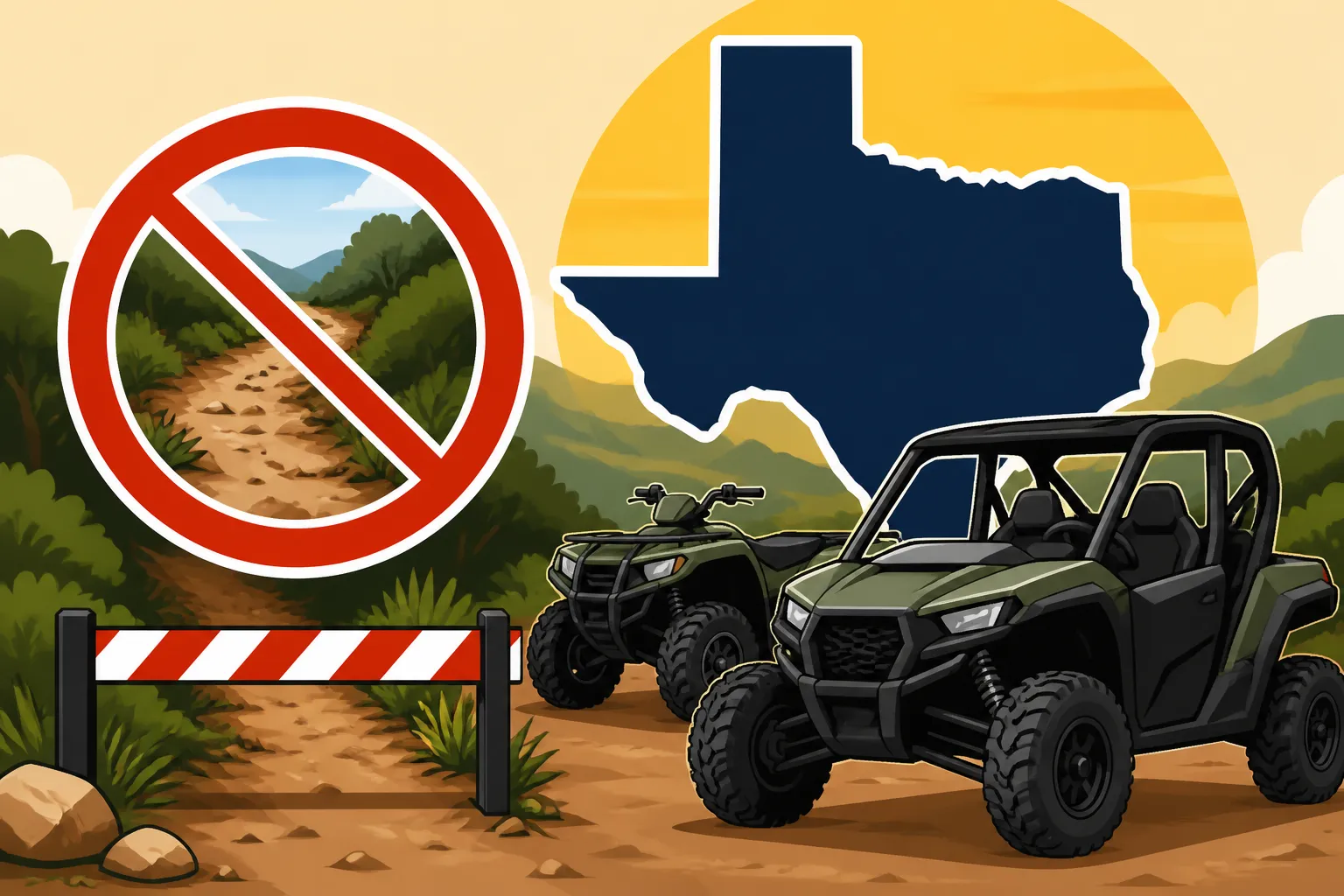
A gate, barricade, cable, or berm is also a clear warning to stop. Do not go around it, move it, or look for a gap beside it. A closure may be in place even if the trail beyond appears passable, and bypassing the barrier can create a new route that causes additional damage.
The same caution applies when a closure is not marked at the point where you encounter it. A map or current notice may show that a route is closed farther ahead. If you are unsure whether the restriction still applies, turn around and check with the land manager rather than testing the boundary.
What to do when you find a closure
Use this simple process before and during a ride:
- Check access information before leaving. Review the riding area’s current trail notices and rules. For public land, use the information provided by the agency responsible for that specific area. For a private park or ranch, check with its operator or owner.
- Look for signs at entrances and intersections. A closure may be posted where the route begins, at a junction, or where the restriction starts. Read signs before choosing a trail, not only when you reach a barrier.
- Follow the restriction as written. If a notice says a trail is closed to motorized use, do not ride it because another type of visitor may be allowed. If the closure boundaries are unclear, ask before proceeding.
- Turn around without creating a new route. Retrace the route you came in on where it is safe to do so. Do not ride around the closed section through brush, across a field, or along an unofficial bypass.
- Report an unclear or damaged closure. Contact the park or land manager if a sign is missing, a gate is damaged, or a closure notice conflicts with a map. Do not remove or alter a sign yourself.
Use the right source for the right place. A park’s website or staff can answer questions about that park; an agency contact can clarify restrictions on the public land it manages. A general trail map, old social media post, or rider’s comment may not reflect a closure that began recently. This is especially important after heavy rain, when conditions can change quickly. See Texas Trail Closures to Check First and Texas Trails After Heavy Rain for related planning considerations.
| What you encounter | What to do |
|---|---|
| A closed sign or barrier | Stop and turn back; do not bypass it |
| A map showing a closed segment | Avoid the segment even if no sign is visible at your approach |
| A muddy trail with no posted closure | Stay on the authorized route and use good judgment; check current conditions rather than assuming it is safe |
| Conflicting information | Pause and contact the land manager before riding |
| A closure notice with unclear boundaries | Treat the uncertain area as closed until the manager clarifies it |
A state OHV decal, park admission, or safety certificate does not override a trail closure. These requirements address different issues: access rules, fees, or rider qualifications. They do not give permission to enter a closed route. For details on where a decal applies, see Where a Texas OHV Decal Is Required; for general access rules, see Texas Rules for Riding Public Land.
Why closures matter and what can go wrong
Riding a closed trail can harm more than the surface beneath your tires. When riders leave an authorized route to get around a barrier, they can crush vegetation, widen a trail, disturb wildlife, damage water channels, or create tracks that other riders mistake for approved routes. If the closure protects soft soil or a repair site, a single pass can undo work intended to keep the trail usable.
There are also practical risks. A closed trail may have a washout, unstable ground, fallen debris, or no safe way through. It may be closed because crews or emergency responders need access. Riding in can leave you stuck or injured in an area where help is harder to reach. A closure is not proof that a hazard is present, but it is a reason not to assume the route is safe.
The consequences depend on who manages the land, what the posted restriction says, and what happened. A rider could be removed from a park, lose access privileges, face a fee or citation, or be treated as trespassing if they enter land without permission. Do not rely on a single penalty figure from another park or county: rules and enforcement vary. For background on access without permission, see Texas Trespass Rules for Riders.
Keep the distinction between a land-access rule and a vehicle rule in mind. An ATV or UTV may meet equipment requirements and still be prohibited on a particular route. Conversely, a trail being open does not necessarily mean every vehicle can use it. Width limits, surface conditions, vehicle classes, or local park rules may narrow access. Review [Texas Rules for Riding Off a Marked Route] and Texas Rules for a Machine Over 50 Inches before treating an alternative route as acceptable.
For national forest or other public-land rides, check the rules for the specific trail system. Routes may have designated uses, seasonal restrictions, or conditions that differ from those at a nearby park. The general information in Texas Rules for Riding a National Forest Trail can help frame what to check, but the current notice for your chosen area is what matters for that trip.
Plan a legal alternative before you ride
A closure is easier to handle when the ride plan includes another option. Before loading your machine, identify the trails that are open, check how the route connects, and make sure the alternative allows your vehicle. If the closure divides the trail system or blocks your planned loop, do not improvise a crossing through private land or an unmarked route.
A useful pre-ride check includes:
- The current open and closed trail list for the specific riding area
- Any weather-related or seasonal notices
- Vehicle restrictions, including width or class limits
- Whether a permit, decal, or other access requirement applies
- A legal way to return if the route is blocked or conditions change
- A contact number or other way to reach the land manager
For private property, permission must come from the owner or someone authorized to grant access. A trail shown on a map is not proof that you may ride it, and permission to use one route does not necessarily extend to nearby land. If a private trail is closed, do not assume the closure is only a request. See Texas Rules for Riding Private Land With Permission for more on the permission side of access.
For a public riding area, keep your machine on designated routes and follow posted signs even if other riders appear to ignore them. Another rider’s tracks do not make a route legal or safe. If a closure affects your route, turn back or use an alternative that the manager identifies as open. More generally, Texas Rules for Riding a Closed Trail is not a permission question you can settle by judging the ground from the seat: the land manager’s current restrictions control access.
If you see someone bypassing a barrier, avoid following them. If the situation creates an immediate safety concern or appears to involve damage to a closure, report it through the land manager’s appropriate contact channel. Do not confront another rider in a way that could escalate the situation, and do not attempt to repair, move, or enforce the barrier yourself.
The practical rule is simple: verify access, obey the closure, and use only an authorized alternative. That protects the trail, keeps your ride within the land manager’s rules, and reduces the chance that a small detour turns into a much larger problem.
Disclaimer
This article is for general informational purposes only and does not constitute professional advice. Laws, prices and regulations vary by location and change over time. Consult a qualified professional for guidance on your specific situation.