Texas Trespass Rules for Riders
An ATV or UTV can be titled, equipped with the right decal and ready for a ride—and still be somewhere it has no permission to go. In Texas, the key question is not whether a machine is allowed on a road or trail in general, but whether the rider has a legal right to enter that particular property. Here’s how to check access and avoid a trespass problem.
The basic rule: permission matters
Texas trespass rules apply to riders just as they apply to people traveling on foot or in a vehicle. In general, a person may commit criminal trespass by entering or remaining on someone else’s property without effective consent when they have notice that entry is forbidden, or by staying after being told to leave. The exact legal outcome depends on the circumstances, so do not treat any single sign, fence or conversation as a complete answer to every situation.
For riders, the practical point is straightforward: a route that looks rideable is not necessarily open to the public. A visible trail, tire tracks, a ranch road or an unlocked gate does not, by itself, prove that you may ride there. Likewise, a machine’s title, license plate or OHV decal does not grant access to land.
Texas law recognizes different ways a rider may receive notice that entry is prohibited. Notice may be given directly, such as when an owner, manager or authorized representative tells you not to enter. It may also be communicated through signs, fencing or other conditions on the property. Texas law includes specific rules for some forms of notice, including signage and purple paint markings, so do not assume that a marking is valid—or invalid—without checking the current requirements.
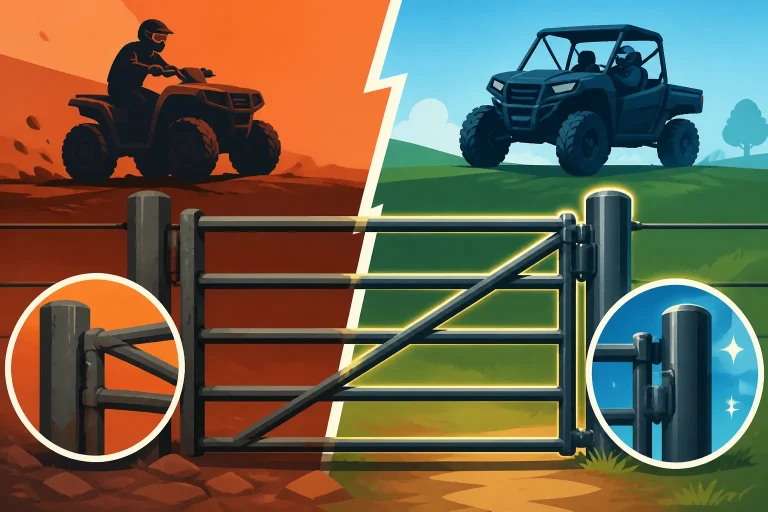
A locked gate is a clear reason to stop and find another route. An open gate is not an invitation to enter; it may have been left open for livestock, farm work or another authorized user. A fence can mark a property boundary even when it is damaged or easy to cross. If you are unsure where the boundary lies, the safest choice is to turn around rather than test it.
Trespass can also happen after a rider has entered lawfully. For example, a landowner may allow access for a particular purpose and later withdraw that permission. If the owner or an authorized person tells you to leave, do so promptly and calmly. Continuing the ride, arguing on the property or taking another route across the same land can make a manageable misunderstanding more serious.
It helps to separate three questions that are often mixed together:
| Question | What it tells you | What it does not tell you |
|---|---|---|
| Is the machine titled or otherwise documented? | Whether ownership and vehicle paperwork are in order | Whether the rider may enter a property |
| Does the machine have the required decal or permit for a riding area? | Whether a specific land-use requirement may be met | Whether every nearby trail is open |
| Do you have permission or another legal basis for access? | Whether you may enter the specific land or route | Whether all riding rules, safety requirements or trail limits are satisfied |
A rider needs to answer the access question separately from the paperwork and equipment questions. For an overview of where riding is generally available, see Where to Ride an ATV in Texas. For land-access situations involving the owner’s approval, see Texas Rules for Riding Private Land With Permission.
Getting permission before you ride
The most reliable way to avoid trespass is to get clear permission from someone who has authority over the property. Ask before unloading, crossing a field, entering a trail or using a private road. If permission is given, make sure it covers the activity you actually intend to do.
A useful permission conversation should establish:
- Which property or route you may use.
- Whether ATVs, UTVs or both are allowed.
- Whether the permission covers passengers, guests or a group.
- Where you may park, unload, ride and turn around.
- Whether there are limits on dates, hours, speed, noise or trail direction.
- Whether you may cross a gate, creek, road or other boundary.
- Who to contact if the route is blocked or conditions change.
Permission to enter for one purpose does not automatically include permission for another. A person allowed to retrieve a stranded machine, help with ranch work or visit a residence should not assume that they may also take a recreational ride around the property. A landowner’s permission for one rider does not necessarily extend to that rider’s friends.
Try to get permission directly from the owner or from someone who clearly manages access. A neighbor’s assurance that “people ride there all the time” is not the same as consent from someone authorized to allow entry. A leaseholder, caretaker or ranch employee may be able to grant access in some situations, but their authority can be limited. Ask rather than infer.
Written permission is useful when access is recurring, involves a group or depends on specific boundaries. A text or email can help both sides remember what was agreed, but it is not a substitute for confirming that the person giving permission has authority over the land. For an occasional ride, a clear verbal agreement may be enough in practical terms; the important part is knowing exactly what is allowed and following the conditions.
Gates, roads and boundary lines
Do not open or cross a gate unless you have permission to do so. If a landowner has authorized access through a gate, ask whether it should be closed behind you. Leaving a gate open can let livestock escape; closing a gate that was meant to remain open can also disrupt property operations. The owner’s instruction controls.
A road across private land is not necessarily a public road. Some ranch roads are used by employees, tenants, contractors or guests without being open to general traffic. A graded surface, road sign or well-worn track does not establish public access. If you cannot confirm that the route is open to the public or that you have the owner’s consent, do not use it as a shortcut.
Do not assume that a public road gives you permission to ride onto the adjoining property. The public right to travel on a road and the right to enter the land beside it are different questions. Stay within the route’s legal limits, and do not cut across a field, drainage area, shoulder or private drive to bypass a closure.
If you have permission for a route but cannot tell where it goes, stop before you reach an uncertain boundary. Ask the owner or manager for a map, a marked route or a clear turnaround point. Riding until someone objects is not a safe way to find out where permission ends.
Special cases riders often misunderstand
Some riding situations involve more than a simple private-property boundary. The access rules can change with the land’s ownership, management and permitted use. When you cannot confirm the status of a route, do not assume that riding is allowed just because another type of access exists.
Hunting leases and ranch roads
A hunting lease does not automatically give every person on the lease permission to ride an ATV or UTV wherever they want. The lease agreement, landowner’s conditions and directions from the lease manager may limit vehicle use to particular roads, tasks or times. A guest’s permission to hunt does not necessarily include permission to bring or operate a machine.
Likewise, permission to use a ranch road for a specific job may not extend to recreational riding. Ask whether the access includes the machine, the route and the purpose you have in mind. If the owner allows travel only to reach a work site or hunting location, stay on that route and do not treat it as an invitation to explore surrounding land. See [Texas Rules for Riding a Hunting Lease] for more on that situation.
Utility corridors and easements
A power line, pipeline or other utility corridor may look like a convenient, open trail. But an easement is a legal right to use land for a defined purpose; it does not automatically make the corridor a public riding route. The utility, landowner or another party may control access, and the terms of an easement can be narrow.
Do not ride under or along a utility corridor unless you have confirmed that riding is allowed there. A corridor may cross several parcels with different owners, and a permission granted for one portion may not cover the rest. Learn more about access concerns in Texas Rules for Riding a Utility Right of Way.
Riverbeds and banks
A riverbed or dry creek can create confusion because public rights may depend on the waterway and the location. A rider should not assume that a riverbed is public merely because water flows through it, nor assume that a route is private solely because the banks are privately owned. Access rights can turn on facts that are not obvious from the trail.
Before riding a river route, confirm which areas are open, where the public route begins and ends, and whether getting to the bed requires crossing private land. Permission to use a riverbed would not, by itself, authorize crossing a private bank or entering private land to reach it. See Riding a Riverbed Nobody Owns and Private Land on Both Banks for more detail.
Public land, closed routes and trail boundaries
Public land is not a blanket invitation to ride anywhere. A managing agency or landowner may open only designated trails, limit access to certain machine types, close routes seasonally or prohibit riding off the marked route. Entering a closed trail or cutting around a barrier can create a trespass or other enforcement issue, even when the surrounding land is publicly managed.
Follow posted signs and current closure information. If a gate or barrier blocks a route, do not go around it because the trail appears dry, the closure seems inconvenient or other tire tracks are visible. A closure may protect wildlife, prevent erosion, allow repairs or address a safety hazard. See Texas Rules for Riding Public Land, [Texas Rules for Riding a Closed Trail] and [Texas Rules for Riding Off a Marked Route] for related limits.
A permit, decal or day-use payment may be required for a particular public riding area, but that requirement is separate from route access. Paying to enter an area does not mean every road, service track or closed section is available to riders. Confirm both the land-use requirement and the route restrictions before unloading.
A practical access check before unloading
A few minutes of checking can prevent a ride from turning into a boundary dispute. Use this process whenever you are visiting unfamiliar land, following a new route or riding with a group.
- Identify who manages the property. Check the park or land manager’s information, ask the owner, or contact the person who arranged access. Do not rely only on a map label, online route, old directions or a previous rider’s claim.
- Confirm permission for your specific machine and purpose. Ask whether ATVs or UTVs may enter, where they may go and whether recreational riding is included.
- Check the route boundaries. Get a map or clear directions. Confirm gates, turnarounds, no-go areas and any private parcels the route crosses.
- Look for current notices. Read signs at entrances and trail junctions. Check for closures, restricted hours, vehicle limits and instructions from the land manager.
- Brief every rider in the group. Make sure guests know where they may ride, how to handle gates and what to do if separated. One person’s permission should not be treated as permission for the entire group unless that is what the owner agreed to.
- Stop when the facts are unclear. Do not cross a fence, bypass a closed gate or continue down an uncertain road to see where it leads. Call the owner or manager, or choose a route with confirmed access.
- Leave when asked. If someone with apparent authority tells you to leave, move off the property safely and promptly. Do not escalate the situation or assume that an earlier permission overrides a later instruction.
Keep any written permission, route map or park confirmation accessible during the ride. This is especially helpful when access depends on a particular trail or when several people are riding together. It may not settle every legal disagreement, but it reduces confusion about what the group was told.
If an owner or manager raises a concern, remain respectful, stop the machine and ask what route to use to exit. Do not argue over the boundary while standing on disputed land. If you believe you have permission from someone else, explain that calmly, but leave if directed and resolve the issue later with the person who granted access.
The safest rule is simple: when you cannot confirm that a route is open to you, do not ride it. Permission should be specific, current and given by someone authorized to provide it. That approach protects the land, prevents avoidable confrontations and helps keep access available for riders who follow the rules.
Disclaimer
This article is for general informational purposes only and does not constitute professional advice. Laws, prices and regulations vary by location and change over time. Consult a qualified professional for guidance on your specific situation.