Texas Rules for Riding Public Land
Riding an ATV or UTV on Texas public land takes more than finding an open trail. The machine may need a Texas OHV decal, the rider may need a safety certificate, and the land manager can require separate access permits or close routes for weather. This guide explains how those requirements fit together, what out-of-state riders should check, and how to avoid arriving at a gate unprepared.
What Counts as Public Land for an OHV Ride
“Public land” sounds like one category, but it covers places managed by different agencies with different purposes. A national forest, a national recreation area, a state park, a water-district park and a city recreation area may all be open to visitors, yet each can have its own rules for motorized access. Public ownership does not mean every road, trail or open space is available to ATVs and UTVs.
The most important distinction is whether the land manager has designated a place for OHV riding. A trail may be open to hikers and mountain bikes but closed to motor vehicles. A gravel road may be open to highway-licensed vehicles but not to an unregistered quad. Even within an OHV area, some routes may be restricted by vehicle width, season, surface conditions or the type of machine allowed.
Texas riding opportunities are spread across public and publicly accessible sites, but many are limited to specific trail systems or recreation areas. The land manager’s current map and rules matter more than the fact that the land appears on a public map. Before you load a machine, find the official page for the exact riding area and confirm that it allows your type of vehicle.
Public land is not the same as public-road access
An OHV trail and a public road are different things. A Texas OHV decal does not register an ATV or UTV for ordinary road use, and it does not make a closed road legal to ride. The rules for riding on roads are narrow and separate from the rules for public land trails. If your route includes a road, check the specific road-use restrictions rather than assuming that access to a nearby trail settles the question. See Why Texas Will Not Register an OHV for the Road and Texas Rules for Getting Across a Road.
Also distinguish public land from a private recreation park. A privately operated park can be open to the public while still being private property. The operator may set its own admission rules, waivers, riding hours, equipment standards and trail limits. That is different from riding on land managed by a government agency, although state OHV decal rules may still matter at some facilities.
Identify the land manager before you plan the route
Start by answering three questions:
- Who manages the exact area where you want to ride?
- Does that manager designate trails or roads for your machine type?
- What permits, fees and operating conditions apply there?
A name on a search result or a social-media post is not enough. Routes can close, boundaries can be confusing, and local requirements may differ between nearby sections of land. When in doubt, call the managing office or use its official trail-status information.
Texas areas may be managed by the U.S. Forest Service, the National Park Service, the U.S. Army Corps of Engineers, a state agency, a water district, a municipality or another public entity. Each manager controls access to its own land. A Texas decal or another agency’s pass does not override those local rules.
The Texas OHV Decal and Other Permits
The Texas OHV decal is one part of the compliance picture, not a universal riding permit. It is associated with the machine, while a safety certificate applies to a rider and a land-access permit or day-use pass applies to a particular place or visit. You may need more than one of these, and having one does not substitute for the others.
For an overview of what the state decal does and where it applies, see [The Texas OHV Decal Requirement Explained]. Before a trip, confirm the current decal rules and any exemptions through the appropriate official channel. Do not assume that a title, plate, safety certificate, park payment or out-of-state sticker automatically replaces it.
| Requirement | Usually relates to | What it does not do |
|---|---|---|
| Texas OHV decal | The machine | Does not register it for general road use or grant access to every public trail |
| Safety certificate | The rider, where required | Does not replace the machine decal or a site permit |
| Day-use payment or land pass | A location or visit | Does not make a closed trail open |
| Trail-specific permit or reservation | A designated area or activity | Does not replace other requirements that still apply |
| Title and OHV plate | Ownership records and the Texas title system | Do not serve as a public-land riding pass |
Decal requirements for Texas riders
The Texas OHV decal is generally a machine-level requirement for riding covered OHVs on public land. The details can depend on the machine and the land, so check the state rules and the site’s rules before setting out. The decal is not an annual vehicle registration sticker, and it should not be treated as permission to ride wherever a gate is open.
One frequent mistake is to think a Texas title or OHV plate covers the decal requirement. Those documents serve different purposes. Texas titles an OHV but does not offer ordinary road registration for it. The decal program is separate from the title process. For that distinction, see Why Texas Titles But Never Registers an OHV.
The decal is generally associated with each machine rather than each person in a group. If several family members take separate ATVs, do not assume one decal covers the whole group. Likewise, borrowing a friend’s machine does not mean you can transfer a decal from your own vehicle. Confirm whether the machine has the required decal and whether it remains valid for the trip.
Day-use fees and land passes are separate
A site can charge for day use, parking, camping or trail access even when you already have the Texas OHV decal. The reverse is also true: paying an entrance or day-use fee does not necessarily satisfy the state decal requirement. Ask what each charge covers instead of treating “the permit” as one all-purpose document.
Some federal areas use separate fee systems for access or recreation. A national forest pass, for example, may relate to day-use charges, while OHV trail access has its own conditions. Review Texas National Forest Permits before riding a national forest trail. On other public land, check the land manager’s page for admission, reservations, vehicle permits and any required proof of payment.
A machine that is street-legal or registered in another jurisdiction may qualify for an exception under a specific rule, but don’t infer an exemption from the presence of a license plate. Confirm it for both the machine and the riding area. An exemption from the Texas decal requirement, if applicable, does not erase the land manager’s own access conditions.
Buying a decal and checking its validity
Use the official purchasing or issuing channel identified by the responsible agency. Do not rely on an online marketplace listing to determine whether an item is a valid Texas OHV decal. Amazon may carry generic stickers, flag parts or other riding accessories, but a look-alike decal is not proof that a required state decal has been issued.
When you receive a decal, check the instructions for placement and display, and keep any receipt or confirmation that the issuing agency provides. If a decal is damaged, lost or difficult to read, ask the issuing agency how to replace it rather than improvising a copy. The same advice applies if you buy a used ATV: inspect the machine’s paperwork and decals, but verify what must be transferred, replaced or obtained for your own ride.
Riding on Federal, State and Local Land
Different land managers can impose different restrictions, even when the same state decal applies. Always look for the rules for the specific unit, trail or recreation area. A general map that shows public ownership is useful for orientation, but it is not a substitute for an official motor-vehicle map or current closure notice.
National forests
In a national forest, riding is generally limited to routes designated for motorized use. Do not assume that an unmarked forest road is open to your machine, or that a trail shown on an old map remains available. The forest may designate routes by vehicle type or width, and temporary closures may apply after rain, maintenance work or resource damage.
The Sam Houston National Forest OHV trail is one example of a specific, managed riding system. Riders should check its current trail status, access requirements and width restrictions before traveling. A machine that is too wide for a trail is not made eligible by having a Texas decal or paying a day-use fee. Review Texas Rules for Riding a National Forest Trail and the current information for the particular forest trailhead.
National forests can have more than one fee or compliance requirement. Confirm whether your planned trip involves a trail fee, a day-use payment, an annual pass, an OHV decal, a safety certificate or some combination. Keep proof of payment available if the agency requires it.
National recreation areas and reservoirs
A national recreation area may include a variety of uses, but OHV riding is permitted only in designated places and under the managing agency’s rules. The fact that an area has a shoreline, open ground or a visible track does not establish that motorized riding is allowed there. Check the route map and access notice for the exact section. See Texas Rules for Riding a National Recreation Area.
Lake Meredith’s Rosita Flats OHV area, for example, has its own access information and riding conditions. Visitors should check the current requirements for permits, decals, flags and open areas before driving there. Do not assume that a permit used at one recreation area is valid at another.
Corps of Engineers and water-district land
Land around a reservoir may be managed by the Corps of Engineers, a water district or another entity. The access rules can vary from one recreation area to another, and an OHV may be permitted only in a designated zone or not permitted at all. Trails can also be affected by water levels, erosion, hunting activity or facility work.
Before riding, confirm the land manager and the specific rules for motorized vehicles. For relevant areas, use Texas Rules for Riding Corps of Engineers Land as a starting point, then verify details with the office responsible for the actual site. A public boat ramp, picnic area or shoreline is not automatically an OHV route.
State and local land
State parks and other state-managed properties generally control motorized access through site-specific rules. Some facilities provide OHV riding opportunities; many do not. Never assume that an ordinary state-park vehicle pass includes permission to ride an ATV. Check [Texas Rules for Riding State Land] and confirm access with the park or agency that manages the land.
City and county properties may have their own ordinances and closure rules. A city trail network can allow bicycles and pedestrians while prohibiting motorized use. A local park’s general opening hours do not tell you whether an OHV is allowed. Contact the local manager if the published rules are unclear.
A public grant or public funding history also does not mean that a site is permanently open or operated by the state. Some OHV facilities are run by local governments, nonprofits or other organizations, and their current operating rules still control access. Check the operator’s own page for hours, closures, vehicle limits and admission requirements.
Rider Eligibility, Certificates and Safe Operation
Public-land riding can involve requirements for both the machine and the person operating it. The age of the rider, the kind of machine and the land manager’s rules may all matter. For children and teens, check the state requirements before the trip and ask the riding area whether it adds its own age or supervision rules.
Safety certificates and out-of-state riders
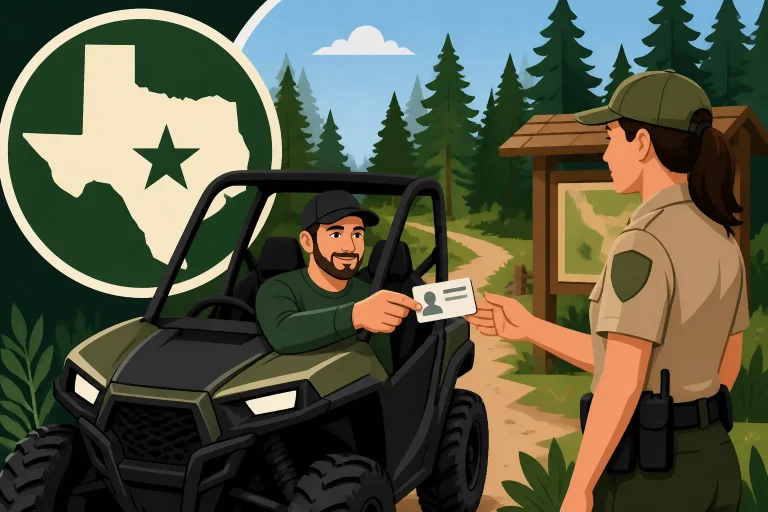
Texas has safety-certificate requirements for some young OHV riders. The rules can involve the rider’s age, course completion and supervision, so review [Texas OHV Safety Certificate Requirements] rather than relying on another state’s age limits. Keep the certificate available if the rules require the rider to carry or show it.
A certificate from another state may be recognized in some circumstances, but don’t assume that any card, online course completion or parent-signed form qualifies. Check Does Texas Accept an Out-of-State Safety Certificate? if you are visiting from elsewhere. If you are supervising a minor, confirm who is qualified to supervise and what “direct supervision” means under the applicable rule. A qualified adult riding somewhere else on the property may not meet the requirement.
The certificate belongs to the rider, not the machine. It does not replace a machine’s Texas decal, land-use payment or facility waiver. Similarly, a decal on the ATV does not establish that the rider meets age or supervision requirements.
Helmets, passengers and equipment
Follow Texas safety rules as well as any stricter rules imposed by the riding site. Requirements can differ by rider age, machine design and riding situation. A park may require helmets for every rider and passenger even when a state-law exception might apply in another setting. The simplest approach is to arrive with appropriate protective gear for everyone and check the site’s rules before unloading.
Passenger rules are especially important on ATVs. A passenger should not ride on a single-seat quad unless the manufacturer designed it to carry a passenger. A UTV’s bench or bucket seating, restraint system and passenger capacity also matter. Never add a passenger just because there appears to be room.
Before leaving home, inspect the machine and its equipment:
- Check brakes, throttle return, steering, tires and lights.
- Confirm that seat belts and rollover protection are in working order on a UTV.
- Secure cargo so it cannot shift into the rider’s controls or fall onto a trail.
- Carry water, basic repair supplies and a way to contact your group.
- Follow any posted requirements for flags, spark arresters, noise control or protective equipment.
Some parks require a tall whip flag or a particular style of flag. If you buy a flag pole or mount through Amazon, check the riding area’s height, visibility and attachment requirements before ordering; a generic accessory may not meet them. For helmets and protective equipment, verify the applicable standards and fit rather than choosing by product photos alone.
Keep the machine on authorized routes
Stay on designated routes and obey posted signs. Riding around a closed gate, crossing fragile ground to avoid a muddy section or cutting a new shortcut can damage land and put access at risk. A route that looks rideable is not necessarily open. If a trail is closed, use an authorized alternative or end the ride.
This matters after rain. Soft soil can rut quickly under a heavy UTV, and agencies may close trails to prevent damage. A closure is not an invitation to find an unofficial route nearby. Check trail status on the day of the ride and again if conditions change while you are there.
Noise, dust, speed and group size also affect the experience of other visitors. Keep a safe distance, slow down around pedestrians and respect posted limits. Riding responsibly helps protect the trail and reduces the chance of complaints that can lead to tighter restrictions.
Reciprocity for Nonresidents and Machines From Other States
Visitors often ask whether an out-of-state OHV decal, registration or safety certificate will work in Texas. The answer depends on what document you mean. Reciprocity is not a single agreement that makes every other state’s rules interchangeable with Texas rules.
Do not assume another state’s decal replaces Texas requirements
Texas may require its own OHV decal for riding covered machines on public land, including machines brought in by nonresidents. Check Does a Nonresident Need a Texas OHV Decal? before traveling. An out-of-state registration plate, trail sticker or proof of purchase should not be treated as a Texas decal unless the official rules specifically say it qualifies.
A nonresident may need to meet Texas requirements even if the machine is titled or registered at home. The land manager may also have additional local requirements. Confirm the state-level decal question and the area-level permit question separately.
The reverse is not necessarily true. A Texas decal does not automatically grant riding rights in another state, nor does it satisfy that state’s sticker, permit or registration system. Before crossing a state line, check the destination’s requirements for residents and visitors.
Certificates require a separate check
Safety-certificate recognition is separate from decal reciprocity. If a young rider completed an approved course in another state, confirm whether Texas recognizes that specific credential. Carry the certificate and any supporting record the authority recommends. Do not rely on an instructor’s verbal assurance if the family will need to demonstrate qualification at a trailhead.
Machines with plates or road registration
A machine with a license plate may still be restricted from OHV routes, and it may still need to satisfy local access conditions. Conversely, a Texas OHV decal does not give an ATV ordinary road privileges. Do not use a plate as a shortcut for checking access. Look at the actual machine category, its registration status, the route designation and the rules published for that property.
For a multi-state trip, make a checklist for every state and every riding area. Keep the decal and certificates attached to the correct machine or rider, and store digital copies of receipts and permits where you can retrieve them without cell service.
Planning a Compliant Public-Land Ride
A few minutes of preparation can prevent a long drive to a closed trail or an avoidable ticket. Use this process for a first visit, a new machine or a ride in an unfamiliar part of Texas.
- Choose a specific riding area. Identify the actual trail system or designated riding zone, not just the county or park name.
- Find the land manager. Use its official page or contact information to confirm who controls access.
- Check whether your machine is allowed. Look for vehicle type, width, passenger and route restrictions.
- Confirm the Texas decal requirement. Check the state rule and any site-specific instruction. Verify the decal for each machine that needs one.
- Check rider qualifications. Confirm age, certificate, supervision, helmet and passenger requirements.
- List every fee or permit. Separate the Texas decal from entrance charges, day-use payments, annual passes, reservations and trail permits.
- Review closures and conditions. Check status close to departure, especially after rain or severe weather.
- Prepare the machine and documents. Carry required certificates, payment confirmation, identification and any permit the site asks you to show.
- Follow posted routes on site. Treat signs, gates and current staff instructions as controlling.
- Recheck before the next ride. Rules, access points and closures can change between trips.
What to have ready at the trailhead
What you need to show depends on the area, but a practical ride folder can include:
- Proof of the required Texas OHV decal for each machine.
- Any day-use, trail or access permit.
- A safety certificate for a rider who must have one.
- The official trail map or downloaded route information.
- Emergency contact details and a plan for poor cell coverage.
- The machine’s ownership or purchase documents if the site or situation calls for them.
Do not carry unnecessary originals if a safe copy will do, but follow any specific instruction from the agency. Download permits and maps before leaving town. A screenshot may be useful where a trailhead has no signal, though the agency may require a particular physical decal or printed document.
Questions to ask if the rules are unclear
A quick call to the managing office can resolve questions that a broad web page does not answer. Be specific:
- “Can this type and width of ATV or UTV use this trail?”
- “Is the route open today, and are there weather closures?”
- “Does this trip require a Texas OHV decal?”
- “Is there a separate day-use payment or reservation?”
- “Does my out-of-state safety certificate meet the rider requirement?”
- “Are flags, helmets, spark arresters or other equipment required?”
- “Can I bring a passenger in this machine?”
Describe your actual machine rather than asking generally whether “ATVs” are allowed. A full-size side-by-side, youth quad and narrow ATV may be treated differently by a particular trail system.
Common mistakes that lead to trouble
Treating a public map as permission. The map may show ownership, not motorized access. Find the official route designation.
Assuming the decal pays every fee. State decal rules and site admission rules are separate. Confirm both.
Relying on an out-of-state sticker. Visitor status does not necessarily exempt a machine from Texas requirements. Verify before traveling.
Assuming a title or plate is an OHV permit. Ownership paperwork and riding access are different matters.
Following an old trail post. A route may have closed or changed. Check the manager’s current status information.
Riding around a gate or closure. A closed route remains closed even if another rider has crossed it.
Buying a generic sticker as a substitute. A marketplace listing, including one on Amazon, cannot establish that a state or land manager issued a valid permit. Use the official channel for required decals and passes.
Questions Riders Commonly Ask
Does a Texas OHV decal let me ride anywhere on public land?
No. The decal addresses a state requirement; it does not open trails or grant permission on every publicly owned property. The land manager decides where motor vehicles may operate and can impose separate access conditions.
Is a national forest road automatically open to an ATV?
No. Use routes designated for motorized travel and confirm whether the route allows your vehicle type. Forest roads can have different restrictions from OHV trails, and current maps and closure notices should guide your decision.
If I paid an entrance fee, do I still need the Texas decal?
Possibly. An entrance or day-use payment and the state OHV decal serve different purposes. Ask the site what its fee covers, then check whether the state decal requirement also applies.
Does an out-of-state OHV sticker count in Texas?
Do not assume it does. Check the current Texas rules for nonresident machines and confirm any site-specific requirements. A sticker from another state may not replace a Texas requirement.
Can I ride a public trail if my ATV has a license plate?
A plate does not automatically authorize every public-land trail. Confirm that the route allows your type of machine and that your registration status satisfies any applicable exception. A license plate also does not convert every OHV route into a public road.
Can I ride on public land without a safety certificate?
That depends on the rider’s age and the requirements that apply to the activity and location. Check the Texas certificate rules and the land manager’s own conditions, especially when a minor is riding.
Can I follow another rider onto a trail if the gate is open?
Not safely as a rule. An open gate does not necessarily mean the route is open to your type of vehicle, and a closure may be marked elsewhere. Check official signs and trail information before entering.
Disclaimer
This article is for general informational purposes only and does not constitute professional advice. Laws, prices and regulations vary by location and change over time. Consult a qualified professional for guidance on your specific situation.