Why Texas Honors Out-of-State Certificates
Why Texas Honors Out-of-State Certificates
If you completed an ATV or UTV safety course in another state, you may be wondering whether Texas will make you take it again before you ride. In many cases, Texas accepts an out-of-state certificate for its OHV safety education requirement. The key is knowing what that recognition covers, what proof to bring, and which separate permits or land-use rules still apply.
What Texas Means by Honoring an Out-of-State Certificate
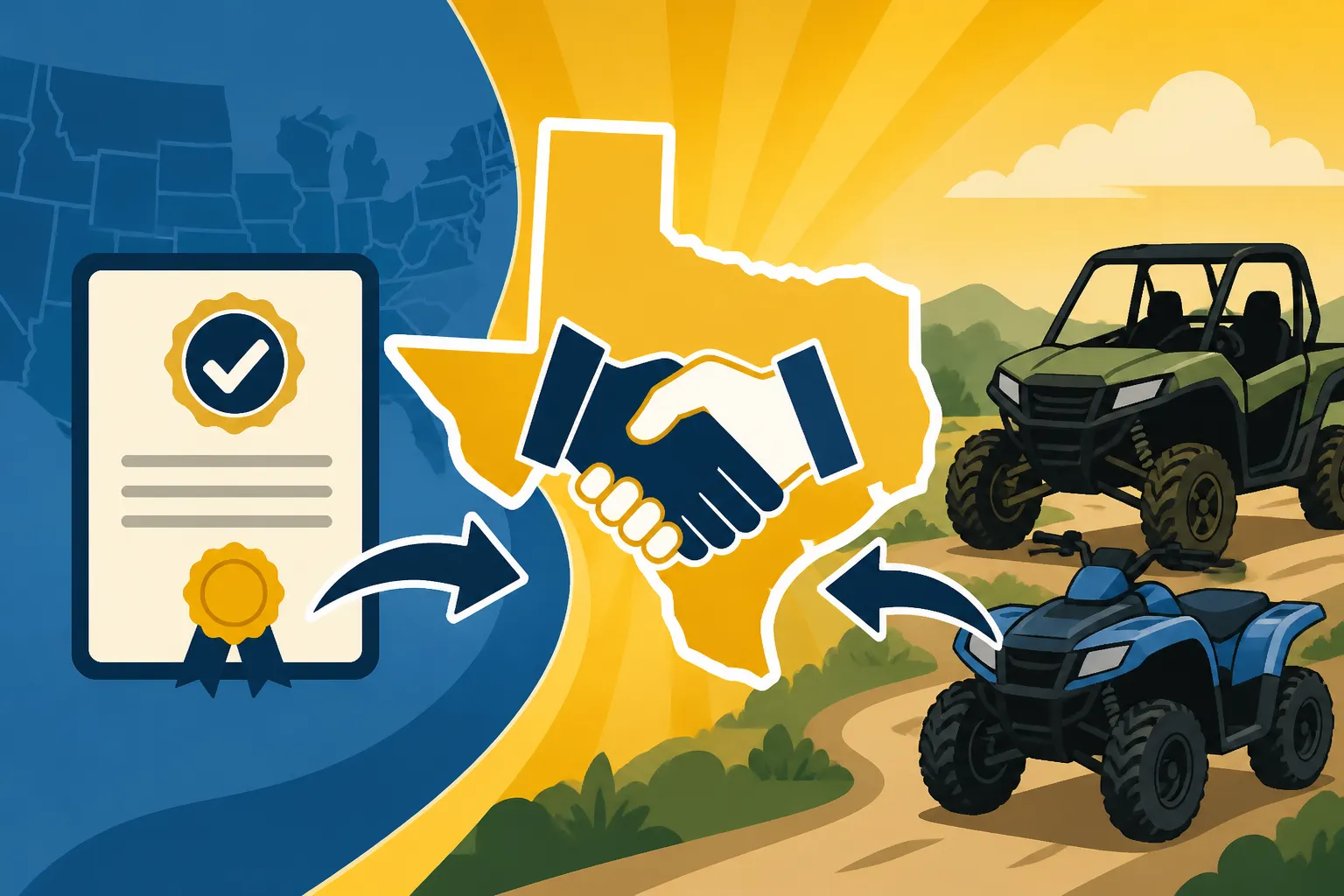
Texas recognizes qualifying safety certificates issued by other states so riders do not automatically have to repeat training simply because they cross a state line. That is a form of reciprocity: a credential earned elsewhere can count toward Texas’s safety education requirement.
The point is practical. A rider who has already completed an accepted course should not need to take an equivalent course again just to visit Texas. Recognition also makes it easier for families and groups to travel with their machines without treating every state border as a fresh start.
But “Texas honors out-of-state certificates” does not mean that every document called a certificate is automatically accepted for every purpose. A course-completion card, a rental orientation, a state operating permit, and a trail pass are different things. The certificate must be the kind of safety credential Texas recognizes, and you may need to show proof when asked.
For an overview of the Texas requirement itself, see Texas ATV Safety Certificate Explained. For the narrower reciprocity question, Does Texas Accept an Out-of-State Safety Certificate? is also useful.
Reciprocity is about training, not a blanket riding pass
A safety certificate shows that a rider completed qualifying education. It does not, by itself, give permission to ride on every Texas road, park, forest trail, beach, or private property. Each place has its own access rules.
A certificate also does not replace other requirements that may apply to a ride, including:
- An OHV decal or other land-specific permit
- A day-use or trail fee
- A minimum-age rule
- Direct adult supervision for a young rider
- A helmet or other protective equipment
- Permission from the landowner
- Rules about machine width, flags, hours, or designated routes
Think of the certificate as one part of the rider’s eligibility, not as the whole checklist. Before a trip, confirm both the education requirement and the rules for the specific place you plan to ride.
Recognition does not change what the course teaches
Texas can recognize a certificate from another state without using the same course name or issuing the same card. What matters is whether the credential meets the applicable recognition requirements, not whether its wording looks identical to a Texas-issued document.
A card from another state may use different terminology, show a different issuing agency, or have a layout that does not resemble a Texas card. That alone does not mean it is invalid. Keep the card and any official course-completion record together, and check with the relevant Texas authority or riding area if you are unsure about a particular credential.
Do not assume that an attendance slip, a dealer’s demonstration, or a quick rental briefing is equivalent to a recognized safety certificate. Those activities can be helpful, but they may not satisfy the formal requirement.
Which Out-of-State Certificates May Count
The safest approach is to confirm that your certificate came from a recognized safety course or issuing authority, rather than relying on the word “certificate” alone. Requirements can depend on the type of course, the issuing state, the credential itself, and the rider’s situation.
If you already have a card, check it before traveling. Look for:
- The rider’s full name, spelled clearly
- The name of the course or safety program
- The issuing organization or state
- A completion date or other course record
- A certificate number or identification details, if provided
- A way for the issuer to verify completion
Not every certificate will display all of these details. Their absence does not automatically make a card unacceptable, but incomplete information can make a roadside or gate check slower. If your certificate is hard to read, damaged, or missing identifying details, ask the issuing organization how to get a replacement or official verification.
Verify the issuing course if the card is unclear
A card that says “ATV safety” may describe a formal course, a private training session, or a brief orientation. If the issuing organization is not obvious, contact it before your trip and ask whether it can confirm the course was completed and provide a replacement record.
If the card comes from another state’s government program or an established safety-course provider, the issuer should be able to explain what the credential represents. Keep that information with your documents, especially if the card’s design or terminology differs from what a Texas official might expect.
Do not rely only on a screenshot of a course advertisement or a receipt showing that you enrolled. Enrollment is not proof of completion. A completion certificate, official digital record, or written confirmation from the course provider is more useful.
For background on how these credentials fit into Texas requirements, see Certificates Issued by Another State. That distinction matters if you completed training outside Texas but will ride on land where proof of education may be checked.
Online records and paper cards
Some course providers issue digital certificates; others provide a physical card or allow a rider to request a replacement. If your course record is digital, save it somewhere you can access without a strong cell signal. Download the file to your phone before leaving home, and consider carrying a printed copy as a backup.
A phone image can be convenient, but it is not wise to make it your only record. Batteries die, screens break, and service may be unreliable at remote trailheads. A printed copy tucked into a document sleeve gives you another way to show the information.
A small waterproof sleeve can protect a paper certificate from mud, sweat, and rain. You might find one at an outdoor retailer or on Amazon; choose a simple sleeve that closes securely and fits with your other ride documents. Keep the original card in a safe place if you do not want it exposed to trail conditions.
If your certificate was earned years ago
A certificate may not have an expiration date, but that does not settle every question about whether it will be accepted for a particular ride. Course policies and land-manager requirements can differ, and rules can change. Check the certificate itself and confirm with the relevant authority or riding area if the credential is old or its status is unclear.
Even when a certificate remains valid, a refresher can be worthwhile. Riders may forget procedures for crossing obstacles, handling passengers, choosing protective gear, or responding to a rollover. A course card is proof of completion, not a guarantee that a rider remembers every skill or will ride safely in unfamiliar terrain.
Who Needs a Safety Certificate in Texas
Whether a rider must hold a certificate depends on the applicable Texas rule and the rider’s age and circumstances. Do not infer that a passenger, a child, or someone riding only on private land has the same requirements as an adult operating an OHV on public land. The exact rule for the place and activity matters.
A rider who has completed a qualifying course in another state should keep that proof available. A rider who has not completed a course should not assume that being a visitor, having a driver’s license, or renting a machine makes the education requirement disappear.
Young riders need extra attention
Age rules are especially important for children. Texas has specific provisions for younger riders, and a child’s out-of-state certificate does not necessarily remove every age-related restriction. Course eligibility and permission to operate a particular machine are separate questions.
A young rider may need to be under direct supervision even if the child has completed safety education. Conversely, an adult’s certificate does not automatically qualify that adult to supervise in every circumstance. Confirm the current supervision rule and who may serve as the supervising person before the ride.
For details, see Texas Rules for Riders Under 14 and Texas Supervision Rules for Young Riders. Those rules are important when a family is bringing a child’s certificate from another state. The certificate can address training; it does not override minimum-age or supervision requirements.
A certificate does not establish that a machine is suitable
Safety education and machine fit are different issues. A child’s course completion does not mean that a large, heavy, or powerful machine is appropriate for that rider. Consider the rider’s size, strength, experience, and ability to reach the controls, and follow the manufacturer’s age guidance.
For UTVs, passengers need proper seating and restraints designed for the machine. An ATV designed for one rider is not made safe for two people by adding a certificate or by deciding that a short ride is harmless. Read the machine’s manual and follow the seating and passenger rules.
The same principle applies to adults. Training can improve judgment and technique, but it cannot make a machine stable on every slope, safe at every speed, or appropriate for every trail. Match the vehicle to the terrain and the rider’s experience.
Renting a machine does not replace the credential
A rental company may provide an orientation, demonstrate controls, or ask riders to sign a waiver. Those steps can be useful, but they should not be treated as a substitute for a required safety certificate unless the applicable rules expressly allow it.
Ask the rental provider before booking what documents it requires and what safety briefing it offers. If the rider is underage, confirm that the provider allows that rider to operate the machine and that the planned route is permitted. A rental company’s willingness to hand over a vehicle does not necessarily establish that every legal requirement has been met.
See Texas Rules for a Rented Machine for more on the separate considerations that can apply to rented OHVs. Bring your certificate even if the rental shop has its own training process.
What to Carry and How to Prove Your Certificate
The best proof is the official certificate or a record that the issuing course provider can verify. Carry it in a form that is legible and accessible. If you have both a physical card and a digital record, bring both when practical.
A sensible document set for an out-of-state rider may include:
- The original safety certificate or official replacement card
- A saved digital copy or downloaded completion record
- A printed backup if the original is digital
- The issuer’s contact information or verification instructions
- Any required land permit, decal, or day-use confirmation
- Identification and any additional documents requested by the riding area
Keep documents separate from items likely to get soaked or covered in mud. A small waterproof wallet can be useful, but do not place the only copy of your certificate somewhere you cannot reach while riding or checking in.
If the provider allows you to download a replacement, save it in a folder on your phone and make it available offline. You can also print a copy at home. A low-cost document sleeve from a local store or Amazon can help keep the paper copy readable; it is a convenience, not a legal requirement.
For more practical advice about what to carry, see Carrying the Certificate on a Texas Ride.
What to do if an official questions the card
Stay calm and show the document rather than arguing from memory. Point out the issuing state, course name, and rider details. If the official needs more information, provide the issuer’s contact or verification method if you have it.
A different card design is not, by itself, proof that the credential is invalid. At the same time, a rider should not expect every trail gate or enforcement officer to recognize an unfamiliar card immediately. Clear documentation reduces confusion.
If you are turned away because the certificate cannot be verified, ask what information is missing and who can confirm the requirement. Write down the name of the course provider and the exact credential you hold. Then contact the provider or relevant Texas authority before returning. Do not try to solve a documentation issue by presenting a different rider’s card or by claiming that a rental briefing was a formal course.
If the certificate is lost
Contact the organization that issued the certificate. Many providers can confirm completion or explain how to obtain a replacement, but the process varies. Be ready to provide the rider’s name, approximate course date, location, and any registration details you retained.
If you cannot retrieve the record before your trip, do not assume that a photo of the card from someone else will be accepted. Consider postponing the ride or choosing an activity that does not require the missing proof until the issuer verifies your completion. That is inconvenient, but it is better than arriving at a remote riding area and discovering that the document cannot be confirmed.
If you completed a course in another state and moved to Texas, keep the original record when you update other documents. A certificate may be useful for years, and replacing it later can be difficult if the provider has changed or your contact information is out of date.
What Reciprocity Does Not Replace
The most common misunderstanding is treating the safety certificate as a general Texas OHV permit. It is not. Training credentials, vehicle decals, land-use permits, and access fees serve different purposes.
Texas OHV decals and land permits
Texas has an OHV decal requirement for certain riding on qualifying public land. Whether a decal applies depends on the type of machine, where it is being operated, and the land involved. An out-of-state safety certificate does not replace a Texas decal when one is required.
Visitors should review Texas OHV Decal Requirement Explained and Nonresidents and the Texas Decal before heading to a trailhead. The certificate and decal answer different questions:
| Document or requirement | What it generally addresses | Does an out-of-state certificate replace it? |
|---|---|---|
| Safety certificate | Completion of recognized OHV safety education | It may satisfy the education requirement if Texas recognizes the credential |
| Texas OHV decal | The applicable Texas decal requirement for certain OHV use | No |
| Park or trail pass | Access to a particular managed riding area | No |
| Day-use fee or forest pass | Use of a particular site or trail system | No |
| Landowner permission | Authorization to ride on private property | No |
| Age or supervision rule | Whether and how a rider may operate | No |
A certificate also does not establish that the machine itself meets all requirements. A land manager may have rules about width, equipment, flags, spark arresters, or permitted routes. Check the current rules for the exact site rather than relying on a general description of Texas law.
Public land and private land are different
Texas riding rules depend heavily on who manages the land. A machine can be legally operated on private property with the owner’s permission while being restricted from a nearby public road or trail. A safety certificate does not create access rights on private land, and landowner permission does not necessarily waive rules that apply elsewhere.
For help separating those categories, see [Texas Rules for Riding Public Land]. If you plan to ride on national forest land, check both the trail’s current status and any required fee or permit. The Texas National Forest OHV Fee article explains why a safety certificate and a trail-use fee are separate matters.
On private land, get permission from the owner or authorized manager and follow any conditions they set. A hunting lease, ranch, or utility property is not open to riding simply because there is an existing track. A signed release or verbal invitation may also have limits on where, when, and how you may ride.
Road access is a separate legal question
An out-of-state safety certificate does not make an ATV or UTV street legal in Texas. Road use is controlled by separate laws and exceptions. Adding lights, mirrors, a horn, or other equipment does not automatically convert an OHV into a road-legal vehicle.
If your plan includes a short trip on a public road, verify the rule for that specific road and purpose before setting out. Some narrow exceptions may apply in particular circumstances, but they are not a general permission to ride an OHV from a trailhead to a store or between properties.
Do not rely on a certificate, an out-of-state plate, or a dealer’s description as proof that a machine can be driven on Texas roads. The education credential concerns rider training; vehicle classification and road access are separate issues.
Planning a Texas Ride as an Out-of-State Rider
A little preparation prevents the common problem of arriving at a gate with the wrong document or an assumption that does not fit the land. Start by choosing the specific riding area, then check the area’s current rules rather than planning around a general statement about Texas.
Use a trip checklist
Before leaving, confirm:
- Whether the area is open to your type of machine
- Whether the trail has width or equipment limits
- Whether the rider needs a safety certificate
- Whether Texas recognizes the certificate you hold
- Whether a Texas OHV decal, park pass, or day-use payment applies
- Whether children need direct supervision
- Whether helmets, flags, or other gear are required
- Whether the trail is closed because of weather or surface conditions
- Whether the machine’s title, plate, or other documents are needed
- Whether the property requires a waiver or advance reservation
A park’s website, office, or official phone line is usually the right place to confirm site-specific details. Conditions may change because of weather, maintenance, hunting activity, or crowding. A route that was open on a previous trip may not be open now.
If the ride is far from town, check fuel, water, recovery gear, and communications as well as paperwork. A certificate can get you through a training check; it will not help if the group runs short of water or becomes stranded on an unfamiliar trail.
Keep a paper backup for weak-signal areas
Many Texas riding areas have limited mobile service. Do not depend on opening an email or logging into a course account at the gate. Download the certificate and any permit confirmation while you still have reliable service.
A printed backup is especially useful for families carrying several riders’ documents. Keep each certificate clearly matched to the rider named on it. If you use a phone wallet or document pouch, separate cards so that you can show the right one quickly without exposing every document to dust and rain.
A waterproof folder or small sleeve may be available from a local retailer or Amazon. If you already use a riding pack, designate a dry pocket for certificates, trail confirmations, emergency contacts, and any site map. The important part is not where you bought the pouch; it is being able to produce the documents when needed.
Ask before the trip if your credential is unusual
If your certificate came from an employer, a military program, a private instructor, or a course with an unfamiliar name, verify it in advance. Do not wait until you are at the trailhead to discover that the document does not clearly show completion of an accepted course.
When asking, provide the course name, issuing organization, state, and a description or image of the certificate. Ask whether it satisfies the Texas OHV safety education requirement for the planned activity and whether the riding area has any additional proof requirements.
Keep the response with your trip documents. If you receive verbal guidance, note when and from whom you received it. That does not override the law or a land manager’s posted conditions, but it can help you resolve a misunderstanding more quickly.
Common Questions About Out-of-State Certificates
Do I need to retake a course just because I moved to Texas?
Not necessarily. Texas honors qualifying out-of-state certificates, so moving across state lines does not automatically mean you must start over. First confirm that your specific certificate is recognized and that it covers the activity and rider in question. If the card is unclear, contact the issuing provider or the relevant Texas authority.
Does a certificate from another state work at every Texas riding area?
The state’s recognition of a qualifying certificate does not erase site-specific rules. A riding area may require additional permits, passes, fees, or safety equipment. Check with the area where you plan to ride, especially if it is managed by a separate agency, city, county, water district, or private operator.
Is a driver’s license the same as an ATV safety certificate?
No. A driver’s license and an OHV safety certificate are different credentials. Having permission to drive a car does not automatically prove that a rider completed OHV safety education, and an OHV certificate does not automatically grant permission to drive an ATV or UTV on public roads.
Does a parent’s certificate cover a child?
No. A certificate belongs to the person who completed the course. A parent’s training record does not become a child’s certificate. A child may also be subject to age and supervision rules, whether or not that child has completed a course. Review Texas Rules for Riders Under 14 and the supervision requirements before planning a family ride.
Does my certificate replace the OHV decal?
No. A safety certificate is proof of education. A decal or land pass relates to access or use requirements. If your route or riding area requires a Texas OHV decal, an out-of-state course card does not replace it.
Can I use a photo of my certificate?
A clear digital copy can be useful, particularly if the issuing organization provides electronic records. However, not every check-in process will handle digital documents the same way, and a phone may be unavailable or out of power. Carrying an official card or a printed backup is a safer plan.
What if the course provider has closed?
Gather any records you still have, such as an email confirmation, registration receipt, course number, or old card. Search for a successor organization or contact the relevant state agency that administered or approved the course. If no one can verify completion, ask the Texas authority or riding area how to proceed before traveling.
Can a rental company’s briefing count as a course?
Do not assume so. A rental orientation may cover controls and basic operating instructions, but it may not be the same as a recognized safety course. Ask the rental provider what the briefing qualifies as, and check the applicable Texas requirement separately.
The Practical Takeaway
Texas honors qualifying out-of-state safety certificates because riders should not automatically have to repeat equivalent training when they visit or move to the state. But recognition is limited to the safety education credential. It does not replace a Texas OHV decal, site pass, age rule, supervision requirement, landowner permission, or road-use restriction.
Before a trip, confirm that your certificate is recognized, carry legible proof, and check the rules for the particular land you plan to ride. If the card is old, damaged, or issued through an unfamiliar program, verify it before you leave. That small check can save a long drive and make the rest of the ride more straightforward.
Disclaimer
This article is for general informational purposes only and does not constitute professional advice. Laws, prices and regulations vary by location and change over time. Consult a qualified professional for guidance on your specific situation.