Buying a Texas Decal at a Dealer
Buying a Texas Decal at a Dealer
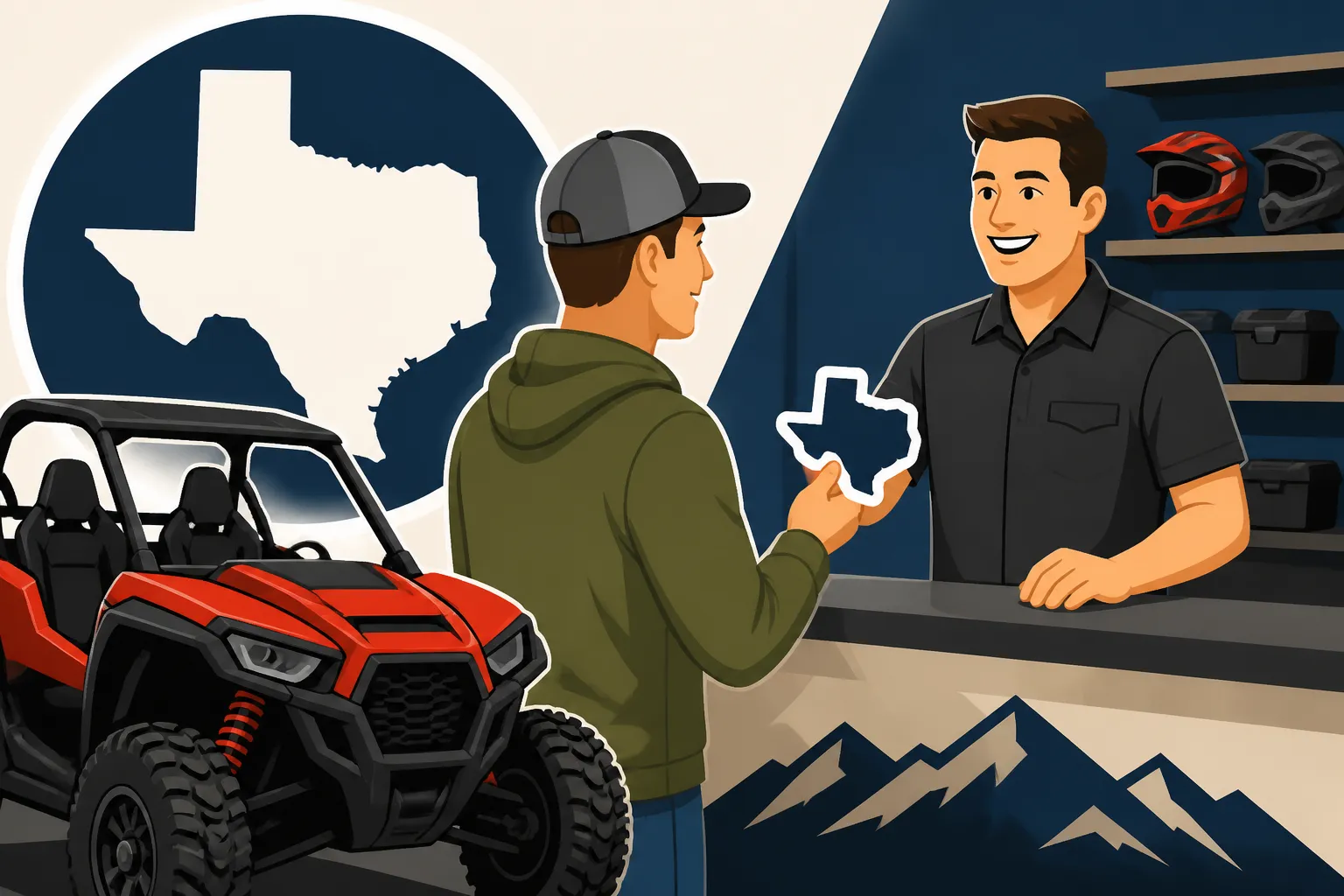
If you need a Texas OHV decal before a ride, a participating dealer can be a convenient place to buy one in person. The catch is that not every ATV or powersports dealer sells the official decal, and the sticker is not a title, plate, registration, or park permit. Here’s how to check before you go, what to ask for at the counter, and what the decal does—and does not—allow.
What You’re Buying at the Dealer
The Texas OHV decal is the state’s off-highway vehicle decal. It is separate from the paperwork that establishes ownership of your ATV, UTV, or other qualifying machine. Texas titles many off-highway vehicles, but a title does not turn one into a road-registered vehicle. The decal is a separate requirement for riding on certain public lands.
For a broader explanation of where the decal fits into the rules, see The Texas OHV Decal Explained. It helps to keep three different items straight:
- Title: A document showing ownership of the machine. For an overview of that process, see Titling an ATV in Texas.
- OHV decal: A state decal associated with riding on covered public land.
- Park or trail fee: A separate charge or permit that a particular riding area may require.
A dealer selling the decal is acting as a sales point, not granting permission to ride on every public property in Texas. The land manager’s rules still apply, and a decal does not replace day-use fees, an OHV safety certificate, or any other requirement that applies to your ride.
Dealers may also sell ordinary accessories or decals for a machine’s make and model. Ask specifically for the official Texas OHV decal. A decorative sticker, an aftermarket registration-style sticker, or a dealer’s own inventory label is not the state decal.
A powersports dealer may not be a decal seller
The word “dealer” can be confusing. A business may sell ATVs and UTVs without selling Texas OHV decals. Conversely, a participating decal seller may not be the place where you bought your machine. Do not assume that a dealership has decals just because it sells off-road vehicles.
Before making the trip, check the official sales information or call the business. Ask whether it has official Texas OHV decals available for purchase today. If the person answering is unsure, ask whether the store is an authorized sales location and whether it sells the decal at the counter rather than directing customers to order elsewhere.
The state’s decal information can help you compare ways to buy one: Where to Buy a Texas OHV Decal. If you are trying to avoid a wasted trip, that is a better starting point than assuming every dealership participates.
The decal is generally tied to the machine, not each person riding it
An OHV decal is not a personal pass that lets its buyer move from one machine to another. If several people in a group are taking separate machines, plan around the machines and their individual requirements, not simply the number of riders. The same distinction matters when you borrow or rent a vehicle: do not assume a decal on one machine covers the rest of the group.
The particular land manager’s policy may add its own steps. For example, a park or trail system may require its own entry payment, waiver, pass, permit, or equipment checks. Check the rules for the destination before you leave. A dealer can sell you a decal; it cannot confirm that every trail you plan to ride is open or that the machine meets that property’s conditions.
Before You Drive to the Dealer
A little preparation makes a counter purchase easier. The main goal is to confirm that the store has the right decal and that you understand what you are buying. You generally do not want to arrive, ask for a “plate,” and end up discussing a different product.
Call ahead with a precise question
Use clear wording: “Do you sell the official Texas OHV decal, and do you have it in stock?” If you have a side-by-side rather than a quad, mention that too. If the machine is rented, borrowed, newly purchased, or registered in another state, say so and ask whether that changes what you should bring or how you should use the decal.
You can also ask:
- Is the decal available for walk-in purchase?
- Is it the current decal for the applicable decal year?
- What payment methods do you accept?
- What is the current price, including any applicable sales or handling charge?
- Do you provide a receipt?
- Does the decal come with instructions for placement?
- If you need a replacement, what should you bring?
Do not rely on an old online post or a friend’s memory for current price or availability. The cost and sales arrangements can change, so verify the current amount with the dealer or official state information. The related guide Texas OHV Decal Cost explains what to check when comparing purchase channels.
Have useful machine details available
A dealer may be able to sell the decal without examining your vehicle, but it is sensible to have the basic details at hand in case a question comes up. Know the machine’s make, model, and type, and have the VIN available. A photo of the VIN plate or stamped number can help if you are away from the machine.
The VIN is particularly useful if you are unsure whether the machine falls within the relevant OHV category or if the machine has an unusual configuration. That does not mean the dealer will inspect the VIN or that every buyer must present it to purchase a decal. It simply gives you a way to answer questions accurately instead of guessing.
If you have just bought the machine, keep the purchase paperwork together with the title documents. The title and decal are separate matters, but having the machine’s identity and ownership documents nearby can help you keep the paperwork organized. If the title process is still ahead of you, The Texas Title Application Every OHV Buyer Files covers that separate task.
Check the dates before buying
Texas OHV decals operate on a yearly cycle, so timing matters. Before purchasing, confirm which decal year applies to your intended ride and when the next decal period begins. Do not assume a sticker bought near the end of a season will cover a trip that takes place in the next one.
The practical question is not just “Is this an official decal?” but also “Will it be valid on the date and at the place I plan to ride?” If the trip is coming up soon, ask the dealer to confirm that the decal is current for that trip. If you already have a decal, check its dates rather than relying on the fact that it is still attached.
For renewal details, see Texas OHV Decal Renewal. If you are buying partway through the decal year, Buying an OHV Decal Halfway Through Its Year can help you think through timing before you pay.
Dealer purchase compared with other options
A dealer is one convenient route, but it is not the only one. The best option depends on how soon you need the decal, whether you want a person to answer questions, and whether you are already going to a participating location.
| Purchase option | Useful when | What to confirm |
|---|---|---|
| Participating dealer | You want an in-person purchase or need to ask a question at the counter | That the store sells the official decal and has it available |
| Online purchase | You want to arrange the purchase before a trip | Delivery timing, current instructions, and whether the decal will arrive in time |
| Phone purchase | You want to ask questions or arrange a purchase without visiting a store | The current process, payment method, and delivery time |
| Park or trailhead seller | You are buying close to the riding location | Whether the specific site sells decals and whether other entry fees apply |
For online details, see Buying a Texas Decal Online. If you prefer to call rather than visit, Buying a Texas Decal by Phone may be a better fit. Some parks sell decals at the gate, but availability and park charges are separate considerations; see Texas Decals Sold at a Park Gate.
What to Do at the Counter
Once you have confirmed the dealer sells the official decal, the transaction should be straightforward. Still, take a moment to check what you receive. A small mistake—such as leaving without the decal or receipt—can become an avoidable problem when you are preparing for a ride.
- Ask for the official Texas OHV decal. Be specific. Do not ask only for a “sticker” or “plate,” since those words can refer to unrelated products.
- Confirm the decal year. Make sure it is the one applicable to your planned ride.
- Check the total before paying. Ask whether the amount includes any additional dealer charge, and confirm current pricing rather than relying on a figure you found elsewhere.
- Take the decal and receipt. Check that the receipt describes the purchase clearly enough for your records.
- Read any placement instructions. Put the decal where the official instructions specify, on the machine it is meant to identify.
- Keep the paperwork with your riding records. A receipt is useful if you later need to confirm when or where you bought the decal.
- Check the destination’s rules separately. Confirm access, fees, opening status, safety requirements, and any local conditions before you ride.
If the dealer hands you a decal but cannot answer a question about where it is valid, do not treat that as a problem with the sale. Sales staff may be able to explain how to buy it without knowing every land manager’s rules. Check the destination’s official information before relying on a general answer.
Inspect what you receive
Before leaving, confirm that you have the physical decal if you expected to receive one at the counter. If the dealer says it will be mailed or must be collected later, get the details: expected timing, how you will be notified, and what proof of purchase you should keep until it arrives.
Check that any printed instructions or accompanying material are for the Texas OHV decal, not a dealer’s own sticker or an unrelated vehicle product. If something seems unclear, ask the seller to identify the item and its intended use while you are still at the counter.
Do not assume that a receipt alone is a substitute for a required decal. A receipt documents a purchase; it is not necessarily the item the land manager expects to see on the machine. If the decal has not arrived before your trip, ask the official source or land manager what to do rather than improvising.
Apply it as instructed
Follow the state or seller’s placement guidance. The point is for the official decal to be displayed as required and associated with the correct machine. Avoid putting it somewhere that is hidden by a bag, rack, mud flap, or added accessory. If the instructions call for a visible location, make sure normal machine equipment does not cover it.
Clean and dry the intended surface before applying an adhesive decal, and avoid trimming or altering the decal unless the official instructions say to do so. If the surface is damaged or the decal will not adhere, seek guidance from the seller or the state rather than trying to create a homemade substitute.
Keep a clear record of the decal’s purchase and the machine it went on. If you manage several machines, a simple note in your maintenance or trip log can prevent confusion later, especially when machines are shared among family members or kept at different properties.
What the Decal Does Not Let You Do
The most common misunderstanding is treating the decal like a general permission slip. It is not. It does not make an ATV or UTV street legal, replace a title, or grant access to land that is closed to motorized riding.
It does not replace a title or a road plate
Texas’s OHV decal is not the same thing as a title or the title-related OHV plate. If you are buying a machine, transferring ownership, or sorting out paperwork, handle those steps separately. For a closer look at the difference between a decal and a title-related plate, see The Texas Off-Highway Vehicle License Plate and Why Texas Titles But Never Registers an OHV.
An OHV decal also does not convert an off-highway vehicle into a street-registered vehicle. Adding lights, mirrors, or other equipment does not make the decal a road registration credential. Road access is a separate legal issue with narrow exceptions, and the rules depend on the type of road and the circumstances. If road use is part of your plan, read Street Legal ATVs in Texas: The Short Answer before riding.
It does not cover every type of land or every fee
Whether a decal is required depends on where you ride and the rules governing that land. Private land, public land, parks, forests, and other properties may not all follow the same access process. Even when the decal requirement applies, the location may charge a separate entry or day-use fee.
Before heading out, ask the land manager:
- Is the property open to the kind of machine I have?
- Is the route open on the day I plan to visit?
- Is a Texas OHV decal required here?
- Is there a separate entrance, day-use, or camping charge?
- Are there width, noise, helmet, flag, or safety-certificate rules?
- Are there weather-related closures or other temporary restrictions?
For private property, permission from the owner is the key access issue; a decal is not a substitute for permission. The guide Do You Need a Texas OHV Decal on Private Land? explains that distinction. For public riding, start with the land manager’s own information, because a state decal does not override a closure or property-specific rule.
It is separate from the safety certificate
The OHV decal and a rider’s safety certificate are different requirements. A decal is associated with the machine and the relevant access rules. A safety certificate relates to the rider and may apply to younger riders on public land. One does not replace the other.
If a child will ride, check the age and supervision requirements before the trip. Do not assume that buying a decal from the dealer completes all compliance steps for the family. For more on the rider requirement, see The Texas ATV Safety Certificate Explained and [What Texas Requires of Riders Under 14].
The same principle applies to rentals. A rental company may supply a machine and explain its own policies, but you should confirm which state and property requirements apply to the ride. See [Texas OHV Decal for a Rented Machine] if you are planning to rent.
Common Problems and How to Avoid Them
Most problems are preventable with a phone call and a quick check of the decal and destination rules. These are the issues most likely to catch a rider off guard.
The dealership does not have decals in stock
A dealer’s website may show that it sells off-road vehicles without saying whether it sells OHV decals. Inventory can also change. Call ahead, and if the store cannot confirm that it has official decals in stock, use the official purchase information to find another option.
If you need the decal immediately, ask whether another listed sales location or the destination’s gate offers it. Do not plan a full day of riding around an unconfirmed assumption. A gate may sell the decal, but it may also have limited hours, separate entry procedures, or additional fees. Confirm all of that before driving there.
You bought a generic sticker by mistake
Search results and marketplace listings can make it easy to confuse a state decal with a decorative or aftermarket sticker. An item sold on Amazon, for example, may be a model-specific graphic, a number plate, or an adhesive accessory. That does not make it the official Texas OHV decal.
Likewise, an Amazon order confirmation or product description is not proof that the official state decal has been purchased. If you shop online, use the official buying instructions and check that the item is the state-issued decal—not merely a sticker that mentions Texas or off-road riding.
Amazon can still be useful for unrelated riding supplies, such as a storage pouch for paperwork, but buying accessories there does not satisfy a state decal requirement. Keep the distinction simple: use the official channel for the decal, and use general retailers for ordinary gear.
You have the decal but the ride still requires something else
A rider may reach the trailhead with a valid decal and discover that the park also requires a day-use payment, a waiver, a reservation, or a separate permit. The reverse can happen too: paying a park fee does not necessarily satisfy the state decal rule.
Make a short pre-trip checklist for each riding location. Include the decal, any required certificate, the park’s fees or pass, machine-specific equipment, and the current trail status. If you are visiting public forest land, check whether a separate forest day-use payment applies. The decal is one piece of the trip plan, not a substitute for checking the property’s complete requirements.
You are a nonresident or riding a borrowed machine
Do not assume that an out-of-state registration sticker, a home-state decal, or another rider’s paperwork automatically meets Texas requirements. Nonresidents should check the Texas rules for the machine and land they intend to use. Nonresidents and the Texas Decal explains the state-specific issue.
For a borrowed machine, ask the owner what decal is attached and whether it is current. Confirm that the decal belongs with the machine and that the riding location accepts the machine for the planned use. If you are borrowing multiple machines, check each one individually rather than assuming one decal or receipt covers the whole group.
A Simple Dealer-Buying Checklist
Before you leave home:
- Find a participating dealer or another official sales option.
- Call to confirm that the dealer sells the official Texas OHV decal and has it available.
- Ask about the applicable decal year, current total, payment methods, and receipt.
- Have the machine’s make, model, type, and VIN available in case a question comes up.
- Check whether you need a decal for each machine in your group.
- Confirm what the riding destination requires beyond the decal.
At the counter:
- Ask specifically for the official Texas OHV decal.
- Confirm that it is for the relevant decal year.
- Check the item and any placement instructions.
- Keep the receipt and any related paperwork.
Before riding:
- Apply the decal as instructed.
- Confirm the land is open to your machine and intended activity.
- Check for separate park fees, permits, safety-certificate rules, and equipment requirements.
- Do not treat the decal as title, road registration, or permission to enter private land.
Buying at a dealer can be the easiest option when the business participates and has decals in stock. The key is to verify those two points before you go, then check the rules for the actual place you plan to ride. If the dealer cannot provide what you need, use the official buying information to choose another channel rather than substituting a generic sticker or relying on an unrelated receipt.
Disclaimer
This article is for general informational purposes only and does not constitute professional advice. Laws, prices and regulations vary by location and change over time. Consult a qualified professional for guidance on your specific situation.