Street Legal ATVs in Texas: The Short Answer
Let's be honest, the dream of cruising down a Texas road in your ATV or UTV is incredibly tempting. You imagine running errands, popping over to a friend's house, or just extending your off-road adventure without the hassle of loading up a trailer. But then reality hits, and you start hearing whispers about laws and restrictions, leaving you wondering, "Can I actually drive my quad on the street here?" It's a question that brings a lot of confusion and even frustration, especially when you see golf carts or other smaller vehicles seemingly everywhere. This comprehensive guide is here to clear up that confusion once and for all, detailing exactly what Texas law says about taking your off-highway vehicle onto public roads and where those crucial exceptions lie.
The Baseline Truth: Texas Says No to Street Legal ATVs and UTVs
It's a tough pill to swallow for many enthusiasts, but the foundational truth in Texas is that All-Terrain Vehicles (ATVs) and Utility Task Vehicles (UTVs) are generally not considered street legal. This isn't just some local ordinance; it's baked into the very definition of these machines under state law. I know it can feel like a major roadblock to enjoying your machine to its fullest, especially if you live in a rural area where a quick hop onto a paved road would make life so much easier. The state has a very clear stance, and understanding why that stance exists is the first step in navigating the rules.
Why the Blanket Ban Exists
The primary reason for the blanket ban stems from how Texas classifies these vehicles. Unlike cars, trucks, or motorcycles, which are designed and manufactured to meet federal motor vehicle safety standards for on-road use, ATVs and UTVs are built explicitly for off-highway operation. They lack many of the safety features required for street legal vehicles, such as certain types of lighting, turn signals, specific brake systems, and often, crash protection standards. Imagine trying to integrate into fast-moving traffic on a machine with a top speed of 45 mph, no turn signals, and an open roll cage. The safety concerns for both the rider and other motorists are significant, and that's precisely what the law aims to address. It's not about punishing enthusiasts; it's about public safety.
This isn't to say that modern UTVs, for example, aren't incredibly capable and sturdy machines. Many come from the factory with features that look like they're ready for the road, like seatbelts and even headlights. However, looking the part isn't enough when it comes to legal classification. The state isn't just looking at individual features; it's looking at the entire vehicle's design intent and certification. Because they're not certified for highway speeds and mixed traffic, they're kept off. It's the same reason you can't just slap a license plate on a dirt bike and ride it down Main Street, even if you’re riding responsibly.
The Core Definition of an Off-Highway Vehicle
Texas law is very specific about what constitutes an "off-highway vehicle" (OHV), and this definition is key to understanding why they're excluded from street use. An OHV, as defined in Texas Transportation Code Chapter 663, generally refers to a motor vehicle, other than an all-terrain vehicle, mini-motorcycle, or recreational off-highway vehicle (UTV), that is designed by the manufacturer for primarily off-highway use and that is not capable of being registered for on-highway operation. For our purposes, it pretty much lumps ATVs, UTVs (often called recreational off-highway vehicles, or ROVs, in the legal text), and similar machines into this category. The crucial phrase here is "not capable of being registered for on-highway operation." This single phrase shuts down most arguments about street legality right from the start.
This legal definition captures everything from your typical four-wheel ATV to your larger, multi-passenger UTVs. It doesn't matter if it's a [Texas ATV Title for a Side-by-Side] used for ranch work or a sport quad used for racing; if its primary design intent is off-highway, it falls under these rules. This strict classification simplifies enforcement but can be incredibly frustrating for owners who feel their particular machine is perfectly safe for a short jaunt on a quiet county road. The state essentially draws a line in the sand based on design and federal certification, rather than on a case-by-case assessment of a vehicle's features or a driver's skill.
What "Off-Highway Use Only" Means on Your Title
If you've ever titled an ATV or UTV in Texas, you might have noticed a particular phrase stamped or printed on the document: "Off-Highway Use Only." This isn't just a suggestion or a friendly reminder; it's a legal designation that explicitly restricts the vehicle's operation to off-highway environments. This remark serves as a clear indicator that the machine is not to be driven on public roads, highways, or even most paved county roads. It’s part of the comprehensive effort by the Texas Department of Motor Vehicles to ensure everyone understands the limitations of these vehicles. If you ever wondered about [The Off-Highway Use Only Remark on a Texas Title], this is its core purpose – to prevent street use.
This designation is especially important if you're buying a used machine or bringing one in from out of state. If a vehicle has this remark on its title, it means the state recognizes it as an off-highway vehicle, period. No amount of aftermarket modifications, like adding mirrors, turn signals, or even a full cab, will override this core designation. The title essentially cements its status as an off-road machine, regardless of how much it might look like a street-legal vehicle to the untrained eye. It’s a permanent mark that clarifies the vehicle’s legal standing in the state, ensuring that there’s no ambiguity about its intended use.
Understanding the Exceptions to the Rule
While the general rule in Texas is a firm "no" to street legal ATVs and UTVs, there are indeed some very specific, narrowly defined exceptions. These aren't loopholes you can exploit to drive wherever you want; they are carefully crafted allowances for particular types of work or situations where the benefit outweighs the inherent risks, or where the roads are simply not designed for high-speed traffic. These exceptions often come with their own set of rules and requirements, so simply falling into a category isn't enough; you still have to comply with the specifics.
Agricultural and Timber Operations
One of the most common and crucial exceptions is for machines used in bonafide agricultural and timber operations. Texas recognizes the essential role that ATVs and UTVs play on farms, ranches, and logging sites. Moving equipment, herding livestock, checking fences, or transporting tools across a large property often requires crossing or briefly using public roads. So, if your machine is being used for legitimate agricultural or timber purposes, you might be allowed to operate it on public roads, but with significant caveats. This exemption is primarily designed to facilitate agricultural work, not to provide a convenient way to get to town. It’s important to understand the details of [Texas Agricultural Exemption for ATVs on Roads].
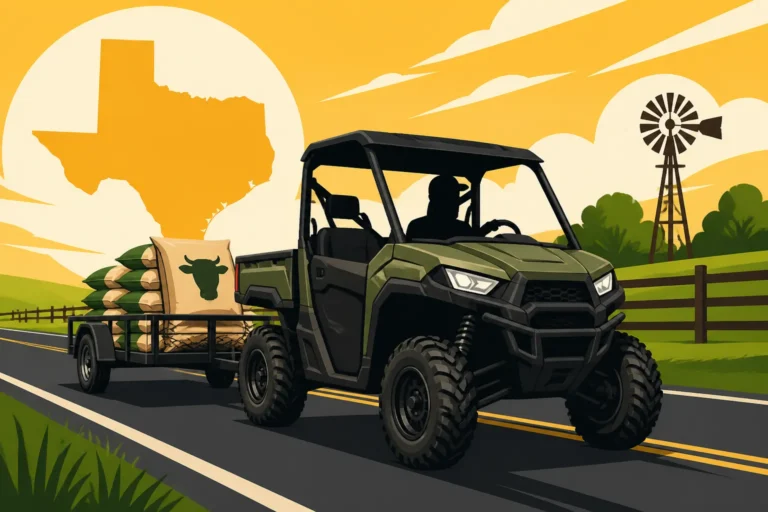
To qualify, the OHV must be used directly for agricultural or timber production. This means hauling feed, checking irrigation lines, moving logs, or other similar tasks. The law typically requires the operator to display a slow-moving vehicle emblem (the orange triangle with a red border) and, in some cases, to have proper lighting if operated at night. Furthermore, there are often restrictions on the distance traveled on public roads – usually limiting it to short distances between fields or parts of a ranch. You can't just claim an "ag exemption" and then drive your UTV an hour to the grocery store. It's about practical necessity for the operation, not general commuting.
Emergency Responders and Utility Work
Another important exception applies to emergency responders and those performing essential utility work. Fire departments, law enforcement, and utility companies often rely on the versatility of ATVs and UTVs to access difficult terrain, navigate disaster sites, or perform maintenance on remote infrastructure. Think of a UTV equipped to fight wildfires in rough terrain or an ATV used by a search and rescue team to cover vast areas. These vehicles are indispensable in these specific, high-stakes scenarios where conventional vehicles simply can't go.
When used in an official capacity by an agency or company, these vehicles are generally granted permission to operate on public roads when necessary to perform their duties. This might include crossing roads to get to an incident, or even traveling short distances on a public road to reach a power line or pipeline right-of-way. Just like with agricultural uses, these vehicles are typically marked and operated by trained personnel, and their road use is directly tied to their official function. This exception is not for personal use or general travel; it’s strictly for the execution of critical public services.
Specific County and Community Ordinances
This is where things can get a little bit tricky and where local rules start to diverge from the statewide norm. While the state has its blanket ban, Texas law does allow for certain counties and specific types of communities to adopt ordinances that permit limited operation of OHVs on their public roads. This isn't a free-for-all, however. These exceptions are typically found in smaller, rural counties (often those with populations under 37,000) or within very specific types of master planned communities. It's a recognition that not all roads are created equal, and in certain low-traffic environments, responsible OHV use might be acceptable.
For example, some rural counties, often with approval from the Texas Department of Transportation, might designate certain low-speed county roads where ATVs and UTVs are permitted to travel, often with specific speed limits and equipment requirements. Similarly, [Texas Rules for Master Planned Communities] can allow for UTVs and golf carts to be used on internal community streets, provided the community meets specific criteria and has passed the necessary ordinances. However, these local allowances almost never extend to state highways or major thoroughfares. It's absolutely critical to check with the specific county or community’s law enforcement or administration office before assuming you can ride on their streets. What's allowed in one small town might be strictly prohibited in the next.
Roads Where Limited ATV/UTV Use is Permitted
Even beyond the specific occupational exemptions, Texas law carves out a few very narrow situations where an OHV might briefly touch or use a public road. These aren't permissions to cruise around; they are designed to allow practical movement when absolutely necessary, often for short distances and under very strict conditions. Understanding these specific scenarios is crucial to avoiding a ticket or worse.
Crossing Public Roads
One of the most frequently asked questions is about simply crossing a highway or a county road to get from one section of your property to another, or to access an adjacent trail. Good news! Texas law generally allows for an OHV to cross a public road, but it must be done safely and efficiently. This isn't an invitation to drive down the middle of the road for a block before turning off; it's strictly for traversing the roadway from one side to the other. There are specific rules you must follow when [Crossing a Highway on an ATV in Texas].
When crossing, you must yield to all other traffic, cross at a right angle to the flow of traffic, and do so only when the crossing can be made in safety and without interfering with other traffic. This usually means picking a spot with good sight lines, coming to a complete stop, looking both ways, and crossing quickly. You cannot operate the OHV in the median or on the shoulder for any significant distance; it's purely for the act of crossing. Think of it like crossing a street on foot – you're allowed to cross, but you're not allowed to walk down the middle of the street. Also, crossing a divided highway usually involves even more care, often requiring you to stop in the median if safe, before crossing the second set of lanes.
The 25-Mile Farm Road Rule
Here’s a rule that often causes a bit of excitement and sometimes misinterpretation. Texas Transportation Code allows for a person to operate an OHV on a public road within 25 miles of the place the vehicle is parked or stored if the vehicle is being used for farming or ranching operations. This is often referred to as [Texas's 25 Mile Farm Road Rule]. It sounds like a pretty broad allowance, right? Well, it is, but with important limits. This rule primarily applies to county roads and, in practice, usually low-traffic farm-to-market roads. It typically does not apply to state highways, interstates, or heavily trafficked urban roads.
The intent here is still tied to agricultural use. It's meant to allow a rancher to travel a reasonable distance on a county road to check on cattle, move equipment, or perform other necessary tasks without having to load the UTV onto a trailer for a short trip. However, it still falls under the "agricultural use" umbrella. You must be engaged in an agricultural operation. This isn't a blanket pass for recreational riding on county roads. Furthermore, when operating under this rule, your OHV must be equipped with certain safety features, such as headlights, taillights, and a slow-moving vehicle emblem. Always confirm with your local county sheriff’s office if you plan to utilize this rule, as interpretation and enforcement can vary.
Golf Course Access and Master Planned Communities
This is another common scenario where you might see UTVs or even ATVs operating on what looks like a public street. Many golf course communities or [Texas Rules for Master Planned Communities] have specific regulations that allow for the use of golf carts and sometimes UTVs on their internal roads. These communities are often designed with lower speed limits, less traffic, and specific pathways or designated lanes for these types of vehicles. The intent is to provide convenient access to the golf course or other community amenities for residents.
However, these permissions are typically very localized. They usually only apply within the boundaries of the master planned community or the golf course itself. If you drive outside those designated areas onto a major public road, you're back under the statewide "no street legal" rule. Furthermore, these allowances often come with their own set of rules regarding daylight operation, driver age, and even specific equipment, like mirrors or safety flags. It’s important not to confuse these very specific, localized permissions with a general statewide right to drive your OHV on any street. A UTV that's perfectly legal on the roads inside a gated community may become illegal the moment its tires touch a city street just beyond the gate.
Equipment Requirements for Legal Road Use (Even Under Exceptions)
Even when an exception applies and you're legitimately allowed to operate your ATV or UTV on a public road for a specific purpose, it's not a free-for-all. Texas law still mandates certain equipment to ensure the safety of the operator and other motorists. This is where companies like SuperATV come into play, offering a vast array of aftermarket parts that can help you meet these requirements, even if they don't magically transform your machine into a street-legal vehicle for general use. These are crucial safety measures that, if ignored, can lead to serious consequences, regardless of whether you're operating under a valid exception. [Texas Equipment Rules for an ATV on a Road] are quite clear.
Essential Safety Gear
While Texas does not have a universal helmet law for all ATV/UTV riders on private land, when you're operating under one of the specific road-use exceptions, personal safety gear becomes paramount. Operators are generally required to wear a helmet, and often eye protection, especially if the vehicle doesn't have a windshield. This isn't just a suggestion; it’s about protecting yourself in an environment where you might be sharing the road with much larger, faster vehicles. A helmet can literally be a lifesaver in an unexpected incident.
Beyond personal gear, the vehicle itself needs some basics. A slow-moving vehicle (SMV) emblem, that bright orange triangle, is almost always required when an OHV is operating at speeds below 25 mph on a public road. This alerts faster-moving traffic behind you to your presence and slower speed. Think of it as a courtesy and a critical safety warning. Your machine should also have functional brakes and a reliable horn to signal your presence when needed. These seem like common sense, but it’s important to verify everything is in working order before heading out, even for a short agricultural run.
Lighting and Visibility
Visibility is key, especially if you're operating your OHV on a public road during dawn, dusk, or nighttime hours, or in inclement weather. For any road use under an exception, your ATV or UTV must be equipped with working headlights and taillights. These aren't just for your benefit to see where you're going; they're vital for other drivers to see you. Many stock ATVs and UTVs come with basic lighting, but ensuring they are bright and fully functional is your responsibility. Aftermarket light bars and auxiliary lights, while great for off-roading, are not usually considered substitutes for proper, DOT-compliant headlights and taillights required for road use.
In addition to lights, some allowances might require other visibility enhancements. A whip flag, particularly a bright orange one mounted high above the vehicle, can significantly increase your visibility, especially on dusty roads or in areas with undulating terrain. While not universally mandated for all road exceptions, it's a smart addition and sometimes required in specific local ordinances or parks. Think about how difficult it can be to spot a small OHV in the glare of the sun or around a bend – anything that makes you more noticeable is a good idea.
Spark Arresters and Mufflers
When we talk about operating on public roads, even under an exception, noise and emissions become considerations. Texas law often requires OHVs operating on public land or under certain road-use exceptions to be equipped with a spark arrester and a proper muffler. A spark arrester is a device designed to prevent the emission of flammable debris from the exhaust, reducing the risk of wildfires, especially critical in dry Texas conditions. Many stock machines come with spark arresters, but if you've modified your exhaust, you'll need to ensure it still complies.
Likewise, a muffler helps control the noise level of your machine. While some aftermarket exhausts might sound great on the trail, they might exceed legal noise limits for road operation. The goal is to minimize disruption to nearby residents and other motorists. It's about being a good neighbor and complying with environmental safety standards. Always check that your exhaust system is intact, not excessively loud, and fitted with a functioning spark arrester, especially if you're using your machine in or around public spaces.
Common Misconceptions and What Doesn't Work
There's a lot of well-meaning but ultimately incorrect advice floating around about making ATVs and UTVs street legal in Texas. It's easy to get caught up in rumors or see what others are doing and assume it's permissible. However, relying on these misconceptions can lead to fines, vehicle impoundment, or even serious accidents. Let's clear up some of the most persistent myths.
Adding Lights, Horns, and Mirrors Won't Make it Street Legal
This is perhaps the biggest misconception out there. Many well-intentioned owners spend significant money adding turn signals, brake lights, side mirrors, and horns to their ATVs or UTVs, believing these modifications will magically transform their off-road machine into a street-legal vehicle. While these additions are fantastic for safety and often required if you are operating under a legal exception, they do not, by themselves, change the fundamental legal classification of your vehicle. You can buy all the turn signal kits and DOT-approved mirrors from SuperATV that you want, and they will make your machine safer and more visible, but they won't change its "Off-Highway Use Only" status.
The issue isn't just about having the right accessories; it's about the vehicle's original design, manufacturing certification, and how the state defines and titles it. No matter how many street-legal accessories you bolt on, a vehicle designed and titled for off-highway use remains an off-highway vehicle in the eyes of Texas law. It's like putting racing stripes on a family sedan – it might look faster, but it doesn't change what's under the hood or its performance limits. Save those modifications for enhancing your off-road experience or meeting requirements for specific, limited road use under an exception, but don't expect them to grant general street legality.
The Difference Between a Golf Cart and a UTV
This is another area of immense confusion, especially since you see golf carts on roads in many Texas communities. Many people assume that if a golf cart can be driven on a street, then a UTV, which often looks more substantial and capable, should certainly be able to. However, Texas law makes a very clear distinction between golf carts and OHVs like UTVs. Golf carts typically fall into their own classification as "slow-moving vehicles" or "neighborhood electric vehicles" (NEVs), which often have different, often more permissive, rules for limited street use. [Texas Golf Cart Titling Rules] are distinct.
Golf carts are typically slower, have different safety standards, and are often specifically addressed in local ordinances as permissible on certain public roads. UTVs, despite their often similar appearance and capabilities, are classified as off-highway vehicles and are therefore subject to the stricter OHV rules. You might be able to get a special plate for a golf cart in some areas for street use, but [Why Texas Will Not Register an ATV for the Road] applies to UTVs as well. It's a matter of legal definition and classification, not just what the vehicle looks like or how fast it can go. Don't assume that because your neighbor drives their golf cart to the community pool, you can do the same with your UTV.
Why a License Plate Doesn't Grant Road Access
Some folks mistakenly believe that if they manage to get any kind of license plate for their ATV or UTV, it then becomes street legal. In Texas, for off-highway vehicles, there is indeed an "Off-Highway Vehicle License Plate" available. However, this plate does not grant general street-legal status. It's a special plate for off-highway vehicles only, and its primary purpose is usually for identification and to signify that the vehicle has been titled and any applicable sales or use taxes have been paid. It absolutely does not mean you can drive your quad down the highway. If you're curious about [Why a Texas OHV Plate Never Expires], it's because it's tied to the machine for identification, not for annual road registration.
The existence of an OHV plate is often a source of confusion because traditional plates signify road legality. But for OHVs, it's different. This plate allows the state to track ownership and ensure taxes are handled, but it doesn't change the vehicle's core "Off-Highway Use Only" designation. If you have this plate and are pulled over for operating your ATV on a road where it's not explicitly permitted by one of the narrow exceptions, you're still likely to face a citation. The plate is for identification, not permission to operate on public roads.
Penalties for Illegal Street Use
Ignoring Texas's rules regarding ATV and UTV street legality can lead to a host of unpleasant consequences, ranging from financial penalties to the loss of your vehicle. Law enforcement takes these regulations seriously, primarily due to the safety risks associated with off-highway vehicles operating in mixed traffic environments. It's not just a slap on the wrist; these can be significant disruptions to your life and wallet.
Class C Misdemeanors and Fines
Operating an ATV or UTV on a public road where it is prohibited is typically classified as a Class C Misdemeanor in Texas. This might sound minor compared to a felony, but a Class C Misdemeanor can still result in a substantial fine, usually ranging from a few hundred dollars up to $500. This is just for the primary offense of illegal operation. On top of that, you could face additional fines for other violations observed by the officer, such as not wearing a helmet, lacking proper lighting (even during the day), or not having a valid driver's license (even though you typically don't need a special license for an OHV off-road, you need a regular driver's license to operate any vehicle on a public road). It’s worth knowing [What a Class C Misdemeanor Costs a Rider].
A Class C Misdemeanor also means you'll have a record of the offense. While it might not carry jail time, it's still a criminal offense that can show up on background checks. Imagine facing a $500 fine and the hassle of a court appearance just for a quick hop down the road to a gas station. It’s simply not worth the risk when considering the convenience. The fines can add up quickly, making that short, illegal trip a very expensive one.
Vehicle Impoundment and Other Consequences
Beyond fines, law enforcement has the authority to impound your ATV or UTV if you are caught operating it illegally on a public road. This is a significant consequence. If your vehicle is impounded, you'll be responsible for towing fees, storage fees (which can accumulate daily), and potentially administrative release fees before you can even get your machine back. These costs can quickly dwarf the initial fine, turning a few hundred dollars into well over a thousand, or even more, just to retrieve your own property.
Furthermore, if the officer deems your operation reckless or a danger to others, or if you refuse to comply, you could face more severe charges. Repeated offenses could lead to even harsher penalties. And if you cause an accident while illegally operating your OHV on a public road, the legal and financial ramifications could be catastrophic. This brings us to the next point: insurance.
Insurance Implications
While Texas does not generally require insurance for ATVs or UTVs used exclusively off-road, this changes dramatically if you're operating the vehicle on a public road, even under a purported exception. If you cause an accident while driving your uninsured OHV on a public road, you could be held personally liable for all damages, injuries, and legal fees. This means paying out of pocket for property damage to other vehicles, medical bills for injured parties, and your own legal defense, which could amount to hundreds of thousands of dollars.
Even if you have an off-road insurance policy, many standard policies specifically exclude coverage for incidents that occur while operating the vehicle on public roads where it is not legally permitted. You might think you're covered, only to find out your policy is voided due to illegal operation. This lack of coverage can turn a minor fender-bender into a life-altering financial disaster. Always review your insurance policy thoroughly and consider specific coverage options if you plan to utilize one of the narrow road-use exceptions. It's always better to be over-prepared than facing an uncovered claim.
How to Explore Texas Legally Off-Road
Given the strict rules about street legality, many new ATV and UTV owners in Texas feel a bit disheartened. But don't let the road restrictions deter you! Texas is a vast state with incredible opportunities for legal, exhilarating off-road adventures. The key is knowing where you can ride and planning your trips accordingly. This state truly has something for everyone, from sandy dunes to rocky trails, all designed for legal OHV use. If you want to know [Where to Ride an ATV in Texas], there are plenty of choices.
Dedicated OHV Parks and Trails
The most straightforward and often most enjoyable way to ride your ATV or UTV legally in Texas is at one of the state's many dedicated off-highway vehicle parks and trail systems. These parks are specifically designed and maintained for OHV use, offering a variety of terrain and challenges for riders of all skill levels. Places like Barnwell Mountain Recreation Area in Gilmer, Hidden Falls Adventure Park near Marble Falls, and Sam Houston National Forest near New Waverly provide miles of marked trails, often with amenities like camping, restrooms, and even rental services.
These parks operate under specific rules – often requiring helmets, spark arresters, and sometimes even a Texas OHV decal – but within their boundaries, you're free to explore and enjoy your machine without worrying about road legality. They are designed environments where you can push your machine's limits safely and legally. Many parks have different trail ratings, from easy scenic routes to extreme rock crawling, ensuring there's always a new adventure waiting. Look into [Texas OHV Parks by Region] to find one near you.
Navigable Riverbeds and Private Land
Beyond organized parks, Texas law allows for OHV operation on navigable riverbeds (with certain caveats) and, crucially, on private land with the owner's permission. Riding along a dry riverbed can be an incredibly unique experience, offering miles of open space and natural challenges. However, you must be absolutely certain that the riverbed is classified as "navigable" by state law and that you are not trespassing on private property if the river runs through or next to it. Navigable waterways are generally considered public property below the "gradient boundary" – the average water level over time. Always do your homework before venturing out onto a riverbed.
The most common place for Texans to ride, though, is on private land. If you own acreage, have a hunting lease, or get explicit permission from a landowner, you can ride your ATV or UTV to your heart's content on that property. This includes ranches, farms, and large tracts of undeveloped land. Always ensure you have clear, preferably written, permission before riding on someone else's property to avoid trespassing charges. This is often how many rural Texans enjoy their machines – as tools for work and recreation on their own, or permitted, land.
Planning Your Off-Road Adventures
Successful and legal off-road exploration in Texas comes down to careful planning. Before you load up your trailer, take the time to research your destination. Check the specific rules of any OHV park you plan to visit, as they can vary greatly. Verify trail status, especially after heavy rains, as many trails in the Sam Houston National Forest, for example, close temporarily to prevent damage when wet. Always let someone know your itinerary, especially if you're venturing into remote areas.
Consider joining a local ATV/UTV club or an organization like the Texas Motorized Trails Coalition. These groups often have intimate knowledge of riding areas, organize legal group rides, and advocate for more riding opportunities. They can be an invaluable resource for finding new places to ride and ensuring you stay within the legal bounds. And always, always carry sufficient water, a first-aid kit, and basic repair tools – Texas weather and terrain can be unforgiving.
Important Documents and What to Keep Handy
Even though your ATV or UTV isn't street legal for general use, there are still important documents related to its ownership and operation that you should keep accessible. Just because you're off-road doesn't mean you're outside the realm of law and order. Having your papers in order can save you a lot of hassle and potential legal trouble, whether you're at a dedicated park, on private land, or utilizing one of the rare road-use exceptions.
Proof of Ownership
Just like any other valuable vehicle, you should always have proof of ownership for your ATV or UTV. This typically means having your Texas Certificate of Title handy, or at least a copy. If you're buying a used machine, ensure the title is properly transferred into your name. If you’re ever asked by law enforcement to prove ownership, having the title readily available (or a photo of it on your phone) can clarify matters quickly. This is especially important if you're riding on public lands or are transporting your machine. If you're ever in a situation where you need to identify your machine or prove it belongs to you, the title is your ultimate proof.
A bill of sale can also serve as temporary proof, especially if you've recently purchased the machine and are awaiting your new title. Make sure the VIN on any document matches the VIN on your machine. This helps prevent issues with stolen vehicles and ensures that you are the rightful owner. It's a fundamental part of responsible vehicle ownership, regardless of whether it's street legal or not. [Checking a VIN Before a Texas Purchase] is always a good idea to avoid issues.
Safety Certificates for Young Riders
Texas has specific requirements for young riders operating ATVs and UTVs. While not directly related to street legality, these rules are crucial for safety and legal compliance, especially if you ride at OHV parks or on certain public lands. Generally, riders under the age of 14 are required to have either successfully completed a hands-on ATV safety course certified by the Texas Department of Licensing and Regulation (TDLR) or be under the direct supervision of an adult who holds such a certificate. This certificate demonstrates that the rider has received proper training on safe operation.
It's a good idea to carry this certificate, or proof of completion, with you (or the supervising adult) whenever a young rider is operating an OHV. This can be critical if you're asked by park officials or law enforcement to demonstrate compliance with youth riding laws. Even if your child is incredibly experienced, the state values documented training. This is why [Texas ATV Safety Certificate Requirements] are in place – to promote safe riding habits from a young age and reduce accidents.
Understanding Your County's Rules
Lastly, always have a general understanding of the rules specific to the county or municipality where you are riding. While state law sets the baseline, local ordinances, particularly in rural areas or master-planned communities, can add layers of specific permissions or restrictions. What's allowed in, say, a Red River county under specific conditions, might be entirely different in a Central Texas county. These local rules can cover things like noise restrictions, specific routes for OHV use, or even curfews.
The best way to stay informed is to check the county or city's official website, or even better, contact the local sheriff's department or city hall for clarification. They are the ones who will ultimately be enforcing the rules, so getting information directly from the source is invaluable. Assuming that what applies in one part of Texas applies everywhere else is a recipe for a ticket and unnecessary headaches. Always do your local homework.
Disclaimer
This article is for general informational purposes only and does not constitute professional advice. Laws, prices and regulations vary by location and change over time. Consult a qualified professional for guidance on your specific situation.