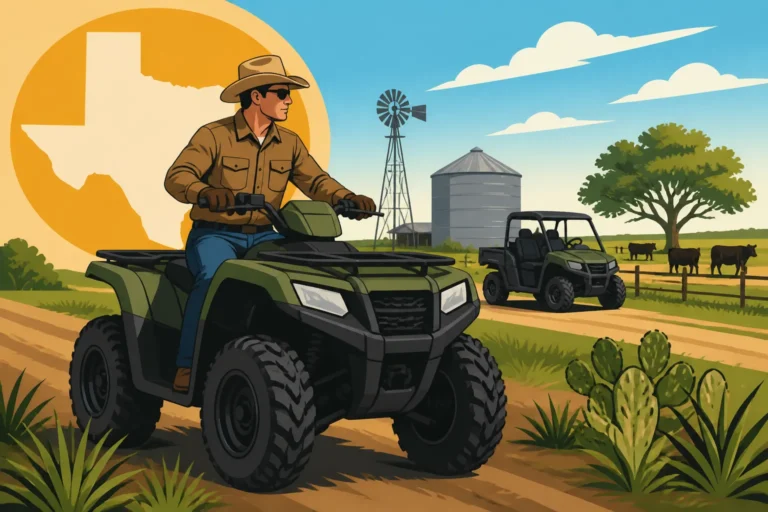
Lights On in Broad Daylight
Many Texas ATV and UTV riders dream of the convenience of taking their machines on public roads, even if just for a short hop. However, the reality of Texas law often creates a maze of confusion, especially when it comes to seemingly simple requirements like turning on your lights in broad daylight. This can be incredibly frustrating for folks who just need to cross a road or get to a nearby field. This guide is here to untangle the complexities and clarify exactly when and why your off-highway vehicle needs its lights illuminated, even when the sun is shining bright, on Texas public roads.
The Core Rule: Why OHVs Aren't Street Legal in Texas
It's a common misconception that with a few modifications, your ATV or UTV can become a full-fledged street-legal vehicle in Texas. Unfortunately, for most machines, that simply isn't the case. Texas law draws a very clear line in the sand between vehicles designed for roads and those intended for off-highway use. Understanding this fundamental distinction is key to grasping all the specific rules, including those for lighting.
Understanding the "Off-Highway Use Only" Designation
When you get a title for your ATV or UTV in Texas, you'll likely notice a rather clear statement on it: "Off-Highway Use Only." This isn't just a suggestion or a casual remark; it's a legal classification that fundamentally defines your machine's primary purpose and legal operating environment. This designation means your vehicle lacks the specific design and safety features — things like windshields, proper turn signals, or even impact-resistant bumpers — that state law mandates for traditional street-legal vehicles. It's a foundational piece of information that dictates where and how you can ride your machine. [Off-Highway Use Only Stamped on the Paper]
This classification is a major source of frustration for many riders who just want a bit more flexibility. You've invested in a powerful, versatile machine, and the idea of being so restricted can feel overly burdensome. However, from a legal standpoint, this distinction is about public safety, attempting to minimize the risk of mixing off-road equipment with high-speed road traffic. It means that any time your OHV does touch a public road, it's operating under a very narrow exception, which always comes with its own set of stringent rules, including those often surprising requirements for daytime lighting.
The Limited Exceptions to Road Use
So, if "Off-Highway Use Only" is the general rule, are there any circumstances where an ATV or UTV can be on a public road in Texas? The answer is a qualified "yes," but these exceptions are incredibly narrow and specific. We're not talking about cruising down the highway to the grocery store. We're talking about specific, utilitarian, or short-distance transit situations. These might include crossing a public road, performing agricultural tasks on certain roadways, or operating within very specific, locally designated areas like some master planned communities. [Are ATVs Street Legal in Texas?]
Because these exceptions are so limited and often involve mixing different types of traffic, the state and local authorities impose additional safety requirements. These are designed to mitigate the inherent risks of having an OHV on a road not built for it. Think of it as a tightly controlled permission slip, not a free pass. And right at the top of these safety requirements is often the mandate for enhanced visibility, which frequently translates to using your lights, even in bright sunshine, to make your presence undeniable to other drivers who aren't expecting to see an ATV. [Why Texas Will Not Register an OHV for the Road]
Texas Lighting Requirements for Permitted Road Use
When your ATV or UTV is allowed to be on a public road in Texas, even under one of the specific exceptions, the state doesn't just assume everyone will see you. Instead, specific lighting requirements kick in, and for many riders, the most surprising one is the need for lights in broad daylight. It’s easy to think, "It's noon, the sun is high, why would I need my headlights?" But the law looks at it differently.
Headlights and Taillights in Broad Daylight
It truly can feel counterintuitive to flip on your lights when the sky is clear, and the sun is beating down. Yet, when an off-highway vehicle is operating on a public road in Texas under one of the few permitted exceptions, state law frequently mandates the continuous use of headlights and taillights. This isn't about illuminating your path, as it would be at night; it's entirely about making your vehicle as conspicuous as possible to everyone else on the road. Drivers in cars and trucks aren't typically scanning for an ATV on the shoulder or crossing an intersection, so extra visual cues are critical. [Headlights and Taillights in Daylight]
Imagine you're driving a pickup truck down a rural road, and you quickly approach an intersection or a slight curve. Your brain is conditioned to look for other cars, trucks, and perhaps motorcycles. An ATV, especially one that might be smaller or lower profile than what you're used to seeing, can blend into the background, particularly against certain landscapes or during glare conditions. Having its lights on, even in the middle of the day, creates a distinct visual signature that grabs attention and helps other drivers quickly identify your machine as a moving object, prompting them to react with caution.
Why Visibility is Key for OHVs on Roads
The emphasis on visibility for OHVs on public roads stems from several key factors that differentiate them from standard road vehicles. First, off-highway vehicles, by their very design, often sit lower to the ground, have smaller profiles, and can be easily obscured by larger vehicles, road signage, or even dips in the road. Second, their handling characteristics are different; they might accelerate or brake differently, and their turning radius can be more abrupt than a car's. Third, and perhaps most crucially, other motorists simply aren't expecting to encounter them on the pavement. [Texas Equipment Rules for an ATV on a Road]
This unexpected presence creates a higher potential for accidents. By requiring headlights and taillights to be on during the day, Texas law aims to provide an unmistakable visual signal. This isn't just a courtesy; it's a critical safety measure. A well-lit OHV, even in daylight, is far more likely to be noticed, giving car and truck drivers those precious extra seconds to adjust their speed, change lanes, or simply be more aware of your presence. This extra layer of caution can make all the difference in preventing a collision, especially during quick crossings or brief stretches of road travel. [Texas Safety Apparel Rules for ATV Riders]
Specific Scenarios Requiring Daytime Lighting
The "lights on in broad daylight" rule isn't just a blanket suggestion; it applies specifically to certain contexts where the interaction between your OHV and other road users is most likely. These are the moments when your visibility becomes paramount, turning a legal requirement into a critical safety feature. Knowing these scenarios will help you stay compliant and safe.
Crossing a Public Road
One of the most frequent reasons an ATV or UTV might legally touch a public road in Texas is for a simple crossing. This could be moving your machine from one side of your property to another, accessing a different field for agricultural purposes, or even connecting two segments of an off-road trail that are bisected by a county road. While these crossings are often permitted, they are inherently high-risk maneuvers because you're momentarily placing a slower, less visible vehicle into the flow of faster-moving traffic. [Crossing a Texas Road at an Intersection]
For this very reason, even for a quick dash across the asphalt, Texas law typically mandates that your headlights and taillights must be illuminated. The briefness of the exposure doesn't reduce the danger; in fact, quick crossings can be more perilous because drivers might not have enough time to react if they don't see you immediately. Having your lights on provides that instant visual cue, making your presence clear and reducing the chances of a sudden, dangerous encounter. It's a small action that significantly enhances your safety during a vulnerable moment. [Texas Rules for Getting Across a Road]
Agricultural and Ranch Operations
Texas, being a state with deep agricultural roots, recognizes the vital role ATVs and UTVs play in ranching and farming. Therefore, specific exemptions exist that allow these machines to operate on certain public roads when used for legitimate agricultural or timber operations. Whether you're hauling feed to livestock, checking fences along a county right-of-way, or moving equipment between fields, these uses are often permitted within limited distances. However, these permissions are not without conditions.
Even when operating under these agricultural exemptions, especially on paved or improved public surfaces, having your lights on during daylight hours is frequently a legal requirement. Think about a farmer driving a UTV slowly, perhaps pulling a small trailer, down a rural road to a distant pasture. This machine, while essential for the farm, might be moving much slower than other traffic and could be carrying an unusual load. Requiring lights ensures that passing motorists have ample warning, seeing your working machine clearly and understanding that it's present on the roadway. For ranchers and farmers who rely on their machines daily, investing in robust lighting solutions from companies like SuperATV can ensure both compliance and enhanced safety, especially for those early morning or late evening tasks. [Riding an ATV for a Texas Agricultural Operation]
Riding on Low-Speed Roads or Master Planned Communities
Beyond agricultural use and road crossings, there are a few other highly specific scenarios where OHVs might be permitted on public ways, and these almost universally come with lighting stipulations. For example, some counties or cities, particularly those with populations under 37,000, may opt-in to allow OHV use on roads posted 35 mph or less, or within designated master planned communities with specific covenants. These are not widespread permissions and depend heavily on local jurisdiction. [Riding on Roads Posted Thirty-Five or Less in Texas]
Even in these highly localized and specific circumstances, the principle of maximum visibility persists. The reason is simple: you're still sharing the road with vehicles that are faster, heavier, and operated by drivers who aren't necessarily looking out for ATVs or UTVs. Having your headlights and taillights illuminated, even when there's plenty of natural light, acts as a crucial alert. For riders in such communities, ensuring your machine is properly equipped, perhaps with an aftermarket street-legal kit including bright LED lights or turn signals from a provider like SuperATV, is not just about legality but about being a responsible and safe road user. These communities often have specific rules, and being overly visible is never a bad thing. [What Texas Cities Can and Cannot Allow]
Practical Tips and Equipment for Compliance
Navigating the nuances of Texas ATV and UTV laws, especially regarding road use and lighting, can feel overwhelming. But being prepared and properly equipped isn't just about avoiding a ticket; it's about safeguarding yourself and others. Taking a proactive approach to your machine's setup and your riding habits will make all the difference.
Inspecting and Maintaining Your Lighting System
Before you even think about putting a tire on a public road, even for a quick crossing or a permitted agricultural run, a thorough inspection of your ATV or UTV's lighting system is non-negotiable. Every single light must be in perfect working order. This means not just your headlights and taillights, but also any additional lighting you've installed for safety, such as turn signals or brake lights. A burnt-out bulb isn't just a minor inconvenience; on a public road, it immediately compromises your visibility and can lead to a safety hazard, not to mention a potential citation. [Texas Fines for Illegal ATV Road Use]
Make it a routine to check your lights before every ride that might involve public road interaction. Wiggle connections to ensure they're secure, check for frayed wires, and clean lenses to remove dirt, mud, or dust that can diminish light output. Remember that off-road environments are tough on electrical systems, so what worked perfectly last week might have taken a beating on the trail. Regular maintenance will not only ensure compliance but, more importantly, keep you and those around you safer.
Enhancing Visibility Beyond Basic Requirements
While Texas law specifies the minimum lighting requirements for OHVs on public roads, there's absolutely no reason you can't exceed those for your own peace of mind and enhanced safety. Minimums are just that – the bare minimum. Consider adding auxiliary lighting, such as brighter LED light bars or additional running lights, to make your presence even more prominent. These don't just help you see the trail at night; they significantly boost your daytime visibility to other drivers. Many riders choose aftermarket lighting kits that integrate seamlessly with their machine's electrical system, providing robust and reliable light output.
Beyond active lighting, think about passive visibility enhancements. Reflective tape on your machine, particularly on the front, sides, and rear, can catch the headlights of approaching vehicles and make you more noticeable. Furthermore, wearing brightly colored riding gear – think neon vests, bright helmets, or high-visibility jackets – creates a stark contrast against most backgrounds, making you easier to spot. Companies like SuperATV offer a vast array of lighting and visibility accessories, from powerful LED headlights and taillights to full street-legal kits with turn signals and horns, all designed to help you stand out and stay safer.
Always Check Local Ordinances and Signage
One of the trickiest aspects of ATV and UTV road use in Texas is the patchwork of regulations. While state law provides the overarching framework, local counties and cities do have some limited authority to enact their own specific rules, especially concerning OHV use on local roads within their jurisdiction. What might be permissible in one rural county could be strictly prohibited just across the county line, even concerning specific details like hours of operation or lighting requirements.
Therefore, it is absolutely paramount to always double-check any specific local ordinances or posted signage in the precise area where you intend to ride, even for brief periods. Don't assume that because you were allowed to cross a road with your lights on in one place, the same rules apply everywhere. Visiting the county tax assessor-collector's office or checking local government websites can often provide clarity. It’s always better to be over-informed than to face a fine or, worse, be involved in an accident due to a misunderstanding of local regulations.
Road Use Scenarios and Lighting Requirements
To help clarify when and where daytime lighting is typically required for OHVs on Texas public roads, here's a brief overview:
| Scenario | Typical Permissibility | Daytime Lighting Requirement | Primary Purpose of Lights |
|---|---|---|---|
| Crossing a Public Road | Generally Permitted | Headlights & Taillights On | Maximize visibility during crossing |
| Agricultural/Timber Operations on Roads | Limited Access | Headlights & Taillights On | Warn other traffic of slow-moving vehicle |
| Master Planned Communities | Restricted by Local Ord. | Headlights & Taillights On | Enhance visibility on shared streets |
| Roads 35 MPH or Less (Opt-In Counties) | Restricted by Local Ord. | Headlights & Taillights On | Improve conspicuity among general traffic |
| General Public Road Use (Non-Exempt) | Not Permitted | N/A | N/A |
This table provides a general guideline, but remember that specific details, including precise distances, speed limits, and other equipment requirements, can vary. Always consult the most current Texas Transportation Code and any applicable local ordinances for definitive rules.
In Texas, making your ATV or UTV visible on public roads, even in broad daylight, isn't just a suggestion; it's a critical safety measure embedded in the law's limited allowances for off-highway vehicles. While the general rule is "off-highway only," the few exceptions that permit road use come with a clear mandate for enhanced visibility. Turning on those headlights and taillights, even when the sun is shining, is a simple, effective way to significantly reduce risk and ensure that your brief, permitted ventures onto the asphalt are as safe as possible for everyone involved. Stay informed, stay equipped, and ride responsibly!
Disclaimer
This article is for general informational purposes only and does not constitute professional advice. Laws, prices and regulations vary by location and change over time. Consult a qualified professional for guidance on your specific situation.