10 Miles for a Volunteer Firefighter
For most of us, the idea of taking our beloved ATV or UTV out on a Texas public road feels like walking a tightrope – one wrong move, and you're looking at a serious ticket. It's a common frustration for off-road enthusiasts who just want to get from Point A to Point B, whether it’s to another part of their ranch or to a local trail. Texas law is pretty clear that these machines are built for the dirt, not the asphalt. However, there are a few very specific, narrowly defined exceptions to this rule, and one that often catches folks by surprise is the allowance for volunteer firefighters. This guide is here to shed light on that particular exception, detailing exactly when and how a volunteer firefighter can legally operate their off-highway vehicle on a public road in the Lone Star State, and why these rules are so important to understand.
The General Rule: Why OHVs Stay Off Texas Public Roads
Let's be blunt: for the vast majority of us and our off-highway vehicles, public roads in Texas are a no-go zone. It's a fundamental aspect of Texas law that often leads to confusion and frustration among riders. Many people move to Texas from other states where ATV or UTV road use might be more permissible, only to find a much stricter environment here. The underlying principle is that off-highway vehicles (OHVs), which include ATVs, UTVs, and even some sand rails, are not designed, manufactured, or intended for use on public highways. They lack the safety features, such as specific lighting, turn signals, and crash protection, that are mandated for street-legal vehicles.
When you get a title for an ATV or UTV in Texas, you'll often see a clear "Off-Highway Use Only" remark stamped right on the paper. This isn't just a suggestion; it's a legal designation that explicitly states the vehicle's intended purpose and restrictions. It serves as a constant reminder that this machine is built for trails, fields, and private property, not for cruising down Main Street. The state’s titling process for OHVs is distinct from that of cars and trucks precisely because these vehicles will not be registered for road use. You get a title to prove ownership, but you won't ever receive traditional license plates that would allow highway travel. This is why you'll often hear us say [Why Texas Will Not Register an ATV for the Road].
The Texas Department of Motor Vehicles (TxDMV) and county tax assessor-collectors handle OHV titling, but the process deliberately stops short of full road registration. There’s no annual registration fee for an OHV in Texas, nor is there a renewal process because, simply put, they aren't registered to drive on public roads. This stands in stark contrast to cars and trucks, which require annual registration and inspection. This clear separation is key to understanding why exceptions, like the one for volunteer firefighters, are so carefully delineated and limited. The state wants to ensure that while these powerful machines can perform vital functions, they do so within a framework that prioritizes public safety on shared roadways. Any deviation from the "off-highway only" rule is a specific carve-out for particular, essential purposes, not a broad permission for general road use.
The Volunteer Firefighter Exception: Ten Miles for Essential Duties
Now, while the general rule in Texas prohibits OHVs on public roads, there are indeed a few very specific, statutorily defined exceptions. One of the most notable and often misunderstood of these is the allowance for volunteer firefighters. This isn't a free pass for them to joyride around town on their quad; rather, it's a carefully crafted provision designed to ensure these essential community heroes can perform their duties effectively, especially in areas where traditional vehicles might struggle.
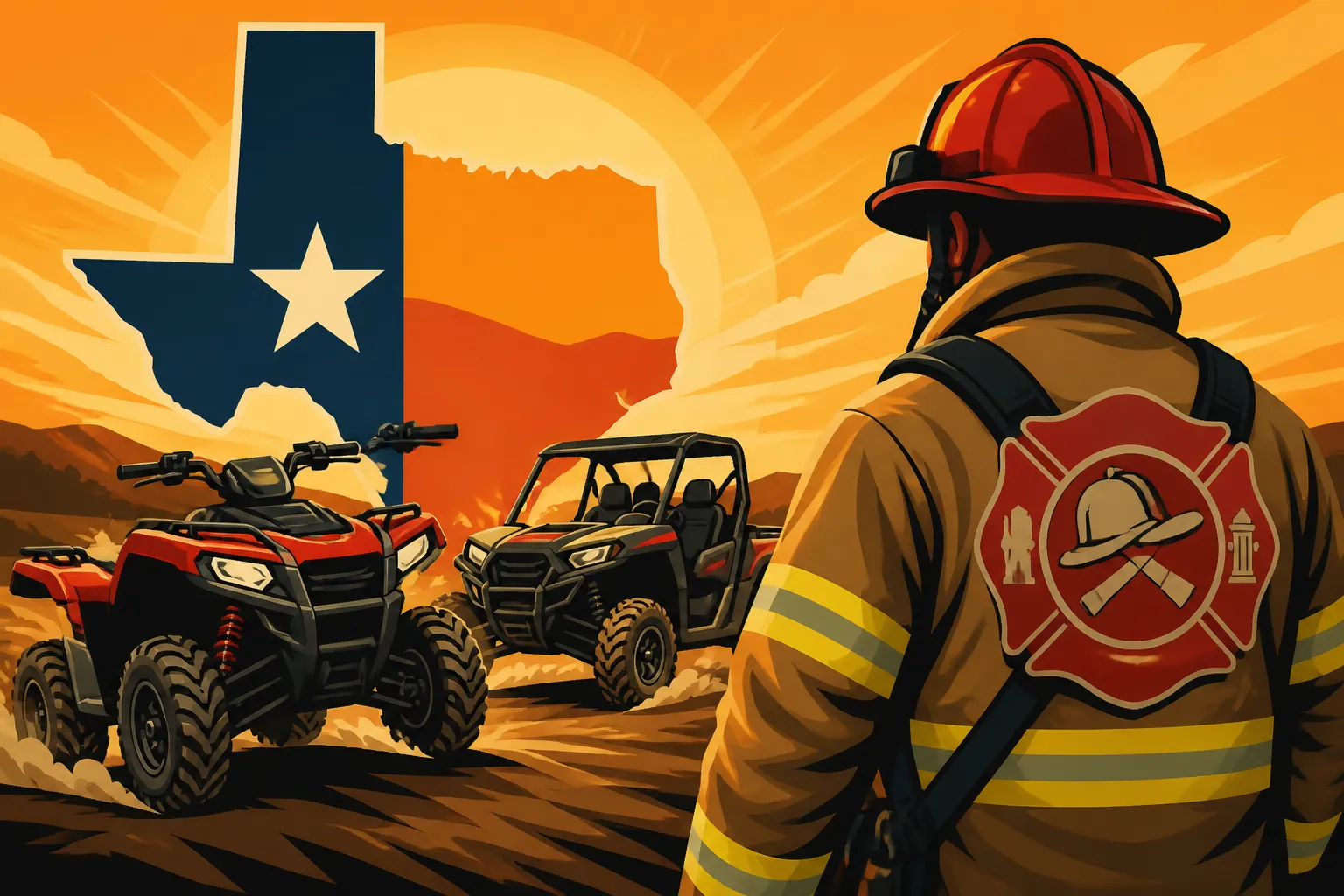
The law permits a volunteer firefighter to operate an off-highway vehicle on a public road if it is within a 10-mile radius of the fire station where they are a member. This "10-mile limit" is absolutely crucial. It creates a defined operational zone, acknowledging that rural and semi-rural fire departments often rely on these nimble machines to reach incident sites, particularly those off the beaten path or in challenging terrain that larger fire trucks cannot access quickly. For instance, imagine a brush fire far back on a ranch road, or an accident scene in a remote, muddy field. An OHV equipped with basic emergency gear can be invaluable for initial assessment or rapid response, allowing firefighters to get to the scene faster than on foot or in a larger, less agile vehicle.
However, the "10 miles" is just one piece of the puzzle. The statute is explicit that this privilege is granted only when the volunteer firefighter is operating the OHV in the course of the firefighter’s official duties. This means they are responding to an emergency call, participating in training exercises directly related to their fire department responsibilities, or conducting maintenance activities for the department. It's not for personal errands, commuting to a regular job, or simply driving to a friend's house within that radius. The intent is to support the critical public service these individuals provide, not to expand general OHV road access. Without this exception, some volunteer departments might find themselves significantly hampered in their ability to serve their communities effectively, especially given the diverse and often rugged landscapes found across Texas. It's a recognition of the unique challenges volunteer firefighters face and how an OHV can be a vital tool in their arsenal.
Specific Duties and Conditions for This Exception
Let's dive deeper into what "official duties" actually entails for a volunteer firefighter using their OHV on a Texas public road. It's not a vague concept; the law points to specific scenarios where this exception applies, always keeping that 10-mile radius in mind.
One primary scenario is emergency response. This is perhaps the most obvious and critical use. Picture a volunteer firefighter receiving a call for a brush fire in a hard-to-reach area of East Texas piney woods or a remote pasture in Central Texas. Instead of waiting for a larger apparatus to navigate difficult terrain, they can jump on their ATV or UTV, equipped with necessary tools like shovels, water backpacks, or even basic medical supplies. This quick response can be crucial in containing a small fire before it escalates or providing initial aid at an accident scene where immediate access is challenging. Companies like SuperATV offer heavy-duty accessories such as winches, cargo racks, and skid plates that can be incredibly useful for these types of challenging emergency scenarios, ensuring the machine can handle the demands of off-road rescue and recovery.
Another key area is training exercises. Volunteer firefighters need to regularly hone their skills, and sometimes these drills require them to move equipment or personnel across public roads to designated training grounds within that 10-mile limit. This could involve practicing maneuvers, transporting specialized gear to a simulated incident site, or even moving an OHV itself to a location where specific rescue techniques involving the machine can be practiced. These are not casual rides but structured activities integral to maintaining readiness for actual emergencies.
Finally, the exception covers maintenance activities related to the fire department. This could mean transporting a specialized tool or small piece of equipment for repair, or moving an OHV from a storage facility to the main station for routine checks and servicing, again, all within that prescribed 10-mile zone. It's about enabling the continuous operation and preparedness of the volunteer fire department, ensuring that their assets are always ready for deployment. For an OHV to perform reliably in these critical roles, proper maintenance and durable components are essential. Many firefighters might look to upgrade or replace parts with robust options from brands like SuperATV to ensure their machines are up to the task.
It’s vital to remember that in all these instances, the volunteer firefighter must be actively performing a duty for the fire department. This isn't permission for general commuting or personal use. The focus is strictly on supporting the essential public service they provide. While Texas has other specific, limited exceptions for OHV road use, such as [Texas Agricultural Exemption for ATVs on Roads] or crossing a road at a 90-degree angle, the volunteer firefighter exception is unique in its scope for ongoing, mission-critical operations.
Important Considerations and Limitations
While the exception for volunteer firefighters is a valuable tool for community safety, it comes with strict parameters that cannot be overlooked. Understanding these limitations is just as important as knowing the exception itself, as misuse can lead to significant penalties.
First and foremost, the 10-mile radius is not a suggestion; it’s a hard limit. Operating beyond this distance, even if still on official duty, would put the firefighter outside the bounds of the legal exception. This requires volunteers and their departments to be mindful of their operational area and plan accordingly. It also means that a volunteer might use their OHV for a brush fire 7 miles from the station, but if a call comes in for an incident 12 miles away, they would need to use a different, street-legal vehicle or transport the OHV on a trailer.
Secondly, the "official duties" clause is paramount. This means the OHV must be used for genuine fire department business – emergency response, training, or maintenance. It cannot be used for personal errands, even if those errands happen to be within the 10-mile radius. Taking the kids to the store or picking up dinner on the OHV, even if you're a volunteer firefighter, would be a violation. The intent of the law is to support critical public service, not to provide a workaround for general road access. Any other use on a public road, even if it feels benign, could be interpreted as illegal operation.
Volunteer firefighters must also still adhere to basic safety practices and traffic laws while on public roads. While the vehicle itself might be an OHV, the rules of the road—speed limits, stop signs, yielding to traffic—still apply. Common sense and cautious driving are essential. Although Texas generally does not require helmets for adult ATV riders on private land, if a volunteer firefighter is operating their OHV on a public road under this exception, they should still consider full safety gear, including a helmet, especially during high-stress emergency responses. [Texas Safety Apparel Rules for ATV Riders] are always a good reference for best practices.
It’s important to note that this exception typically does not waive other equipment requirements that might apply to general road crossing rules. For example, while the OHV isn't street legal, when crossing a public road, most Texas regulations would still expect certain lighting for visibility, especially during low-light conditions. Although not explicitly stated as a requirement for this specific exception, maintaining visible headlights and taillights, perhaps even adding an orange flag if operating in open areas, is a smart move for any OHV operating near or on public thoroughfares. You'll find many useful lighting and visibility solutions from companies like SuperATV that can enhance safety for any OHV user, including volunteer firefighters needing to be seen.
Finally, while the exception exists, volunteer firefighters are not immune to legal repercussions if they operate an OHV outside of these strict conditions. [Texas Fines for Illegal ATV Road Use] can be significant, ranging from Class C misdemeanors for basic infractions to more serious charges depending on the severity of the violation or any accompanying reckless behavior. Enforcement officers have the discretion to issue citations if they determine the operation does not fit the legal definition of official volunteer firefighter duties or falls outside the 10-mile radius. Therefore, knowing and strictly adhering to these rules is not just about compliance; it's about protecting yourself and maintaining the integrity of this important exception.
Here's a quick look at the distinctions:
| Feature | General OHV Road Use in Texas | Volunteer Firefighter Exception |
|---|---|---|
| Legal Status | Generally Prohibited | Permitted under strict conditions |
| Road Registration | Not available | Not applicable (still no registration) |
| Operational Area | Private property, designated trails | Within 10 miles of fire station |
| Purpose | Recreation, farm work, private use | Official emergency, training, maintenance |
| Typical Equipment | Off-road tires, suspension | May include specialized gear, lighting |
| Passenger Restrictions | Manufacturer-designed seating only | Same, for safety |
| Penalties for Misuse | Fines, potential vehicle impound | Fines, loss of privilege, potential criminal charges |
This specific provision highlights the state's careful balance: acknowledging the utility of OHVs for critical functions while maintaining a strong stance against general road use. It is a testament to the value Texas places on its volunteer firefighters and their ability to protect communities across the vast and varied landscape of our state.
Disclaimer
This article is for general informational purposes only and does not constitute professional advice. Laws, prices and regulations vary by location and change over time. Consult a qualified professional for guidance on your specific situation.