Showing the Card on Demand
A Texas riding trip can go sideways if you have a machine decal but cannot show your safety certificate when asked. The certificate and decal serve different purposes, and riders need to know what to carry, when it applies, and what to do if a certificate comes from another state. Here’s how to prepare before riding public land.
What “showing the card” means in Texas
When you operate an off-highway vehicle on public land in Texas, you must carry your valid safety certification and show it upon request, according to the Texas Parks and Wildlife Department. In practice, that means having the certificate available while you ride, not leaving it at home or stored somewhere you cannot access.
A safety certificate is evidence that you completed qualifying ATV safety training. The Texas Parks and Wildlife Department recognizes certificates for successful completion of the ATV Safety Institute’s ATV RiderCourse, including hands-on training, as well as equivalent safety training certificates issued under the authority of Texas or another state. If you are unsure whether a particular document counts, confirm its status before your trip rather than assuming that any course card will be accepted.
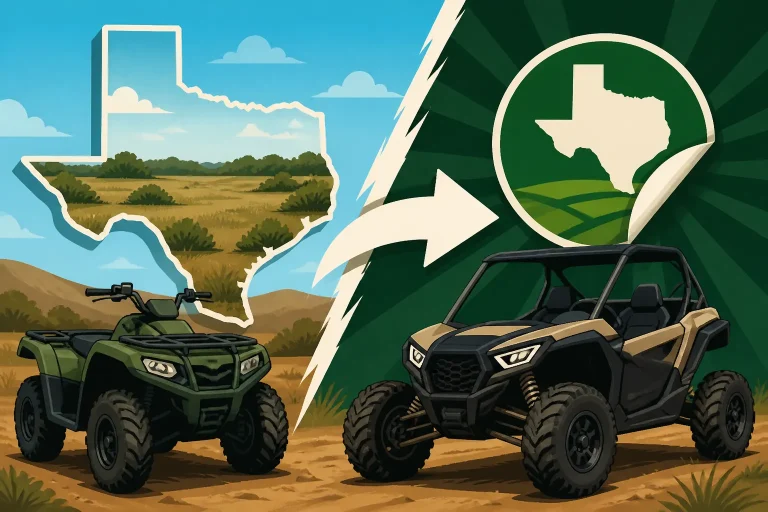
There is an important distinction between the safety certificate and the Texas OHV decal:
| Item | What it shows | What to do while riding public land |
|---|---|---|
| Safety certificate | The operator has completed qualifying safety training | Carry the valid certificate and show it upon request |
| Texas OHV decal | The vehicle meets the state’s decal requirement for applicable riding areas | Display the valid decal on the vehicle |
| Decal receipt or proof of purchase | The decal has been purchased but may not have arrived yet | Keep proof readily available if the decal has not arrived |
The Texas Parks and Wildlife Department administers the OHV decal program. A decal is not a substitute for the rider’s certificate, and a certificate does not replace the vehicle’s decal. Keep both requirements in mind when preparing for a trip.
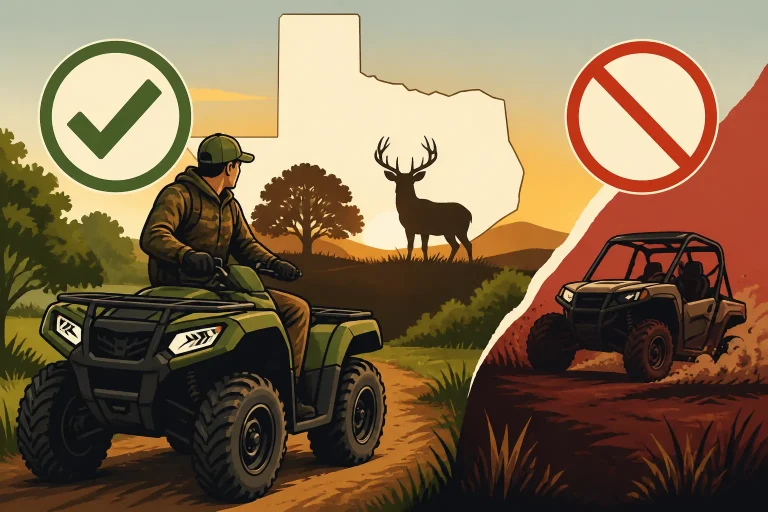
Texas also draws a clear line between public and private property. The Texas Parks and Wildlife Department says an OHV decal is not required when an ATV or recreational off-highway vehicle is operated exclusively on private property. That does not make certificate rules, riding-area rules, or other safety requirements interchangeable; check the requirements that apply to the place where you plan to ride.
For an overview of who needs training and when, see Texas OHV Safety Certificate Requirements. If your question is specifically about what to carry during a ride, Carrying the Certificate on a Texas Ride covers that issue more narrowly.
Who needs a certificate and when
The certificate requirement matters most when a rider expects to ride public land without adult supervision. Texas’s age rules also affect how families should plan a ride.
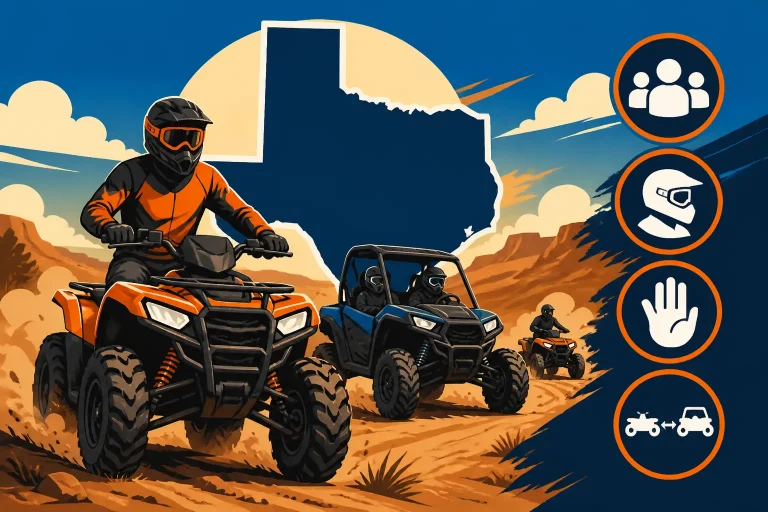
According to the Texas Legislature, anyone under 14 operating an ATV on public land must be accompanied by and under the direct supervision of a parent, guardian, or authorized adult. The Texas Parks and Wildlife Department says a person must be at least 14 to operate an ATV on public land without adult supervision, provided the person holds a safety certificate. Operators aged 14 or older may also ride under the direct supervision of a certificate holder.
In other words, a young rider should not treat an adult’s presence as a replacement for understanding the supervision rule. The adult must meet the applicable requirements and directly supervise the rider. For younger riders, the type and size of the vehicle may also matter: the Texas Legislature says children operating or riding ATVs are subject to age and vehicle-engine-size restrictions on public land and in state parks.
The safety-card question is not the only preparation families need to handle. The Texas Parks and Wildlife Department requires ATV operators and passengers on public lands to wear a helmet that meets United States Department of Transportation standards. For UTVs on public lands, seat belts must be worn if the vehicle is equipped with them. These are separate obligations from carrying a certificate.
A certificate also does not grant permission to ride anywhere. Riders must follow the rules for the specific park, trail system, or other public area, and a certificate cannot make a closed route or prohibited area available for riding. Before setting out, check both the access requirements and the riding rules for your destination. Texas Rules for Riding Public Land is useful for understanding how location-specific rules fit alongside the certificate requirement.
If a child will ride, review What Texas Requires of Riders Under 14 before deciding who will supervise and what machine is appropriate. The details can affect whether the trip is suitable, even when the family has the necessary cards and vehicle decal.
Which documents to carry, including an out-of-state certificate
A useful pre-ride check is to separate the documents by what they prove. The operator’s certificate relates to training; the OHV decal relates to the vehicle and the riding area. Keeping the two requirements distinct makes it easier to spot a missing item before reaching a trailhead.
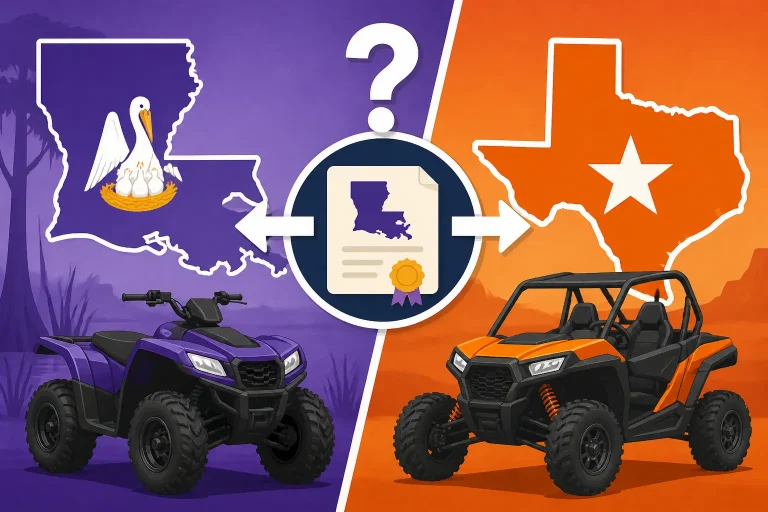
Texas recognizes qualifying safety certificates issued under another state’s authority, according to the Texas Parks and Wildlife Department. The department also identifies successful completion of the ATV Safety Institute’s ATV RiderCourse, including hands-on training, and equivalent state-authorized training as qualifying certificate pathways. A card from another state may therefore be acceptable, but the key is whether it documents training that Texas recognizes—not simply whether it looks like a safety card.
If you are visiting Texas, do not assume that a home-state decal or registration works in place of the Texas OHV decal. The Texas Parks and Wildlife Department says Texas has no reciprocity agreement for out-of-state OHV registrations or decals. Nonresidents riding public lands or grant-funded venues in Texas must purchase the Texas decal. Read Certificates Issued by Another State for the certificate question, and Texas Reciprocity and Why It Is One-Sided for the separate decal issue.
Before leaving, use this checklist:
- Confirm that the rider has a qualifying safety certificate. Check that it reflects recognized training and that the certificate is valid.
- Carry the certificate during the ride. The Texas Parks and Wildlife Department requires riders to show it upon request.
- Check the vehicle’s decal. On applicable public riding areas, display a valid Texas OHV decal.
- If the decal has not arrived, carry proof of purchase. The Texas Parks and Wildlife Department says proof of purchase or a receipt must be readily available in that situation.
- Review the destination’s rules. A state park, forest trail system, or other public venue may have additional requirements.
A phone photo may seem convenient, but the stated requirement is to carry the valid safety certification and show it upon request. The supplied rule does not establish that a photograph alone is accepted everywhere. If you plan to rely on a digital copy, check with the managing authority for the destination first. Carrying the physical certificate, when available, avoids uncertainty about whether a phone image will satisfy an on-site check.
A clear, water-resistant document pouch can help keep a paper certificate and receipt readable in dusty or wet riding conditions. Riders who already shop on Amazon may find a basic pouch there, but the important point is not the brand: protect the documents and keep them accessible. Do not store the certificate in a place that is difficult to reach while riding.
If you ride in Sam Houston National Forest, remember that the trail system is managed by the USDA Forest Service. Check the Forest Service’s current access instructions as well as Texas requirements before departure. What Texas Riders Must Show at Sam Houston can help you think through the documents and proof that may be relevant at that trail system.
What to expect if an officer asks
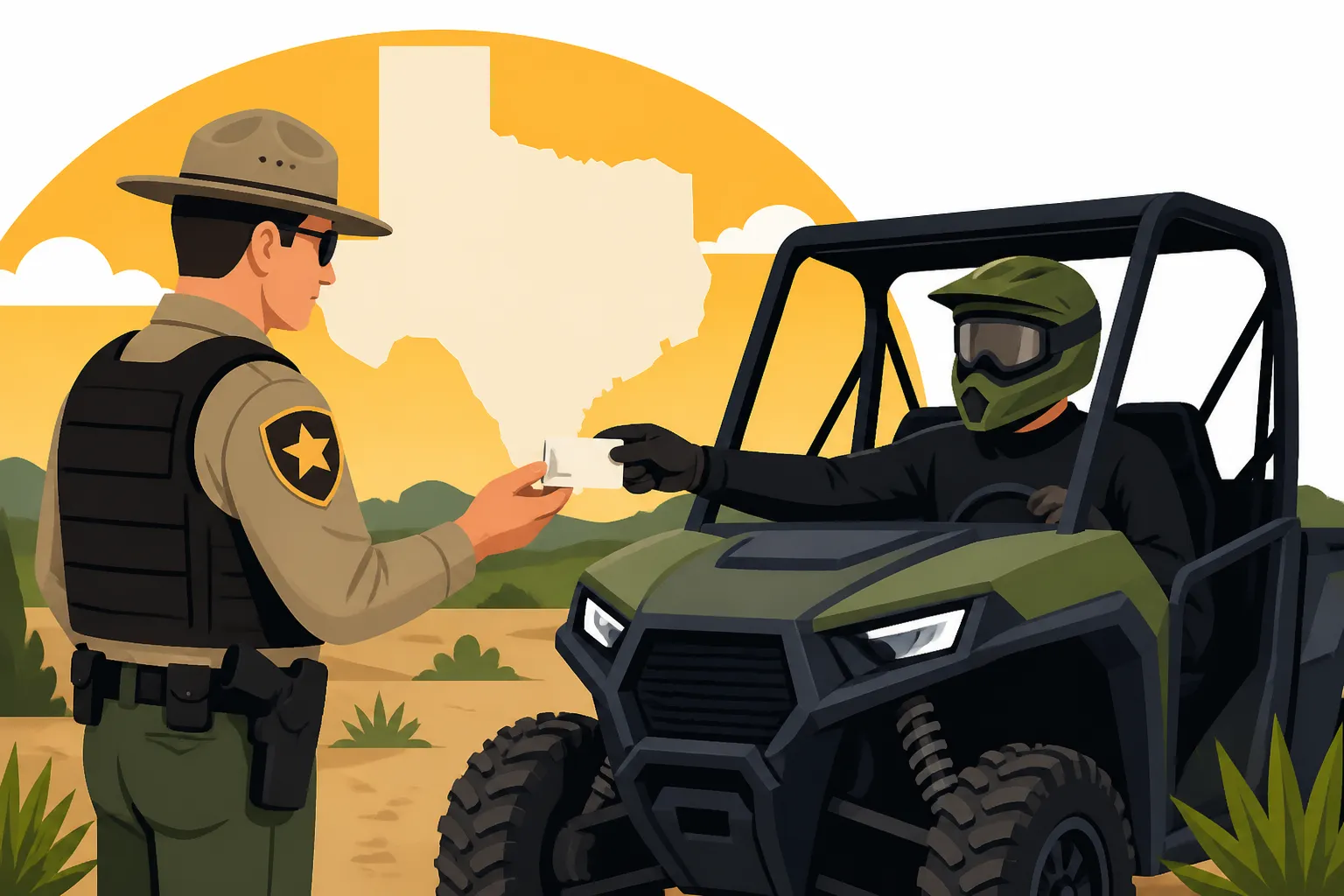
If an official asks to see your certificate, the practical response is straightforward: stop safely, locate the document, and present it. The Texas Parks and Wildlife Department says riders must carry a valid certificate and show it upon request while operating an OHV on public land. Keeping the certificate somewhere accessible makes that interaction simpler than searching through gear or trying to contact someone at home.
A request to see the certificate does not mean the decal or other riding requirements have disappeared. The officer may also be checking that the machine has the required decal or that proof of purchase is available if the decal has not yet arrived. Keep the proof for the machine separate from the operator’s training document so you can produce the right item without confusion.
The Texas Parks and Wildlife Department says operating an OHV without a required decal on public land is a Class C misdemeanor and may result in a citation and a fine ranging from $25 to $500, as of November 2026. That is a decal consequence, not a penalty description for failing to show a safety card; do not confuse the two. For the decal requirement itself, see The Texas OHV Decal Requirement Explained.
The certificate requirement also does not replace basic machine and rider rules. For example, the Texas Parks and Wildlife Department requires a helmet meeting DOT standards for ATV operators and passengers on public lands. The Texas Legislature requires public-property OHVs to have a qualifying USFS spark arrester that has not been removed or modified, and prohibits muffler cutouts or bypasses. Other rules cover lighting, passengers, alcohol, and where a vehicle may be operated. The authority managing the trail or park can explain what applies at that site.
State parks have their own enforcement presence: the Texas Parks and Wildlife Department says OHV regulations in Texas State Parks are enforced by state park law enforcement and game wardens. Be ready to follow instructions and provide the requested documentation, but do not assume that a valid card alone makes every vehicle or riding activity compliant.
A short departure routine can prevent most document problems: check the rider’s certificate, check the vehicle’s decal or receipt, confirm the destination’s rules, and make sure the papers are accessible. If any part of the certificate is unclear—especially an out-of-state course or a digital record—resolve that question with the relevant authority before riding rather than at the trailhead.
Sources
- Texas Legislature — Transportation Code Title 7, Chapter 663. Certain Off-Highway Vehicles (checked November 2, 2026)
- Texas Parks & Wildlife Department — OHV FAQ — Texas Parks & Wildlife Department (checked November 2, 2026)
- Texas Parks and Wildlife Department — Prohibition of Wheeled or Tracked Motor Vehicles in Stream Beds (checked November 2, 2026)
Disclaimer
This article is for general informational purposes only and does not constitute professional advice. Laws, prices and regulations vary by location and change over time. Consult a qualified professional for guidance on your specific situation.