Why Fourteen Is the Floor
A child riding an ATV on Texas public land needs more than a suitable machine and a willing adult. The age rule changes at 14, but reaching that age does not remove every supervision or training requirement. Here’s what the rule means for younger riders, what changes at 14, and what families should check before heading to a public trail.
What the age-14 rule actually means
The age rule is about when a rider may operate an ATV on public land without adult supervision. It is not a general minimum age for riding, and it does not mean that every rider who turns 14 may ride alone.
According to the Texas Legislature, a person younger than 14 operating an ATV on public land must be accompanied by and under the direct supervision of a parent, guardian, or authorized adult. The Texas Parks and Wildlife Department likewise says that a person must be at least 14 to operate an ATV on public land without adult supervision, provided the rider holds a safety certificate.
That makes 14 a threshold for the possibility of riding without an adult beside the rider, not a guarantee of independent riding. The certificate requirement still matters. A rider aged 14 or older who does not hold a safety certificate may ride only while under the direct supervision of a certificate holder, according to the Texas Legislature.
| Rider’s situation on public land | What the rule requires |
|---|---|
| Younger than 14 and operating an ATV | A parent, guardian, or authorized adult must accompany and directly supervise the rider, according to the Texas Legislature. |
| Aged 14 or older, with a safety certificate | The rider may operate without adult supervision, according to the Texas Legislature. |
| Aged 14 or older, without a safety certificate | The rider must be under the direct supervision of a certificate holder, according to the Texas Legislature. |
The under-14 rule names the adult who must supervise: a parent, guardian, or authorized adult. The older-rider rule refers to direct supervision by a certificate holder when the rider lacks a certificate. Don’t assume that a certificate, by itself, replaces the adult supervision required for a rider younger than 14.
For a closer look at the younger-rider rule, see Texas Rules for Riders Under 14 and What Texas Requires of Riders Under 14. Those topics can help families separate the supervision requirement from other rules that may apply to children and their machines.
Most importantly, the age rule applies to ATV operation on public land. It does not, by itself, tell you whether a particular child can safely handle a particular ATV, whether a park has additional conditions, or whether a machine is allowed on a given trail. Those questions should be checked separately before the ride.
What changes at 14, and what does not
Turning 14 changes the supervision options available to an ATV operator on public land. It does not cancel the safety-certificate requirement for riding without supervision, and it does not make other trail rules optional.
A rider who is at least 14 and holds the required certificate can operate without adult supervision under the rule described by the Texas Legislature. If the rider does not hold a certificate, the alternative is direct supervision by a certificate holder. That is why age alone is not enough to answer whether a teenager may ride independently.
The Texas Parks and Wildlife Department recognizes certificates showing successful completion of the ATV Safety Institute’s ATV RiderCourse, including hands-on training, or equivalent safety training certificates issued under the authority of Texas or another state. Texas Parks and Wildlife Department guidance also describes the requirement as holding a safety training certificate issued by the Texas Department of Public Safety or an equivalent certificate issued under another state’s authority.
Those descriptions point riders toward formal, state-authorized training—not just an informal lesson or a parent’s assurance that the rider knows how to operate the ATV. Before a trip, confirm that the rider’s document is an accepted safety certificate and that the rider can present it if asked. For details about accepted training, see Texas ATV Safety Certificate Explained. Families with a certificate issued elsewhere can also review Does Texas Accept an Out-of-State Safety Certificate?.
The certificate rule is specifically about operating an ATV on public land. It should not be treated as a universal permission slip for every property, vehicle, or riding situation. Private property is different in some respects, but landowner permission and safe supervision remain practical essentials. A rider also needs to follow the rules that apply to the location and machine.
The age rule does not establish a full set of child eligibility requirements. Texas law separately restricts children operating or riding ATVs on public land and in state parks according to age and vehicle engine size, but the facts available here do not specify the applicable engine-size thresholds. Check with the relevant park or land manager before choosing a machine for a child.
The rule also concerns the person operating the ATV, not simply the age of anyone along for the ride. According to the Texas Legislature, a person operating an ATV on public property may not carry a passenger unless the vehicle was specifically designed by its manufacturer to transport one. That restriction applies regardless of the passenger’s age. A second seat added later does not establish that the machine was designed to carry a passenger.
If the vehicle is a UTV rather than an ATV, don’t assume that ATV age guidance answers every question about passenger capacity or vehicle requirements. For public lands, Texas Parks and Wildlife Department says seat belts must be worn in a UTV if the vehicle is equipped with them. Check the rules for the specific vehicle and riding area before taking a child as a passenger.
How to prepare a young rider for a public-land trip
The safest approach is to confirm supervision, certification, the vehicle, and the site rules before loading the ATV. Requirements at the destination may be different from what a family is used to on private land.
-
Confirm the rider’s age and supervision plan. If the rider is younger than 14, arrange for a parent, guardian, or authorized adult to accompany and directly supervise the rider, as required by the Texas Legislature. If the rider is at least 14, check whether the rider has a qualifying safety certificate or will be directly supervised by a certificate holder.
-
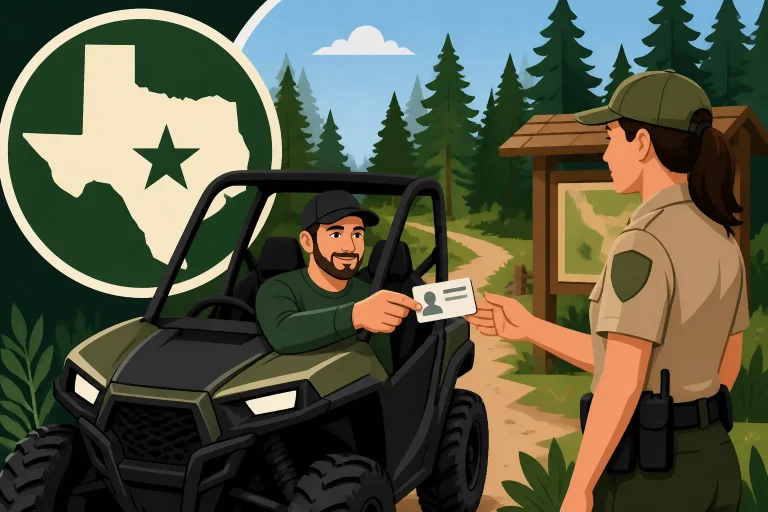
Check the certificate before leaving. Texas Parks and Wildlife Department says riders must carry a valid safety certification while operating an OHV on public land and show it upon request. Keep the document accessible rather than packed where it cannot be produced at the trail. Review Texas Supervision Rules for Young Riders if the adult plan depends on who holds the certificate.
-
Confirm the land’s access requirements. A public trail, state park, national forest trail, and grant-funded riding venue may have different operational details. Texas Parks and Wildlife Department administers the Texas OHV decal program, and riders in Texas state parks must display a valid Texas OHV decal. The state does not offer reciprocity for out-of-state OHV registrations or decals, so a nonresident should not assume an out-of-state decal will satisfy the Texas requirement. For broader riding requirements, see Texas Rules for Riding Public Land and The Texas OHV Decal Requirement Explained.
-
Inspect the ATV and required safety equipment. Texas Parks and Wildlife Department requires ATV operators and passengers on public lands to wear a safety helmet that complies with United States Department of Transportation standards. Texas law also requires public-property OHVs to have a United States Forest Service-qualified spark arrester that has not been removed or modified. The Texas Department of Motor Vehicles says an OHV on public OHV land must have a headlight and taillight; Texas Parks and Wildlife Department specifies that lights must be on during nighttime hours and whenever visibility is reduced.
-
Make sure the machine is in proper working order. Texas law prohibits muffler cutouts, bypasses, and similar devices on motor vehicles, including OHVs operated on public property. Texas Parks and Wildlife Department also requires an adequate muffler system in good working condition on ATVs and UTVs operated on public OHV lands. If riding a state park trail system, the exhaust sound limit is 96 decibels, according to Texas Parks and Wildlife Department.
-
Review passenger and conduct rules. Don’t carry an ATV passenger unless the manufacturer designed that model to transport one. In state parks, public display or consumption of alcoholic beverages is prohibited, and operating while under the influence of alcohol or drugs is prohibited, according to Texas Parks and Wildlife Department. These rules apply alongside the age and certificate requirements, not instead of them.
This checklist is not a substitute for the riding area’s own instructions. For example, the Sam Houston National Forest OHV trail system is managed by the USDA Forest Service. Check with the relevant land manager for current access conditions and any site-specific requirements before making the trip.
Common misunderstandings about the rule
“Once a rider turns 14, they can ride alone.” Not necessarily. The Texas Legislature says a rider aged 14 or older may operate without adult supervision if they hold a safety certificate. Without one, the rider must be directly supervised by a certificate holder. Age opens the door to independent operation only when the certificate condition is met.
“A parent’s supervision replaces the need for a certificate for every rider.” The rules differ by age. A rider younger than 14 must be accompanied and directly supervised by a parent, guardian, or authorized adult. For a rider aged 14 or older, the Texas Legislature describes the options as holding a safety certificate or riding under the direct supervision of a certificate holder. Check the applicable requirement for the rider’s situation rather than assuming one rule covers everyone.
“A safety certificate means the adult can supervise any child from a distance.” The under-14 rule requires direct supervision and says the adult must accompany the rider. A certificate does not change those words into permission for remote or casual oversight. Plan to stay close enough to supervise directly.
“The age rule means any ATV is suitable if an adult is present.” The age rule does not determine whether the machine fits the rider or meets other public-land restrictions. Texas law notes separate age and engine-size requirements for children on public land and in state parks. Confirm those requirements for the specific venue and machine before riding.
“A family can carry a second person on any ATV if the passenger is a child.” No. The Texas Legislature says an ATV operator may not carry a passenger on public property unless the manufacturer specifically designed the vehicle to transport one. The passenger’s age does not create an exception.
“An out-of-state certificate or decal automatically settles every Texas requirement.” Texas Parks and Wildlife Department recognizes qualifying safety certificates issued under the authority of another state, but Texas does not offer reciprocity for out-of-state OHV decals. A nonresident riding on public lands or grant-funded venues in Texas must purchase a Texas OHV decal. Check both the rider’s certificate and the machine’s decal requirements; they are separate matters.
A little planning can prevent a frustrating turn-around at the trailhead. Confirm the rider’s age, the supervision arrangement, the certificate, the vehicle’s passenger setup, and the destination’s rules as separate checks. If a requirement is unclear, ask the agency or land manager responsible for the place where you plan to ride.
Sources
- Texas Legislature — Transportation Code Title 7, Chapter 663. Certain Off-Highway Vehicles (checked November 2, 2026)
- Texas Parks and Wildlife Department — Eisenhower State Park OHV Rules and Regulations (checked November 2, 2026)
Disclaimer
This article is for general informational purposes only and does not constitute professional advice. Laws, prices and regulations vary by location and change over time. Consult a qualified professional for guidance on your specific situation.