Does Texas Accept an Out-of-State Safety Certificate?
A safety certificate from another state can create confusion when you bring an ATV or UTV to Texas. The short answer is that Texas recognizes qualifying out-of-state OHV safety certificates, but the certificate is only one part of the rules. Here’s how reciprocity works, who needs proof, and what else to check before riding.
Does Texas accept an out-of-state OHV safety certificate?
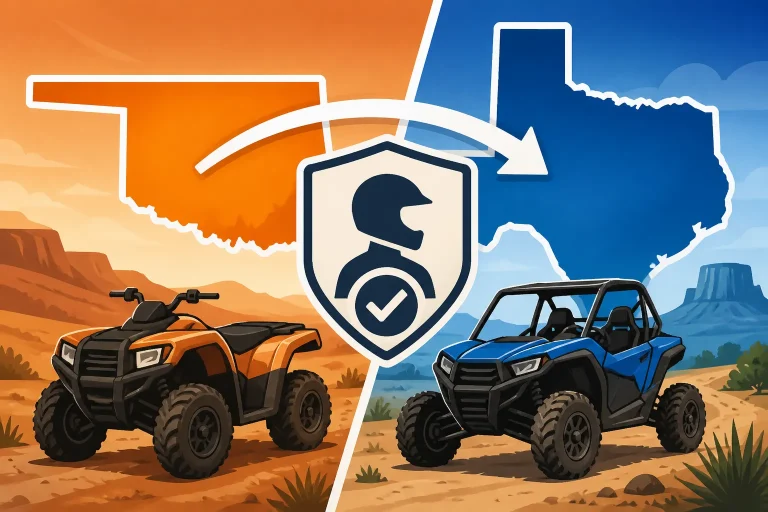
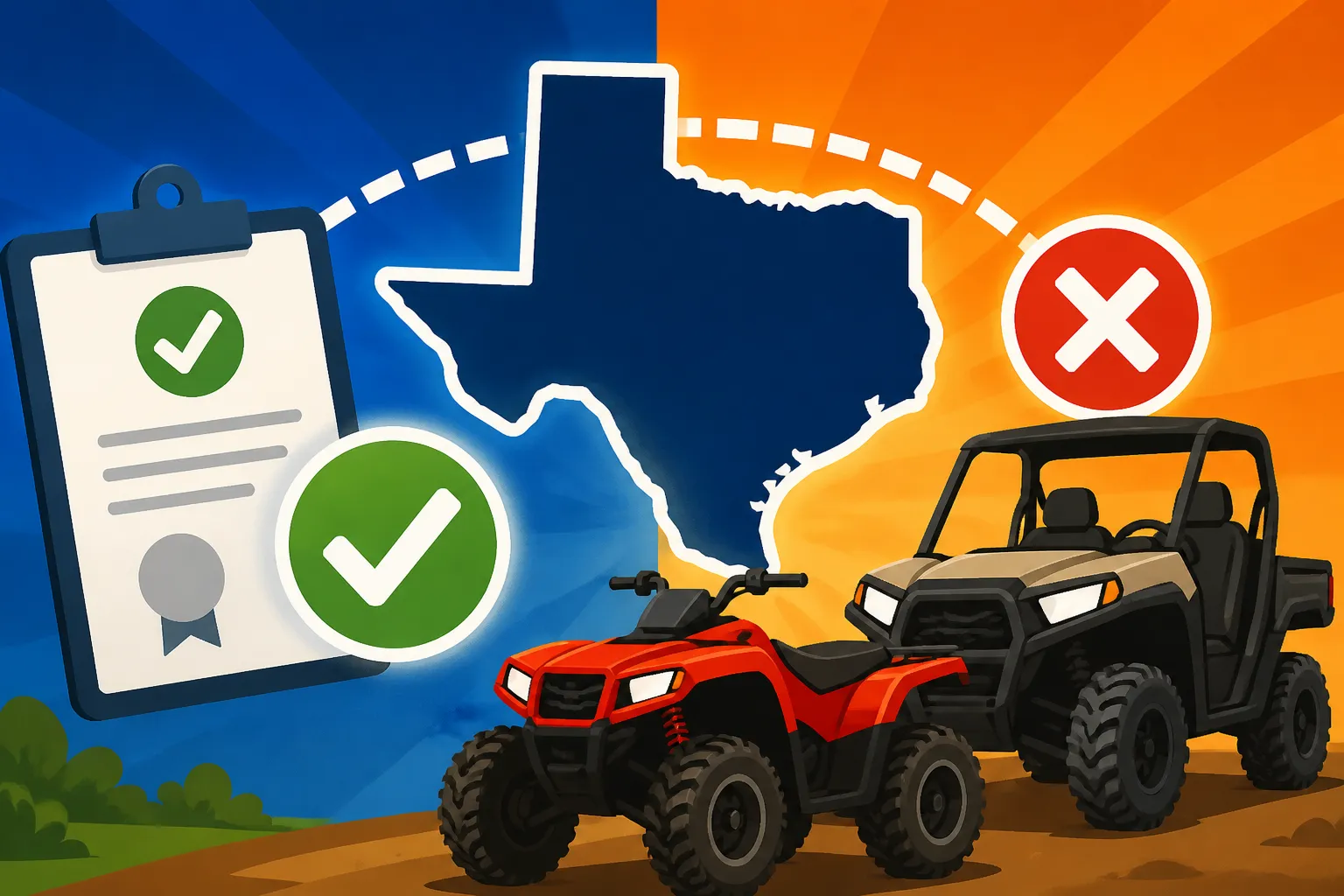
Generally, yes. Texas recognizes an off-highway vehicle safety certificate issued by another state when it meets the applicable Texas requirement. A visitor who completed an accepted safety course elsewhere should not need to repeat the course solely because the certificate came from outside Texas.
The key issue is whether the document is actually an OHV safety certificate, rather than a certificate for a different activity or a general training record. Keep the original card or certificate, or an official digital record if that is what the issuing program provides. A course completion email, a driver’s license, or proof that you own an ATV is not automatically a substitute.
Texas’s recognition of another state’s certificate is often described as reciprocity, but that does not mean every rule or document transfers across state lines. It means Texas may accept the qualifying safety credential. It does not exempt a rider from Texas land-access rules, decal requirements, park rules, or any age-related supervision requirement.
If you are unsure whether your document qualifies, check with the Texas agency responsible for the course and certification before your trip. You can also ask the land manager or park where you plan to ride what proof it expects. This is especially useful if your certificate is old, does not clearly identify the course, or is available only through an online account you may not be able to access at the trailhead.
For a broader explanation of what the credential does and does not cover, see The Texas ATV Safety Certificate Explained. Texas’s out-of-state recognition is covered in more detail in Certificates Issued by Another State and Texas Reciprocity and Why It Is One-Sided.
| What you have | What it generally means in Texas | What to check before riding |
|---|---|---|
| A qualifying OHV safety certificate from another state | Texas generally recognizes it for the applicable safety-certificate requirement | Carry the certificate or accessible proof of completion |
| A boating, motorcycle, or general driver-training card | It may not count as an OHV safety certificate | Confirm the issuing course specifically covers OHV safety |
| No certificate, but you are riding with a qualified adult | Supervision may matter for a young rider under Texas rules | Check the age and supervision requirements for the land you will use |
| A Texas OHV decal | It addresses a separate access requirement on certain public lands | Check whether your riding location requires the decal |
| A park admission receipt or membership | It may satisfy the park’s entry process | Confirm whether other state or land-manager requirements still apply |
The practical takeaway: don’t assume that carrying any safety-related card is enough. Confirm that the credential is for OHV safety, bring proof, and check the rules for the specific place where you intend to ride.
Who needs a safety certificate, and what does supervision change?
Texas safety-certificate rules are not simply a blanket rule that every rider needs the same card. Age and supervision matter. In general, the certificate requirement applies to riders who meet the state’s age threshold, while younger riders are handled through supervision rules rather than being expected to earn a certificate they are not eligible to receive.
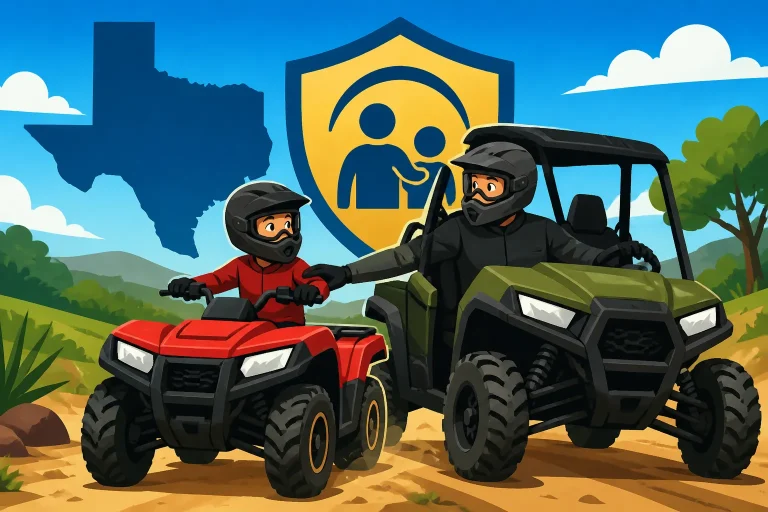
That distinction can be confusing for families. A child may be allowed to ride under the supervision of an adult who holds the required safety credential, even though the child does not have a certificate of their own. The adult’s certificate does not automatically make every riding situation lawful: the adult must meet the applicable supervision requirements, and the land manager may have additional rules.
For Texas-specific details, see What Texas Requires of Riders Under 14 and Texas Supervision Rules for Young Riders. Those rules are separate from whether a certificate from another state is accepted.
A parent’s certificate is not a general pass
When a child rides under adult supervision, the adult’s role matters. Make sure the supervising person is the one who holds the recognized certificate and is present in the way Texas requires. A certificate held by a parent who is not accompanying the child should not be treated as permission for the child to ride alone.
Do not rely on a family member’s certificate to satisfy requirements for an unrelated adult rider, either. If several people are riding, each person should understand whether they personally need a certificate or must ride under a qualified adult’s supervision. A group leader’s credential does not necessarily cover everyone in the group.
The certificate does not determine whether a rider may use a particular machine
A safety certificate is not a license for every ATV or UTV. The machine still needs to be suitable for the rider, and the rider must follow applicable age, passenger, and equipment rules. A certificate does not make an undersized child ready for a full-size side-by-side, permit a passenger on a machine not designed for one, or override a park’s restrictions.
For young riders, check both the training and machine requirements. The relevant rules may differ depending on whether you are using private property, a private OHV park, a state-managed riding area, or another public-land site. A certificate accepted by Texas does not require a park to admit a rider who does not meet that park’s own age or equipment policies.
Before leaving home, decide who in the group needs a certificate, who may ride under supervision, and who will be the supervising adult. If the answer depends on a child’s age or the type of land, verify the details with the land manager rather than relying on a general statement about reciprocity.
What the certificate does not replace
A recognized out-of-state certificate meets only the safety-certificate part of the process. It does not serve as a Texas OHV decal, a trail permit, a park pass, or permission to ride on land. These requirements have different purposes and are administered or set by different organizations.
For example, some Texas public riding areas require an OHV decal, while private property generally has different access rules. A fee or receipt from a park may cover that park’s admission but does not necessarily cover another permit. The details depend on where you plan to ride. See The Texas OHV Decal Requirement Explained and Texas Rules for Riding Public Land before assuming your out-of-state certificate is all you need.
A certificate also does not make a machine street legal. Texas has separate limits on where an ATV or UTV may be operated on public roads. Lights, mirrors, a safety course card, or an OHV decal do not by themselves authorize ordinary road use. If your plan includes riding along or crossing a road, check Are ATVs Street Legal in Texas? and the rules for the specific route.
Requirements can differ by land manager
Texas riding locations may be operated by state or federal agencies, local governments, water districts, nonprofit organizations, or private businesses. A place can accept an out-of-state safety certificate while still requiring a separate fee, decal, waiver, permit, or equipment check.
A private park may set its own policies for rider age, passenger use, helmets, machine size, and proof of training. Public lands can also have site-specific conditions. Check the current rules for the exact area and trail system, not just the general Texas rule.
If a park’s website says a safety card is required, ask whether it accepts an out-of-state certificate and what forms of proof it will review. If staff need to verify your credential, make sure you can retrieve it without reliable cell service. A saved image or offline copy can help, but follow the park’s stated documentation requirements.
Keep the certificate separate from your other riding paperwork
A useful pre-trip folder can include your safety certificate, any decal or permit confirmation, park reservation details, and emergency contacts. Store digital copies somewhere accessible offline, and bring a physical copy when practical. This makes it easier to respond if a gate attendant or ranger asks for proof.
Do not confuse the safety certificate with a vehicle title or ownership document. A title establishes information about the machine; the certificate relates to rider education. Nor does the certificate prove that you have permission to use private land. Get permission from the landowner when required, and keep it separate from your riding credentials.
How to prepare before riding in Texas
A few checks before the trip can prevent a frustrating turn-around at the gate. Start with the certificate itself, then confirm the access rules and the needs of every rider in the group.
- Confirm that the credential is for OHV safety. Look for the issuing program, course name, and rider information. If the document is vague or you cannot find it, contact the issuing organization to request confirmation or a replacement record.
- Check whether the certificate is valid for the rider and situation. If the rider is under the age at which Texas expects an individual certificate, review the supervision rules instead. Do not assume the same rule applies to every child or riding location.
- Carry accessible proof. Keep the original card or an official digital version available. If you rely on an online account, save the contact details or retrieval instructions in case you cannot get a signal.
- Check the destination’s current rules. Ask whether the area requires a decal, admission payment, reservation, waiver, or other permit. Confirm rules for age, passengers, helmets, machine width, and trail access as well.
- Review the planned route. A certificate does not authorize road riding, and a trail system may have closed routes or restricted areas. Confirm that the route is open and appropriate for your machine.
- Make sure the supervising adult is clear. If a younger rider depends on adult supervision, identify the responsible adult before riding and check that the adult’s credential is accepted.
If the certificate was issued by another state, the most useful question is not just “Does Texas accept it?” Ask whether it is a qualifying OHV safety certificate, whether the rider’s age changes the requirement, and what proof the destination wants to see. That approach covers both state recognition and practical access.
For a young rider who has not earned a certificate, do not try to solve the issue by presenting an adult’s card without checking the supervision rule. Texas distinguishes between a rider who holds a certificate and a rider permitted to operate under the supervision of a qualified adult. See Riding Alongside Your Child Under Direct Supervision for the supervision question, and Texas ATV RiderCourse Locations if a rider needs to find an eligible course.
Before traveling, verify details with the relevant Texas agency and the land manager. Rules and local operating policies can change, and a general statement about reciprocity cannot answer every question about a specific park, trail, rider, or machine. A brief check in advance is usually easier than discovering at the entrance that a document or separate permit is missing.
Disclaimer
This article is for general informational purposes only and does not constitute professional advice. Laws, prices and regulations vary by location and change over time. Consult a qualified professional for guidance on your specific situation.