Texas Rules for Riding Without a Certificate
Texas riders often confuse an OHV safety certificate with a permit, decal, or driver’s license—and the result can be arriving at a trail without the right qualification. The key question is where you’ll ride: Texas certificate rules focus on public land, while private sites may set their own requirements.
When Texas requires an OHV safety certificate
In general, a person operating an off-highway vehicle on Texas public land must have completed an approved OHV safety course and hold the resulting certificate. If you do not have one, do not assume that a parent’s permission, a Texas OHV decal, or a driver’s license is an alternative. The main exception is riding under the direct supervision of a person who holds a valid certificate.
The certificate rule concerns the operator. It is different from rules about passengers, helmets, vehicle equipment, or where a machine may be driven. It also does not by itself authorize riding on a particular trail or property. Review Texas OHV Safety Certificate Requirements and Texas Rules for Riding Public Land when planning a public-land ride.
“Public land” can include areas managed by different public agencies, and the applicable rules may depend on the specific place and activity. A public trail area, national forest trail, or other publicly managed riding area may have entry, decal, permit, or day-use requirements in addition to the certificate rule. A certificate does not replace those requirements, and having a decal does not replace the certificate. For a national forest trip, check both the local trail rules and Texas National Forest Permits.
| Riding situation | Is riding without your own certificate generally allowed? | What to check |
|---|---|---|
| Operating an OHV on Texas public land | Only if you qualify for an exception, such as direct supervision by a certificate holder | The land manager’s rules, certificate requirements, and any decal or permit |
| Riding under direct supervision on public land | Generally, yes, if the supervising person is certificate-qualified and supervision meets the rule | Whether the supervisor will remain close enough to supervise directly |
| Riding on private property with permission | The public-land certificate requirement generally does not apply | The owner’s permission, site rules, and any safety or age requirements |
| Riding at a privately operated OHV park | Do not assume the site has no certificate requirement | The park’s current admission, age, and operating rules |
| Riding with a certificate issued by another state | It may be accepted if it qualifies under Texas rules | Whether Texas recognizes that specific certificate |
There is no general shortcut based on owning the machine, having ridden for years, or being an experienced driver. If the ride is on public land and you are the operator, plan on having the certificate unless you have confirmed that an exception applies. For a fuller overview, see Texas Rules for Riding Without a Certificate and Texas OHV Safety Certificate Requirements.
The certificate is also separate from the Texas OHV decal. A decal may be required for certain public-land riding, depending on the land and its program rules, but it is not proof that the operator completed a safety course. The reverse is true as well: a certificate does not serve as a decal or public-land pass. Check The Texas OHV Decal Requirement Explained alongside the requirements for the specific riding area.
The direct-supervision exception
A rider without a certificate may be able to operate an OHV on public land while under the direct supervision of a person who holds a valid certificate. This is an exception to the operator’s own certificate requirement, not a blanket permission for an uncertified rider to go out alone or ride wherever a certified person happens to be.
Treat “direct supervision” as active oversight during the ride. The certificate holder should be able to monitor the rider and step in if needed; simply being at the same park, camping nearby, or agreeing to supervise before the group separates is not a safe basis for relying on the exception. Check the current definition and requirements before your trip. More detail is available in Texas Supervision Rules for Young Riders.
Age matters. Texas does not issue the relevant OHV safety certificate to children below the minimum certification age. A younger rider therefore cannot solve the problem by taking the course early; if operating on public land, the rider must meet the supervision requirement. See Texas Minimum Age for a Safety Certificate and Why Texas Will Not Certify Below Fourteen for the age-specific explanation.
Before riding with a younger or uncertified operator, agree on the supervision plan. Confirm who holds the certificate, who will stay with the rider, and whether the riding area’s rules impose additional age or supervision conditions. A family’s plan should account for the route and the rider’s ability, not just the legal minimum. If the group is large, splitting into separate routes can leave the younger rider without the required direct oversight.
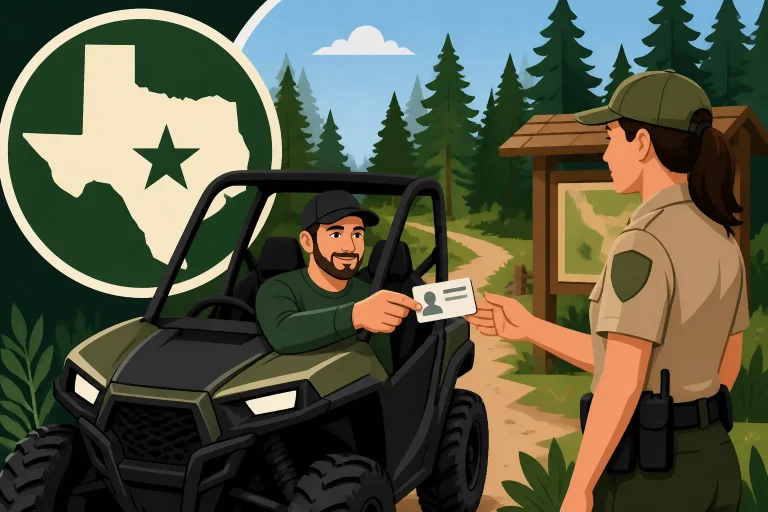
A certificate holder should carry proof of certification during the ride. A course completion record stored at home may not help if staff or an officer asks for proof at the site. Confirm what form of proof is accepted and keep it accessible. The practical details are covered in Carrying the Certificate on a Texas Ride.
What to check before riding without your own certificate
If you do not hold a certificate, check the land status and the riding-area rules before unloading the machine. A site’s name or entrance arrangement may not make it obvious whether you are on public land, private land, or a privately operated facility with its own conditions. Ask the land manager or park operator if the classification or requirement is unclear.
Use this checklist:
- Identify who manages the riding area. Find out whether the ride is on public land, private property, or a private facility. Do not rely only on a social media post, old map, or informal description.
- Ask whether the certificate rule applies. If you will operate on public land without your own certificate, confirm whether direct supervision is permitted and what the site expects.
- Confirm the supervisor’s qualification. Make sure the supervising rider holds a valid certificate and will remain with you in a way that meets the direct-supervision requirement.
- Check every separate entry requirement. Ask about decals, permits, day-use fees, age limits, and any site-specific safety rules. These are separate from the certificate.
- Carry proof and follow site instructions. Keep the certificate holder’s proof available, and follow any directions from park staff or land managers.
Private property is different, but not a free-for-all. Texas’s public-land certificate rule generally does not control a ride that stays on private property, yet the owner can set conditions for access and operation. Those conditions may include completing a course, riding only with an adult, or using designated routes. Permission to enter is not permission to ignore the property’s rules. See Texas Rules for Riding Private Land With Permission.
Private OHV parks deserve a separate check. A privately operated park may have requirements of its own, and those can apply even when the state public-land certificate rule does not. Review the park’s current visitor rules before traveling, especially when bringing a child, renting a vehicle, or arriving for an organized event. Rental operators may also have their own instruction and age procedures; see Texas Rules for a Rented Machine.
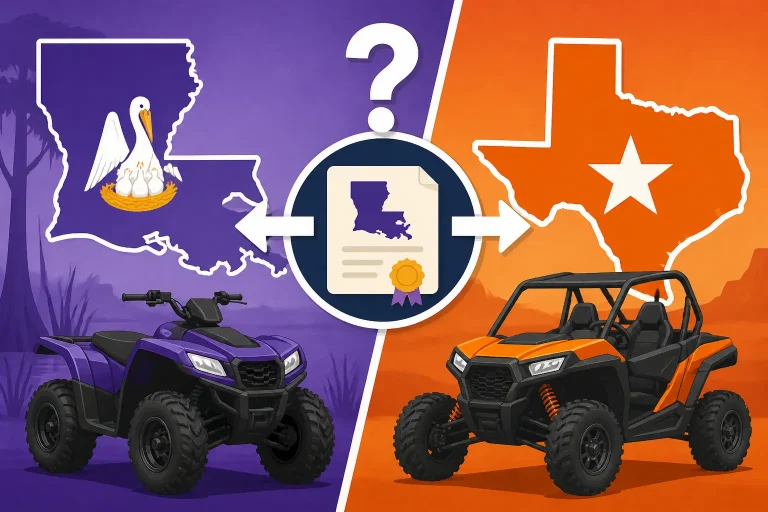
An out-of-state certificate may be useful, but do not assume every card, online completion record, or course from another state is automatically accepted. Texas may recognize qualifying certificates issued elsewhere, but acceptance depends on whether the credential meets the applicable requirements. Check the issuing authority and the Texas rules before the trip. The reciprocity question is covered in Does Texas Accept an Out-of-State Safety Certificate? and Texas Reciprocity and Why It Is One-Sided.
If a certificate is required and you cannot show that you hold one or qualify for the supervision exception, the safest choice is to delay operating on public land until you meet the requirement. Do not count on being able to explain the situation at the trailhead or sort it out after a ride begins. If you need certification, use the official course information and confirm the required proof before you go.
Common misunderstandings and practical answers
A driver’s license is not a substitute. A license authorizes certain on-road driving privileges; it does not automatically demonstrate completion of the Texas OHV safety course. Likewise, an OHV certificate does not make an OHV street-legal. The rules for road use are separate, and Why Texas Will Not Register an OHV for the Road explains that distinction.
A decal is not a certificate. The decal and the safety certificate address different requirements. A decal relates to access or funding rules for designated riding areas; a certificate concerns operator training. Check both when they apply.
A certificate does not guarantee access. A certified operator can still be turned away for missing a site permit, decal, fee, or other required item. Trails may also be closed or subject to size, equipment, or seasonal restrictions. Check the current rules for the place you plan to ride, rather than treating certification as universal permission.
A parent’s presence is not automatically enough. If relying on the supervision exception, make sure the adult meets the certificate requirement and is providing direct supervision. A parent who is not certified, or a certified adult who is riding elsewhere, may not satisfy the exception.
Private land still requires permission. Even when the public-land certificate rule does not apply, the landowner controls access. Riding without permission can create trespass and safety problems, and the owner may require training or supervision as a condition of entry.
A little advance checking prevents the most common problem: arriving ready to ride but discovering that the operator lacks the required qualification or the group has misunderstood the supervision rule. Confirm the land status, the certificate requirement, who will supervise, and any separate access conditions before you travel.
Disclaimer
This article is for general informational purposes only and does not constitute professional advice. Laws, prices and regulations vary by location and change over time. Consult a qualified professional for guidance on your specific situation.