Texas Reciprocity and Why It Is One-Sided
Texas riders can arrive from another state with a safety card or OHV sticker and still need to check Texas rules. The confusion comes from treating decals, safety certificates, titles and road permission as one kind of reciprocity. They are separate. Here’s what Texas recognizes, what it doesn’t promise, and what to verify before riding across a state line.
What “One-Sided Reciprocity” Means in Texas
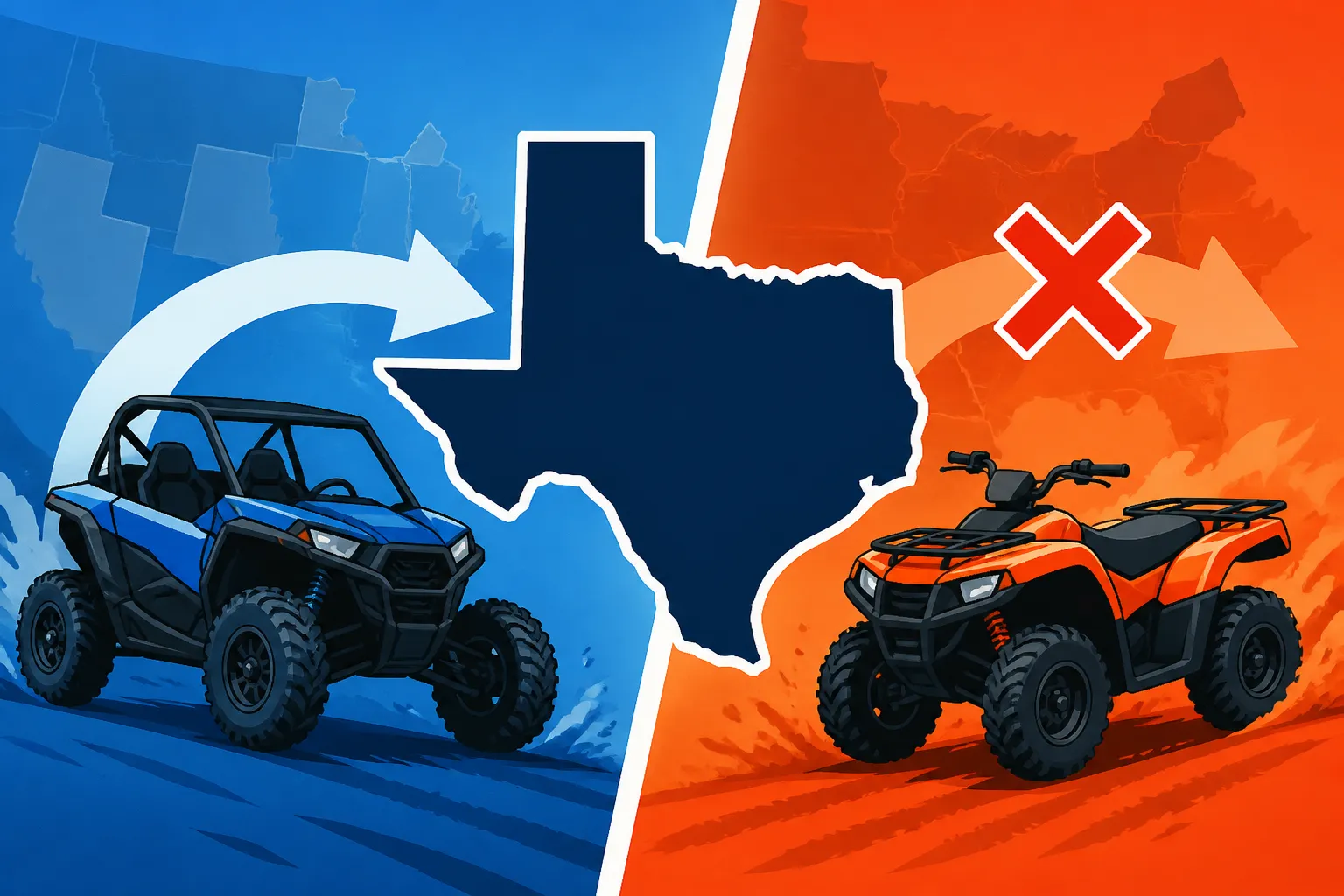
Reciprocity is an agreement or practice under which one jurisdiction recognizes something issued by another. For Texas OHV riding, the word can be misleading: recognition in Texas does not automatically mean Texas documents work elsewhere.
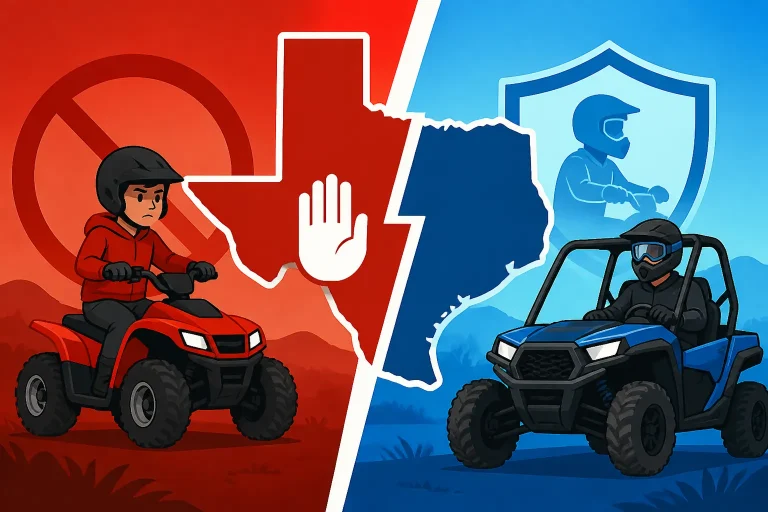
The clearest example is rider safety education. Texas recognizes qualifying OHV safety certificates issued by another state. That can help an out-of-state rider meet Texas’s safety-certificate requirement without repeating an equivalent course. But Texas’s recognition is a Texas rule. It does not compel another state to accept a Texas certificate.
A safety certificate is also different from a decal. A course card shows that a rider completed safety education; it is not permission to ride on a particular trail, proof of ownership, or road registration. A decal is a separate requirement connected to riding on certain Texas public lands. Having one does not establish that a rider has completed a required course.
The practical takeaway is to check both sides of a trip independently:
- If you’re bringing a machine into Texas, confirm Texas’s requirements for the place you plan to ride.
- If you’re taking a Texas machine out of state, check the destination’s rules for its own decal, permit, safety course, and land access.
- Don’t assume that a Texas title, plate, decal, or certificate carries the same effect in another state.
The distinction matters even when two states use similar terms. A state’s OHV sticker may be a registration document, a trail permit, a funding decal, or some combination. Similar appearance does not make the documents interchangeable.
What Texas Recognizes From Another State
Texas recognizes qualifying safety certificates issued by other states. That recognition is useful for visitors, families who have moved, and riders who completed training before planning a Texas trip. It is still important to confirm that the document is actually a safety certificate for off-highway vehicles, rather than a driver’s license, a course reservation, or a receipt.
If you’re unsure whether a card qualifies, look for the issuing state or authorized program, the rider’s name, and an indication that the course was completed. Keep the certificate available while riding, preferably in a format you can show if asked. A digital copy may be useful as a backup, but don’t rely on it without confirming that the land manager will accept it.
The certificate addresses the rider’s education requirement. It doesn’t waive other Texas rules. Depending on the rider, machine, and location, you may still need to comply with supervision requirements, equipment rules, trail conditions, and the land manager’s admission or permit terms. For the age-specific requirements, see Texas Rules for Riders Under 14. For a broader explanation of when a certificate is required, see [Texas OHV Safety Certificate Requirements].
A certificate can also be valid without being sufficient for every trip. Public land, private parks, and organized events may have different entry conditions. A park may require a waiver, proof of insurance, or its own orientation, even if the rider already has a state-recognized safety card. Ask the property operator what to bring instead of assuming the state certificate covers every park rule.
The certificate doesn’t travel automatically with the rider
Texas accepting another state’s certificate does not create a nationwide credential. When riding elsewhere, check that state’s own rules:
- Does it require a safety course for this rider’s age or birth date?
- Does it accept certificates from other states?
- Does it require a particular provider, course format, or card?
- Must the rider carry proof while operating?
- Does a child need direct supervision even with a certificate?
The answer can depend on the jurisdiction and type of land. A state agency’s requirements may differ from a private park’s policies or federal land rules. If the destination does not clearly explain reciprocity, contact the agency or property operator before leaving home.
Decals and Permits Are Separate From Reciprocity
A Texas OHV decal is not a safety certificate, and an out-of-state decal should not be assumed to substitute for a Texas decal where Texas requires one. Texas’s decal program is tied to riding on covered public land. It is not a general registration for the machine and does not make an ATV or UTV street legal.
A visitor’s home-state sticker may be valid at home but have no effect on Texas access requirements. The reverse is also true: a Texas decal does not automatically satisfy a different state’s trail-permit system. When a riding area requires a permit or decal, check that specific area’s instructions rather than relying on the sticker already attached to the machine.
| Document or permission | What it generally addresses | What it does not automatically provide |
|---|---|---|
| Safety certificate | Rider education requirements | Trail access, machine ownership, or road legality |
| Texas OHV decal | Texas decal requirements on covered riding areas | A substitute for another state’s permit or registration |
| Out-of-state decal | Requirements set by the issuing state or program | Automatic approval to ride in Texas |
| Title | Ownership record under the issuing jurisdiction’s rules | Permission to ride on a particular property |
| License plate or registration | Road-use requirements where applicable | Permission to use OHV trails or private land |
| Park pass or permit | Access under a particular land manager’s rules | Compliance with every state safety or equipment rule |
Before a trip, identify who manages the riding location. A state forest, a federal trail, a city park, and a privately operated OHV park may have different requirements. Even on public land, a land manager may impose additional entry conditions. Start with Texas Rules for Riding Public Land and Where to Buy a Texas OHV Decal if you need to sort out Texas decal questions.
A sticker from another state can still be useful for riding there, but it is not proof that Texas has waived its own requirement. Similarly, carrying a Texas decal does not mean a visitor is covered everywhere in Texas: the decal is not a substitute for a park’s admission, reservation, or use rules. For more detail on land covered by the decal program, see Where a Texas OHV Decal Is Required.
Private land and street-legal machines
The decal question can change with the type of land and machine. Texas generally does not require its OHV decal simply because a machine is being operated on private property with the owner’s permission. A street-legal machine may also fall under a different set of rules from a non-street-legal OHV. Don’t apply a decal requirement for a public trail to every ride, or assume an exemption from one decal rule removes other obligations.
Permission is essential on private land. An out-of-state sticker does not provide access to someone else’s property, and a Texas decal does not replace the landowner’s permission. For details on the private-land distinction, see Do You Need a Texas OHV Decal on Private Land?. For street-legal machines, see Texas OHV Decal for a Street-Legal Machine.
What Texas Documents Don’t Establish
“Reciprocity” can sound as though a machine’s papers travel with it and settle every question. They don’t. Ownership, trail access, rider qualifications, and public-road use are separate issues.
A title is evidence of ownership under the title rules of the issuing jurisdiction. It does not make the machine eligible for every type of public-road use in Texas, nor does a Texas title mean another state must treat the machine as road legal. Before buying or transporting a used machine, review its paperwork and VIN. What a Texas OHV Title Looks Like explains the Texas title’s role, while Checking a VIN Before a Texas Purchase covers a basic ownership check.
Likewise, a plate or registration issued elsewhere is not a general Texas road-use pass. Texas has specific rules for OHVs on roads, with limited exceptions. A machine’s lights, mirrors, or other modifications do not by themselves establish that it qualifies for ordinary road use. See Why Texas Will Not Register an OHV for the Road and Street Legal ATVs in Texas: The Short Answer before planning a route that includes public roads.
This matters especially for cross-border trips. A rider may legally transport a machine through a state without being allowed to ride it on that state’s roads. The destination may permit certain trail use while restricting public-road travel. And a valid certificate does not change the machine’s classification.
Keep the documents sorted by purpose:
- Ownership: title, bill of sale, or other records the relevant jurisdiction requires.
- Rider qualification: safety certificate or course record.
- Trail access: decal, pass, permit, reservation, or park admission.
- Road use: registration, plate, insurance, and equipment requirements where applicable.
- Property access: permission from the landowner or operator.
A document in one category should not be used as a substitute for another. If a ranger, park employee, or officer asks for proof, presenting the correct document for that requirement makes the conversation clearer.
How to Check Reciprocity Before You Ride
A few checks before departure can prevent a wasted trip or a ticket. The key is to verify the exact requirement with the authority responsible for it, not rely on a forum post, an old sticker, or the assumption that neighboring states share rules.
- Write down the destination and land manager. “Riding in Texas” is too broad to answer the access question. Identify the park, trail, forest, or private property.
- Ask what access document is required. Confirm whether the location requires a Texas OHV decal, a site-specific pass, advance booking, or another permit. If you’re visiting a private park, check its current rules directly.
- Check the rider’s certificate separately. Confirm whether the rider must have a safety certificate and whether Texas accepts the particular out-of-state document. Carry proof of completion.
- Check the destination state before leaving Texas. If riding across the border, ask that state whether it recognizes the Texas certificate or decal and whether a separate purchase is needed.
- Confirm the machine’s classification. An ATV, UTV, golf cart, and street-legal vehicle may be treated differently. Don’t infer road status from a title or from equipment added after purchase.
- Review requirements close to the trip. Park access, trail closures, seasonal conditions, and permit procedures can change. Confirm current rules with the official agency or land manager.
- Keep proof accessible. Store certificates and purchase confirmations where they can be shown without digging through a trailer or relying on a weak signal.
For visitors entering Texas, the most common mistake is treating a home-state decal as a universal pass. For Texans traveling elsewhere, the common mistake is the opposite: assuming the Texas document will be honored because Texas accepts a certificate from another state. Reciprocity is not automatically mutual.
A quick call or official program check is especially worthwhile when a child is riding, the trip includes more than one state, or the plan involves multiple land managers. Also check whether a park’s gate sells a decal or requires advance purchase; a state-level requirement and a park’s preferred purchase process are not necessarily the same thing.
Frequently Asked Questions
Does Texas accept an OHV safety certificate issued by another state?
Texas recognizes qualifying out-of-state OHV safety certificates. Carry proof of completion and confirm that the document meets the requirement for the rider and location.
Does an out-of-state OHV decal replace the Texas decal?
Don’t assume so. Texas decal requirements and another state’s decal program are separate. Check the Texas rules for the specific land where you plan to ride.
Can I use a Texas safety certificate in every other state?
No. Texas’s recognition of out-of-state certificates does not require other states to recognize Texas certificates. Check the destination’s official rules before riding.
Does a Texas OHV decal let me ride on any Texas public land?
No. A decal is not universal access permission. Land managers can have separate permits, admission rules, reservations, closures, and safety requirements.
Disclaimer
This article is for general informational purposes only and does not constitute professional advice. Laws, prices and regulations vary by location and change over time. Consult a qualified professional for guidance on your specific situation.