Nonresidents and the Texas Decal
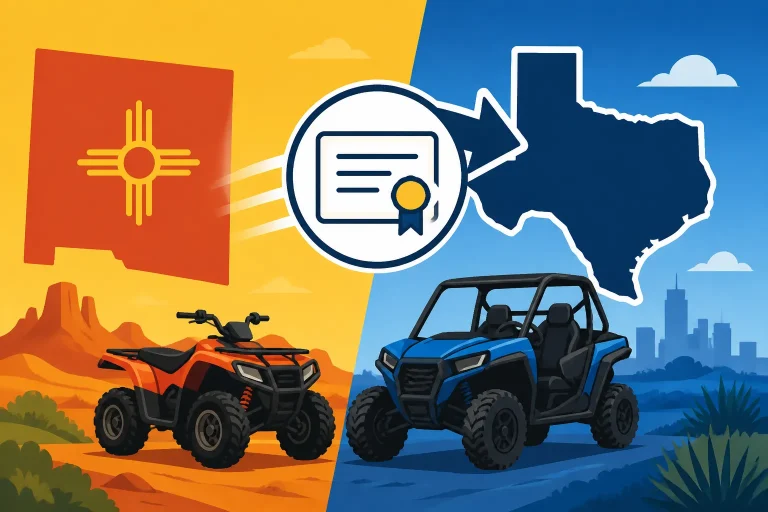
A visitor bringing an ATV or UTV to Texas may already have a home-state registration, permit, or off-road sticker. The catch is that those documents do not automatically replace Texas’s OHV decal requirement. Here’s how nonresidents can tell when they need the Texas decal, what it does—and does not—cover, and what to check before riding.
Does a nonresident need a Texas OHV decal?
Often, yes. If you bring an off-highway vehicle to Texas, your state of residence does not by itself exempt you from Texas decal rules. When a Texas OHV decal is required for the place where you plan to ride, visitors generally need to meet that requirement too. A plate, registration, decal, or permit from another state should not be treated as a substitute unless the relevant Texas rule or land manager specifically recognizes it.
The key question is not simply, “Is the machine registered where I live?” It is, “What does Texas require for this machine on this particular land?” Texas distinguishes between operating an OHV on covered public land and keeping or riding one on private property. A visitor should check the land and route, not assume that a document accepted at home will work in Texas.
The Texas OHV decal is a state off-highway decal, not general vehicle registration. It is associated with the machine, and a decal for one vehicle should not be assumed to cover another. A group traveling with several ATVs or UTVs should check whether each machine needs its own decal rather than treating the decal as a rider pass or a group permit. The overview in The Texas OHV Decal Explained covers the decal’s basic purpose and how it differs from other riding requirements.
For a nonresident, a useful starting point is to sort the planned ride into three categories:
- Private property: Texas’s public-land decal rule generally is not the reason to buy a decal for riding solely on private land. The property owner may still set access conditions, and other laws can still apply.
- Covered public riding land: Expect to need the Texas OHV decal unless an applicable exception is confirmed. This may include a public riding area, trail system, or other public land where the decal requirement applies.
- Road travel: The decal does not make an ATV or UTV street legal or authorize riding on roads. Road-use laws are a separate issue.
The phrase “public land” can cover different kinds of property and management arrangements. A trail may be on federal, state, county, or other publicly managed land, and the responsible agency may impose additional requirements. Before setting out, confirm the decal rule with the land manager for the specific trail or recreation area. The details in Where a Texas OHV Decal Is Required can help clarify why the location matters.
If the visit includes several riding areas, check each one separately. A decal requirement at one location does not tell you whether another location has the same rule, and having the state decal does not automatically cover a park’s admission, day-use charge, reservation, or separate permit.
Why an out-of-state sticker may not count
States do not all use the same off-road vehicle systems. One state may issue a registration sticker, another may sell a trail permit, and another may rely on a different type of vehicle document. Similar-looking stickers do not necessarily carry the same legal effect.
Texas’s decal requirement is its own requirement. A nonresident should not assume that a home-state OHV sticker, registration card, license plate, or proof of ownership is equivalent to the Texas decal. Likewise, a street-use registration from another state does not automatically settle whether a vehicle needs a Texas decal when it is used on covered Texas public land.
This is why “reciprocity” can be confusing. The word suggests that a document from one state is automatically accepted by another. In practice, recognition depends on the applicable laws and agreements; it is not safe to infer reciprocal treatment just because both states issue some kind of off-road credential. For the Texas-specific distinction, see Texas Reciprocity and Why It Is One-Sided.
A home-state document can still be useful. It may help establish who owns the machine, identify the vehicle, or satisfy a rule that applies to the trip or location. But usefulness is not the same as substitution. Keep your ownership and registration documents available if appropriate, while separately confirming whether a Texas OHV decal is required.
Consider a visitor who arrives with a state-issued off-road sticker already attached to the UTV. That sticker may be valid for riding in the visitor’s home state, but it should not be relied on as the Texas decal. If the destination requires the Texas decal, the visitor needs to follow Texas’s process rather than assuming that one state’s sticker is accepted in place of another.
The same caution applies to online listings and general travel advice. A post saying that a vehicle is “registered for off-road use” may describe another state’s rules, not Texas’s. A sticker that looks official may also be a park pass, membership identifier, safety mark, or decorative product. Confirm the issuing authority and the land manager’s requirements before relying on it.
A product purchased through Amazon or another general retailer is not a substitute for an official Texas OHV decal. If you need a decal, use an authorized purchase channel and confirm that what you receive is the state-issued decal for the correct machine. The options and purchase details are covered in Where to Buy a Texas OHV Decal.
What the Texas decal does—and does not—authorize
The decal is one part of a legal ride, not an all-purpose permission slip. It is important to separate the vehicle decal from land access, safety qualifications, and rules about where a machine may be operated.
| Requirement or document | What it generally addresses | What it does not automatically provide |
|---|---|---|
| Texas OHV decal | A Texas off-highway vehicle decal requirement where applicable | Admission to every park, permission to ride private land, or road-use authority |
| Home-state registration or sticker | A credential under the issuing state’s rules | Automatic acceptance as the Texas decal |
| Park admission or reservation | Entry to a particular recreation area, subject to its rules | The Texas OHV decal or permission to use other land |
| Safety certificate | A rider qualification where required | A vehicle decal or land-access permit |
| Title or ownership paperwork | Evidence about ownership and vehicle identity | Permission to operate on a trail or public road |
| Street-use registration | Road-use status under applicable vehicle rules | Automatic exemption from every off-road decal requirement |
The Texas decal should not be confused with a title. A title records ownership and other vehicle information; a decal is an off-highway requirement for eligible riding situations. A vehicle can have a title without being permitted on a particular trail, and a decal does not establish ownership. For the distinction between ownership paperwork and road registration, see Does a Texas ATV Need Registration?.
The decal also does not grant a right to ride wherever the public can enter. Public land may have designated trails, seasonal closures, width limits, sound rules, hours, permit conditions, or restrictions on particular vehicle types. A trail manager may close a route because of weather or maintenance even when the machine and rider have all required credentials. Review Texas Rules for Riding Public Land and the destination’s current instructions before traveling.
A park can require its own entry payment or reservation in addition to the state decal. Conversely, paying a park’s entry charge does not necessarily mean the state decal requirement has been met. These are separate costs and permissions, even when they are handled at the same gate. If you are riding in a national forest, check its own day-use rules as well; the decal and forest fee are not automatically the same thing. Texas National Forest OHV Fee explains that distinction.
The decal does not make a machine street legal. Texas has specific rules about where ATVs and UTVs may be used on roads, and those rules are separate from the OHV decal. Adding headlights, mirrors, or other equipment does not by itself turn an off-highway vehicle into a street-registered one. If your plan includes riding on a public road, check the road-use rules before making that part of the trip.
Nor does the decal replace safety requirements for riders. A public area may require or enforce rules about helmets, rider age, safety certificates, supervision, or protective equipment. Requirements can depend on the rider and the location. A decal on the machine does not certify that every person riding it meets those requirements.
Finally, a decal does not override the property owner’s control. Permission is needed to ride private land, and a public trail’s access terms still apply. Treat the decal as one checkpoint in a broader checklist rather than proof that every legal and practical condition has been satisfied.
How to prepare before bringing an ATV or UTV to Texas
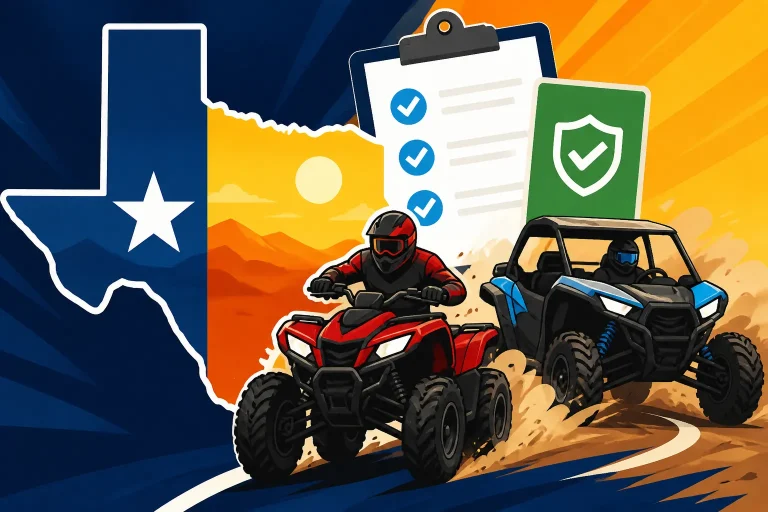
A little preparation can prevent a wasted trip, especially when the riding destination is remote or the group is towing several machines. Use this sequence before leaving home.
- Identify every planned riding location. Write down the actual park, trail system, forest, public area, or private property. “We’ll ride somewhere near town” is not specific enough to check the rules.
- Find the land manager. Determine who operates or manages each area. A park operator, public agency, or private landowner can explain the rules that apply at that destination.
- Ask directly about the Texas OHV decal. If the site’s instructions do not clearly answer whether a nonresident needs one, ask whether a Texas decal is required for your machine on the route you intend to use. Do not rely only on a home-state credential.
- Check what counts as the correct vehicle. Confirm whether your ATV, side-by-side, or other machine falls under the site’s OHV rules. Vehicle categories, size limits, and trail restrictions can affect access independently of the decal.
- Confirm how many decals are needed. If the group is bringing more than one machine, ask whether each one needs its own decal. Do not assume one decal covers a family, trailer, or riding party.
- Check the purchase method and timing. Confirm the official way to obtain the decal and whether it can be purchased before travel or at the destination. If you buy in advance, verify that it is valid for the intended trip and vehicle.
- Check separate entry and permit requirements. Ask about reservations, day-use payments, annual passes, park memberships, and any required permits. A state decal may not include any of these.
- Review rider and trail rules. Check age and supervision requirements, safety certificates, helmets, vehicle width, trail closures, hours, and any seasonal restrictions.
- Carry supporting documents. Keep proof of ownership or other vehicle documents that are relevant to the trip, along with any permit or confirmation the destination requires.
- Recheck close to departure. Conditions and operating rules can change. Confirm that the area is open and that your chosen route remains suitable for your machine.
When checking purchase timing, do not assume a decal is valid for an unlimited period. The state’s decal period and expiration details should be verified before you buy or travel. See [When a Texas OHV Decal Expires] for the timing issue, and confirm current details through the official purchase channel.
For a group, assign one person to make a simple checklist for each machine. Record the machine’s identifying details, whether its decal requirement has been confirmed, and any location-specific documents or fees still needed. This is especially helpful when the group has a mix of ATVs, UTVs, youth machines, rented vehicles, or vehicles owned by different people.
If you are renting, ask the rental provider who supplies the decal and what documentation accompanies the machine. Do not assume a rental unit’s decal covers every trip or that the rental agreement includes public-land access. The provider may explain what is included, but the destination’s requirements still matter. See [Texas OHV Decal for a Rented Machine] for the rental distinction.
Common mistakes nonresidents can avoid
The most frequent problem is treating a home-state credential as a Texas-wide pass. A visitor sees a sticker on the machine and assumes the paperwork is finished. The safer approach is to ask whether that exact credential is recognized for the Texas location. If the answer is unclear, confirm with the land manager before loading the machine.
Another mistake is buying the decal but skipping the location check. The decal does not guarantee that a particular trail is open to your machine. Width, vehicle type, trail designation, hours, closures, and access permits still matter. For example, a full-size side-by-side may be excluded from a narrow trail even when its decal is correct.
Some visitors also confuse an OHV decal with a public-land permit. These terms can sound interchangeable in casual conversation, but they may refer to different requirements. A state decal, a forest day-use fee, and a park admission pass can each serve a separate purpose. Ask the agency or operator to identify exactly what each payment or document covers.
A further mistake is assuming that a Texas decal resolves road legality. It does not. If the route from a campsite to a trail requires using a public road, verify whether the machine may use that road and under what conditions. Do not rely on the decal, home-state plate, or equipment modifications as proof of permission.
Visitors can also overlook the difference between machine requirements and rider requirements. The decal is associated with the OHV, while safety certificates, age rules, and protective equipment concern the people riding. Make a separate check for each rider, especially when children or teenagers are in the group.
Finally, avoid waiting until the gate to resolve every question. A destination may have limited hours, no convenient decal sales, or separate rules for reservations and entry. An advance call or review of the operator’s current instructions can save a long drive and keep the group from arriving with a vehicle that cannot use the planned trail.
Frequently Asked Questions
Does a nonresident need a Texas OHV decal on private land?
The Texas public-land decal requirement is not generally what governs riding solely on private property. Still, get the owner’s permission and follow any conditions they set. Other laws and safety requirements may apply.
Does my home-state OHV sticker replace the Texas decal?
Do not assume that it does. A credential issued by another state is not automatically the Texas OHV decal. Confirm the rule for the specific Texas riding location and ask the land manager if the instructions are unclear.
Does the Texas decal let me ride on public roads?
No. The decal is not road registration and does not make an ATV or UTV street legal. Road use is governed by separate rules.
Does the decal include park entry or a forest day-use fee?
Not necessarily. A decal, park admission, reservation, and land-use fee may be separate requirements. Check the destination’s instructions to see what is included.
Can one decal cover several machines?
Do not assume so. The decal is associated with an off-highway vehicle, so confirm the requirement for each machine in the group before traveling.
Disclaimer
This article is for general informational purposes only and does not constitute professional advice. Laws, prices and regulations vary by location and change over time. Consult a qualified professional for guidance on your specific situation.