Riding Under an Adult Who Holds One
Riding with an adult who holds an ATV safety certificate can help a Texas rider meet the supervision rule, but the details depend on the operator’s age and where the ride takes place. The certificate is not a decal, and having a qualified adult nearby does not replace other riding requirements. Here’s how to plan a supervised ride and avoid mixing up the rules.
When an adult’s certificate can cover the rider
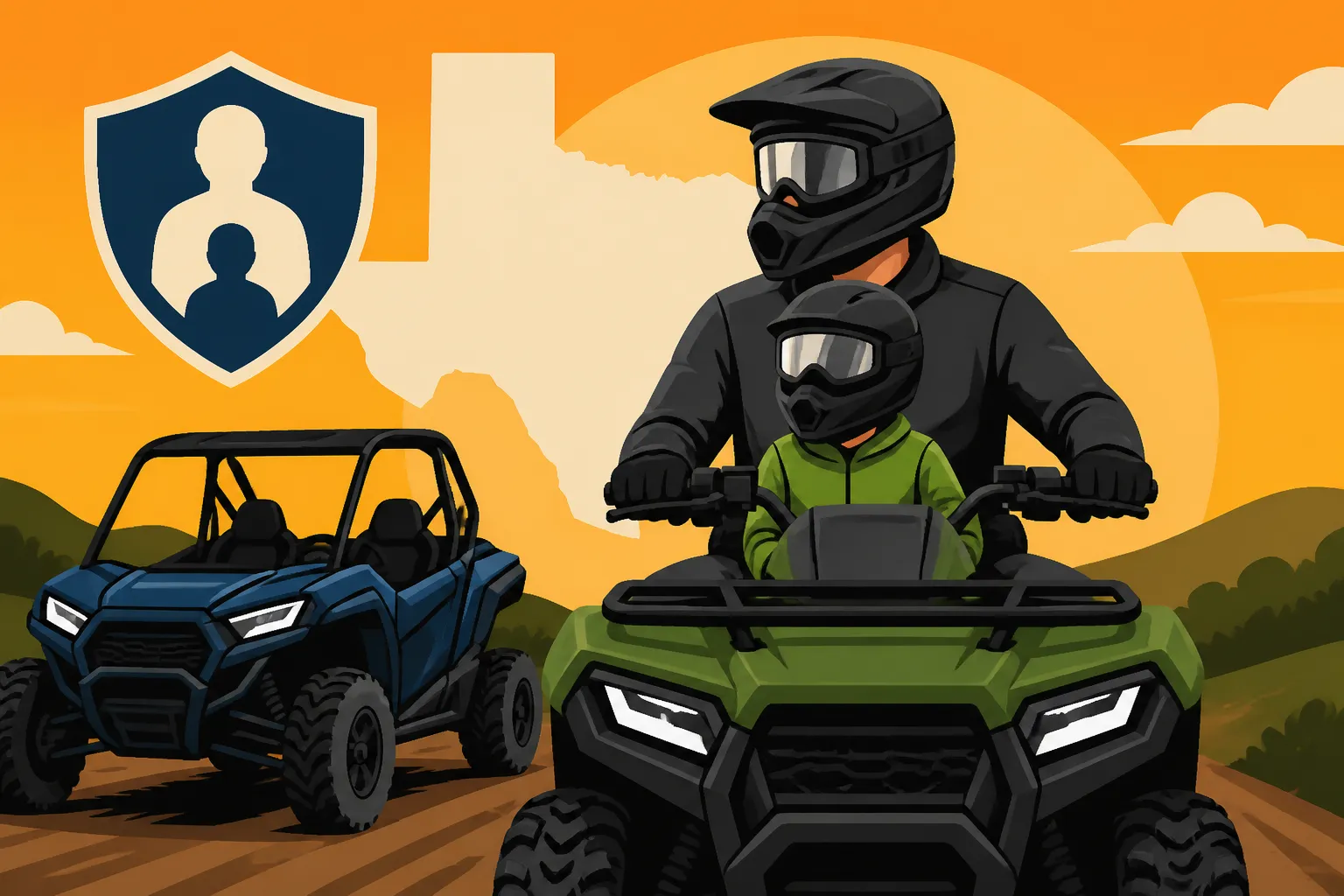
On public land, an operator aged 14 or older may ride without adult supervision if they hold a safety certificate. They may also ride under the direct supervision of a certificate holder. According to the Texas Legislature, anyone under 14 who operates an ATV on public land must instead be accompanied by and under the direct supervision of a parent, guardian, or authorized adult.
That distinction matters. For an operator aged 14 or older, the adult’s certificate is one route to meeting the safety-certificate requirement. For someone under 14, the law also requires a parent, guardian, or authorized adult to accompany and directly supervise them. Don’t assume that simply bringing a certified adult satisfies the under-14 rule if that adult does not also fit the required description.
| Rider and setting | What to plan for |
|---|---|
| Operator under 14 on public land | The Texas Legislature requires accompaniment and direct supervision by a parent, guardian, or authorized adult. |
| Operator aged 14 or older on public land | The Texas Legislature allows riding without adult supervision with a safety certificate, or riding under the direct supervision of a certificate holder. |
| Operator riding only on private property | Confirm which rules apply to the specific property and activity; the public-land supervision rules described here concern riding on public land. |
| Rider heading to a public OHV venue | Check both certificate requirements and the venue’s decal and access rules with the Texas Parks and Wildlife Department or the land manager. |
A certificate belongs to the person who completed the training. The supervising adult’s certificate does not become the younger rider’s certificate, and it does not authorize a different adult to supervise in their place. If another adult will take over supervision, confirm that person also holds a qualifying certificate and meets any age-based requirements that apply to the rider.
The Texas Parks and Wildlife Department recognizes certificates showing successful completion of the ATV Safety Institute’s ATV RiderCourse, including hands-on training, as well as equivalent safety-training certificates issued under the authority of Texas or another state. For the public-land operator requirement, Texas Parks and Wildlife Department guidance describes a certificate issued by the Texas Department of Public Safety or an equivalent certificate issued under another state’s authority. When in doubt about a particular course or card, check with the department before the ride.
If you need to sort out who needs their own certificate and which documents count, see The Texas ATV Safety Certificate Explained and Direct Supervision by a Texas Certificate Holder. For riders below the age threshold, Texas Rules for Riders Under 14 and Texas Minimum Age for a Safety Certificate cover related questions.
What direct supervision should look like on a real ride
The rule calls for direct supervision, not merely an adult’s presence somewhere at the riding area. A practical plan is to keep the certified adult actively involved: agree on the route, ride where the adult can monitor the operator, and pause if terrain, traffic, or visibility makes supervision difficult. This is sensible risk management, not a substitute for checking the official interpretation of the rule for a particular location.
Before setting out, make sure the adult and rider agree on how to communicate. A rider should know where to stop, what to do if the group becomes separated, and how to signal a problem. Pick terrain suited to the rider’s ability rather than relying on the adult’s experience to make a difficult route safe. If the younger rider is struggling to control the machine, stop and reassess instead of pressing on.
The safety certificate is only one part of readiness. According to the Texas Parks and Wildlife Department, ATV operators and passengers on public lands must wear a helmet that complies with United States Department of Transportation standards. The department also says that UTV occupants must wear seat belts when the vehicle is equipped with them. These requirements apply even when a rider is accompanied by a certificate holder.
Other equipment rules can affect whether a ride is ready to go. According to the Texas Legislature, ATVs and UTVs operated on public property or public lands must have a United States Forest Service-qualified spark arrester that has not been removed or modified. Texas Parks and Wildlife Department guidance also requires a lighted headlight and taillight from one-half hour after sunset to one-half hour before sunrise, and whenever visibility is reduced. Check the machine before leaving, and confirm the riding area’s additional rules.
Passenger rules are separate from supervision rules. According to the Texas Legislature, a person operating an ATV on public property cannot carry a passenger unless the machine was specifically designed by the manufacturer to transport one. A supervising adult riding nearby does not change what the ATV was designed to carry. Children operating or riding ATVs may also be subject to age and engine-size restrictions on public land and in state parks, so check the rules for the rider and vehicle combination.
For a broader preparation list, Carrying the Certificate on a Texas Ride explains what to have available if asked to show proof. If your group includes children, review Texas Supervision Rules for Young Riders before choosing a machine or route.
Certificate, decal, and title: three different things
A common planning mistake is treating an adult’s safety certificate as though it covers every requirement for the machine or the riding site. It does not. A safety certificate is training documentation for the rider. A Texas OHV decal is a separate requirement for certain public-land riding. A title is a record of ownership, not permission to ride.
The Texas Parks and Wildlife Department administers the OHV decal program. The department says riders in Texas state parks must display a valid Texas OHV decal. Texas does not offer reciprocity for out-of-state OHV registrations or decals, so nonresidents must purchase a Texas decal to ride on public lands. The department also says that ATVs and recreational off-highway vehicles operated exclusively on private property do not need the Texas OHV decal.
Before a trip, check whether the destination is public land, a state park, or a grant-funded venue and confirm its decal rules. Carry the rider’s valid safety certification while operating on public land and show it upon request, according to the Texas Parks and Wildlife Department. The department also says a valid Texas OHV decal must be displayed on the vehicle, or proof of purchase or a receipt should be readily available if the decal has not arrived.
Those documents do different jobs:
| Item | What it concerns | What it does not replace |
|---|---|---|
| Safety certificate | The rider’s qualifying safety training and, where applicable, the certificate-holder supervision option | The vehicle’s decal or ownership title |
| Texas OHV decal | Permission-related requirements for riding at covered public venues | The rider’s safety certificate or title |
| Texas OHV title | The vehicle’s ownership record | A public-land decal, safety certificate, or road registration |
Texas residents must title their off-highway vehicles, including ATVs and UTVs, with the Texas Department of Motor Vehicles, but these machines are not eligible for standard motor vehicle registration. That title requirement is separate from the supervision question. If you are buying or transferring a machine, Titling an ATV in Texas and The Texas OHV Decal Requirement Explained can help you keep the paperwork categories straight.
A certificate also does not turn a public-land ride into a road-legal trip. Supervision and training requirements do not grant permission to ride on roads or in areas where OHVs are prohibited. Confirm the permitted route and the land manager’s conditions before riding.
A practical checklist before riding together
Use this checklist to prepare, then verify any location-specific rules with the appropriate land manager.
- Confirm the rider’s age and the supervision route. According to the Texas Legislature, an operator under 14 on public land must be accompanied by and under the direct supervision of a parent, guardian, or authorized adult. An operator aged 14 or older may ride with their own certificate or under the direct supervision of a certificate holder.
- Check that the adult’s certificate qualifies. The Texas Parks and Wildlife Department recognizes the ATV Safety Institute’s ATV RiderCourse, including hands-on training, and equivalent certificates issued under Texas or another state’s authority. If the certificate is unfamiliar or the course was not hands-on, confirm its status before traveling.
- Plan for active supervision. Choose a route the rider can manage, keep the adult involved throughout the ride, and agree on how the group will stop or respond if someone needs help. The adult should not assume that being at the same venue is enough.
- Check the destination’s access requirements. Confirm whether the riding area requires a Texas OHV decal and whether it has additional safety or equipment rules. A certificate does not replace the decal.
- Carry the documents. The Texas Parks and Wildlife Department requires riders on public land to carry a valid safety certification and show it upon request. Keep proof of decal purchase readily available if the decal has not arrived.
- Inspect the machine and protective equipment. Check the required helmet for ATV riders and passengers, seat belts in equipped UTVs, lights, spark arrester, and the machine’s passenger capacity. Follow any additional rules for the venue.
- Keep the ride within the permitted area. An adult’s certificate does not authorize riding in a closed area, on a prohibited route, or somewhere the group lacks permission to use.
The consequences of ignoring a separate requirement can be significant. Operating an OHV without a required decal on public land is a Class C misdemeanor, and the Texas Parks and Wildlife Department says it can result in a citation and a fine ranging from $25 to $500. That is why it helps to check the destination’s decal rule before leaving, rather than relying on the adult’s certificate as proof that everything is covered.
Alcohol and drugs are another hard boundary, not a supervision workaround. The Texas Parks and Wildlife Department prohibits operating trail machines while under the influence of alcohol or drugs. Its state park rules also prohibit public display or consumption of alcoholic beverages, including on OHV trail systems.
For questions about certificates from another state, Texas Reciprocity and Why It Is One-Sided explains why an out-of-state decal does not remove the Texas decal requirement. For the rules about proof of training during a ride, see Carrying the Certificate on a Texas Ride.
Sources
- Texas Legislature — Transportation Code Title 7, Chapter 663. Certain Off-Highway Vehicles (checked November 2, 2026)
- Texas Parks & Wildlife Department — OHV FAQ — Texas Parks & Wildlife Department (checked November 2, 2026)
- Texas Parks and Wildlife Department — Prohibition of Wheeled or Tracked Motor Vehicles in Stream Beds (checked November 2, 2026)
Disclaimer
This article is for general informational purposes only and does not constitute professional advice. Laws, prices and regulations vary by location and change over time. Consult a qualified professional for guidance on your specific situation.