The Texas Department of Licensing and Regulation
Texas riders can easily confuse an ATV safety certificate with a park permit, an OHV decal or permission to ride on public land. The Texas Department of Licensing and Regulation has a specific role in rider education, but it does not issue every approval a ride may require. Knowing what the certificate does—and what it does not do—helps families plan without arriving short of paperwork.
What the Texas Department of Licensing and Regulation Does
The Texas Department of Licensing and Regulation (TDLR) oversees Texas’s ATV safety education program. That role is about rider training and certification: approved courses, the people who teach them, and the certificates that show a rider has completed the required training.
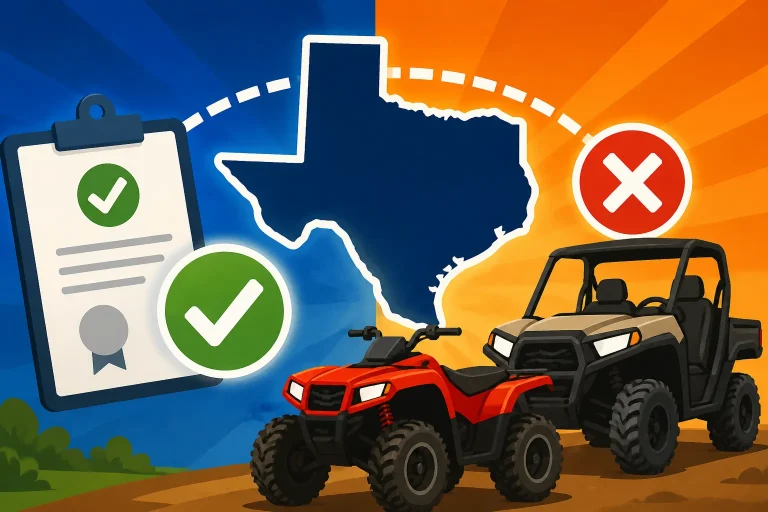
It helps to separate that responsibility from other parts of riding. TDLR’s safety certificate is not a general riding permit. It does not register or title an ATV, issue a Texas OHV decal, grant access to a trail, or make a machine street legal. Those requirements depend on the machine, the rider, and where the ride takes place.
| Requirement or document | What it addresses | What it does not do |
|---|---|---|
| TDLR-related safety certificate | Completion of required ATV safety training | Does not give access to a particular trail or property |
| Texas OHV decal | A state requirement for certain machines used on applicable public land | Does not replace a safety certificate |
| Park permit or admission | Access to a specific riding area under its rules | Does not replace state requirements |
| Title | Ownership record for a machine | Does not authorize road use or trail access |
| Permission from a landowner | Access to private property | Does not waive other applicable safety or land rules |
This separation matters most when a child is riding. A parent may have the machine’s paperwork and a valid park reservation, yet still need to check the course and supervision rules. Likewise, an adult who has completed training may still need a decal or a separate land-use permit.
For the larger picture of decals, certificates and where each applies, see Texas OHV Safety Certificates and The Texas OHV Decal Requirement Explained. If the question is about ownership paperwork rather than rider training, The Texas Department of Motor Vehicles and OHVs explains the separate vehicle-title role.
Who Needs a Certificate and What It Means
The certificate is evidence of completing an approved safety course. It is not simply a card that comes with an ATV purchase or a substitute for reading the owner’s manual. The course is intended to prepare riders to operate safely, recognize hazards and understand their responsibilities.
Age is especially important. Texas does not issue an ATV safety certificate to a child below the program’s minimum age. That means a young rider cannot take the certificate requirement into their own hands by completing the course early. When a rider is under 14, check the applicable supervision rules and do not assume that a parent standing nearby automatically meets them. Texas’s under-14 requirements are discussed in What Texas Requires of Riders Under 14 and Texas Rules for Riders Under 14.
Where the rules require a qualified adult to supervise a younger rider, confirm that the adult holds the required certificate and can provide direct supervision. A certificate belonging to a different adult in the group may not satisfy the rule if that adult is not the one actually supervising. Nor should families assume that the course card of an older sibling, guide or rental employee covers the child.
The age threshold and supervision requirement are not the same thing. A child’s age may affect whether they can be certified, while a separate rule determines whether and how they may ride. The machine’s size, its passenger capacity, the land manager’s requirements and the child’s ability to control it are additional considerations. A certificate does not mean every machine is suitable for every rider.
If a child is below the course’s minimum age, plan around the applicable supervision requirements instead of looking for a way to obtain a certificate that is not available to them. The details can depend on the location and activity, so check with the land manager before the trip. The overview at Texas Minimum Age for a Safety Certificate can help clarify the age question.
A certificate also has limits for adults. Completing a course does not eliminate the need to ride within your ability, follow the machine manufacturer’s limits or obey land-specific restrictions. It does not authorize riding on a road, waive helmet or equipment requirements, or give a rider permission to use closed trails. Think of it as one safety credential within a larger set of responsibilities, not a blanket endorsement for any ride.
How to Find and Complete an Approved Course
If a rider needs a certificate, the practical first step is to locate a course that is approved under the Texas program. Do not assume that any online ATV course, dealer session or informal safety talk produces a certificate recognized for Texas requirements. Before paying or making travel plans, confirm that the course and instructor are approved and that successful completion results in the certificate you need.
Texas’s required rider training is hands-on. A short online module or a video can be useful preparation, but it should not be treated as a replacement unless the program specifically recognizes it for the required certification. The hands-on element allows a rider to practice core skills and receive instruction in a controlled setting. Course details, availability and enrollment procedures can vary, so confirm them with the provider.
Use this process to avoid a last-minute paperwork problem:
- Check the rider’s age and the applicable rule. Establish whether the rider needs a certificate, must be supervised, or falls under another age-related requirement. If the rider is under 14, read Texas Supervision Rules for Young Riders as well as the course information.
- Find a provider through the appropriate program information. Use the state’s current information for approved courses or schools. Finding a Texas RiderCourse School offers a related starting point.
- Ask what the course includes. Confirm whether it is hands-on, what equipment the rider must bring, how long the session lasts and what the provider requires for enrollment.
- Confirm the certificate outcome. Ask how the certificate is issued, how to access it afterward and what proof the rider should carry. Do not rely on a verbal assurance that a course is “recognized” without confirming what certificate it provides.
- Keep the proof accessible. Save the certificate in a place where the rider or supervising adult can show it if asked. Carrying a readable paper or digital copy is sensible, but check whether the riding location requires a particular form of proof.
- Check the destination’s rules separately. A course certificate does not automatically meet a park’s admission, decal, permit, width, equipment or trail restrictions.
A course is also useful even when a rider is not required to have a certificate for a particular private-land outing. Training can help riders develop safer habits before they encounter obstacles, changing terrain or other machines. But voluntary training does not replace required supervision or land rules.
Families should consider the rider’s readiness, not just the minimum age. A young rider who has completed a course may still need a smaller machine, close supervision and a route that matches their experience. A certificate does not establish that a rider is physically or developmentally ready for a particular ATV or UTV.
Reciprocity, Decals and Other Rules Are Separate
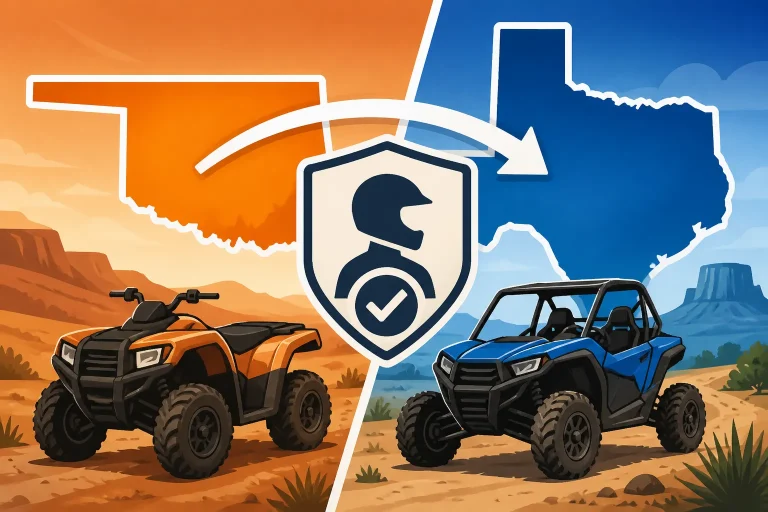
A certificate from another state may be recognized in Texas, but the course’s name or the fact that it was completed elsewhere is not enough to establish acceptance. Check that the credential meets Texas’s requirements before relying on it. If you are bringing a child or machine from out of state, confirm both the certificate and any supervision rules that apply once you ride in Texas. See Does Texas Accept an Out-of-State Safety Certificate? and Texas Reciprocity and Why It Is One-Sided.
Reciprocity for safety training does not mean every other requirement travels with the certificate. A valid safety credential does not automatically cover the Texas OHV decal requirement, park admission, a national forest fee or a permit required by a specific property. It also does not make the machine street legal or exempt the rider from rules about helmets, passengers, lights or trail width.
Before heading to a riding area, check these questions independently:
- Is a safety certificate required for this rider? Consider the rider’s age and the rules for the specific use.
- Does an adult need to supervise? If so, confirm who must supervise and whether that adult needs a certificate.
- Does this machine need a Texas OHV decal? Requirements vary according to the land and the machine’s status. The decal is not a substitute for a course certificate.
- Does the destination require an additional permit, fee or registration? A public trail system may have its own entry process.
- Are there machine restrictions? Width limits, passenger rules and equipment requirements may affect whether the vehicle can use the route.
- Is the trail open? Weather, maintenance or seasonal restrictions can close a route even when the rider has all required credentials.
The rules for private land differ from public-land requirements, and the details depend on who controls the land. Permission from a private landowner does not necessarily remove the need to follow safety laws, but the state decal rules do not simply apply to every private-property ride. For more on where a decal is needed, see Where a Texas OHV Decal Is Required and Why Private Land Needs No Texas Decal.
For a visit to a national forest, a state decal and the forest’s own day-use requirements should be checked separately. The course certificate does not pay a trail fee, and a trail fee does not demonstrate that the rider has completed training. Likewise, a park may set its own requirements for helmets or other protective gear. Check the destination’s current rules directly instead of assuming that a certificate settles the question.
If you are riding with a rental machine, ask the rental provider what it supplies and what the renter must bring. A rental company may explain its own safety briefing or waiver process, but do not assume that a rental agreement replaces state training requirements. The same distinction applies to guided rides: a guide’s presence is not automatically the same as legally required supervision by a qualified adult.
A Practical Pre-Ride Check
The easiest way to use TDLR’s role correctly is to treat the certificate as one item on a pre-ride checklist. Start with the rider, then the machine, then the destination. That order makes it less likely that a family will focus on the vehicle paperwork while overlooking an age or access requirement.
For each rider, record their age, whether they hold the required certificate and who will supervise if supervision applies. If relying on a certificate earned outside Texas, confirm acceptance before travel. Keep a copy of the certificate accessible, and make sure the supervising adult understands what direct supervision entails in the setting where the ride will happen.
For each machine, identify whether it is an ATV or UTV and confirm that it is suitable for the rider. Check that the machine’s seating is designed for the passengers who will use it. A certificate does not make it safe or lawful to carry a passenger on a machine without a manufacturer-designed passenger seat. Check the machine’s equipment and condition, too, especially if it is rented, borrowed or newly purchased.
For the destination, check its land manager’s rules rather than relying on a general statement that the area is open to OHVs. Confirm access, permits, decals, trail width limits, hours, closures and any required protective equipment. If the route includes a public road, do not assume that training or a decal grants permission to ride there. Texas has limited exceptions to the general road-use restrictions; details are covered in Why Texas Will Not Register an OHV for the Road.
If a course provider, rental company or park gives you information that seems inconsistent with the state’s requirements, ask which specific rule or credential they mean. For example, “safety card,” “decal,” “permit” and “park pass” can refer to different things. Getting the exact name of the requirement helps you verify it and avoid arriving with the wrong document.
A concise checklist for the day before the ride:
- Confirm the rider’s age and certificate status.
- Confirm whether the rider needs a certificate or must ride under qualified supervision.
- Verify that any out-of-state certificate is accepted.
- Check the machine’s suitability, passenger seating and condition.
- Confirm the OHV decal and destination permit requirements separately.
- Check current trail access, width limits and closures.
- Save proof of training and access documents where they can be retrieved.
- Review the route and safety expectations with every rider.
When requirements are unclear, ask the relevant program or land manager before setting out. TDLR is the right point of reference for its safety education program; the authority managing the trail or property is the right place to confirm local access conditions. One agency’s approval should not be treated as a substitute for another’s.
Frequently Asked Questions
Does TDLR issue Texas OHV decals?
No. A safety certificate and an OHV decal serve different purposes. Check the current decal requirements and where they apply at The Texas OHV Decal Requirement Explained.
Can a child under 14 receive a Texas ATV safety certificate?
The Texas program has a minimum age for certification, so a child below that age should not assume they can qualify by taking the course. Check the supervision rules that apply to the child and the riding location.
Does an out-of-state ATV safety certificate count in Texas?
Some out-of-state certificates may be accepted, but confirm that the specific credential meets Texas requirements before relying on it. A certificate from another state does not automatically satisfy decal, park or land-access rules.
Does a safety certificate let me ride an ATV on Texas roads?
No. The certificate demonstrates training; it does not authorize road use. Texas road-use rules have limited exceptions, and riders should check whether a particular route qualifies.
Is a certificate enough to enter an OHV park?
Not necessarily. A park may have separate admission, decal, permit, equipment and trail rules. Contact the park or land manager to confirm current entry requirements.
Disclaimer
This article is for general informational purposes only and does not constitute professional advice. Laws, prices and regulations vary by location and change over time. Consult a qualified professional for guidance on your specific situation.