Why Private Land Needs No Texas Decal
Texas ATV and UTV riders often hear that a state OHV decal is required, then wonder whether that applies on their own land or a private ranch. The short answer is generally no: Texas does not require the state decal just to ride on private land. The key is knowing where the property ends, what the landowner requires, and whether your route enters a place where the decal applies.
The basic rule for riding on private land
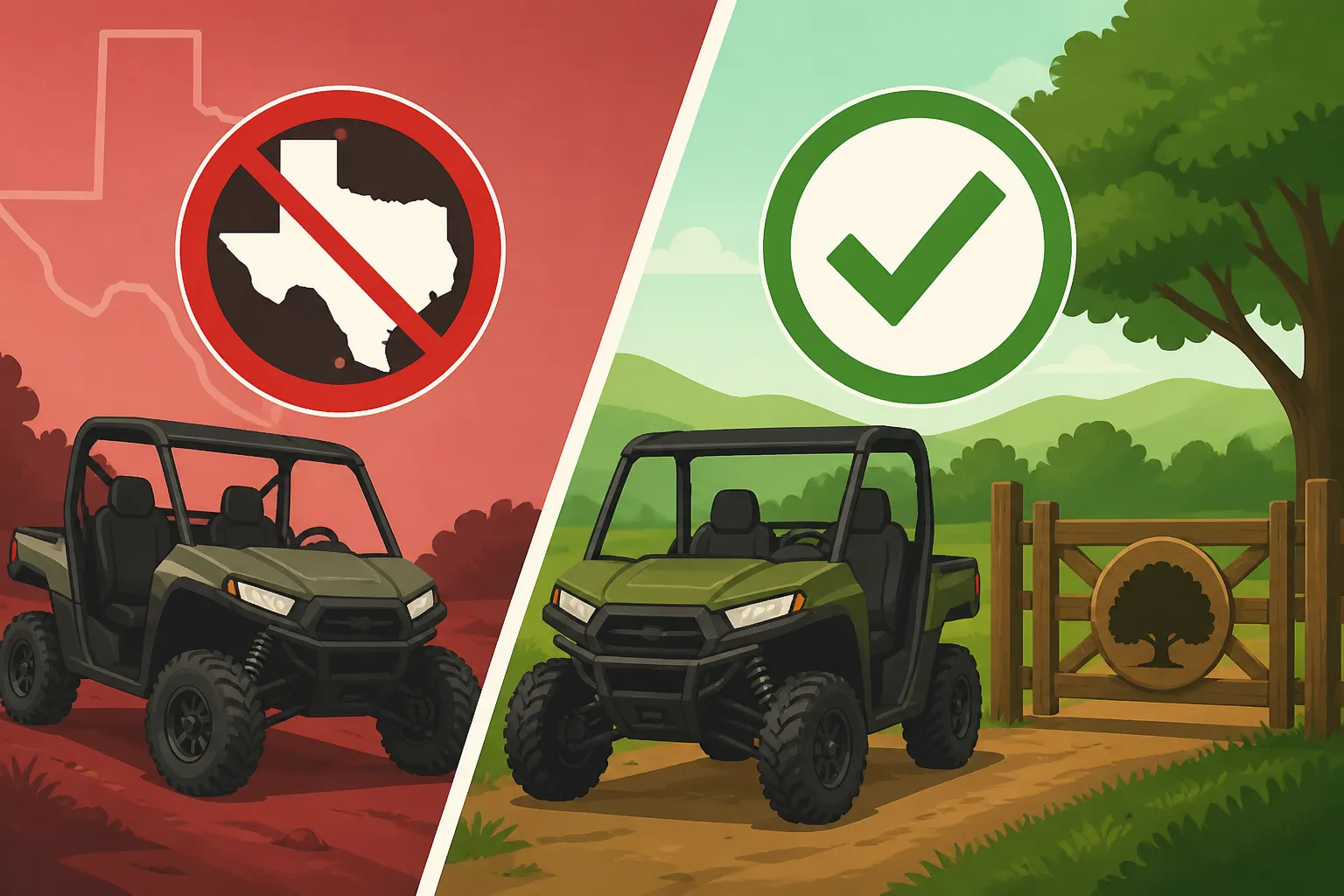
Texas’s OHV decal requirement is tied to operating an off-highway vehicle on covered public land, not simply to owning or riding an ATV or UTV anywhere in the state. If you are riding entirely on private land, the state OHV decal generally is not required for that ride.
That includes riding on land you own and on private property where the owner has given you permission. The permission may be informal for a family property, or it may come with written rules for a ranch, hunting lease, or private riding area. Either way, the landowner’s rules are separate from the state decal requirement.
The distinction is about the land and the ride, not the machine’s appearance. A quad used only on private acreage does not need a Texas OHV decal just because it is an ATV. Nor does a UTV need one solely because it has a roll cage, side-by-side seating, or a utility bed. A machine’s classification may matter for other Texas laws, but it does not turn a private pasture into public land.
| Where you ride | Is the Texas OHV decal generally required? | What else to check |
|---|---|---|
| Private land you own | No, for riding confined to that land | Property boundaries, local restrictions, safe operation |
| Private land with the owner’s permission | No, for riding confined to that land | Permission, lease rules, park or landowner conditions |
| Covered public riding land | Generally yes, unless an exception applies | Site rules, permits, safety requirements, current access conditions |
| A route that starts private and enters public land | The decal may be required for the public-land portion | Exact boundary, route, and any exception |
| A private OHV park or riding venue | Not automatically exempt; site conditions matter | Whether the land is covered by program requirements and what the operator requires |
This is a useful starting point, not a substitute for checking a specific property. A private parcel can sit beside public land, contain a public access route, or be operated under special conditions. If the ride might cross a boundary, do not assume the private-land rule covers the whole route.
For a broader explanation of the decal’s purpose and scope, see The Texas OHV Decal Requirement Explained. The key point is that the decal is not a general statewide registration sticker for every ATV and UTV.
How to tell whether the land is private or covered public land
The hardest part is often not understanding the basic rule. It is figuring out what land you are actually riding on. A ranch road may look like a private trail, but appearance alone does not establish ownership or access rights. Likewise, a private park can have conditions that differ from a private ranch.
Before you ride, identify the property boundaries and the status of the route. Ask the owner, lease manager, or site operator if you are not sure. A map can help, but posted signs, recorded access arrangements, and direct confirmation are more useful than guessing from a fence line or trail entrance.
A private ranch or family property
If you own the property, or have permission from the owner, and your ride stays on that private property, the Texas OHV decal generally is not required. That does not make the land unrestricted. The owner can set rules about where vehicles may go, who may ride, which machines are allowed, and whether guests need permission.
A hunting lease can add another layer. The leaseholder may have access rights but not authority to allow every kind of vehicle use. Confirm with the person who controls the relevant land and access, rather than assuming permission to hunt or visit automatically includes permission to ride. [Texas Rules for Riding a Hunting Lease] covers that separate question.
Private land may also be subject to a landowner’s safety, conservation, or seasonal restrictions. Those rules can be stricter than the state’s decal requirement. A no-decal rule does not override a closed gate, a seasonal closure, a lease agreement, or a landowner’s instruction to stay off a particular area.
A private riding park or commercial venue
A riding venue may be privately owned and still have its own entry requirements. The operator can set conditions for access, including requiring a state OHV decal, a site pass, a waiver, or specific safety equipment. Those venue rules do not necessarily mean the state decal is required on every private property in Texas; they mean the operator has established conditions for using that site.
There can also be a difference between land that is privately owned and land that is treated as covered public riding land for a particular program or site. If a park has received public support or is managed under an arrangement that affects its operating requirements, do not decide the decal question based on the deed alone. Ask the site operator whether a Texas OHV decal is required for the trails you plan to use.
A park’s own entry charge is not the same thing as the state OHV decal. The park may collect a day-use fee or require a membership even when the state decal is not required, and a state decal does not automatically pay for admission. Why a Park May Charge More Than the State explains why access charges and the state decal are separate costs.
Trails and routes that cross a boundary
A ride can begin on private land and still enter a public area. That may happen where a ranch connects to a public trail system, a public road, a government-managed recreation area, or another property with its own access rules.
If you plan to cross onto covered public land, check whether the decal is required for that section. Do not rely on the fact that the vehicle started the day on a private parcel. The relevant question is where the ATV or UTV is being operated.
When a route crosses several parcels, get permission for each private portion and confirm the rules for each public portion. A trail easement or customary route does not necessarily mean that the land is open for unrestricted OHV use. Texas Rules for Riding Private Land With Permission and Texas Rules for Riding Public Land address the permission and public-land sides of that distinction.
Situations that can change the answer
The private-land exemption is simple when the land is clearly private and the ride stays there. A few situations call for closer checking because the property, access, or vehicle’s use may not fit that straightforward case.
Public access or public management
A location may be open to visitors without being ordinary private land. It may be publicly owned, managed by a public agency, or operated under an arrangement that affects riding rules. Conversely, a private operator may control access to land that has specific program conditions.
Do not treat “open to the public” and “private land” as interchangeable. The first describes who may visit; the second describes ownership or legal control. Neither phrase alone answers whether the state decal applies at a particular riding area. Ask the land manager or operator which rules govern the trails.
Where a site participates in a public OHV program, its published requirements are especially important. The state decal program supports designated OHV recreation, and site-level conditions can apply even when a rider thinks of the venue as privately run. Where a Texas OHV Decal Is Required can help frame the question, but the site manager is the practical source for the status of a particular trail.
Nonresidents and out-of-state decals
Being from outside Texas does not turn private Texas property into decal-required land. If you are riding only on private property with permission, the general private-land rule still applies.
If your trip includes covered public land, however, do not assume an out-of-state sticker or certificate automatically replaces a Texas requirement. Reciprocity can differ by program, and decal rules are not the same as safety-certificate rules. Check the current Texas requirements for the specific land you plan to ride. See Does a Nonresident Need a Texas OHV Decal? for the visitor question.
Rental machines and organized rides
Renting an ATV or UTV does not determine whether a decal is required. The land and the terms of the ride still matter. A rental business may include a decal or arrange access requirements for a particular destination, but riders should ask what is included and where the machine may be operated. Do not assume the rental paperwork covers every public area you might enter. [Texas OHV Decal for a Rented Machine] addresses that distinction.
Organized rides can also involve additional conditions. A private group ride on private land is different from an event using public land or a managed trail system. The organizer should explain the required decals, permissions, and site rules before participants arrive. A participant’s belief that the ride is “private” does not settle the matter if the route uses land with separate requirements.
A decal is not a title, plate, or permission slip
Because Texas uses different requirements for different purposes, it helps to separate the OHV decal from vehicle paperwork and land access.
A title documents ownership. An off-highway plate is a separate title-related item, and neither should be treated as permission to ride on a particular property. The state OHV decal is connected to riding on covered land. Landowner permission is yet another matter. Having one does not automatically provide the others.
| Requirement or document | What it is for | What it does not do |
|---|---|---|
| Texas OHV decal | Meets the decal requirement where it applies | Does not grant permission to enter private land |
| Title | Records ownership of the machine | Does not authorize riding on public trails |
| OHV plate | A title-related plate for the machine | Does not replace a required decal |
| Landowner permission | Allows access to private property under stated conditions | Does not waive requirements that apply on covered public land |
| Safety certificate | Addresses operator education requirements where applicable | Does not replace a decal or site access approval |
This distinction matters even when a machine never leaves a ranch. The absence of a decal requirement for a private ride does not necessarily remove title obligations or other legal duties. For example, a sale or ownership transfer can still require paperwork. Titling an ATV in Texas explains the title side, while [Texas OHV Safety Certificate Requirements] covers the separate operator-education issue.
Likewise, a decal does not make an ATV street legal. It is not a road registration, and it does not grant the right to ride on a public street or county road. Road use has its own restrictions and exceptions. If the plan includes any road travel, check the rules for that route rather than treating a decal as road authorization.
How to check before you ride
A few minutes of checking can prevent a denied entry, an unexpected stop at a boundary, or a disagreement with a landowner. Use this process whenever the property status is unclear or the route may include more than one type of land.
- Identify the exact riding area. Get the address, trail map, gate location, or parcel information. Do not rely only on a general destination name.
- Confirm who controls access. Ask the property owner, lease manager, park operator, or land manager who can authorize the ride.
- Ask directly about the Texas OHV decal. Explain whether you will ride only on private property or enter public trails as well. If the site has special program conditions, ask whether they apply to your route.
- Check the full route, not just the starting point. Include connectors, access roads, crossings, and any return path that could leave the private parcel.
- Ask about separate entry requirements. Find out whether the operator requires a site pass, waiver, reservation, proof of insurance, safety equipment, or other conditions.
- Keep permission and instructions available. For a lease, ranch, or private venue, retain the relevant written permission or entry information and follow posted rules.
- Recheck before a return visit. Access conditions and site rules can change. Confirm current requirements before hauling the machine to the property.
When calling a site, use a precise question: “Does this specific trail require the Texas OHV decal, or is it entirely on private land with separate entry rules?” That is more likely to get a useful answer than asking whether the whole property is “private.”
If the operator cannot answer, ask who manages the property or which agency administers its OHV requirements. Until you have a clear answer, avoid assuming that a private-looking gate or a landowner’s permission covers an adjacent public trail.
Frequently Asked Questions
Do I need a Texas OHV decal to ride an ATV on my own land?
Generally, no. The state decal is not required just because you operate an ATV on private property you own. Other laws and property-specific restrictions may still apply.
Does a friend need a decal to ride my private ranch?
The state decal generally is not required for a ride confined to private land. Your friend still needs your permission and must follow any conditions you set. If the ride enters covered public land, check the decal requirement for that portion.
Can a private OHV park require the state decal?
Yes, a private operator can make a decal one of its access conditions. A site may also have requirements tied to how its trails are managed or supported. Ask the operator about the exact property and routes.
Does the decal let me ride on private land without permission?
No. A decal does not grant land access. You still need permission from the person who controls the property, and you must follow the conditions of that permission.
Disclaimer
This article is for general informational purposes only and does not constitute professional advice. Laws, prices and regulations vary by location and change over time. Consult a qualified professional for guidance on your specific situation.