Texas National Forest OHV Fee
Planning an ATV or UTV ride in a Texas national forest means budgeting for more than fuel and trail snacks. The federal trail-use fee, a Texas OHV decal, and any rider or vehicle requirements serve different purposes, so one payment may not cover the others. Here’s how to tell what you may need, where the fees apply, and what to check before heading out.
What the Texas National Forest OHV Fee Covers
For many Texas riders, the relevant national forest OHV trail is the Sam Houston National Forest trail system. Its designated trail offers about 85 miles of riding, but a visit can involve a fee separate from state OHV requirements. The fee is for using the designated recreation area under the terms posted there; it is not a general permit to ride anywhere in the forest.
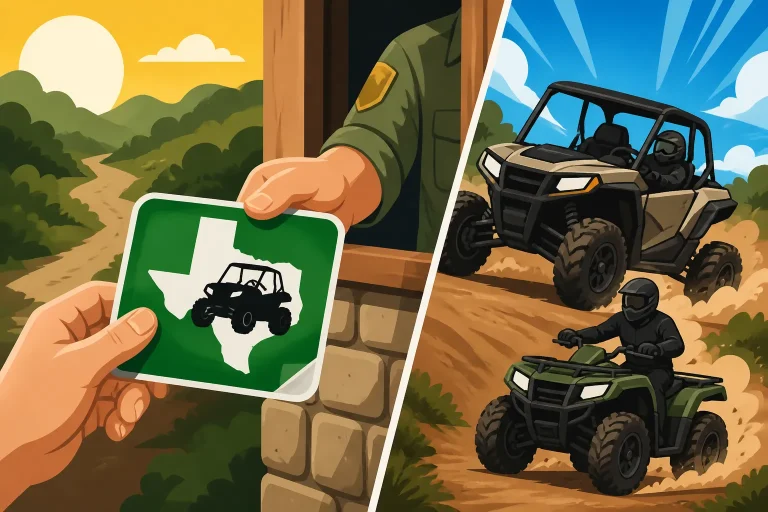
A day-use payment is intended for a ride during the period specified by the current trailhead instructions. Some trailheads have used self-service fee stations, where riders pay and follow directions for displaying or keeping proof of payment. Do not assume the process, accepted payment methods, or exact fee are unchanged. Check current Forest Service information and the signs at the trailhead before riding.
Past information has listed a $5 day-use payment and a $25 national forest annual pass. Treat those figures as a reference, not a guarantee of the current charge. Fees and payment procedures can change, and the posted instructions at the riding area control.
| Payment or requirement | What it is for | What it does not replace |
|---|---|---|
| National forest day-use fee | Access to the designated fee area for the period described by the Forest Service | Texas OHV decal, safety requirements, or permission to ride closed or undesignated routes |
| National forest annual pass | Eligible use at the sites and under the conditions listed for that pass | Every federal recreation fee, state OHV decal, or separate park charge |
| Texas OHV decal | Texas OHV program requirement where it applies | National forest day-use fee or trail-opening status |
| Safety certificate | Rider qualification requirement for riders covered by Texas rules | Any fee, decal, or land-access permission |
The fee is attached to access and use, not to ownership of an ATV or UTV. Buying a machine, carrying a Texas title, or holding an OHV plate does not by itself pay the national forest fee. Likewise, paying the forest fee does not make every forest road or trail open to motorized riding. Stay on routes designated for your type of machine and follow closures.
The Sam Houston route is not a general invitation to ride off-trail. Soil conditions, maintenance, weather, and other resource concerns can lead to temporary closures. Before departure, check Riding the Sam Houston Trail and Calling the Trail Status Line. A fee paid in advance does not override a closure, and a trail being shown on an old map does not establish that it is currently open.
Annual Pass, Day Payment, and the Texas OHV Decal
A national forest annual pass may be useful for riders who return often, but the pass is only worthwhile if its terms match the way you ride. Check which recreation sites it covers, whether it applies to OHV trail use, how long it is valid, and whether it covers one person, one vehicle, or another defined unit of use. Do not assume that a pass for one national forest site covers every federal recreation area.
For an occasional ride, paying the day-use fee may be simpler. For frequent visits, compare the current annual-pass terms with the fees you expect to pay. The calculation should include only visits to eligible sites. A pass that covers a particular fee does not necessarily cover camping, special events, another agency’s recreation fee, or any required state decal.
The Texas OHV decal is a separate state requirement. It supports the state’s OHV program and may be required when riding on qualifying public land. It is not the same thing as a Forest Service day-use payment or annual pass. For a closer explanation of the state sticker, see The Texas OHV Decal Explained and Where a Texas OHV Decal Is Required.
Keep the distinction clear when budgeting:
- The Forest Service fee addresses use of the designated federal recreation area under its posted terms.
- The Texas OHV decal addresses state OHV program requirements where those apply.
- A safety certificate addresses rider qualification rules for riders who must hold one.
- A trail closure or route restriction still applies regardless of what you have paid or carry.
This means you may need both a national forest payment and a Texas OHV decal for the same outing. Paying one does not automatically waive the other. The same is true in reverse: having a current state decal does not satisfy a federal fee requirement.
If you are comparing the national forest visit with riding at a state or private OHV park, check each site’s own rules. A park may charge its own entrance or riding fee, require a separate decal, or have restrictions that differ from the national forest. The phrase “OHV fee” is not one universal payment recognized at every Texas riding area.
Nonresident Riders and Reciprocity
Out-of-state visitors should separate three questions: whether Texas requires a state OHV decal, whether Texas accepts their safety certificate, and whether the national forest fee applies to their visit. These are different rules, administered for different purposes.
Do not assume that an OHV decal from another state substitutes for the Texas decal. Texas reciprocity for OHV requirements is not a blanket exchange of every state’s stickers and permits. If you are bringing a machine from outside Texas, review Does a Nonresident Need a Texas OHV Decal? and Texas Reciprocity and Why It Is One-Sided before traveling.
A safety certificate is another separate issue. Texas may recognize certain out-of-state certificates under its rules, but that does not remove a federal recreation fee or authorize riding on a closed route. Check Does Texas Accept an Out-of-State Safety Certificate? if the rider completed training in another state.
Nonresident riders should also avoid confusing a machine’s registration or license plate with an OHV decal. A plate or title may establish ownership or vehicle status, but it does not necessarily cover the requirements for riding on a national forest trail. Confirm the rules for the specific machine and the specific land.
For a trip with several riders or machines, check the fee station’s instructions for how payment is assessed. A fee may be handled per person, vehicle, day, or another unit defined by the agency. Do not assume one pass or receipt covers an entire group. If the terms are unclear, resolve that before unloading or riding rather than relying on another rider’s payment.
Before You Head to the Trailhead
A little preparation prevents the common problem of arriving with the wrong payment, an expired pass, or a machine that cannot use the route. Use this checklist before leaving:
- Confirm the trail is open. Check current Forest Service trail information and closures. Recent rain or wet soil can affect trail access. See Texas Trails After Heavy Rain for why conditions matter.
- Confirm the fee and payment process. Check the current day-use charge, annual-pass coverage, payment options, and instructions for displaying or retaining proof.
- Check Texas OHV decal rules. Determine whether each machine needs a Texas decal for the land you plan to ride. Do not treat the federal payment as a substitute.
- Review machine restrictions. The Sam Houston trail has a width limit. Confirm the current measurement method and maximum allowed width before taking a wide UTV or side-by-side. Texas’s 50-Inch National Forest Width Limit explains the issue.
- Carry proof and follow posted directions. Keep receipts, passes, and any required certificates accessible. If the fee station instructs riders to display proof, follow that instruction exactly.
- Check rider requirements. Age, supervision, and safety-certificate rules may apply independently of fees. Review Texas Rules for Riders Under 14 if a child will ride.
- Have a backup plan. If the trail is closed, the fee station is unavailable, or your machine does not meet the trail limit, do not improvise by riding an undesignated forest road. Choose another legal riding area.
Practical planning also includes more than the fee itself. Confirm fuel availability, trailhead access, weather, and whether you have enough water for the ride. If you shop for ride supplies through Amazon, check that any safety equipment or accessories fit your machine and meet the specific requirements of the trail or park; a purchase does not establish compliance.
The best way to avoid confusion is to check the national forest’s current information shortly before the trip, then read the trailhead signs when you arrive. Budget for the Forest Service use fee where required, verify whether a state OHV decal also applies, and treat every pass or certificate as limited to the purpose stated in its rules. That approach is more reliable than assuming one sticker, receipt, or out-of-state permit covers everything.
Disclaimer
This article is for general informational purposes only and does not constitute professional advice. Laws, prices and regulations vary by location and change over time. Consult a qualified professional for guidance on your specific situation.