Does a Nonresident Need a Texas OHV Decal?
A visitor can bring an ATV or UTV across the Texas line and still be unsure whether its home-state sticker is enough. The practical answer depends on where you plan to ride, what kind of machine you have, and whether a park requires its own permit. Here’s how to sort out the Texas OHV decal before you unload.
The short answer for nonresidents
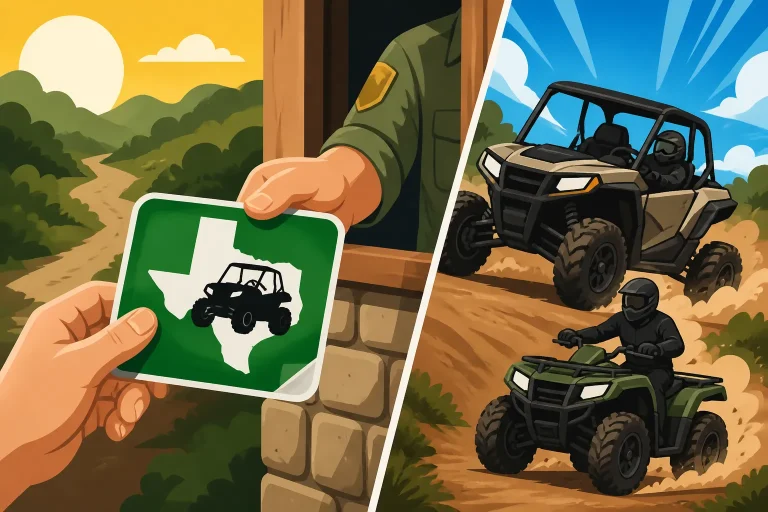
If you are riding an off-highway vehicle on a Texas public riding area where the state OHV decal is required, plan on getting a Texas decal even if you live elsewhere. Residency does not generally remove the requirement, and a decal or registration from your home state should not be assumed to take its place.
The Texas OHV decal is different from a title, a license plate, a safety certificate, and a park entrance permit. Each serves a separate purpose. A Texas title documents ownership; an OHV plate is tied to titling and is not ordinary road registration. The decal is associated with riding on qualifying public land. A park or land manager may also charge admission or require another permit.
That distinction matters because “the machine is legal at home” does not answer every Texas question. An out-of-state registration may show that the machine is registered where you live, but it does not automatically satisfy Texas’s public-land decal requirement. Likewise, a safety certificate accepted in Texas is not a substitute for the decal. Texas’s approach to safety-certificate reciprocity and decal requirements is different; see Texas Reciprocity and Why It Is One-Sided.
| Your situation | What to plan for |
|---|---|
| Nonresident riding an ATV or UTV on a Texas public OHV area | Get a Texas OHV decal if the area is covered by the requirement |
| Machine has an out-of-state OHV sticker | Do not assume that sticker replaces the Texas decal |
| Riding only on private property with the owner’s permission | A state public-land decal is generally not the same requirement, though the property owner may set conditions |
| Riding a street-legal, registered vehicle | The decal rules may differ from those for an OHV; confirm how the machine is classified |
| Visiting a park with an entry permit or day-use fee | Check whether the park requires both the Texas decal and its own fee or permit |
The safest planning rule is simple: if your trip includes a Texas public OHV riding area, check the decal requirement before you travel and buy the Texas decal if required. The state program and land manager can clarify how the rule applies to a particular area or machine. The overview in The Texas OHV Decal Explained is useful if you also need to understand what the decal does and does not cover.
Where the decal applies and what it does not cover
The decal requirement is tied to the place where you ride, not simply to the state where the machine is titled or the rider lives. Texas visitors commonly need to think about it when planning to use public OHV trails or recreation areas. A public area can have its own operating rules, hours, fees, closures, and vehicle restrictions in addition to the state decal requirement.
Do not read “public land” as permission to ride anywhere that happens to be publicly owned. A road, park, or open space may not be open to OHV use at all. A decal does not give permission to enter a closed area, leave a marked trail, or ride on a road where OHVs are prohibited. Before heading out, verify both whether OHVs are allowed and which documents or payments the manager requires. Where a Texas OHV Decal Is Required and Texas Rules for Riding Public Land cover those separate questions.
Private property is different. A rider who stays on private land with the owner’s permission generally does not need a state decal solely because the property is in Texas. But permission to ride on private land does not automatically cover the road to get there, a neighboring parcel, a public trail, or a privately operated park’s own rules. A private riding facility may choose to require proof of a decal or charge its own admission, so ask the operator rather than treating “private land” as a blanket exemption.
A street-legal vehicle can also be treated differently from a vehicle operated as an OHV. The relevant question is not just whether the machine has lights, mirrors, or a plate. Confirm whether it is actually registered for highway use and how the land manager classifies it. An OHV plate used for title identification is not the same thing as a road registration. For the distinction, see Why a Street-Legal Machine Skips the Texas Decal.
The decal also does not replace a land manager’s day-use charge or access permit. For example, a public trail may require visitors to show that they have paid a separate fee even when the machine has the state decal. The decal is not an all-purpose pass to every Texas trail or public recreation area. If you are planning a national forest ride, check the specific trail’s requirements as well as the decal rule; Does a Texas OHV Decal Cover the Forest Day-Use Fee? explains why those charges should be considered separately.
Why an out-of-state sticker may not be enough
State OHV programs are not interchangeable by default. A decal issued elsewhere may be valid for riding under that state’s rules, but Texas visitors should not assume it grants the same access or fulfills Texas requirements. Treat the Texas decal as its own requirement unless the relevant Texas authority confirms that a specific exception applies.
This is especially easy to confuse with reciprocity for rider safety credentials. Texas may recognize a qualifying out-of-state safety certificate in situations where one is required, but that does not mean an out-of-state OHV sticker is automatically accepted in place of the Texas decal. A certificate belongs to the rider; a decal belongs to the machine and its use in covered areas. They solve different problems.
Nor should an out-of-state license plate be confused with the Texas OHV decal. A road registration may be relevant to whether the vehicle qualifies for a decal exception, but it is not the same document as an OHV decal. Conversely, an OHV plate connected with a Texas title does not turn an ATV or UTV into a highway-registered vehicle. If your machine has an unusual registration status, ask the land manager or the state program how it will be treated before relying on it.
For a visitor, the practical takeaway is to carry the documents that fit the trip:
- The Texas OHV decal for each machine that needs one.
- Any safety certificate required for the rider, including a qualifying certificate from another state if accepted.
- Any park, trail, or day-use permit required by the location.
- Proof of road registration if you are relying on the machine’s street-legal status.
- Identification and any other documents the land manager asks riders to show.
If you are unsure whether a home-state sticker qualifies, do not make the decision based on the sticker’s appearance or the fact that another state accepts it. Check with the Texas program or the specific recreation area. In practical terms, buying the Texas decal is often the simpler way to avoid arriving at a trailhead and having to sort out an eligibility question at the gate.
Getting ready for a Texas ride
Plan the decal as one item in a broader pre-trip check. First, choose the riding area and confirm that it is open to your type of machine. Then check its current rules for decals, fees, permits, width limits, flags, helmets, and trail closures. These details can differ by location, and conditions such as wet soil may close routes even when your paperwork is in order.
Next, confirm that you are buying the right decal for the machine and trip. Texas OHV decals are associated with individual machines, not with a group of riders sharing one sticker. If several ATVs or UTVs are going, check the requirement for each one. A passenger does not need a separate machine decal, but each rider may still have separate safety or age-related obligations.
The decal follows its own validity cycle. Check the current dates and purchase instructions before setting out, particularly if you are travelling near the start or end of the cycle. Do not rely on an old sticker, an online post, or a receipt from an earlier trip as proof that the current decal is valid. The state’s current information is the right place to verify the validity period and any changes.
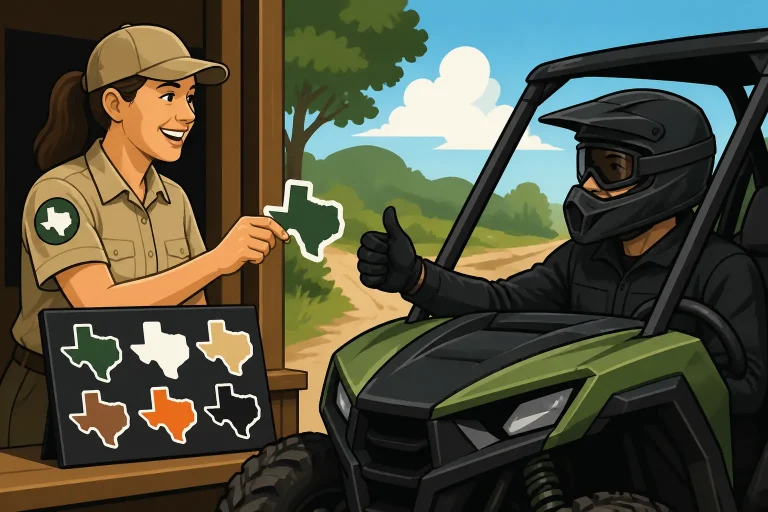
Visitors may be able to buy a decal before the trip or through an authorized sales channel, and some riding areas may sell decals on site. Availability can vary, so buying ahead can reduce uncertainty at the entrance. Check Where to Buy a Texas OHV Decal for the usual options, and confirm the current cost directly with the state or seller. Fees and sales methods can change.
Keep the decal attached as instructed and make sure it can be seen during an inspection. Bring proof of purchase if the decal has been ordered but has not arrived, but do not assume a receipt will substitute for a required displayed decal; ask the seller or land manager what they accept. If you are renting a machine, ask the rental business whether the machine already meets the Texas decal requirement and whether any park-specific permit is included. The rental operator’s answer should be specific to your destination, not just a general statement that the machine is ready to ride. See [Texas OHV Decal for a Rented Machine] for the issues to check.
A short confirmation call or check of the land manager’s current rules can prevent a frustrating detour. Ask directly: Does this area require a Texas OHV decal for a nonresident’s machine? Is another permit or day-use payment required? Does the answer change for a street-legal machine or a rental? Those questions separate the state decal issue from the location’s own entry rules.
For most nonresident riders, the bottom line is straightforward: do not rely on your home-state OHV sticker as a substitute. If you are taking an ATV or UTV onto a Texas public OHV area, confirm that the area requires the Texas decal and obtain one when needed. Then check the separate rules for access, fees, safety, and trail use.
Disclaimer
This article is for general informational purposes only and does not constitute professional advice. Laws, prices and regulations vary by location and change over time. Consult a qualified professional for guidance on your specific situation.