Riding the Sam Houston Trail
The Sam Houston Trail can be a great escape into the pine woods, but a ride goes sideways fast if you arrive without checking trail conditions, width restrictions, or required permits. This guide explains how to prepare for the Sam Houston National Forest OHV trail near New Waverly, what to expect under the trees, and how to make a safer day of it.
Plan your Sam Houston Trail ride
Know what the trail is and where to start
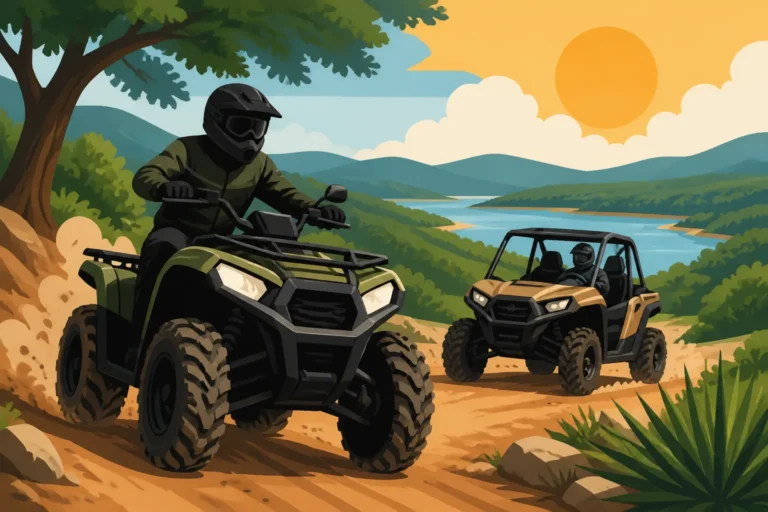
The Sam Houston Trail is an OHV trail system in Sam Houston National Forest, north of Houston and near New Waverly. Its roughly 85 miles of designated routes wind through East Texas forest, with wooded stretches and changing surface conditions. It is a very different outing from riding an open desert track or a groomed motocross course: the route may feel narrow, shaded, and more enclosed, and conditions can change after rain.
Before you leave home, check the official Forest Service information for current access, maps, and trail status. The forest is extensive, and a familiar-sounding road or recreation area is not automatically an OHV trailhead. Confirm how you’ll reach your chosen access point, whether the route is open, and what facilities are available. [Riding the Sam Houston Trail] is a useful starting point for planning the trail itself, while [Texas OHV Parks Near Houston] can help if you’re comparing this ride with other nearby options.
A mapping app can help you orient yourself and keep track of your planned route. For example, onX Offroad can be useful for reviewing a route before the ride and checking your position while you’re out. Treat any app as a planning aid, not permission to leave a marked route or proof that a trail is open. Carry an official forest map or other reliable offline navigation as a backup, and follow posted signs and closures on the ground.
Check width limits, permits, and trail status
One important planning detail is the trail’s 50-inch width limit. Measure your machine at its widest point before loading it, including any accessories that extend beyond the body. A side-by-side that looks compact in the garage can exceed a trail restriction once you account for tires, mirrors, racks, or other equipment. If you’re shopping for a machine specifically for forest trails, compare its actual width with [Texas's 50-Inch National Forest Width Limit] and [Machines Under 50 Inches for Texas Forest Trails].
Check the current requirements for the forest before your trip. Depending on the land and activity, you may need an OHV decal and a separate day-use payment or pass. These are different requirements, so don’t assume one automatically covers the other. Review [Texas Rules for Riding a National Forest Trail] and [Does an OHV Decal Cover the Forest Day-Use Fee?] before heading out. Keep any required proof with you, since a ranger or other authorized staff member may ask to see it.
Trail conditions can be just as important as paperwork. Heavy rain can leave soft soil, standing water, or damaged sections, and closures may be in place to prevent further harm. Check the official status information close to your departure, not just when you first start planning. [Calling the Trail Status Line] is a relevant resource to consult, and onX Offroad may help you keep your bearings, but neither a saved route nor an app map overrides a closure sign at the trailhead.
| Before you go | What to confirm | Why it matters |
|---|---|---|
| Machine width | Measure the widest point, including accessories | The trail has a 50-inch width restriction |
| Trail access | Confirm the trailhead and route are open | Access and conditions can change |
| Required credentials | Check decal and day-use requirements | One requirement may not replace another |
| Weather and soil | Look for recent rain and closure notices | Wet ground can make riding unsafe and damage trails |
| Navigation | Carry an official map and a backup | Cell service and battery life may be unreliable |
Prepare your machine and your group
Do a practical pre-ride inspection
A forest trail ride puts steady demands on tires, brakes, steering, and cooling. Before loading up, check tire condition and pressure, confirm the brakes work properly, and look for loose fasteners or visible damage. On a side-by-side, check that seat belts latch and that passengers have secure seating. On a quad, make sure the controls feel familiar and responsive. A small issue found at home is much easier to handle than one discovered in a muddy stretch far from the trailer.
Pack for the conditions rather than the drive from Houston. Bring water, a basic first-aid kit, tools suited to your machine, and supplies for a minor repair. A tow strap can be useful, but it is not a reason to attempt a risky recovery or pull another machine in a way that could cause injury. Dress for brush, dust, and changing temperatures under the trees. Eye protection matters even when the trail is shaded, since grit, branches, and debris can still reach a rider.
For navigation, save or review your route before cell coverage becomes a concern. onX Offroad can help you see your position relative to a planned ride, but download what you need ahead of time and keep your phone charged and protected. Consider carrying a paper map and a power bank as backups. Agree with your group on a meeting point if riders become separated, and make sure everyone knows the planned route and expected return time.
Ride at a pace that fits the trail
The right speed is the speed that lets you respond to what is around the next bend. Forest trails can include ruts, roots, loose material, puddles, and limited sightlines. Keep enough distance from the machine ahead to avoid eating its dust or being surprised by a sudden stop. Slow down before blind turns, stay on the designated route, and leave room for other trail users.
If you’re riding with children or someone new to off-road riding, be honest about their comfort and experience. Choose a manageable pace, review basic hand signals, and stop somewhere safe to regroup rather than trying to talk over engine noise while moving. Riders should wear the safety equipment required for their machine and circumstances. [Texas OHV Safety Certificate Requirements] and [What Texas Requires of Riders Under 14] cover important rules for younger riders and certification.
Trail courtesy helps protect access for everyone. Avoid widening the trail by riding around muddy patches, and don’t cut across vegetation to pass or turn around. If the route is too wet or a section feels beyond your group’s ability, turn back where it is safe to do so. A muddy shortcut might seem harmless in the moment, but repeated off-trail travel can damage the forest and create problems for future riders.
Navigate weather, closures, and trail conditions
Treat rain and soft soil seriously
In East Texas, a trail that was easy to ride during a dry spell can feel entirely different after rain. Soft soil can hide ruts or make it difficult to keep control, while waterlogged areas may be vulnerable to rutting and erosion. If recent weather has been heavy, check for official updates and be prepared to postpone the ride. A closed trail is not a challenge to work around; it is a signal to stay off that section.
Don’t use a detour that isn’t marked as part of the trail. Going around a wet or blocked area can widen the route, damage plants, or put riders into terrain they haven’t assessed. If you encounter a closure or an unsafe section, stop in a safe place, tell your group, and follow the posted instructions. [Why Texas Trails Close When the Soil Is Wet] explains why closures matter, and [Texas Trails After Heavy Rain] offers more context for planning around weather.
After the ride, check the machine for packed mud, debris, and signs of damage. Pay particular attention to the radiator area on a liquid-cooled machine, since mud and plant material can restrict airflow. Clean the machine where appropriate before it dries into a harder-to-remove layer, and inspect tires and underbody components for damage. A quick post-ride check can catch a problem before the next outing.
Have a backup plan
A flexible plan makes a forest ride less stressful. Decide in advance what you’ll do if your preferred trailhead is unavailable, the route is closed, or rain changes the conditions. That might mean choosing a different open route, spending the day on another activity, or rescheduling rather than trying to force the original plan. Check for nearby fuel and supplies before you head into the forest, and don’t assume every access point has services.
Keep your group’s plan simple enough to remember. Pick a primary route, a turnaround point, and a time to check in. Make sure someone outside the riding group knows where you’re going and when you expect to return. If you change plans, update that person. In unfamiliar areas, onX Offroad may help you follow your intended route, but a reliable backup map and clear group communication are still important.
For a broader look at choosing rides by terrain and experience level, see [Texas Trail Difficulty by Park]. If the Sam Houston Trail is new to you, start conservatively, leave room in the day for breaks, and avoid adding unfamiliar routes just because the group has extra time. A relaxed ride with everyone returning safely is a better outcome than covering more miles than planned.
What to remember on ride day
The most useful preparation is straightforward: confirm the route is open, check the 50-inch width limit, understand the decal and day-use requirements, and match your plan to the weather. Bring enough water and basic supplies, inspect your machine, and make sure everyone in your group understands the route and safety expectations.
Once you’re on the trail, follow signs, stay on designated routes, and give yourself room to react. Use navigation tools as backup rather than as permission to explore closed or unmarked areas. With a little preparation and a willingness to change plans when conditions call for it, the Sam Houston Trail can be an enjoyable way to experience East Texas forest riding.
Disclaimer
This article is for general informational purposes only and does not constitute professional advice. Laws, prices and regulations vary by location and change over time. Consult a qualified professional for guidance on your specific situation.