Are ATVs Street Legal in Texas?
It’s a question that plagues nearly every Texan who owns an ATV or UTV: can I legally ride my machine on public roads? The confusion is real, and the desire to just hop on your quad and run a quick errand or connect trails is completely understandable. This guide is here to cut through the noise, clarify the ins and outs of Texas law regarding off-highway vehicles (OHVs) on public roads, and help you understand when it’s permissible and, more importantly, when it’s absolutely not.
The Short Answer: Generally, No, They Are Not Street Legal
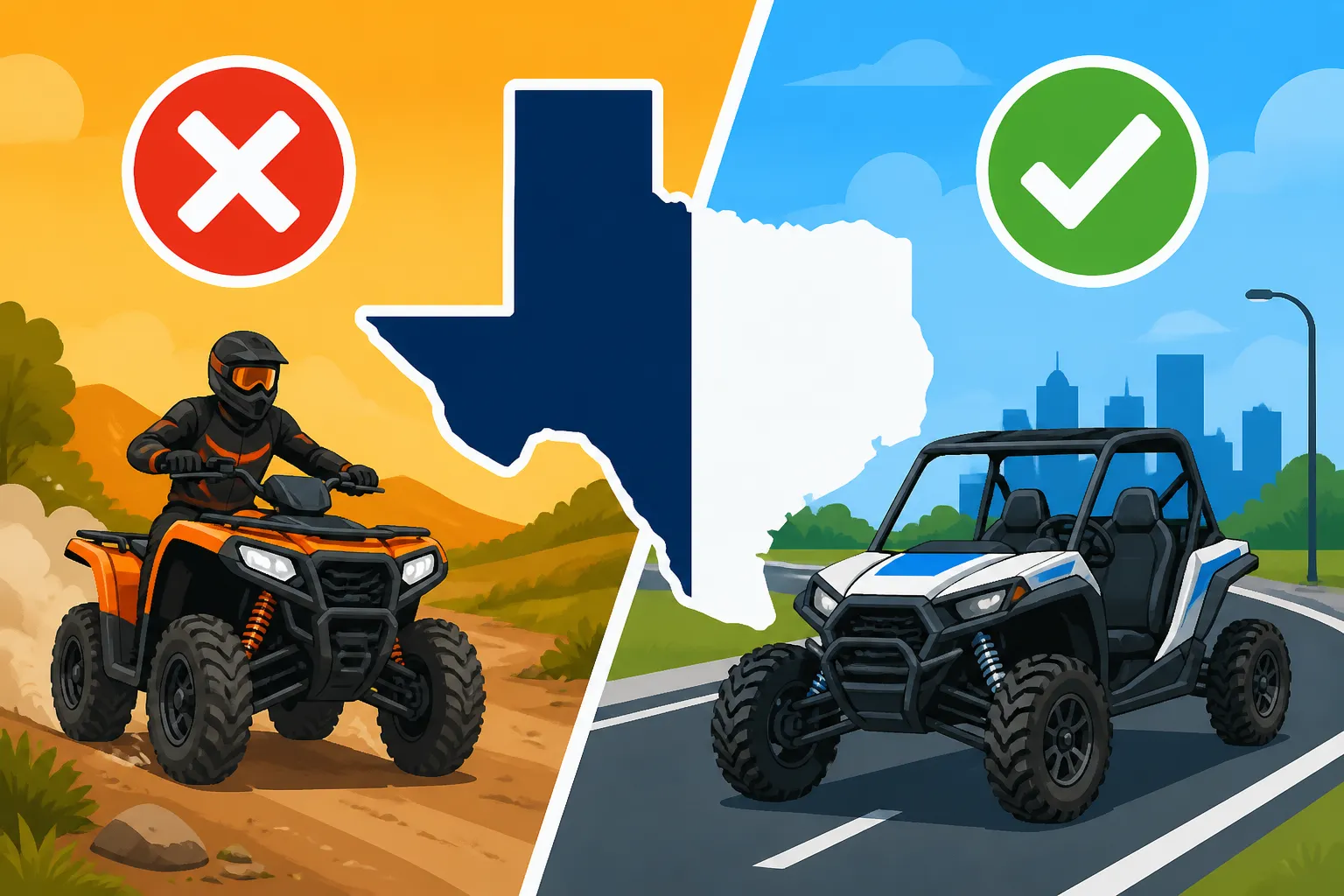
Let's get straight to it: for the vast majority of situations, ATVs and UTVs are not considered street-legal vehicles in Texas. This isn't just some arbitrary rule; it's rooted deeply in how the state defines and classifies different types of vehicles. When you think about a car or truck, it's designed, manufactured, and regulated specifically for highway use. These vehicles meet stringent safety standards for things like braking, lighting, crashworthiness, and emissions. Off-highway vehicles, by their very nature, are built for rugged, unpaved terrain, not the asphalt jungle.
The Texas Transportation Code is pretty clear about this distinction. An off-highway vehicle, by definition, is meant for off-road environments. This means they typically don't have all the equipment required for road-going vehicles, like specific turn signals, mirrors, or DOT-approved tires, though many owners might add aftermarket versions of these. Because of this fundamental difference in purpose and equipment, Texas generally does not allow these machines to be registered for general road use. You'll often see this distinction highlighted directly on the vehicle's title, with a clear "Off-Highway Use Only" remark. This isn't just a suggestion; it's a legal designation that prevents standard road registration. Many owners feel frustrated by this, especially when they see other states with more lenient rules, but Texas has a specific framework. This is also why you'll find that [Why Texas Will Not Register an ATV for the Road].
When you purchase an ATV or UTV, even if it comes from a dealership with all the bells and whistles, it's still primarily intended for trails, ranches, and private property. The state views them differently from cars, trucks, or even low-speed vehicles like golf carts which have their own, albeit limited, road privileges. Trying to argue that your heavily modified side-by-side should be allowed on the freeway because it looks like a truck won't hold up in court, simply because the vehicle classification doesn't change. The designation on your title, which you receive after you handle [The Texas Title Application Every OHV Buyer Files], is a key indicator of its legal status.
Navigating the Exceptions to the Rule
While the general rule is a resounding "no," Texas law does provide very specific and limited exceptions where an ATV or UTV can legally operate on a public road. These aren't loopholes for joyriding; they are carefully carved-out allowances for practical, usually work-related, purposes or for very short, controlled movements. It's vital to understand the precise conditions for each exception, as stepping outside these boundaries can quickly lead to legal trouble.
Agricultural Use
One of the most common and widely utilized exceptions is for bona fide agricultural purposes. If you're a farmer, rancher, or involved in legitimate timber operations, you might be able to use your ATV or UTV on public roads under certain conditions. This is a huge relief for many in rural Texas who rely on these machines for daily tasks.
For instance, you can drive your OHV on a public road if it's being used for a legitimate agricultural purpose, such as hauling feed to livestock in a different pasture across the road, inspecting fences, or moving equipment between fields. However, this isn't a blank check to cruise for miles. The law generally limits such travel to 25 miles from the point of origin to its destination. This means you can't take your machine into town for groceries just because you also own a few cows. The travel must be directly related to the agricultural operation. Furthermore, there are specific safety requirements, like the need for a tall, brightly colored [The 6-Foot Orange Flag Texas Requires] to be mounted on the machine, making it visible to other motorists. These machines are tools for the farm, and companies like SuperATV often provide useful accessories like cargo racks, dump beds, or winches that can significantly enhance an OHV's utility for these agricultural tasks, making them even more indispensable for ranch work, without necessarily altering their fundamental off-highway status. This exemption, detailed further in resources like [Texas Agricultural Exemption for ATVs on Roads], is critical for many Texans.
Golf Course Access
Another very specific exception allows for the limited use of OHVs, particularly UTVs often referred to as golf cars or utility vehicles, to access golf courses. This rule recognizes the practical need for golfers to get their equipment from nearby parking or residences to the course itself.
Under this exception, you can operate your OHV on a public street for a distance of no more than two miles from where the machine is parked, directly to a golf course. This travel must also occur only during daylight hours. So, if you live in a community right next to a golf course, you might be able to drive your UTV from your driveway to the first tee, provided you meet these strict distance and time limitations. It’s important to note that this doesn’t grant you permission to drive your UTV around the entire neighborhood, even if it's a golf cart community. The intent is solely for golf course access, as highlighted in guides like [Texas Rules for Riding a UTV to a Golf Course].
Crossing Public Roads
While you generally cannot ride your ATV or UTV on a public road, Texas law does permit you to cross one. This is a crucial distinction and a necessary allowance for off-road enthusiasts who might encounter a public road interrupting a trail system or needing to access different parts of a large property.
When crossing a public road, you must do so at a right angle (90 degrees) to the roadway. You must also come to a complete stop before entering the roadway and yield to all oncoming traffic. The crossing should be made as quickly and safely as possible, minimizing your time on the paved surface. This is not an invitation to drive down the shoulder or use the road as a connector for any significant distance. It’s a point-to-point maneuver designed to get you from one off-road section to another. Understanding these specific rules is critical, as detailed in articles like [Crossing a Highway on an ATV in Texas], [Crossing a Texas Road at an Intersection], and [Crossing a Texas Road Away From an Intersection]. You’re essentially acting as a pedestrian with a powerful machine, prioritizing safety and yielding the right-of-way.
Master Planned Communities and Local Ordinances
In certain unique circumstances, some master-planned communities or even specific local governments (counties or cities) might have ordinances that allow limited OHV use on certain public streets. This is a much more localized and less common exception, and it absolutely requires you to do your homework.
Master-planned communities with an approved plat and uniform covenants might allow residents to operate OHVs on their streets, usually within strict speed limits and often only during daylight hours. This is typically found in very specific residential developments designed with this kind of recreation in mind. Beyond that, some smaller, less populous counties in Texas (specifically those with populations under 37,000, and certain Red River counties) have the authority to pass local ordinances permitting OHV use on specific county roads. However, this is not a widespread phenomenon, and it varies drastically by location. It is imperative to check with the specific city or county government where you intend to ride. Never assume that because one community allows it, another does. Local law enforcement will be the ultimate authority on these rules in their jurisdiction. If you live in such an area, resources like [Texas Rules for Riding in a Master Planned Community] and [Red River Counties and the Barrier Barrier Island Test] might be particularly relevant. These local allowances are the exception, not the norm, for the vast majority of Texas roads.
Utility Workers and Emergency Personnel
Finally, it's worth noting that utility company employees, law enforcement, and other emergency personnel often have specific exemptions that allow them to operate ATVs and UTVs on public roads when performing their official duties. These machines are invaluable tools for reaching remote areas, responding to emergencies, or maintaining infrastructure. These are not general exemptions that extend to the public; they are specific to the nature of their work and their official capacities.
The Consequences of Illegal Road Use
Ignoring the rules and taking your ATV or UTV onto public roads without meeting one of the very narrow exceptions can lead to a host of problems, ranging from legal penalties to significant safety risks. It's easy to think "I'll just go quickly," but the potential repercussions are not worth the shortcut.
Legal Ramifications and Fines
Operating an off-highway vehicle illegally on a public road in Texas is generally considered a Class C misdemeanor. While this isn't a felony, a Class C misdemeanor can still carry a substantial fine. These fines can add up quickly, especially if the officer also cites you for other infractions, such as reckless driving or lacking proper safety equipment. Beyond the immediate financial penalty, getting a citation can lead to increased scrutiny from law enforcement in the future, and repeated offenses could escalate the legal consequences. Don't underestimate the legal system's ability to enforce these rules. Information on these penalties can be found in articles discussing [Texas Fines for Illegal ATV Road Use].
Moreover, if you are involved in an accident while illegally operating an OHV on a public road, your liability could be significantly higher. Most standard auto insurance policies do not cover ATVs or UTVs, especially when they are being used illegally. This means you could be personally responsible for property damage, medical bills, and any other costs arising from the collision, which can easily run into the tens or hundreds of thousands of dollars.
Safety Concerns and Equipment Limitations
ATVs and UTVs are inherently different from road vehicles, and these differences contribute to why they aren't street legal. They often have:
- Tires: Designed for grip on loose terrain, not for high-speed pavement use. Using knobby tires on asphalt can lead to unpredictable handling, faster wear, and increased risk of a blowout.
- Suspension: Tuned for absorbing impacts off-road, not for smooth, stable handling at higher road speeds. This can make them feel "wobbly" or unstable on pavement.
- Braking: While powerful off-road, they may not offer the same stopping distance or stability as a road vehicle, especially at higher speeds or in emergency situations.
- Visibility: Many ATVs and UTVs lack the robust lighting, turn signals, and mirrors required to be safely seen and communicate intentions to other drivers on public roads. Even if you add aftermarket lights, like some powerful LED bars from SuperATV that are fantastic for off-road night riding, they don't automatically confer street legality or meet all DOT requirements for highway use. Articles like [Why Adding Lights and Mirrors Changes Nothing] explain this in detail.
- Lack of Crash Protection: OHVs offer minimal crash protection compared to cars. In a collision with a full-sized vehicle, the occupants of an ATV or UTV are incredibly vulnerable.
These factors make them less safe for road use, both for the rider and for other motorists. The risk of serious injury or fatality in an ATV/UTV-versus-car collision is alarmingly high.
What You Can Do: Responsible Off-Road Riding in Texas
So, if riding on public roads is mostly out, what's a Texas ATV or UTV enthusiast to do? The answer is to embrace the incredible off-road opportunities the state does offer and focus on safe, legal, and responsible riding practices. Texas has a vibrant off-road community and numerous places to enjoy your machine.
Embrace Designated OHV Parks and Trails
Texas boasts a fantastic network of private and public off-highway vehicle parks and trails designed specifically for ATVs and UTVs. These parks provide diverse terrain, from challenging rock crawling and muddy trails to scenic routes and family-friendly areas. Places like Barnwell Mountain Recreation Area, Hidden Falls Adventure Park, and the Sam Houston National Forest OHV Trail offer hundreds of miles of legal riding. These are the places where your machine truly shines and where you can push its capabilities safely and legally. For a comprehensive look at your options, check out [Where to Ride an ATV in Texas] and explore various [Texas OHV Parks by Region]. These destinations are built for fun, and they often have amenities like camping, restrooms, and sometimes even rental machines or repair services.
Get Your Texas OHV Decal and Safety Certificate
To legally ride on public lands or in parks that receive state funding, your ATV or UTV will need a Texas Off-Highway Vehicle (OHV) decal. This decal, which needs to be renewed annually, helps fund the development and maintenance of these very riding areas. It’s a small investment that directly benefits the riding community. You can learn more about this essential requirement in [The Texas OHV Decal Explained].
Additionally, if you're under the age of 18, you'll generally need an approved ATV safety certificate to operate an OHV on public land. Even if you're an adult, taking a safety course is highly recommended. These courses teach critical riding skills, awareness, and responsible practices that can prevent accidents and injuries. Getting informed about these requirements is easy with resources like [Texas OHV Safety Certificate Requirements]. Safety first, always!
Respect Private Property and Landowner Rights
Texas is largely private land, and much of the best riding happens on ranches or leased property. Always ensure you have explicit permission from the landowner before riding on private property. Trespassing is not only illegal but can also damage the reputation of the entire off-road community. Be a good steward of the land, pack out what you pack in, and leave no trace. This includes being mindful of noise levels and avoiding sensitive ecological areas.
By focusing on these legal and responsible avenues, you can enjoy your ATV or UTV to its fullest extent without the constant worry of fines, accidents, or legal entanglements. The open spaces of Texas offer incredible off-road adventures – just keep them off the pavement unless explicitly allowed.
| Scenario for Road Use in Texas | Generally Allowed? | Conditions / Details |
|---|---|---|
| Connecting Trails / General Commuting | No | Not classified as street-legal vehicles. |
| Agricultural / Timber Use | Yes (Limited) | Must be for bona fide ag/timber purpose; within 25 miles of origin; specific safety flag required. |
| Golf Course Access | Yes (Limited) | Within 2 miles of golf course; daylight hours only; direct route. |
| Crossing a Public Road | Yes | Must cross at 90-degree angle; full stop; yield to traffic; cross safely & quickly. |
| Within Master Planned Communities | Yes (Highly Specific) | Requires specific local ordinances and community covenants; check local rules diligently. |
| Select Rural Counties | Yes (Rare) | Limited to counties under 37,000 population or specific Red River counties if local ordinance exists. |
| Utility/Emergency Work | Yes | Only for official duties by authorized personnel. |
| With Aftermarket Street-Legal Mods | No | Adding lights, mirrors, turn signals does not make an OHV street-legal for general use. |
Disclaimer
This article is for general informational purposes only and does not constitute professional advice. Laws, prices and regulations vary by location and change over time. Consult a qualified professional for guidance on your specific situation.