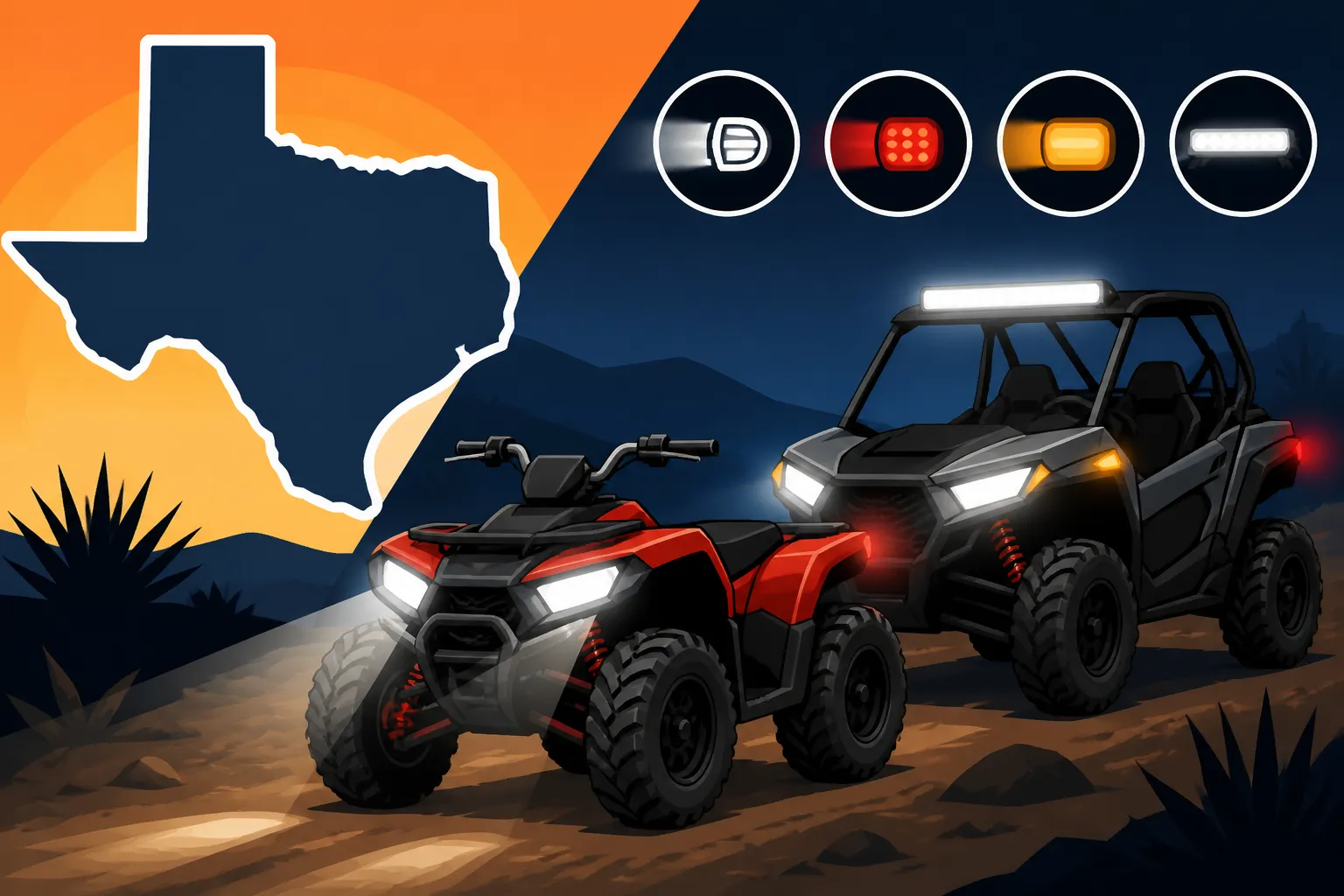
Texas Lighting Requirements for OHVs
Navigating the world of off-highway vehicles (OHVs) in Texas can feel like a maze, especially when it comes to understanding when your ATV or UTV needs its lights on, and what kind of lights are even legal. Many riders get caught off guard, assuming their machine's factory lights are always sufficient or that adding aftermarket lights will somehow make them street legal. This guide is here to untangle the confusion surrounding Texas's lighting requirements for ATVs and UTVs, ensuring you stay safe and on the right side of the law, whether you're hitting the trails or briefly crossing a public road.
The Great Outdoors: When Lights Aren't Always the Primary Concern on Texas Trails
Relying on Daylight and Common Sense for Most Off-Road Adventures
For many of us, hitting the sprawling trails of a Texas OHV park or cruising across a private ranch means enjoying the wide-open spaces during daylight hours. In these pure off-road environments, the legal mandate for lighting often takes a backseat to practical visibility. If you're strictly operating on private land or within a designated off-highway vehicle park during the day, Texas law typically doesn't impose explicit, stringent lighting requirements beyond what the manufacturer originally equipped on your ATV or UTV. Your primary concern here is usually about seeing obstacles like fallen trees, hidden ruts, or sudden drop-offs, and being visible to other riders on shared trails. This is where many riders choose to upgrade their machines with robust aftermarket lighting solutions – not for street legality, but for enhanced performance and safety in challenging off-road conditions. For instance, brands like SuperATV offer powerful LED light bars and pod lights that significantly boost your forward vision, turning nighttime trails into daylight, or simply cutting through heavy dust during the day.
Why Visibility is Always Your Friend, Even Off the Paved Path
While specific legal requirements might be relaxed for daylight, private land off-road use, prioritizing visibility is always a wise move for any rider. Think about those rides that stretch into dusk, or when a sudden cloudburst brings on an early twilight. Being able to clearly see what's in front of you prevents accidents and allows for safer navigation. Furthermore, being seen by others – whether it's another rider cresting a hill, a ranch hand in a truck, or even wildlife – is equally critical. A powerful headlight, a bright taillight, and even strategically placed auxiliary lights can make a huge difference in avoiding collisions. Many experienced riders will upgrade their factory lighting not because the law demands it for their specific use, but because they understand the inherent safety benefits. Aftermarket solutions can provide a wider beam pattern, greater intensity, and improved durability compared to stock options, giving you an edge when the light starts to fade or conditions get tough.
Navigating the Grey Areas: When Texas OHV Lighting Becomes a Must
Brief Encounters: Lighting for Crossing Public Roads
This is where the rules transition from common sense to specific legal requirements, and it's a point of frequent confusion for many OHV owners. While [Why Texas Will Not Register an OHV for the Road] is a fundamental aspect of Texas law, there are very specific, limited circumstances where your ATV or UTV might legally touch a public road. One common scenario is when you need to cross a public road to get from one piece of private property to another, or to access a connecting trail system. During these brief and direct crossings, Texas law generally mandates that your OHV be equipped with at least one headlight (visible from 500 feet to the front) and one taillight (visible from 1,000 feet to the rear). These aren't for taking a scenic detour; they are for ensuring you're a clearly visible object during that short window of exposure to conventional vehicle traffic. Think of it as a bare minimum to prevent your machine from being an unseen hazard. [Crossing a Highway on an ATV in Texas] offers more detailed guidance on how to execute such crossings safely and legally.
Beyond the Crossing: Permitted Road Use and Increased Lighting Demands
Texas law does carve out certain, highly specific exceptions that allow OHVs to operate on public roads, such as for agricultural operations, utility work, or within certain [Texas Rules for Riding in a Master Planned Community] or designated counties under specific conditions. However, these exceptions are not a free pass to drive your OHV anywhere. They come with a host of additional requirements, and upgraded lighting is a significant component. If you are legitimately utilizing one of these exceptions – for example, driving a UTV for ranch work on a county road, as outlined in [Texas Rules for Riding a Farm Road] – your machine must be equipped with a much more comprehensive lighting package to ensure maximum visibility to other drivers.
This enhanced lighting typically includes:
- Headlights: At least two, emitting a white light visible from 500 feet to the front.
- Taillights: At least two, emitting a red light visible from 1,000 feet to the rear.
- Brake Lights: At least two, emitting a red or amber light visible from 300 feet to the rear when the brake pedal is depressed.
- Reflectors: At least two red reflectors on the rear, visible from 600 feet, which provide passive visibility even if your lights are off.
- [The 6-Foot Orange Flag Texas Requires]: While not a light, this highly visible flag is often a mandatory accessory for permitted road use, acting as an elevated warning signal for other drivers.
- Mirrors: At least one rearview mirror is commonly required to observe traffic approaching from the rear.
- Turn Signals: If your OHV is equipped with turn signals, or if you've added them, they must be fully functional and used to indicate turns or lane changes.
These robust requirements are in place to ensure that your OHV, which is inherently slower and less visible than a typical car or truck, can safely share public thoroughfares during these specific, allowed instances. For those using their UTVs extensively for agricultural or utility work that involves public road segments, investing in these compliant lighting solutions is not just about legality; it's about protecting lives.
Diving Deeper: Specific Lighting Equipment for Texas OHV Road Access
Headlights and Taillights: The Absolute Foundation for Visibility
When Texas law grants an OHV permission to operate on a public road, even for a limited purpose, headlights and taillights become non-negotiable safety devices. We're not talking about dimly lit factory lights that barely illuminate the immediate path in front of your tires. For public road use, especially during low-light conditions or after sunset, these lights must be powerful and clearly visible from significant distances. Texas law is quite explicit, generally requiring headlights to be visible from at least 500 feet to the front and taillights from a full 1,000 feet to the rear. This necessitates a lighting system that can project effectively over those distances and emit enough brightness to stand out against ambient light. Many stock OHV lighting systems, while perfectly adequate for unlit trails, simply don't meet these heightened road visibility standards. Upgrading to brighter LED headlights and taillights is a common and highly recommended modification for any rider who plans to utilize their machine on public roads, even under the limited exceptions. [Texas Rules for Riding After Dark] further emphasizes the necessity of superior lighting.
Auxiliary Lighting, Brake Lights, and Reflectors: Enhancing Your Presence
Beyond the basic headlights and taillights, Texas regulations for permitted OHV road use often mandate additional safety lighting and visibility features. Brake lights are paramount for communicating your intentions to following traffic. These must emit a clear red or amber light, visible for at least 300 feet when the brake is engaged. This immediate visual cue is critical for preventing rear-end collisions, particularly given the difference in speed and stopping distance between an OHV and a conventional vehicle. Furthermore, passive safety elements like red reflectors on the rear, which must be visible from 600 feet, serve as a vital backup, ensuring your machine has some level of visibility even if the electrical system fails. While not strictly a "light," the bright orange warning flag, required to be mounted six feet above the ground, acts as an elevated visual identifier, making your OHV noticeable from a greater distance, especially over rises in the road. Companies like SuperATV offer excellent aftermarket brake light kits and durable LED reflector options that integrate seamlessly with your machine, helping you meet these crucial safety and visibility requirements. [Texas Equipment Rules for an ATV on a Road] provides a comprehensive list of these and other essential items.
The Role of Turn Signals and Side Markers: Communicating Your Intent
While not always a universal legal requirement for all OHVs in every specific permitted road use scenario, functional turn signals and side marker lights significantly enhance both safety and clear communication when operating on public roads. If your UTV or ATV is factory-equipped with these, or if you're considering installing them for situations where you frequently use public road segments (such as for [Texas Rules for Riding a 35 mph Road] where allowed), it's imperative that they are in perfect working order. Clearly signaling your intentions to turn or change direction prevents confusion for other drivers and drastically reduces the risk of accidents. Even in instances where turn signals aren't strictly mandated by law, having visible indicators of your planned movements is a proactive step toward responsible and safe integration with conventional traffic. It moves beyond mere compliance to a higher standard of road etiquette and safety awareness.
The "Off-Highway Use Only" Reality: What Aftermarket Lights Can't Change
Beefing Up for the Backcountry, Not the Blacktop
A very common and dangerous misconception among OHV enthusiasts is the belief that by simply adding a comprehensive suite of aftermarket lights – super bright LED light bars, upgraded headlights, side markers, and even turn signals – they can legally transform their ATV or UTV into a "street legal" vehicle in Texas. This is a myth that can lead to significant legal penalties and disappointment. The fundamental truth is that [Street Legal ATVs in Texas: The Short Answer] remains "no" for general road use. No amount of impressive lighting or other modifications will alter its legal classification as an off-highway vehicle designed for unpaved terrain. These aftermarket lighting solutions, many of which are offered by reputable brands like SuperATV, are incredibly effective for their intended purpose: enhancing visibility and capability on trails, during utility work on private land, or for extending your riding into the evening on designated off-road property. They are not a legal loophole for public road access.
The Stamped Truth: "Off-Highway Use Only" on Your Title
Texas state law is quite explicit about the designation of most ATVs, UTVs, and other OHVs. When you receive a title for your machine, you will almost certainly find the phrase [The Off-Highway Use Only Remark on a Texas Title] prominently stamped on it. This isn't a suggestion or a recommendation; it's a legal classification that fundamentally restricts the vehicle from being registered for general use on public roads. All those fantastic light bars, fog lights, and rock lights that dramatically improve your trail riding experience are designed for serious off-road performance, not to circumvent state statutes. Attempting to argue with law enforcement that your machine is street legal because it has bright, compliant-looking lights will not be a successful defense if you are cited for illegal road use. Understanding this critical legal distinction is paramount for every OHV owner in Texas to avoid fines and potential impoundment. For a deeper dive into this, refer to [Why Modifying an ATV Will Not Make It Street Legal].
Don't Get Caught in the Dark: Consequences of Non-Compliance
Understanding the Fines and Legal Headaches
Ignoring Texas's specific lighting requirements for OHVs, particularly when operating on or crossing public roads, can lead to more than just a friendly warning. Texas takes these safety regulations seriously, and non-compliance can result in significant fines and other legal repercussions. Operating an OHV on a public road where it's not permitted, or operating one with insufficient or non-compliant lighting where it is permitted under an exception, can be classified as a Class C misdemeanor. While these might seem like minor offenses compared to felonies, they still carry financial penalties that can quickly add up, and in some cases, may even affect your driving record, depending on the specific violation and the county where it occurred. The cost of a fine will almost certainly outweigh the cost of ensuring your OHV's lighting meets the necessary standards. More details on the potential financial impact can be found in [Texas Fines for Illegal ATV Road Use].
Protecting Yourself, Your Ride, and Your Wallet
Beyond the immediate legal and financial penalties, operating an OHV without proper lighting when required significantly escalates your risk of being involved in an accident. Poor visibility means other drivers may not see your machine, especially if you're crossing a road at dawn or dusk, and you might not have adequate time to spot hazards. This puts you, any passengers, and other road users in serious danger. If an accident occurs on a public road involving an unlit or illegally operated OHV, the consequences can extend far beyond physical injuries to substantial financial liability. Given that [Texas Exempts OHVs From Insurance] for strictly off-road use, any accident on a public road where your OHV shouldn't be, or was not properly lit according to specific allowances, could leave you personally responsible for all damages and medical expenses. The most responsible approach is always to fully understand when and where lights are required, ensure your machine meticulously meets those specifications, and never operate on public roads outside of the very limited, legally defined exceptions. It’s not just about avoiding a ticket; it’s an investment in your safety and long-term peace of mind.
To help visualize the different lighting requirements, here's a brief overview:
| Scenario | Legal Status & General Use | Lighting Requirements (Minimum) | Additional Considerations |
|---|---|---|---|
| Pure Off-Road Trail/Private Land (Daylight) | Permitted, primary OHV use. | Manufacturer's stock lights (headlight, taillight for utility/basic visibility). | Upgrades like LED light bars, pod lights (SuperATV) for enhanced off-road visibility and safety are highly recommended. |
| Pure Off-Road Trail/Private Land (After Dark) | Permitted, with adequate visibility. | Functional headlights and taillights for rider vision and being seen by others. | High-output aftermarket lighting is crucial. Consider bright LEDs for both front and rear. |
| Brief Public Road Crossing | Very limited, direct crossing to connect private property/trails. | At least 1 Headlight (white, 500ft visibility), 1 Taillight (red, 1000ft visibility). | Must be a direct crossing at 90 degrees; stop before crossing. [Crossing a Highway on an ATV in Texas] for details. |
| Permitted Public Road Use | Specific exceptions (e.g., Ag, utility, certain communities/counties). | 2 Headlights (white, 500ft), 2 Taillights (red, 1000ft), 2 Brake Lights (red/amber, 300ft), 2 Rear Reflectors (red, 600ft). | [The 6-Foot Orange Flag Texas Requires], rearview mirror, functional turn signals (if equipped). Comprehensive safety is key. |
| General Public Road Use | Generally Prohibited – "Off-Highway Use Only" on title. | No amount of lighting makes an OHV street legal for general use. | Risk of Class C Misdemeanor, fines, and impoundment. [Why Texas Will Not Register an OHV for the Road] is clear. |
Disclaimer
This article is for general informational purposes only and does not constitute professional advice. Laws, prices and regulations vary by location and change over time. Consult a qualified professional for guidance on your specific situation.