What an Approved Plat Means for Street Riding
There's a lot of head-scratching and misinformation out there about whether you can legally ride your ATV or UTV on the streets here in Texas. It's frustrating when you just want to take a quick spin to a neighbor's house or down to the community pool, but you're worried about breaking the law. This guide will shine a light on one of the specific — and often misunderstood — exceptions: what an "approved plat" really means for riding your off-highway vehicle on public roads within certain subdivisions.
Understanding Texas's Stance on OHV Road Use
Let's be real, the general rule in Texas is pretty clear, and it often feels like a buzzkill: ATVs and UTVs are not typically allowed on public roads. Many of us have experienced that moment of disappointment, realizing that our capable machines, perfect for traversing rough terrain, are largely confined to private land or designated off-road parks. It’s a common frustration for folks living in rural areas or those with sprawling properties who just want to zip down the street to a neighbor's house without loading up a trailer.
The General Ban and Its Frustrations
The Texas Transportation Code generally defines ATVs and UTVs as "off-highway vehicles" (OHVs), and that "off-highway" part really means what it says. They're designed for trails, fields, and rough landscapes, not for paved public streets. This outright ban can be a real headache. Imagine having your side-by-side, maybe one you’ve even tricked out with some awesome gear from a place like SuperATV, sitting in your driveway, and you can’t even take it two blocks to grab the mail. You might have lights, mirrors, and even turn signals, but in most cases, those modifications won't magically make your machine street legal. Many riders wonder, [Are ATVs Street Legal in Texas?], and the short answer is almost always no, with very specific exceptions.
This isn't just about safety, though that's certainly a big part of it. It's also about how these vehicles are regulated, or rather, not regulated, for public road use. They typically aren't designed to meet the same safety standards as passenger cars, lacking things like crumple zones, advanced braking systems for high speeds, or full-enclosed cabs in many cases. So, while it's frustrating, the general prohibition is rooted in a desire to keep everyone safe on the roadways.
Limited Exceptions to the Rule
Now, here's where things get interesting, and a little bit confusing. Texas law does carve out a few very specific, narrow exceptions to the general "no OHVs on the road" rule. These aren't blanket permissions, mind you; they come with strict conditions and often apply only in particular situations or locations. For instance, there are allowances for agricultural use, certain utility operations, and specific circumstances for crossing a public road. You might even hear about [Texas's Golf Course Exception] or rules for riding on roads posted "Thirty-Five or Less in Texas." These exceptions are like tiny windows in a mostly closed door, and the "approved plat" rule is one such window that many people don't fully understand. It’s crucial to know that these exceptions are not an invitation to treat your ATV like a regular car; they are highly restrictive.
What Exactly is an Approved Plat and Why Does it Matter?
When we talk about an "approved plat" in the context of riding your ATV or UTV on streets, we're delving into a specific and often overlooked exception within the Texas Transportation Code. This isn't just some random subdivision; it refers to a planned community where certain conditions were met during its development. It’s a nuance that can make all the difference between a legal short trip and a ticket.
Defining the "Approved Plat" in Texas Law
In urban planning and real estate, a "plat" is essentially a detailed map of a tract of land, showing its boundaries, lots, streets, easements, and other features. When a developer submits a plat for a new subdivision, it goes through an approval process with the local city or county planning department. Once "approved," it becomes a legal document that dictates the layout and public access within that specific area.
The Texas Transportation Code (specifically Chapter 551A) states that a county may allow the operation of an OHV on a public road located within a subdivision that has been formally platted and approved by the county or municipality, if certain conditions are met. This means it's not an automatic right just because you live in a new neighborhood. The key here is the "approved plat" and the subsequent decision by the local governing body to permit OHV use within that platted area. These are often what are commonly called [Master Planned Communities and Uniform Covenants].
How a Plat Connects to OHV Street Riding
The connection is very direct: the existence of an approved plat for a subdivision enables local authorities (either the city or county) to then allow OHV use on the streets within that specific platted area. Without that approved plat, this particular exception simply doesn't apply. It’s a foundational requirement.
For residents in such communities, this can be a game-changer. Imagine being able to ride your UTV down the block to visit a friend, take your kids to the community park, or even get to the mailbox without having to trailer your machine. However, it's vital to understand that even with an approved plat, the permission to ride is often heavily conditional. It’s not an open invitation to ride anywhere, anytime. The local government has to opt in and set specific rules, and those rules can vary wildly from one community to another. This is where understanding [What Texas Cities Can and Cannot Allow] comes into play, as their local ordinances will layer on top of the state allowance.
Navigating the Specifics of Plat-Based OHV Riding
Alright, so you’ve learned about the concept of an approved plat. But what does it actually mean for putting rubber to pavement with your ATV or UTV? This isn't a free pass; it comes with a strict set of conditions and requires a deep dive into your local community’s rules. Ignoring these details could land you in hot water, even if you think you’re in the clear.
Conditions for Riding in Platted Communities
Even if your subdivision has an approved plat and the local government has permitted OHV use on its streets, you're still not entirely free of restrictions. Typically, these permissions come with a laundry list of stipulations designed to ensure safety and minimize disruption:
- Daylight Only: One of the most common conditions is that OHVs can only be operated during daylight hours. This means no late-night joyrides to the community center. You need to be able to see and be seen clearly, and aftermarket lighting kits, while awesome for the trail, don’t usually override this rule. You’ll often find this limitation specified under [Daylight Only Under the Texas Golf Course Rule] as well, highlighting the common sense behind such restrictions.
- Low Speed Limits: The roads where OHVs are permitted are almost always restricted to low speeds, often 35 mph or less. This ensures that these machines, which aren't built for high-speed road travel, are operated safely in residential areas. Trying to push the limits here is a recipe for an accident or a ticket.
- Specific Road Types: The permission often applies only to certain types of public roads within the platted subdivision, usually internal streets that aren’t major thoroughfares or state highways. You won't be taking your UTV onto a busy feeder road, even if it borders your community.
- Equipment Requirements: While a full street-legal conversion isn't usually required, your OHV might need basic safety equipment like functioning headlights, taillights, brake lights, and mirrors. It's smart to check what [Texas Equipment Rules for an ATV on a Road] might apply in your specific jurisdiction, even for these limited uses.
- Driver Licensing: The operator typically needs a valid driver's license to operate an OHV on these public streets, just like any other motor vehicle.
- Local Ordinances Trump: Most importantly, any operation must comply with any applicable local ordinances enacted by the city or county. This is where the real homework comes in.
The Role of Homeowner Associations (HOAs) and Local Ordinances
Here’s where it gets even more localized and potentially more complex. While state law allows cities and counties to permit OHV use in platted subdivisions, that doesn't mean they have to, or that they can't add their own layers of regulation.
- County/City Ordinances: Your first stop should always be your specific city or county office. They are the ones who will have the definitive word on whether they have exercised their option to allow OHV use on platted roads, and under what exact conditions. A city might decide to allow it, but only on streets with a 20 mph speed limit, or only for residents within a certain age range, or only if the OHV has an orange flag mounted six feet high. [Texas Rules for Riding on a 35 mph Road] might offer some guidance, but local rules will be paramount.
- Homeowner Associations (HOAs): Even if the city or county gives the green light, your HOA can still say no. Many master-planned communities have covenants and restrictions that specifically prohibit the operation of ATVs, UTVs, or other recreational vehicles on common streets, even if those streets are technically public. HOAs often prioritize neighborhood aesthetics, quiet enjoyment, and perceived safety, and they have the authority to enforce their own rules, which can be more restrictive than state or local law. So, before you outfit your UTV with a sound system and new tires from SuperATV and take it for a spin, check your HOA documents! It’s better to know upfront than to get a fine.
Practical Considerations and Potential Pitfalls
Beyond the legalities, there are practical realities to consider when riding your OHV in a platted community:
- Neighbor Relations: Even if it's technically allowed, operating an OHV can be noisy or perceived as a nuisance by neighbors who might not appreciate the sound or the dust. Maintaining good neighbor relations is key to avoiding complaints that could lead to stricter rules or increased enforcement.
- Enforcement Discretion: Law enforcement officers might not always be fully aware of every micro-ordinance in every platted community. While you might be legally in the right, you could still be stopped and have to explain the specifics, which can be an inconvenience. It's always a good idea to carry a copy of the relevant ordinance or statute section if you're riding in one of these areas.
- Liability: Even with permission, operating an OHV on public roads carries inherent risks. While [Texas Exempts OHVs From Insurance] for off-road use, that doesn't necessarily extend to liability on public streets, especially if there's an accident. It's always wise to check with your insurance provider about coverage.
- Future Changes: Local ordinances and HOA rules aren't set in stone. What's allowed today might be restricted tomorrow due to resident complaints, accidents, or changes in local government. Staying informed about community meetings and proposed changes is crucial.
Beyond the Plat: Other Limited Road Use Scenarios
While the approved plat exception is a specific focus, it's helpful to understand that it exists alongside other very limited scenarios where an ATV or UTV might legally touch a public road in Texas. These exceptions are critical for certain professions and necessary movements, but none of them grant general street-legal status.
Agricultural and Industrial Exemptions
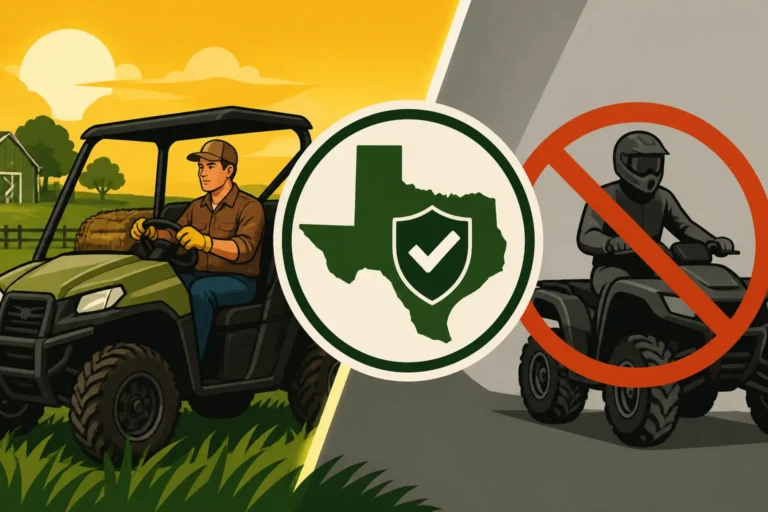
Texas law recognizes that ATVs and UTVs are essential tools for many agricultural and industrial operations. If you're using your machine for legitimate farm, ranch, or timber work, you'll find certain allowances. For example, you can often operate an OHV on a public road within 25 miles of the point of origin to your destination if it's for agricultural purposes. This covers things like hauling feed, inspecting fences, or moving equipment between pastures. This is a crucial exemption for many Texans, and you might even be familiar with the [Texas Agricultural Exemption for ATVs on Roads]. Similarly, certain industrial applications, like utility workers inspecting power lines or pipeline crews, may have specific permissions for road use as part of their job duties. These are not recreational allowances; they are strictly tied to the purpose of the work being performed.
Crossing Public Roads
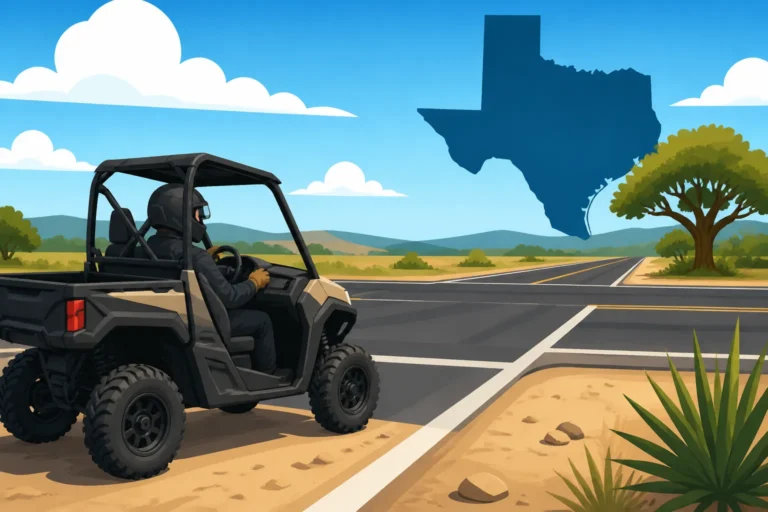
Even if your ATV or UTV is never intended for extended road travel, there will likely be times when you need to cross a public road to get from one section of private land to another, or to access an off-road park. Texas law provides a narrow allowance for this, often referred to as the "Ninety Degrees and a Full Stop" rule. This means:
- You must come to a complete stop before entering the roadway.
- You must yield to all traffic on the road.
- You must cross at a right angle (90 degrees) to the roadway.
- You must cross at an intersection where possible.
- You must have your headlights and taillights on, even during the day, if your machine is so equipped.
This is a quick, direct crossing, not a jaunt down the shoulder. It's designed for minimal exposure to traffic and maximum safety during the brief transition. Trying to extend this crossing into a short ride down the road would be a violation. It’s imperative to remember that these are strict guidelines for crossing, not riding, and require extreme caution.
Here’s a quick overview of some common limited road use scenarios for OHVs in Texas:
| Scenario | Purpose | Key Conditions | Typical Speed Limit | Daylight Only? | Requires Driver's License? |
|---|---|---|---|---|---|
| Approved Plat | Residential/Community Travel | Specific local ordinance, low speed, within platted subdivision | 35 mph or less | Usually | Yes |
| Agricultural Use | Farm, Ranch, Timber Operations | Directly related to agriculture, within 25 miles of origin | Limited | No | Yes |
| Crossing Roadway | Transition between private land | Full stop, yield to traffic, 90-degree angle, briefest path | N/A (crossing) | No | Yes |
| Golf Course Access | To/from golf course property | Within 2 miles of parking, daylight, specific designated paths | Low | Yes | Yes |
| Volunteer Firefighter | Emergency/Official duties | Only during official duties, 10-mile limit from station | Limited | No | Yes |
Understanding these distinctions is crucial. While a company like SuperATV can provide you with incredible performance parts for your trails, none of those parts will magically transform your OHV into a street-legal vehicle for general road use under Texas law. The rules are specific, often frustratingly so, and always demand your full attention to the details.
In conclusion, navigating the rules for riding an ATV or UTV on public streets in Texas is far from simple. The "approved plat" exception offers a glimmer of hope for some residents in specific master-planned communities, but it's heavily contingent on local ordinances and often, HOA rules. Always, always do your homework, starting with your city or county clerk's office and your HOA documents, before you venture out. It’s far better to be informed than to face fines or, worse, an accident.
Disclaimer
This article is for general informational purposes only and does not constitute professional advice. Laws, prices and regulations vary by location and change over time. Consult a qualified professional for guidance on your specific situation.