Why a Park May Charge More Than the State
A Texas OHV decal bought at a park gate may cost more than the state’s advertised price, which can look like an unexplained fee. The difference is usually about where and how you buy the decal, not a different permit. Knowing what the decal covers—and what it does not—helps you decide whether gate convenience is worth the extra charge.
What the State Decal and the Park Gate Price Mean
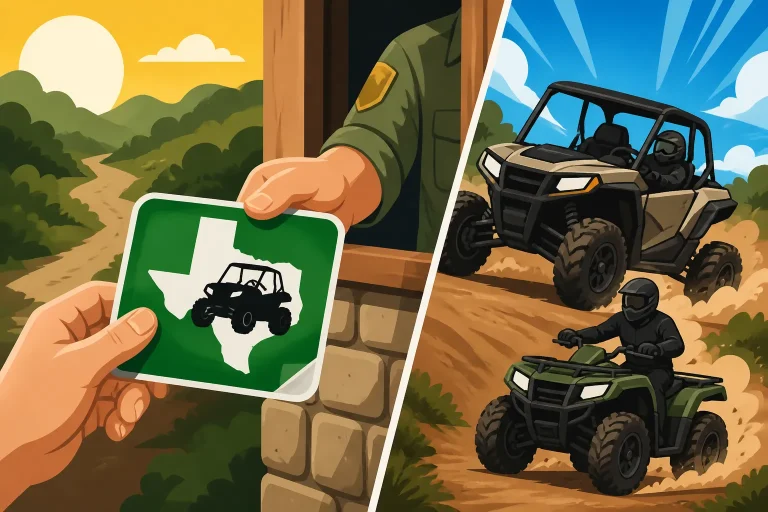
The Texas OHV decal is a state-issued sticker for qualifying off-highway vehicles used in places where the decal is required. The state sets the base price, while a park or other authorized seller may offer the decal at the entrance as a convenient purchase option. That means the amount you pay at the gate may be higher than the state’s listed price.
The sticker itself is not a park admission ticket. Buying one does not automatically pay for a day of riding, reserve a campsite, cover a trail fee, or guarantee that a particular park is open to your machine. Think of the decal and park charges as separate parts of the trip budget.
If you are sorting out the sticker’s purpose and when it applies, start with The Texas OHV Decal Explained. Requirements depend on where and how you ride, so check the rules for your destination rather than assuming every Texas park uses the same entry system.
The state price is not always the gate price
A state price is the base amount associated with the decal. When you buy through a park gate, you are using a retail or distribution channel as well as obtaining a state decal. A seller may charge an additional amount for providing that service. The exact amount and the way it is described can vary, and current charges should be confirmed with the seller before you go.
A higher gate price does not, by itself, mean that the park has invented a separate kind of OHV decal. Ask whether the charge is for the state decal, a seller or handling amount, park entry, or some combination of those items. A clear receipt should help show what you paid for.
A decal and a park fee are different charges
It is easy to confuse the sticker price with the cost of riding because both may be collected at the same counter. But one charge may be for the decal, while another pays for access to the park’s property and facilities. A park can have its own admission, day-use, camping, or reservation charges, subject to its own rules.
The sticker does not give you permission to ride anywhere you choose. You still need to follow the land manager’s access rules, stay on authorized routes, and pay any fees the site requires. Similarly, paying a park’s admission charge does not necessarily replace a decal required for the type of riding you plan to do.
| Charge | What it generally relates to | What to confirm |
|---|---|---|
| Texas OHV decal | A state decal for qualifying off-highway use where required | Whether your machine and riding location require one |
| Gate price for the decal | The price charged by a seller offering the state decal at the park | Whether it includes a seller or handling amount |
| Park admission or day-use fee | Access to the park or its facilities | What access is included and which machines are allowed |
| Camping or reservation charge | An overnight stay or a reserved site | Site rules, availability, and any separate riding charges |
| Other park charges | Park-specific services or requirements | What each line on the receipt covers |
If you are comparing the sticker’s advertised cost with a gate transaction, Texas OHV Decal Cost explains the state-price question more directly. For what a visitor may pay at the entrance, see What Texas Charges Visitors to Ride. Those are related but not interchangeable costs.
Why a Park May Charge More Than the State
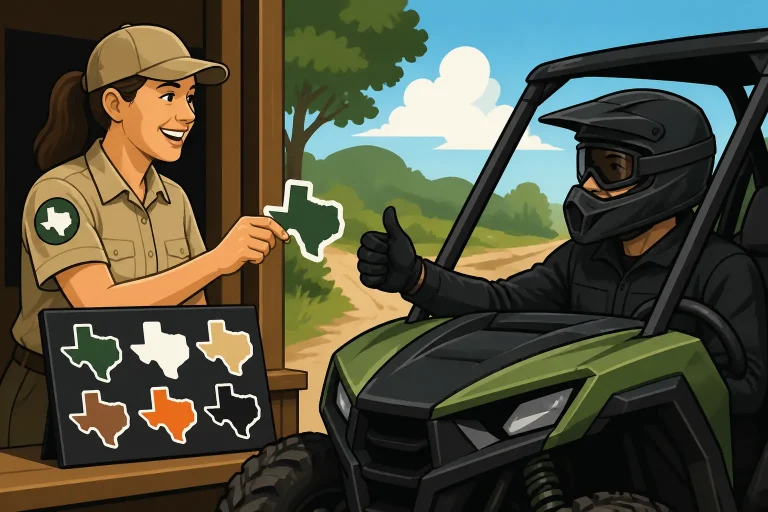
A park may sell decals because riders arrive without one and need a convenient way to meet the requirement before riding. Keeping decals available at the gate takes staff time and involves handling a state-issued item. The seller may charge more than the state’s base price to account for the transaction or the convenience of buying on site.
That extra amount is not necessarily a park admission fee, nor is it necessarily a sign that the state has changed the decal price. It may be a seller’s charge attached to an on-site purchase. The important point is to ask what the posted amount includes before paying, especially if the price is shown beside other park fees.
Convenience has a cost
Buying at the gate can save a separate stop or advance order. If you arrive at a park and discover that you need a decal, paying a little more may be simpler than delaying the ride to find another seller. The trade-off is that an on-site purchase can be more expensive than buying through a lower-cost channel ahead of time.
The gate purchase can also help avoid a practical problem: showing up without the required decal and being unable to ride until you obtain one. If you are planning a trip with several vehicles, check each machine’s decal status before departure. The requirement is generally tied to the individual machine, not to the group as a whole.
The park is acting as a seller, not changing the state decal
The park’s role at the counter does not turn the state sticker into a park-specific permit. A park may distribute the decal while setting its own separate policies for entry, trails, camping, safety gear, or machine access. Those policies can apply whether you bought the decal there or somewhere else.
Ask the staff to separate the charges if the total is unclear. For example: “How much is the state decal, and is there a separate park or handling charge?” That question is practical and neutral. It lets you understand the receipt without assuming that a higher total is an error.
If you want to know whether the park sells decals at all, Texas Decals Sold at a Park Gate covers that buying channel. Availability can depend on the location, so do not count on a gate sale as your only plan unless the park confirms it.
Check the current amount before relying on an old figure
Decal prices, seller charges, and park fees can change. A number posted in an old forum discussion or copied into a trip plan may not match the amount charged at the gate now. Check the state’s current decal information and the park’s own visitor information before you travel.
Also confirm whether the amount shown is the decal price alone or a total that includes other charges. A web page may list park admission separately, while a counter may collect several items in one transaction. Comparing the total at the gate with the state’s base price without separating those items can make the difference look larger or more confusing than it is.
What the Decal Does and Does Not Pay For
The decal is connected to Texas’s OHV program and applies to eligible riding in places where the state requires it. It is not a general-purpose pass for every public or private property. Whether it is needed depends on the location and the relevant rules, so check the land manager’s requirements before assuming the sticker is mandatory—or that it is enough by itself.
The decal also does not replace permission from a landowner or manager. A rider still needs lawful access to the land and must follow posted closures and route restrictions. A decal is not a title, a road-registration plate, or proof that a machine is street legal.
It is not a day pass
A common misunderstanding is that paying for the decal means the rider has paid the park’s full access fee. Unless the park specifically says otherwise, treat the decal and admission as separate. A park may collect both at the same counter, but they serve different purposes.
The same distinction matters at a national forest trailhead. A decal may not cover a separate day-use charge, permit, or pass required by the land manager. Does an OHV Decal Cover the Forest Day-Use Fee? addresses that distinction. Before heading out, check both the state decal requirement and the local site’s entry rules.
It does not guarantee that your machine is allowed
Parks can have machine-specific rules. A site may limit vehicle width, restrict certain types of machines, require safety equipment, or close a trail for conditions. Holding the state decal does not override those limits.
Confirm that the park accepts your particular ATV, UTV, or other machine and that it fits the trails you plan to use. If the park has separate rules for youth riders, passengers, helmets, flags, or noise, those still apply. A decal is one piece of compliance, not a pass that cancels the rest.
It is not the same as title or road registration
The OHV decal should not be confused with an ownership title or a license plate for public-road travel. Texas titling and OHV decal requirements answer different questions: a title records ownership, while a decal is related to off-highway riding where required. Neither, by itself, makes an ATV or UTV legal for ordinary road use.
If you are still sorting out the difference between ownership paperwork and riding permits, Why Texas Titles But Never Registers an OHV explains the distinction. For sticker requirements on public land, Texas Rules for Riding Public Land is a useful next reference.
Buying Before the Trip or at the Gate
You can avoid surprises by deciding before departure whether you want to buy the decal in advance or at the park. Buying early can save time at check-in and may cost less than an on-site purchase. Buying at the gate can be more convenient if you are unsure whether you need one or do not want to arrange it ahead of time—but confirm that the park actually sells it.
For a quick overview of purchase options, see Where to Buy a Texas OHV Decal. If you are choosing between online and in-person options, Buying a Texas Decal Online and Buying a Texas Decal at a Dealer can help you compare the channels.
A simple decision process
- Identify where you will ride. Check the park or land manager’s rules, not just the general state decal information.
- Confirm which machines need decals. Do not assume one sticker covers every vehicle in a group.
- Check whether you already have a valid decal. Look at the sticker and confirm its validity for the trip.
- Compare purchase options. Check the state’s current base price and ask the park whether its gate price includes an additional seller charge.
- Separate the costs. Budget for the decal, park admission, camping, and any other required charges individually.
- Keep proof of purchase. Save the receipt and follow any instructions about where the decal must be displayed.
- Recheck before leaving. Confirm operating hours, access conditions, and any temporary trail closures.
This process helps prevent a common mix-up: arriving with enough money for the decal but not enough for park entry, or assuming an admission payment includes the sticker. If you are riding more than once during the decal year, check how long the decal remains valid and whether it will cover your planned trips. The decal year and the park’s operating season do not necessarily start and end together.
Ask these questions at the gate
If the price is higher than the state price you expected, ask the staff:
- Is this amount for the Texas OHV decal only?
- Does it include a seller, handling, or transaction charge?
- Is park admission separate?
- Does every machine in my group need its own decal?
- Is the decal valid for this location and riding date?
- What proof should I keep after I buy it?
These questions are especially useful when a gate collects the decal fee along with admission or camping charges. Ask for an itemized receipt where available. If the receipt combines charges, a staff explanation can still clarify which amount relates to the state decal and which amounts belong to the park.
If you already have a decal
Do not buy another one automatically just because you are at a park gate. Check the validity of the decal you already have and whether it belongs to the machine you are bringing. If you cannot tell whether it is current, ask the park or consult the current state information before paying for a replacement.
Likewise, do not assume a decal on a borrowed or recently purchased vehicle is usable for your ride. Confirm the applicable rules and that the sticker is properly associated with the machine. If you are purchasing a used ATV or UTV, handle ownership paperwork and decal questions separately.
How to Read the Total and Avoid Confusion
When a park’s gate price appears higher than the state amount, focus on the breakdown rather than the total alone. A larger total can reflect an additional seller charge, park entry, or another service. It can also be a price that has changed since the information you saw was posted. The counter is the right place to ask what is included, but checking in advance gives you more time to compare options.
Keep the following distinctions in mind:
- State price: The base price associated with obtaining the decal through the state program.
- Seller charge: An additional amount that may apply when a park or other seller provides the decal on site.
- Park charge: The site’s own fee for access, camping, or other services.
- Eligibility and access: Whether the machine may ride there and whether the decal is required for that location.
If the seller cannot explain a difference, contact the park before buying or check the state’s current decal information. Avoid relying only on a remembered price, a third-party post, or an old receipt. The goal is not just to find the lowest number; it is to make sure you have the right decal and have paid the charges required for that specific ride.
A higher gate price may be worthwhile if it lets you start riding without making another stop. If you are planning several trips, buying through another available channel may be more economical. The better option depends on the current price, the seller’s charge, the time involved, and how certain you are that the decal applies to your machine and destination.
The most useful pre-trip habit is to check three things independently: the current state decal price, the park’s gate and admission charges, and the land’s riding rules. That prevents the sticker from being mistaken for a day pass and makes it easier to spot an unexplained charge.
Frequently Asked Questions
Is a park allowed to charge more than the state price for a decal?
A park may offer the decal at the gate for a price above the state’s base amount. The difference may reflect the seller’s handling or convenience charge. Ask the park what the posted price includes and verify current amounts before you go.
Does the higher gate price mean the park has its own decal?
Not necessarily. The park may be selling the state OHV decal. A higher price alone does not show that it is a separate park permit. Ask whether the charge is for the state decal, a seller fee, or park access.
Does buying the decal cover park admission?
Do not assume so. The decal and park admission are separate types of charges unless the park specifically says they are bundled. Check the park’s current fee information and keep the receipt.
Should I buy a decal at the gate?
It can be convenient if you arrive without one and the park sells it, but the gate price may be higher than another purchase option. Compare current prices, confirm the park has decals available, and check that the requirement applies to your machine and destination.
Do all machines in a riding group need a decal?
If a decal is required, do not assume that one sticker covers several machines. Confirm the rule for each vehicle and make sure each machine meets the park’s access requirements.
Disclaimer
This article is for general informational purposes only and does not constitute professional advice. Laws, prices and regulations vary by location and change over time. Consult a qualified professional for guidance on your specific situation.