Why Texas Will Not Certify Below Fourteen
Why Texas Will Not Certify Below Fourteen
A parent planning a Texas ride can hit an apparent wall: the state’s OHV safety certificate is not available to children under 14. That does not automatically mean a younger child cannot ride. The important distinction is between earning a certificate and riding under an eligible adult’s direct supervision, while also meeting the rules of the land and the machine.
Why the Certificate Has a Minimum Age
The age floor applies to the safety certificate, not to every opportunity for a child to ride an off-highway vehicle. Texas sets 14 as the minimum age for a rider to complete the state-recognized certification process. A child younger than 14 cannot earn that certificate by taking the course early, even if the child has plenty of experience at home.
The practical reason is that certification is meant to confirm more than familiarity with controls. Safety training covers decisions a rider must make around other people, changing terrain, obstacles, and the limits of the machine. A course may require a learner to absorb instructions, demonstrate skills, and apply them in a controlled setting. The age threshold creates a consistent boundary for that credential; it is not a personalized assessment of every child’s maturity or riding ability.
That distinction matters because parents sometimes treat a certificate as a general permission slip. It is not. A certificate documents completion of safety education. It does not establish that a child is ready for a particular quad or side-by-side, make an otherwise prohibited ride legal, or substitute for permission to use a trail or park.
Texas’s minimum age is also not a general rule that says every child under 14 must stay off every OHV. Younger riders may be allowed to operate on qualifying rides when they are under the direct supervision of an adult who meets the applicable safety requirements. The details of that supervision matter, and the land manager may impose additional conditions. Review [Texas OHV Safety Certificate Requirements] and Texas Minimum Age for a Safety Certificate before planning around a child’s age.
A useful way to separate the issues is:
| Question | What it concerns | What it does not establish |
|---|---|---|
| Can the child earn a Texas safety certificate? | The rider’s eligibility for the certification process | Whether the child may ride on a particular trail |
| Can a child under 14 ride? | The rules for riding under qualifying adult supervision | That any adult, machine, or riding area is acceptable |
| Does the ride require an OHV decal? | The machine’s decal requirement for certain public riding areas | That the rider is certified or supervised |
| Is this child ready for this machine? | Fit, skill, judgment, and the machine’s design | Legal permission to ride |
The certificate, the child’s readiness, and the land’s rules should be checked separately. A family can meet one requirement and still fail another. For example, a child may be allowed to ride under supervision but be on a trail that prohibits the machine’s width. Or a machine may have the required decal while the rider lacks the required adult supervision.
The age limit is a credential rule, not a judgment about a child
An age threshold can feel blunt, especially when a young rider has been operating a small quad for years. But a course certificate is a standardized credential, not a reward for experience. Texas does not issue the certificate below the stated age simply because a child appears confident or has had private instruction.
That approach also makes the requirement easier to apply consistently. A course provider does not need to decide whether an individual child is unusually mature, and a park employee does not have to evaluate a child’s riding résumé at the entrance. The certificate has a clear minimum age; supervision rules address younger riders separately.
Certification is one part of a safe ride
The certificate should not be treated as proof that a rider can safely handle every OHV. Completing a course does not remove the need to match the machine to the rider, use required protective equipment, obey trail signs, or stay within the manufacturer’s passenger and loading limits. For a young rider, those practical checks can matter as much as the certificate itself.
Conversely, a child who cannot yet qualify for a certificate should not be assumed to be unprepared for all riding. A supervised ride on an appropriate machine and a suitable route is different from an unsupervised ride on a challenging trail. The right question is not only “Does the child have a certificate?” It is also “Who is supervising, where is the ride, and is this machine appropriate?”
What a Rider Under 14 May Be Allowed to Do
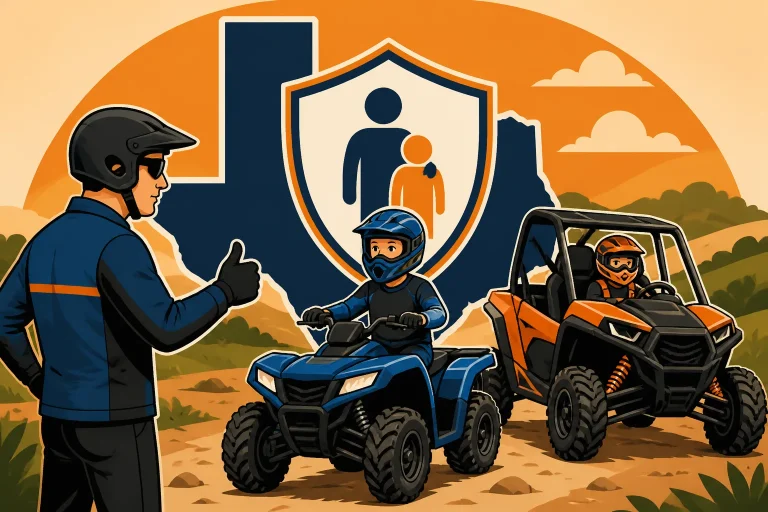
A rider younger than 14 may be able to operate an OHV on a permitted ride while under direct supervision by an adult who satisfies the applicable safety-course requirement. Direct supervision is the key condition. It means active oversight of the child’s riding, not simply being somewhere on the same property or reachable by phone.
This is different from a casual group ride where the adult is far ahead, separated by turns, or occupied with another task. A young rider needs an adult who can observe the ride and intervene promptly if conditions change. That may mean choosing a short route, keeping the child within view, and avoiding terrain where the adult cannot safely reach or assist them.
Before heading out, confirm the current supervision rule and how the riding area applies it. Pay particular attention to whether the supervising adult must hold a Texas certificate, whether a certificate from another state is accepted, and what the park expects the group to show at check-in. Direct Supervision by a Texas Certificate Holder explains the central distinction, while Does Texas Accept an Out-of-State Safety Certificate? is useful if the supervising adult trained elsewhere.
Direct supervision should be practical, not just formal
A certificate-holding adult may satisfy the credential side of the rule, but supervision still has to be meaningful. Before the ride, agree on how close the adult will stay, where the group will stop, and what the child should do if they cannot keep up or become uncomfortable. On the trail, the adult should be able to see the child often enough to judge speed, control, and fatigue.
The child’s ability to operate the machine is another separate question. A young rider who can manage a quad in an open, flat area may struggle with ruts, loose sand, rocks, slopes, or traffic from faster machines. Start with terrain suited to the child’s current skill, and do not treat a successful first lap as proof that more difficult trails are appropriate.
A few practical supervision habits help:
- Ride at a pace the child can maintain without rushing.
- Keep the child close enough to communicate and respond to a problem.
- Choose routes with manageable terrain and clear stopping areas.
- Stop when visibility, fatigue, heat, or trail traffic makes supervision harder.
- Do not allow the child to ride beyond the adult’s view or control.
- Make sure everyone knows the group’s plan if a machine stalls or someone is separated.
The adult should also consider whether supervising one child leaves enough attention for other riders, navigation, and hazards. A crowded group or complicated trail can make close oversight difficult even when the adult is physically present.
The machine must fit the child
The law’s certificate age does not tell a parent which vehicle a child can handle. Fit depends on more than age or the machine’s advertised size. The child should be able to reach and operate the controls, maintain a stable position, and follow directions without straining. A machine that is too powerful, heavy, or tall can make a minor mistake harder to correct.
A side-by-side presents different concerns from a quad. The child may be a passenger rather than an operator, and passenger rules, seating design, restraints, and the manufacturer’s instructions all matter. Do not assume a child can ride as a passenger merely because the vehicle has an extra seat. Check Why Only a Factory-Fitted Passenger Seat Counts and Texas Rules for a Child in a Side-by-Side when considering a UTV ride.
Even on an appropriately sized machine, protective equipment and supervision do not eliminate risk. A helmet and other required gear help, but the safest choice may still be to postpone a ride if the child cannot follow directions, is tired, or is uncomfortable with the terrain.
Public land and private land are not interchangeable
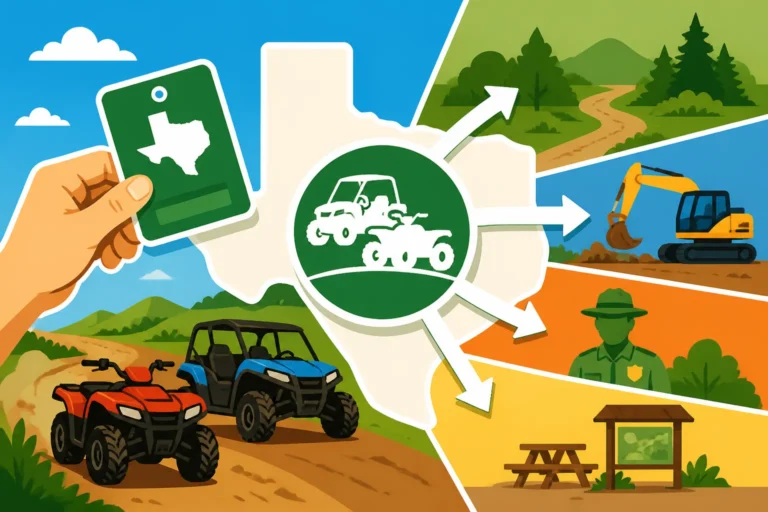
The certificate requirement is especially relevant to riding areas where Texas OHV safety and decal rules apply. A family riding on private property should not assume that every public-land rule applies in the same way, but private property is not a free pass to ignore safety, owner restrictions, or other applicable laws. A private ranch, a public trail, a state park, and a privately operated OHV park can each have different entry and riding requirements.
Confirm the rules for the specific destination rather than relying on a general statement about Texas. Ask the park or land manager whether a rider under 14 may operate, what qualifies as direct supervision, and what documents the supervising adult must carry. For public areas, Texas Rules for Riding Public Land and Where a Texas OHV Decal Is Required help distinguish the rider requirement from the machine’s decal requirement.
How to Prepare for a Ride With a Younger Rider
A family can avoid most last-minute confusion by checking three things independently: the supervision requirement, the machine and riding area rules, and any decal or permit needed for the destination. Do this before loading the trailer. A successful plan depends on all three, not just the child’s age.
- Confirm the location’s rules. Call or check the official information for the park, trail, or land manager. Ask whether the child may operate an OHV under 14 and what “direct supervision” requires there.
- Confirm the adult’s qualification. Make sure the supervising adult has the certificate the rules require, and ask whether an out-of-state credential is accepted. Do not assume that the adult’s riding experience is a substitute for a certificate.
- Check the machine’s requirements. Verify that it is suitable for the child and allowed on the chosen trail. Width limits, passenger rules, and equipment requirements can rule out a machine even when the rider meets the supervision condition.
- Check decal and access requirements. Some riding areas require the OHV decal or other proof of compliance. An adult’s certificate does not cover the machine’s decal, and a machine’s decal does not satisfy a rider’s certificate or supervision rule.
- Plan a manageable route. Choose terrain that fits the child’s ability, and decide where the group will stop or turn back. Keep the first ride short enough to assess comfort, control, and fatigue.
- Carry the necessary proof. Keep the supervising adult’s certificate and any required permits or confirmations available. Check whether the site expects a physical document, an accepted electronic record, or another form of proof.
The separate requirements are easy to confuse. An OHV decal is tied to the machine and the rules for particular riding areas. A safety certificate belongs to a rider who completed the required education. Direct supervision is the condition that can allow a younger rider to participate without holding a certificate. These are not interchangeable. For more on the certificate itself, see Carrying the Certificate on a Texas Ride and Showing the Card on Demand.
Verify reciprocal certificates before relying on one
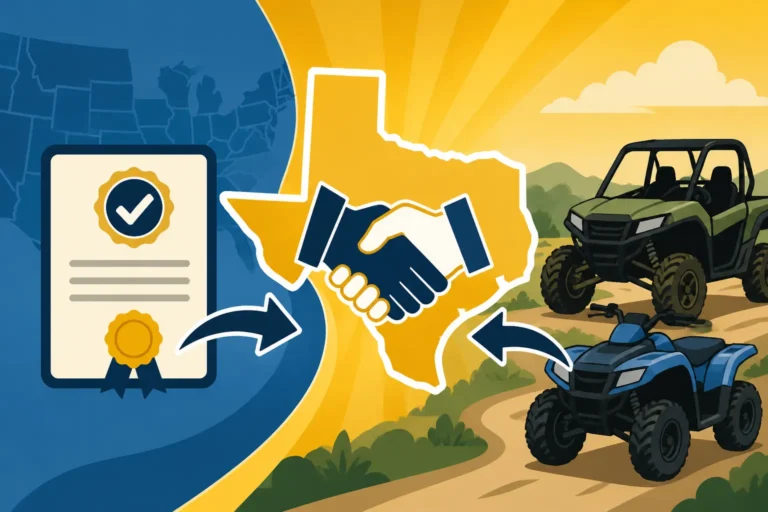
Texas recognizes some safety certificates issued elsewhere, but that does not mean every card, online course, or completion record will automatically qualify. The safest approach is to confirm acceptance with the relevant Texas authority or riding-area manager before relying on an out-of-state credential for supervision. Make sure the document identifies the rider and the course clearly enough to be checked.
This is particularly important if a family travels between states or if an adult earned a certificate through a course that is not familiar to the Texas park. A certificate may be valid in its home state yet not satisfy a particular Texas requirement. Texas Reciprocity and Why It Is One-Sided provides context, and Riding Texas on an Oklahoma Safety Certificate addresses a common cross-border question.
Do not confuse a decal with a safety certificate
Parents sometimes buy a decal or pay an entry fee and assume the child is cleared to ride. Those steps address access or machine requirements, not the rider’s safety education or supervision. The reverse is also true: a qualifying adult’s certificate does not automatically pay for admission, supply a decal, or authorize the group to use a closed trail.
A good pre-trip check should therefore ask: Is the rider permitted to operate under supervision? Does the adult meet the certificate requirement? Is the machine compliant with the destination’s rules? Does the ride require a decal or other access credential? Keeping those questions separate makes the answer clearer and helps avoid a disappointing turn at the gate.
Why the Rule Still Matters After a Child Turns 14
Turning 14 makes a rider eligible for the certificate process; it does not mean a certificate appears automatically or that the rider can skip instruction. The young person still needs to complete the appropriate course and meet the course provider’s participation requirements. Until that process is completed, do not assume that age alone satisfies a certificate requirement.
Nor does certification mean a teen is ready for every machine or trail. A first-time certificate holder may need close adult oversight, conservative route choices, and more practice before tackling steep, crowded, or technically difficult terrain. The certificate is a useful foundation, not a substitute for judgment.
Families can prepare before the age threshold by building safe habits in settings where riding is allowed. A younger rider can practice following directions, stopping on request, sharing a trail, and recognizing when to turn back. Those habits support later course learning, but they do not count as the certificate itself.
When the rider becomes eligible, consider a structured course rather than treating the age milestone as the end of safety education. A formal course can give a teen a chance to practice skills under instruction and identify gaps that may not show up during familiar rides at home. See Booking a Hands-On RiderCourse and What the RiderCourse Covers for details about the training process.
The adult’s role also changes gradually rather than disappearing. A newly certified teen may still benefit from riding with an experienced adult, especially on unfamiliar land or in difficult conditions. Continue to match the route to the rider’s demonstrated control and decision-making, not simply the date on the certificate.
A simple decision check for parents
Before allowing a child under 14 to ride, work through this short check:
- Is the riding area open to the machine and the type of riding planned?
- Does the location allow an under-14 rider under supervision?
- Does the adult meet the certificate requirement and have proof available?
- Can the adult maintain direct supervision on this route?
- Can the child operate the machine’s controls and follow instructions?
- Is the machine appropriate for the child and allowed on the trail?
- Are all required decals, permits, protective equipment, and passenger arrangements in place?
If any answer is uncertain, pause and verify it with the land manager or relevant authority. This is more reliable than relying on a friend’s recollection, an old social media post, or a rule from another state. The details can differ by riding area, and access policies can be more restrictive than the general state rule.
Frequently Asked Questions
Can a child younger than 14 take the Texas OHV safety course?
Texas does not issue the safety certificate to riders below 14. A course provider may have separate policies about observing or participating in some training activities, so ask the provider directly, but do not treat informal instruction as a certificate.
Does the minimum certificate age mean children under 14 cannot ride?
Not necessarily. A younger child may be able to ride under direct supervision by an adult who meets the applicable certificate requirement. Confirm the current rule and the specific riding area’s policies before going.
Can any adult supervise a child under 14?
Do not assume so. The supervising adult may need to hold a qualifying safety certificate, and the supervision must be direct. Check the applicable requirements and keep proof available.
Does an OHV decal replace the child’s certificate requirement?
No. A decal concerns the machine’s access or use requirements in certain areas. It does not certify a rider or replace the supervision rule for a child under 14.
Can an out-of-state certificate qualify a supervising adult?
It may be accepted, but do not assume every credential qualifies. Confirm the certificate’s acceptance with the relevant Texas authority or the riding-area manager before depending on it.
Disclaimer
This article is for general informational purposes only and does not constitute professional advice. Laws, prices and regulations vary by location and change over time. Consult a qualified professional for guidance on your specific situation.