Why Texas Funds Parks It Does Not Run
Why Texas Funds Parks It Does Not Run
Texas can help pay for off-highway vehicle trails without owning or operating the places where riders use them. That arrangement can be confusing if a park has state-supported improvements but sets its own rules, fees, hours and permits. The key is to separate the state’s grant role from the land manager’s authority—and to check what you need before you ride.
Why Texas funds OHV recreation through grants
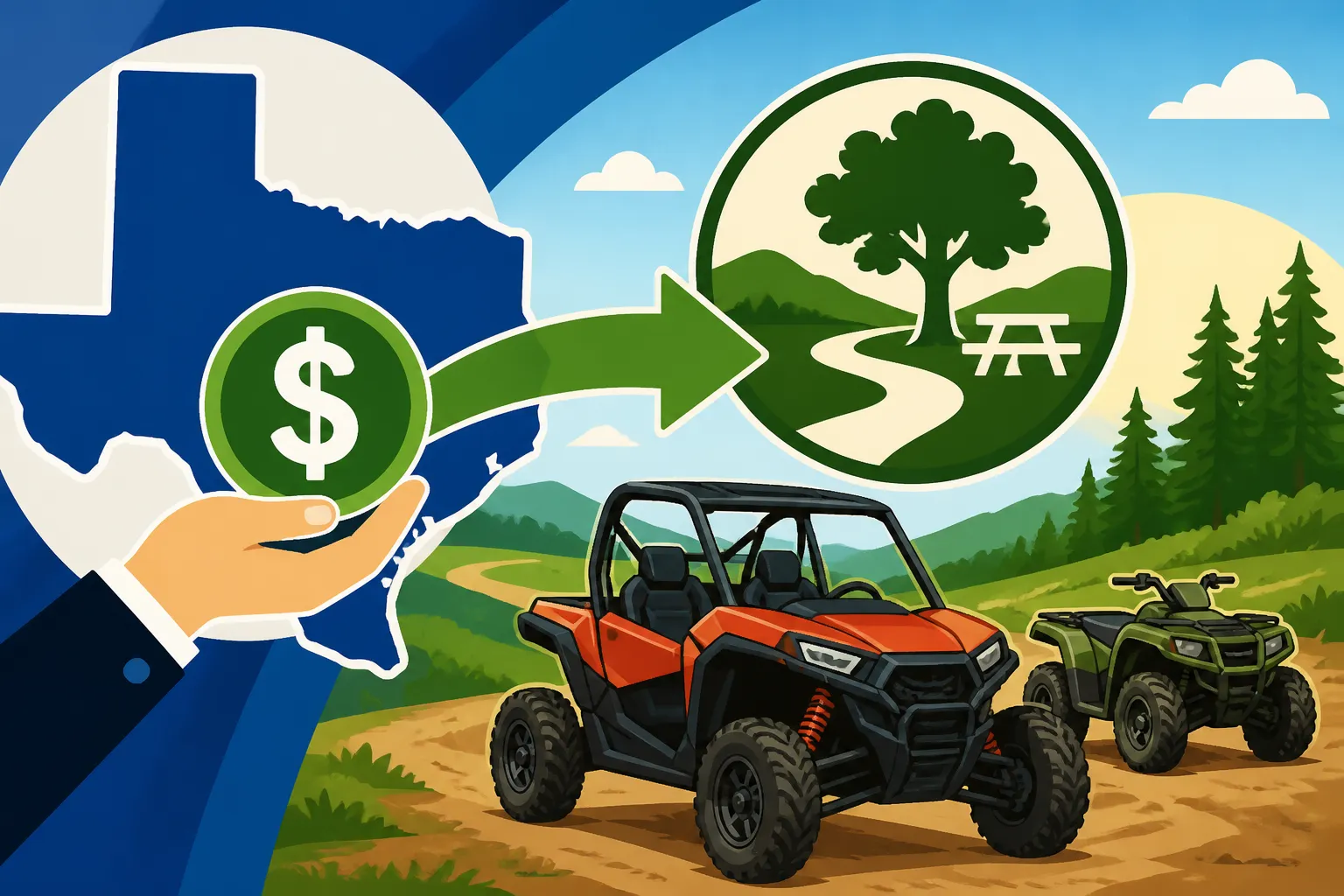
Texas Parks and Wildlife Department administers an off-highway vehicle program supported by OHV decal revenue. Rather than treating that money as a state-run park budget, Texas uses it to support eligible projects through grants. Local governments, public land managers and qualifying organizations may be able to seek support for OHV recreation projects, subject to the program’s current requirements.
That approach lets state funds help create or improve riding opportunities in different parts of Texas without requiring the state to buy every property, staff every trailhead or manage every riding area. A grant may help a park or land manager take on work it could not easily fund on its own. Depending on the project and the grant agreement, that work may involve developing or improving trails, maintaining riding facilities, providing trail information, or supporting safety and other OHV-related needs.
The distinction matters because grant support is not the same thing as state ownership. A city, nonprofit, water district or other land manager may still own the site, decide how it is operated, and take responsibility for day-to-day management. The state’s part may be limited to administering the program, evaluating applications and providing money for approved purposes.
The system also makes a dedicated source of OHV funding available for projects that serve riders. The Texas OHV decal is one part of that system: revenue from the program supports grants, while the organizations receiving grants put approved projects into practice. For more about the funding path, see Where Texas OHV Decal Money Goes and The Texas Parks and Wildlife Grant Program.
A grant program can be useful where riding areas depend on local organizations or public agencies to provide access. It also means there is no single statewide operating model. One park may be managed by a city, another by a nonprofit, and another by a public land agency. Each may have different staffing, facilities, opening schedules and ways of collecting fees.
That variation is not necessarily a sign that something has gone wrong. It is a consequence of keeping the site-level decisions with the organization responsible for the property. Texas can support a riding opportunity without taking over the practical work of running it.
What a grant does and does not pay for
A grant is intended to support a defined project or purpose, not to make every cost at a park disappear. The approved application and grant agreement determine what the money can cover. A grant for a trail project, for example, should not be assumed to pay for unrelated expenses or to cover the park’s entire budget.
A grant-funded improvement might be visible to riders, such as a trail feature or visitor facility. Other supported work may be less obvious, such as planning, upkeep or services needed to make a project usable. The precise scope depends on the program rules and the specific award. It is better to check the project or the managing organization than to infer the grant’s terms from a sign or a new facility.
A useful distinction is:
| What state grant support may do | What it does not automatically mean |
|---|---|
| Help pay for an approved OHV-related project | The state owns the land |
| Support work identified in a grant agreement | The park is operated by Texas Parks and Wildlife Department |
| Help improve access or facilities at a participating site | Every trail or nearby parcel is open to riding |
| Support a project that serves OHV recreation | Riders can enter without paying the park’s charges |
| Provide one source of project funding | The grant pays all ongoing operating costs |
| Make a site part of a state-supported program | The site accepts every out-of-state decal or credential |
The grant’s conditions matter too. Funding may come with requirements for completing the approved work, documenting expenses or meeting project obligations. Depending on the agreement, there may also be conditions related to public use or access. Those details belong to the grant and the project; they should not be guessed from the fact that a park received funding.
The recipient may also need money from other sources to finish or maintain the work. A project grant does not necessarily provide a long-term operating budget. Staff, insurance, utilities, trail inspections, repairs, sanitation, signs and visitor services can continue to cost money after construction is finished.
This is one reason a grant-supported park may still charge riders. Admission and camping charges can help the operator cover expenses that the grant does not pay, or support activities beyond the grant’s approved scope. The park’s own fee schedule is separate from the state OHV decal program. For more on that distinction, see Why a Park May Charge More Than the State.
Nor does grant support mean the state guarantees a particular trail will stay open indefinitely. Weather, maintenance needs, construction, land-use agreements, safety issues and local decisions can affect availability. A route can close even if the park has benefited from public funding. Riders should check the site’s current information before towing there.
Who owns and runs a grant-supported park
The grant recipient and the land manager may be the same organization, but the key practical point is that the organization responsible for the site generally handles the daily operating decisions. That can include setting opening hours, deciding which vehicles a trail can accommodate, managing reservations, setting visitor charges, enforcing site rules and closing areas when necessary.
A city-run park may have municipal procedures and local rules. A nonprofit park may rely on membership, day-use charges, donations or other income. A water district or another public authority may manage land under its own policies. A state or federal land manager may have separate permits and land-use rules. A grant does not erase those distinctions.
The managing organization is usually the best place to confirm:
- Whether the park is currently open and which trails are available.
- Which vehicle types and dimensions are allowed.
- Whether reservations, day-use permits or other site-specific credentials are required.
- What the park charges, and whether camping or other services cost extra.
- Whether a trail is closed because of weather, maintenance or another restriction.
- What safety gear, flags, sound limits or other site rules apply.
Texas Parks and Wildlife Department can administer the OHV funding program without being the contact for every operational question at a funded site. A rider who wants to know whether a particular trail is open should contact the park or land manager, not assume that a state grant office controls daily trail status.
This division of responsibility can feel inconvenient when a visitor is trying to make one phone call or check one website. But it reflects a broader arrangement: the state helps fund eligible recreation projects, while the property’s owner or operator manages the actual place. Some sites may publish grant information, but a grant notice is not a substitute for current visitor instructions.
You can use How to Tell If a Park Took an OHV Grant to understand what grant participation may tell you about a site. It still will not answer every practical question about entry or riding. For a closer look at how local management can affect a rider’s visit, see Riding an OHV Park Run by a Water District and Non-Profit OHV Parks and What They Charge.
Why grant support is not a riding permit
Funding, access and permission are separate questions. A grant may support a trail or facility, but it does not give an individual rider permission to use it. You still need to follow the land manager’s entry rules, use only routes open to your vehicle, and obtain any required park-specific permits or passes.
The Texas OHV decal is another separate part of the picture. It is a state program credential, not a general admission ticket. A decal does not necessarily pay a park’s day-use charge, camping fee, reservation cost or other site-specific expense. Conversely, paying a park at the gate does not necessarily satisfy the state’s OHV decal rules for riding on land where those rules apply. The decal’s requirements and exceptions depend on the machine and where it is used, so check the current rules before traveling. See The Texas OHV Decal Explained for the program overview and Texas Rules for Riding Public Land for the land-use context.
Nonresidents should be especially careful not to assume that a credential from another state automatically substitutes for a Texas decal or a local park permit. Reciprocity can apply differently to different credentials, and a park’s admission requirements are not the same as state decal rules. Check both. Texas Reciprocity and Why It Is One-Sided explains why an out-of-state credential may not settle every Texas requirement.
Before a trip, think of the requirements as separate layers:
- State OHV rules: Confirm whether the machine needs a Texas OHV decal for the land and use planned, and whether an exception applies.
- Land-manager permission: Confirm that the specific site is open to your machine and that your planned route is allowed.
- Park entry requirements: Check whether the park requires a day-use pass, reservation, membership or other payment.
- Additional credentials: Check for safety certificates, age-related requirements or other rules that apply to the rider.
- Site conditions: Confirm trail status, closures, operating hours and any temporary restrictions shortly before departure.
This checklist can prevent a common mix-up: a rider sees a state-supported project and assumes that state funding includes entry. In reality, the decal program and the site’s own operating arrangements may both apply, and neither automatically replaces the other.
Even a public site may have limits on when and where the public can ride. A grant-supported trail is not necessarily open every day, all day, or to every type of OHV. Access may be restricted to designated routes, certain hours or specific seasons. Do not treat a trail shown in an old map or project description as proof that it is currently open.
How to check a park before you go
Start with the organization that manages the riding area. Look for current visitor information rather than relying on an old map, a past trip report or a general statement that the park received a grant. If rules are unclear, contact the site directly and ask a specific question about your machine and planned visit.
A practical pre-trip check includes:
- Confirm the operator. Find out which agency or organization manages the property and where it posts current notices.
- Check the route and vehicle rules. Ask whether your ATV or UTV is allowed on the trails you plan to use. Width, vehicle type and trail classification can matter.
- Verify every credential separately. Check Texas OHV decal requirements and any park-specific permit, pass or reservation requirement.
- Ask about visiting from out of state. Do not assume your home-state decal, registration or safety certificate covers all Texas requirements.
- Review current closures. Heavy rain, maintenance and other conditions can change trail availability.
- Check the full cost structure. Separate the state decal from park entry, camping, rentals or other operator charges. Amounts and policies can change, so use the operator’s current information.
- Confirm what the grant information actually says. If you want to know which improvements were supported, look for details from the grant recipient or the state program. Do not treat a funding announcement as the site’s current operating policy.
For questions about the state decal, consult the Texas OHV program’s current information. For questions about park hours, fees, trail status or local rules, contact the park operator. If a website says only that a site is “grant funded,” ask what that means for the particular project and whether it changes any visitor requirements. In many cases, it will not.
The distinction is straightforward once the roles are clear: Texas may provide funding for an approved OHV project; the land manager controls the site; and the rider is responsible for meeting state and local requirements. Grant support can help create or improve places to ride, but it does not turn each recipient into a state park or make every trail free, open or permit-free.
Frequently Asked Questions
Does a Texas grant-funded OHV park belong to the state?
Not necessarily. Grant funding does not by itself transfer ownership. The property may belong to or be managed by a city, nonprofit, water district or another organization.
Does a Texas OHV decal cover a park’s admission charge?
Not automatically. The state decal and a park’s day-use, camping or reservation charges are separate. Check the park’s current entry requirements.
Can I ride anywhere on land that received an OHV grant?
No. A grant does not make every part of a property open to riding. Use only routes the land manager has designated as open and follow current closures and restrictions.
Does an out-of-state decal replace Texas requirements?
Do not assume that it does. Reciprocity can depend on the credential and the situation. Confirm current Texas rules and the specific park’s requirements before your trip.
Disclaimer
This article is for general informational purposes only and does not constitute professional advice. Laws, prices and regulations vary by location and change over time. Consult a qualified professional for guidance on your specific situation.