Does a Louisiana Safety Certificate Work in Texas?
A Louisiana ATV safety certificate may work in Texas, but an out-of-state card is not automatically enough just because it says “safety course.” The key question is whether it documents training Texas recognizes. This article explains how to check the certificate, what riders must carry on public land, and why certificate reciprocity is separate from Texas’s OHV decal rules.
Does Texas accept a Louisiana ATV safety certificate?
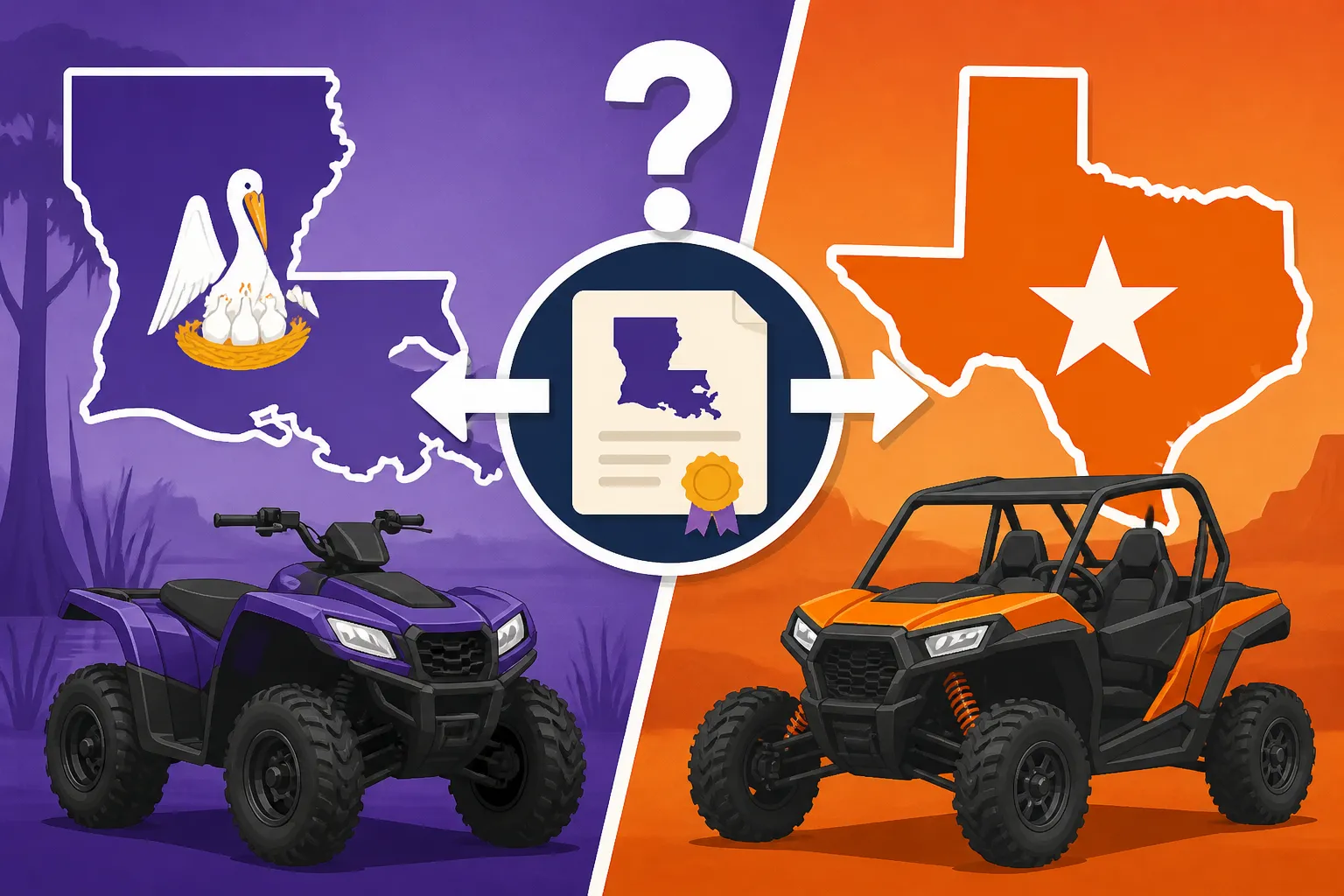
Generally, yes, if the Louisiana certificate shows successful completion of training equivalent to the course Texas recognizes and was issued under the authority of another state. Texas Parks and Wildlife Department recognizes certificates for the ATV Safety Institute’s ATV RiderCourse, including hands-on training, as well as equivalent safety training certificates issued under the authority of Texas or another state.
That means the state associated with the certificate matters, but so does the training it represents. A certificate from Louisiana may qualify; a card from a private course provider that does not document equivalent training or state authority may be harder to rely on. Check the issuing organization and the course details on the certificate before riding.
Texas Parks and Wildlife Department also describes a qualifying safety training certificate as one issued by the Texas Department of Public Safety or an equivalent certificate issued under another state’s authority. If the wording on a Louisiana certificate is unclear, contact the issuer and ask whether the course is state-authorized and whether it includes the training Texas recognizes. You can also confirm the requirement with Texas Parks and Wildlife Department before your trip.
The important distinction is that Texas recognizes certain out-of-state safety certificates, but it does not recognize another state’s OHV decal as a substitute for the Texas decal where one is required. Those are separate requirements:
| What you have | What it covers in Texas | What to check |
|---|---|---|
| Louisiana ATV safety certificate | May satisfy Texas’s rider-training requirement if it is an equivalent certificate issued under another state’s authority | Course content, hands-on training, issuing authority, and proof of completion |
| Louisiana OHV registration or decal | Does not replace the Texas OHV decal requirement on Texas public lands where a decal is required | Obtain and display a valid Texas OHV decal |
| Receipt for a Texas OHV decal | Can serve as readily available proof of purchase if the decal has not arrived | Keep the receipt accessible while riding |
For a closer look at how Texas treats out-of-state credentials, see Does Texas Accept an Out-of-State Safety Certificate? and Texas Reciprocity and Why It Is One-Sided. The main takeaway is simple: a Louisiana safety certificate may be valid for the training requirement, but a Louisiana vehicle sticker or registration does not provide the Texas OHV decal.
What riders need to carry on Texas public land
A qualifying certificate is not just something to leave at home after completing a course. Texas Parks and Wildlife Department requires riders on public land to carry their valid safety certification and show it upon request. Keep the original card or another accepted proof of completion with you, rather than relying on a photograph unless the relevant land manager confirms that a digital copy is acceptable.
If your card is difficult to protect from dust or moisture, a simple document sleeve can help keep it legible. A small weather-resistant card holder sold through retailers such as Amazon is one option, but check that it fits the certificate and does not make it hard to show when asked. The important thing is having valid proof available, not buying a particular accessory.
Age and supervision rules still apply even when a rider has an accepted certificate. According to the Texas Legislature, a person younger than 14 operating an ATV on public land must be accompanied by and under the direct supervision of a parent, guardian, or authorized adult. According to Texas Parks and Wildlife Department, a rider who is 14 or older may operate without adult supervision if they hold a safety certificate; they may also ride under the direct supervision of a certificate holder. A certificate does not cancel the supervision requirement for younger riders.
The certificate also does not replace the other rules that apply to a machine and its riders. For example, Texas Parks and Wildlife Department requires ATV operators and passengers on public lands to wear helmets meeting United States Department of Transportation standards. It also requires UTV occupants to wear seat belts when the vehicle is equipped with them. Riders should check the rules for the particular trail or public area, since land managers may have additional requirements.
Before heading out, use this practical checklist:
- Confirm the certificate qualifies. Check that it documents equivalent ATV safety training and was issued under the authority of Louisiana or another state.
- Carry proof while riding. Texas Parks and Wildlife Department says riders on public land must carry a valid certificate and show it upon request.
- Apply the age and supervision rules. A certificate does not allow a rider younger than 14 to ride an ATV on public land without the required adult supervision.
- Check vehicle and rider equipment rules. Requirements can include helmets for ATV operators and passengers, and seat belts in equipped UTVs.
- Check the riding area’s rules separately. A certificate establishes training; it does not grant access to a trail or replace permits, decals, or site-specific requirements.
These points are especially useful for visitors planning to ride a Texas state park trail or a national forest route. The Sam Houston National Forest OHV trail system is managed by the USDA Forest Service, so check the applicable trail information as well as Texas requirements. Texas Rules for Riders Under 14 explains the age and supervision rules in more detail, while Texas National Forest Permits covers a separate set of land-use requirements.
The certificate does not replace a Texas OHV decal
Safety training and vehicle decals serve different purposes. A valid Louisiana certificate may meet Texas’s rider-training requirement, but Texas does not offer reciprocity for out-of-state OHV decals or registrations. According to Texas Parks and Wildlife Department, nonresidents riding ATVs or UTVs on public lands or grant-funded venues in Texas must purchase a Texas OHV decal.
Texas Parks and Wildlife Department administers the state’s OHV decal program. Riders at Texas state parks must display a valid Texas OHV decal, and riders using other public land or grant-funded venues should check whether the decal is required there. The certificate proves training; the decal is tied to the vehicle and the applicable Texas riding requirements. Neither one takes the place of the other.
There is an important private-property distinction. Texas Parks and Wildlife Department says ATVs and recreational off-highway vehicles are not required to display a Texas OHV decal when operated exclusively on private property. That exception does not extend to public land merely because a rider is visiting from Louisiana, owns the machine elsewhere, or has a valid Louisiana registration. For more detail, see Texas OHV Decal Explained and Texas Rules for Riding Public Land.
A public-land ride may involve requirements beyond the safety certificate and decal. Texas law requires OHVs on public property or public lands to have a qualified, unmodified United States Forest Service spark arrester. Texas Parks and Wildlife Department also requires a headlight and taillight on public off-highway vehicle land; lights must be on during specified low-light conditions. Check the relevant park or trail rules before setting out, because the land manager may enforce additional equipment and access requirements.
Riding without a required Texas OHV decal can have consequences. Texas Parks and Wildlife Department classifies operating an OHV without a required decal on public land as a Class C misdemeanor, which can lead to a citation and a fine ranging from $25 to $500. The department also says riders should display a valid Texas decal on the vehicle or keep proof of purchase readily available if the decal has not arrived.
A quick way to think about the trip is to treat each requirement as its own check:
- Training: Does the Louisiana certificate document training Texas recognizes?
- Proof: Can the rider show the certificate while riding?
- Supervision: Does the rider’s age require an accompanying adult?
- Decal: Does the Texas location require a Texas OHV decal?
- Access and equipment: Does the trail or land manager impose additional conditions?
If one item is uncertain, resolve that question directly rather than assuming the certificate covers everything. A Louisiana safety certificate can address the training requirement when it meets Texas’s recognition standard, but it does not establish that a particular rider may use a particular trail, satisfy the Texas decal rule, or override age-based supervision requirements. For related details, see Texas OHV Safety Certificate Requirements and Texas Rules for Riding Public Land.
Sources
- Texas Legislature — Transportation Code Title 7, Chapter 663. Certain Off-Highway Vehicles (checked November 2, 2026)
- Texas Parks & Wildlife Department — OHV FAQ — Texas Parks & Wildlife Department (checked November 2, 2026)
- Texas Parks and Wildlife Department — Prohibition of Wheeled or Tracked Motor Vehicles in Stream Beds (checked November 2, 2026)
Disclaimer
This article is for general informational purposes only and does not constitute professional advice. Laws, prices and regulations vary by location and change over time. Consult a qualified professional for guidance on your specific situation.