Texas Spark Arrester Rules on Public Land
A spark arrester can look like a small detail on an ATV or UTV, but arriving without a compliant one can stop a public-land ride before it starts. Texas requires an approved, unmodified arrester on off-highway vehicles used on public property. Here’s how to check the requirement, what to verify on your machine, and which other access rules are easy to overlook.
What Texas requires on public land
Texas requires ATVs and UTVs operated on public property or public lands to have a United States Forest Service (USFS)-qualified spark arrester that has not been removed or modified, according to the Texas Legislature. The requirement is about both qualification and condition: an arrester that is not USFS-qualified does not meet the stated rule, and a qualifying unit that has been removed or modified does not either.
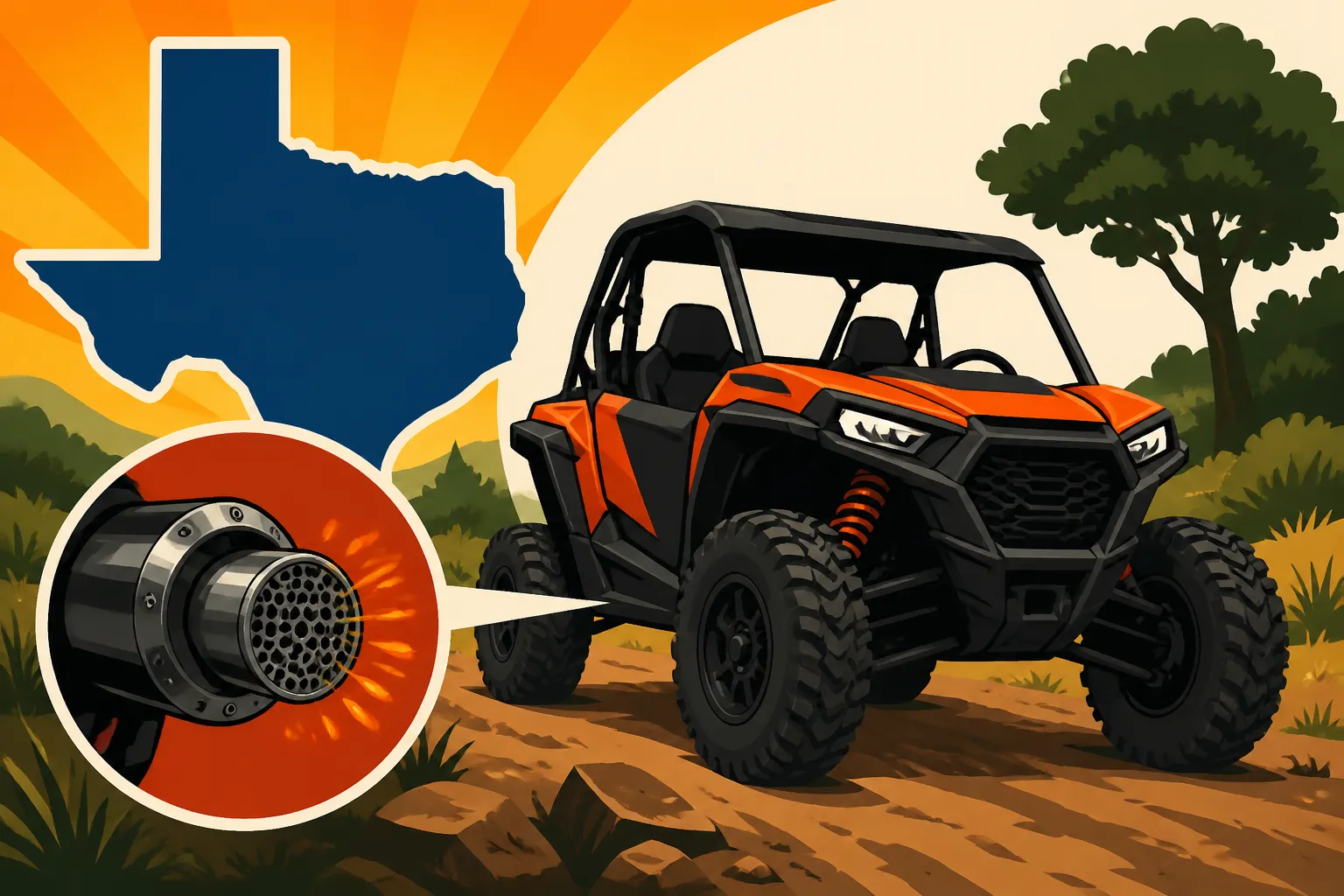
A spark arrester is part of the exhaust system. Its purpose is to help prevent sparks from escaping, which matters when riding in areas with dry vegetation. But a screen or insert that looks like an arrester is not automatically a compliant part. Texas’s requirement is not simply “some kind of screen in the exhaust.” It specifies a USFS-qualified arrester.
That distinction matters if you have replaced or modified exhaust components, bought a used machine, or are unsure whether the original equipment is still installed. Do not assume that an ATV or UTV is compliant just because it came with an exhaust system, or because a seller describes it as having a spark arrester. Confirm the part and its condition before setting out.
The scope of the rule is public property and public lands. It is relevant to public off-highway vehicle areas and public trail systems, including state park riding areas. For example, the Sam Houston National Forest OHV trail system is managed by the USDA Forest Service. The Forest Service manages that trail system, while Texas requirements and the land manager’s site rules remain important to check before a ride.
If you want the focused rule in one place, see Texas Spark Arrester Requirement. For the wider set of riding conditions, Texas Rules for Riding Public Land is useful context.
| What to check | What Texas requires or what to verify |
|---|---|
| Arrester qualification | The arrester must be USFS-qualified, according to the Texas Legislature. |
| Arrester condition | It must not have been removed or modified, according to the Texas Legislature. |
| Where the rule applies | ATVs and UTVs on public property or public lands must meet the requirement, according to the Texas Legislature. |
| Exhaust sound in a state park | A vehicle on a Texas state park trail system must not exceed 96 decibels, according to the Texas Parks and Wildlife Department. |
| Exhaust equipment | Muffler cutouts, bypasses, and similar devices are prohibited under Texas law, according to the Texas Legislature. |
How to check your ATV or UTV before riding
A good check starts with the machine’s current exhaust setup, not a general assumption about what was installed when it was new. If the muffler or exhaust has been changed, or you do not know the machine’s service history, treat the arrester status as unconfirmed until you can verify it.
Identify the installed part
Look for the manufacturer’s information for the exhaust or arrester, and compare the installed component with the part specified for your machine. Keep any documentation that helps establish what is installed and whether it is USFS-qualified. If the paperwork is missing, ask the machine or exhaust manufacturer, or a qualified service shop, to identify the part.
A product description alone may not settle the question. For instance, a listing on Amazon that calls a part a “spark arrester” does not by itself prove that the part is USFS-qualified or appropriate for your machine. Check the manufacturer’s specifications and documentation before buying or fitting a replacement.
Check for removal or modification
Inspect the exhaust for signs that a component is missing, altered, or no longer installed as intended. If you cannot tell whether the arrester has been modified, do not guess. Have a knowledgeable technician inspect it, or ask the manufacturer to confirm how the installed setup should be configured.
This is especially important after performance work or exhaust repairs. A modified exhaust may still operate normally while no longer meeting the public-land requirement. Changing the muffler, removing an insert, or altering the exhaust should prompt a fresh compliance check rather than an assumption that the original setup remains valid.
Do not confuse the arrester with the muffler
The spark arrester and muffler relate to the exhaust system, but they are not interchangeable terms. The Texas Legislature separately prohibits motor vehicles, including OHVs on public property, from using muffler cutouts, bypasses, or similar devices. Texas also requires an adequate muffler system in good working condition on ATVs and UTVs used on public OHV lands, according to the Texas Legislature.
State park sound limits are another separate consideration. The Texas Parks and Wildlife Department sets a maximum exhaust sound volume of 96 decibels for an OHV on a state park trail system. Passing a sound check would not establish that the spark arrester is USFS-qualified, and having a qualified arrester would not by itself establish that the exhaust meets the park’s sound limit.
For more on the exhaust side of the rules, see Texas Muffler Requirements for OHVs. Treat the arrester, muffler condition, and sound limit as related but distinct checks.
Spark arresters are only one part of public-land access
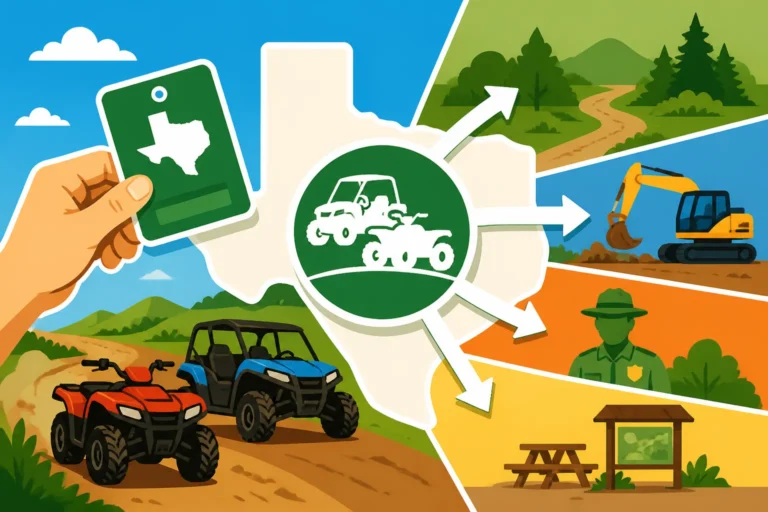
A compliant machine does not automatically meet every requirement for a public ride. Decal, safety, lighting, and location rules can also apply. The details depend on where you plan to ride, so check the land manager’s current instructions as well as the state requirements.
Check the Texas OHV decal
The Texas Parks and Wildlife Department administers the state OHV decal program. A valid Texas OHV decal must be displayed when operating an OHV in a Texas state park, according to the department. The department lists the decal fee as $16.00 per fiscal year as of November 2026.
The requirement is not limited to Texas residents. The Texas Parks and Wildlife Department says Texas has no reciprocity agreement for out-of-state OHV registrations or decals, so nonresidents must obtain a Texas OHV decal to ride on public lands or grant-funded venues in Texas. A decal from another state should not be treated as a substitute.
Decals are not required for ATVs and recreational off-highway vehicles operated exclusively on private property, according to the Texas Parks and Wildlife Department. That private-property exception does not remove public-land requirements when the same machine is taken to a public riding area.
For a fuller explanation of decal rules and where they apply, see The Texas OHV Decal Requirement Explained and Texas Reciprocity and Why It Is One-Sided. Riders looking at a national forest trail can also review Texas National Forest Permits, since a state decal and a site’s own access requirements are not necessarily the same thing.
Carry safety documentation and use required protective equipment
Riders on public land must carry a valid safety certification and show it upon request, according to the Texas Parks and Wildlife Department. The department recognizes certificates showing successful completion of the ATV Safety Institute’s ATV RiderCourse, including hands-on training, or equivalent training certificates issued under the authority of Texas or another state.
The department also requires operators and passengers on ATVs on public lands in Texas to wear a helmet that meets United States Department of Transportation standards. UTV occupants must wear seat belts when the vehicle is equipped with them, according to the Texas Parks and Wildlife Department.
These requirements are separate from the spark arrester check. Having the right exhaust equipment does not replace the required certification, helmet, or seat belt.
Confirm lights and the site’s own rules
An OHV operated on public OHV land in Texas must have a headlight and taillight, according to the Texas Department of Motor Vehicles. Texas also requires a lighted headlight and taillight on an ATV or UTV operated on public property from one-half hour after sunset to one-half hour before sunrise, and whenever visibility is reduced, according to the Texas Parks and Wildlife Department.
Check the specific riding area before traveling. State park OHV rules are enforced by state park law enforcement and game wardens, according to the Texas Parks and Wildlife Department. A particular site may also provide operating instructions that affect trail access or vehicle use. For current closures and conditions, Texas Trail Closures to Check First can help you plan what to verify before leaving.
A practical pre-ride check
Before hauling your ATV or UTV to public land, use a simple check to catch the most common problems. If you are uncertain about the arrester, resolve that uncertainty before the trip rather than waiting until you reach a trailhead.
- Confirm the arrester is the right type. Verify that the installed unit is USFS-qualified, as required under the Texas Legislature’s public-land rule.
- Check that it has not been removed or modified. If you cannot confirm its condition, ask the manufacturer or a qualified service shop to inspect the exhaust.
- Check the rest of the exhaust. The Texas Legislature prohibits muffler cutouts, bypasses, and similar devices, and requires an adequate, working muffler system on public OHV lands.
- Check the riding area’s noise limit. On a Texas state park trail system, the Texas Parks and Wildlife Department limits OHV exhaust sound to 96 decibels.
- Confirm the decal and access requirements. The Texas Parks and Wildlife Department requires a Texas OHV decal for state park riding and says nonresidents need a Texas decal to ride public lands or grant-funded venues.
- Carry your safety certificate. The Texas Parks and Wildlife Department requires riders to carry valid certification and show it upon request.
- Check required equipment and clothing. The Texas Parks and Wildlife Department requires DOT-standard helmets for ATV operators and passengers on public lands, and seat belts in equipped UTVs. The Texas Department of Motor Vehicles requires a headlight and taillight on OHVs used on public OHV land.
- Review the site’s current rules. Confirm trail status and any local operating instructions with the land manager before the drive.
If a machine fails the arrester check, do not remove or alter parts in an attempt to make it pass. Get the correct, documented component installed and verify that the exhaust is in proper condition. If you are still unsure whether the setup meets the USFS-qualified standard, contact the manufacturer or the public land manager before riding.
The key point is straightforward: a spark arrester on a Texas public-land ATV or UTV must be USFS-qualified and unmodified. Check the component itself, not just the product description or the fact that the vehicle runs. Then confirm the decal, safety equipment, exhaust, and riding-area requirements so a small compliance issue does not derail the day.
Sources
- Texas Parks & Wildlife Department — OHV FAQ — Texas Parks & Wildlife Department (checked November 2, 2026)
- Texas Parks and Wildlife Department — Eisenhower State Park OHV Rules and Regulations (checked November 2, 2026)
Disclaimer
This article is for general informational purposes only and does not constitute professional advice. Laws, prices and regulations vary by location and change over time. Consult a qualified professional for guidance on your specific situation.