Riding Sand Without a License in Your Pocket
Heading out for a sand ride can raise a simple but confusing question: does “license” mean a driver’s license, an OHV decal, or a safety certificate? For public-land riding in Texas, the documents and rules depend on where you ride and what you operate. Here’s what to carry, what must be displayed, and what to check before unloading.
What “License” Means for a Texas Sand Ride
For the Texas public-land OHV requirements, the key personal document is a valid safety certificate. A regular driver’s license should not be treated as a substitute: Texas Parks and Wildlife Department says riders must carry their valid safety certification while operating an OHV on public land and show it upon request.
Texas Parks and Wildlife Department recognizes certificates showing successful completion of the ATV Safety Institute’s ATV RiderCourse, including hands-on training, as well as equivalent safety training certificates issued under the authority of Texas or another state. Its guidance also describes a certificate issued by the Texas Department of Public Safety or an equivalent certificate from another state as qualifying for public-land ATV operation. If your certificate came from outside Texas, make sure it documents recognized training rather than assuming any card or course record will do.
This is different from the OHV decal. The certificate relates to the rider’s training; the decal relates to the machine’s use on covered public land. A decal does not replace a safety certificate, and a certificate does not replace a decal. For a fuller explanation of the training document, see Texas OHV Safety Certificate Requirements.
Age and supervision matter, too. According to the Texas Legislature, an ATV operator younger than 14 on public land must be accompanied by and under the direct supervision of a parent, guardian, or authorized adult. According to Texas Parks and Wildlife Department, a person must be at least 14 to operate an ATV on public land without adult supervision, and must hold a safety certificate to do so. Riders aged 14 or older who do not hold the required certificate cannot assume that being old enough by itself makes unsupervised riding permissible.
These public-land age rules specifically address ATVs. Don’t automatically apply them to every vehicle type or setting without checking the rules for the machine and riding area. The practical point is that a young rider’s certificate, the supervising adult’s role, and the site’s rules all need to be considered before the ride.
If you are riding on sand, first establish who manages the area and whether it is public land, private land, or a venue with its own access conditions. “Sand” describes the terrain, not the legal status of the place. A beach, a trail system, a private lease, and a public OHV area may have different requirements. Start with Texas Rules for Riding a Beach and Texas Rules for Riding Public Land, then confirm current entry rules with the land manager.
When the Texas OHV Decal Is Required
The Texas OHV decal program is administered by the Texas Parks and Wildlife Department. For an ATV or UTV on public land where the program applies, the vehicle must display a valid Texas OHV decal. If the decal has not arrived yet, Texas Parks and Wildlife Department says proof of purchase or the receipt must be readily available while riding. In Texas state parks, riders must display the valid decal.
The decal is not a general registration sticker for every place a machine might go. Texas Parks and Wildlife Department says ATVs and recreational off-highway vehicles are not required to have a Texas OHV decal when operated exclusively on private property. That exception is about exclusive use on private property; it should not be read as permission to take the same machine onto a public trail without meeting public-land requirements.
| Where you ride | Texas OHV decal | Safety certificate |
|---|---|---|
| Public land or a covered public OHV venue | Display the valid Texas decal; keep proof of purchase available if the decal has not arrived | Carry a valid certificate and show it upon request |
| Texas state park OHV trail | Display a valid Texas decal | Carry the required safety certification for public-land operation |
| Exclusively on private property | Texas Parks and Wildlife Department says the decal is not required for this use | The public-land requirement described here may not apply; confirm any separate site or activity rules |
| Public land as a nonresident | A Texas decal is required; Texas does not offer reciprocity for out-of-state OHV decals | A qualifying certificate issued under another state’s authority may be recognized |
The table is a practical starting point, not a substitute for a site’s specific rules. A privately managed venue, a state park, and a public trail area may each set access conditions beyond the basic decal requirement.
As of November 2026, Texas Parks and Wildlife Department lists the OHV decal fee as $16 per fiscal year. Check the department for the current fee and purchasing process before a trip. The decal program and the place you ride are separate questions: purchasing the decal does not itself authorize access to every sandy area.
Nonresidents should pay particular attention to reciprocity. Texas Parks and Wildlife Department says Texas has no reciprocity agreement for out-of-state OHV decals, so nonresidents riding on public lands or grant-funded venues in Texas must purchase a Texas decal. An out-of-state decal does not take the place of the Texas one. For the visitor-specific details, see Does a Nonresident Need a Texas OHV Decal? and Texas Reciprocity and Why It Is One-Sided.
A decal is also not the same as a vehicle title or standard motor vehicle registration. Texas Department of Motor Vehicles requires Texas residents to title off-highway vehicles such as ATVs and UTVs, but these machines are not eligible for standard motor vehicle registration. A title establishes ownership paperwork; it is not permission to ride on public land and does not replace the decal or safety certificate. See Why Texas Titles But Never Registers an OHV if you are sorting out those documents.
What to Carry and Check Before You Ride
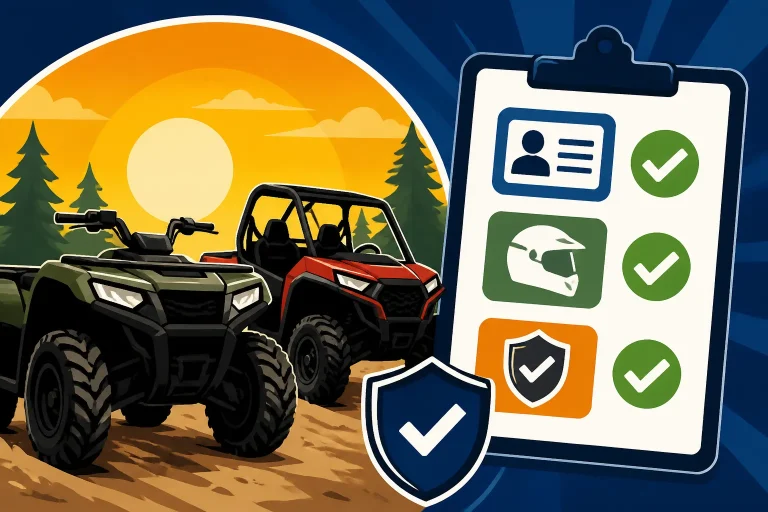
Treat preparation as two separate tasks: have the right documents for the rider, and make sure the machine meets the rules for the location. A certificate in a phone photo may not be accepted as the required document, so confirm what form of proof the land manager will accept. Carry the actual valid certification where practical, and keep the decal displayed as required.
A small waterproof sleeve or document pouch can help protect a paper certificate and decal receipt from sand, water, and dust. Products such as these are available through retailers including Amazon, but the important part is not the brand: keep the paperwork readable and accessible rather than buried in a gear bag or left in the tow vehicle.
Before leaving, check the official site information for:
- Whether the route or riding area is open to your kind of machine.
- Whether the area is public, private, or a grant-funded venue with a decal requirement.
- Whether you need to display the decal or carry a purchase receipt because it has not arrived.
- Whether your safety certificate qualifies and is available to show.
- Any park-specific rules about helmets, passengers, equipment, alcohol, and trail closures.
The machine also has equipment obligations on public land. According to Texas Parks and Wildlife Department, ATV operators and passengers on public lands must wear helmets that comply with United States Department of Transportation standards. According to Texas Parks and Wildlife Department, a UTV’s seat belts must be worn when the vehicle is equipped with them. Passengers are not allowed on an ATV operated on public property unless the manufacturer designed the ATV to carry a passenger, according to the Texas Legislature.
Lighting can matter even when a ride begins in daylight. According to Texas Parks and Wildlife, an ATV or UTV on public property must display a lighted headlight and taillight from one-half hour after sunset until one-half hour before sunrise, and whenever visibility is reduced. According to the Texas Department of Motor Vehicles, an OHV on public OHV land must be equipped with a headlight and taillight. Don’t assume that a machine without required lights is acceptable just because you plan to finish before dark.
Spark arresters and exhaust condition are another pre-ride check. According to the Texas Legislature, OHVs operated on public property or public lands must have a United States Forest Service-qualified spark arrester that has not been removed or modified. The Texas Legislature also prohibits motor vehicles, including OHVs on public property, from using muffler cutouts, bypasses, or similar devices. On public OHV lands, ATVs and UTVs must maintain an adequate muffler system in good working condition.
If the sand area is part of a state park trail system, sound limits can apply as well: according to Texas Parks and Wildlife Department, an OHV’s exhaust sound volume on a state park trail system must not exceed 96 decibels. Park rules are enforced by state park law enforcement and game wardens, according to Texas Parks and Wildlife Department. Check the destination’s requirements rather than relying on assumptions based on another park or riding area.
The Sam Houston National Forest OHV trail system is managed by the USDA Forest Service. That is a useful reminder that the agency managing a trail may not be the same as the agency administering Texas’s decal program. Check both the statewide OHV requirements and the managing agency’s current trail information. Texas National Forest Permits explains why a decal and a separate land-use fee or permit should not be assumed to cover the same thing.
Common Mistakes That Can End a Ride
One common mistake is packing an out-of-state decal and assuming it is enough. Texas Parks and Wildlife Department says Texas does not offer reciprocity for OHV decals, so nonresidents need the Texas decal for covered public-land riding. A certificate issued under another state’s authority may be recognized if it meets Texas Parks and Wildlife Department’s requirements, but certificate recognition does not create decal reciprocity.
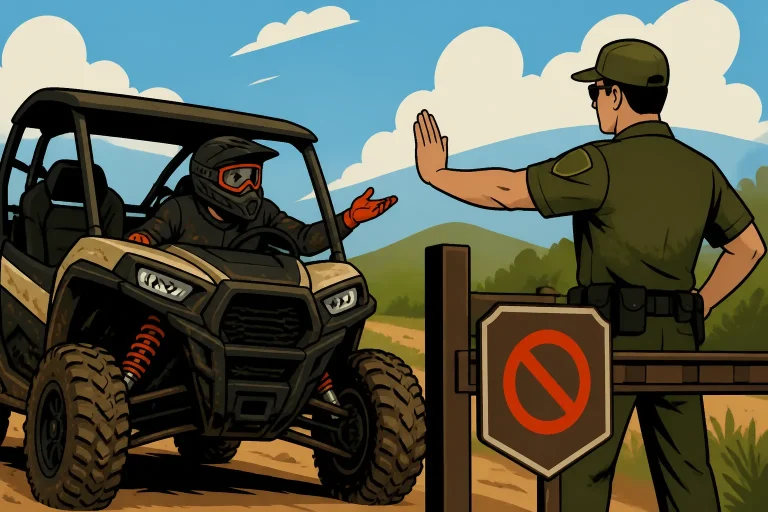
Another mistake is treating the decal as optional because the machine is used mostly on private land. The private-property exception applies when the vehicle is operated exclusively there. If the plan includes a public trail or covered venue, check the decal requirement before setting off. If you are unsure how a site is classified, ask its manager rather than relying on the fact that the land looks remote or undeveloped.
The consequences of riding without a required decal are not just a warning at the gate. As of November 2026, Texas Parks and Wildlife Department classifies operating an OHV without a required decal on public land as a Class C misdemeanor, with possible citation and fines ranging from $25 to $500. A separate rule can apply in protected natural areas: according to Texas Parks and Wildlife Department, operating a motor vehicle such as an ATV in protected public areas such as stream beds is a Class C misdemeanor punishable by a fine of up to $500, with the offense increasing to a Class B misdemeanor for a third or subsequent offense. Sand does not make an area unrestricted, so verify where riding is permitted before entering a stream bed or other protected area.
Finally, avoid treating paperwork as the whole checklist. Texas Parks and Wildlife Department prohibits public display or consumption of alcoholic beverages in state parks, including OHV trail systems, and prohibits operating trail machines while under the influence of alcohol or drugs. Bring the right certificate and decal, but also follow the location’s conduct and equipment rules.
A reliable pre-ride routine is simple: identify the land manager, confirm the area is open to your machine, carry the qualifying safety certificate, display the Texas decal where required, and check the machine’s safety equipment. If any part of the plan involves a beach, park, forest trail, or privately operated riding area, verify its specific rules before you travel. The related Texas OHV Decal Requirement Explained and [Texas Rules for Riding a Closed Trail] can help you separate statewide requirements from site access rules.
Sources
- Texas Legislature — Transportation Code Title 7, Chapter 663. Certain Off-Highway Vehicles (checked November 2, 2026)
- Texas Parks & Wildlife Department — OHV FAQ — Texas Parks & Wildlife Department (checked November 2, 2026)
- Texas Parks and Wildlife Department — Eisenhower State Park OHV Rules and Regulations (checked November 2, 2026)
- Texas Parks and Wildlife Department — Prohibition of Wheeled or Tracked Motor Vehicles in Stream Beds (checked November 2, 2026)
Disclaimer
This article is for general informational purposes only and does not constitute professional advice. Laws, prices and regulations vary by location and change over time. Consult a qualified professional for guidance on your specific situation.