Crossing a Highway on an ATV in Texas
For any Texan who loves hitting the trails on their ATV or UTV, the open road can feel like a tempting, yet often forbidden, zone. We've all been there: needing to get from one private property to another, or just wanting to access a different part of the trail system, and a pesky highway stands between you and your destination. It's incredibly frustrating to know your machine can easily handle the short hop, but the law feels like it's designed to keep you stuck. This guide is here to untangle the complexities of legally and safely crossing a highway on your off-highway vehicle (OHV) in Texas, detailing the specific, narrow exceptions that allow it.
The Harsh Reality of Texas OHV Road Laws
Let's be blunt: Texas generally does not consider ATVs or UTVs "street legal." It's one of the most common points of confusion and irritation for OHV owners. Many folks invest significant money in their machines, adding lights, mirrors, turn signals, and even horns, hoping to make them compliant for street use. But the truth is, these modifications, no matter how comprehensive, simply do not change an off-highway vehicle's legal classification in Texas. The state's transportation code is quite clear on what constitutes a street-legal vehicle, and ATVs and UTVs, by their very nature, typically don't fit the bill for general road registration.
This can be a tough pill to swallow, especially when you see other states with more lenient rules or when you encounter local ordinances that seem to allow certain types of road use. The core issue is that Texas law is designed to keep vehicles built for off-road performance—with their open suspensions, knobby tires, and lack of certain safety features mandated for street vehicles—off the public roadways where higher speeds and different traffic dynamics prevail. It's a safety measure, albeit one that often feels overly restrictive to the casual rider or landowner.
The frustration is completely understandable. You've got a powerful, capable machine, and you just want to move it a short distance without the hassle of loading it onto a trailer. But ignoring the law can lead to serious consequences, from hefty fines to potential liability issues in case of an accident. That's why understanding the precise, limited exceptions is so critical. [Why Texas Will Not Register an ATV for the Road] delves deeper into these fundamental restrictions.
The Two Core Exceptions for Road Use
While general street legality is largely off the table for most ATVs and UTVs in Texas, the law does carve out specific scenarios where limited road operation is permissible. These aren't loopholes; they are carefully defined exceptions meant to facilitate specific types of activities. Understanding these is paramount before you ever consider putting rubber to pavement.
Agricultural and Timber Operations
One of the most significant exceptions revolves around agricultural and timber operations. Texas recognizes that OHVs are indispensable tools for farmers, ranchers, and timber producers. These machines are often the most efficient way to get around large tracts of land, check fences, transport tools, or move livestock. Because of this practical necessity, the law allows for certain road use related to these industries.
If you are using your ATV or UTV solely for agricultural purposes—think checking cattle, hauling feed, repairing irrigation systems, or moving equipment between fields on a ranch—you can often operate it on public roads. Similarly, those involved in legitimate timber operations, using their machines for logging, surveying, or forest management, may also qualify for this exception. The key here is the purpose of the use; it must be directly related to the agricultural or timber operation. This isn't a free pass to take your recreational ride down the highway just because you own a few cows; it's about legitimate, work-related travel. [Texas Agricultural Exemption for ATVs on Roads] provides extensive details on this.
It's also important to note that even under this exemption, there are still rules about visibility and safety. While you might not need a street-legal registration, you will likely need to display a slow-moving vehicle emblem, have proper lighting, and adhere to specific distance limitations. We'll explore these safety requirements in more detail later, but for now, remember that this exception is tied to your professional use, not personal recreation.
Specific Low-Speed Roadways and Communities
The second major exception opens up possibilities for OHVs on certain low-speed roadways and within master-planned communities. This category is often what sparks confusion, as it can vary significantly from one location to another. The general rule allows an ATV or UTV to be operated on a public road if the maximum speed limit for that road is 35 miles per hour or less. However, there's a crucial caveat: the county or municipality must have adopted an ordinance specifically permitting such use.
This means you can't just assume that because a county road has a 35 mph speed limit, you're good to go. You must verify that the local government has passed an ordinance allowing OHV use on those specific roads. Some cities, particularly those with a lot of golf course traffic or large, spread-out residential areas, have embraced these ordinances to facilitate local travel. Similarly, some master-planned communities, often with their own internal road systems, have provisions for OHV use on their private or designated public roads, especially if they are designed to connect to recreational facilities like golf courses or neighborhood amenities. [Texas Rules for Riding on a 35 mph Road] explains the nuances.
For instance, you might find a smaller Texas town where golf carts and UTVs are common on certain city streets, especially those connecting neighborhoods to local shops or parks. But drive a few miles into the next town, and the rules could be entirely different. Always check with the local county sheriff's office or city hall to understand their specific ordinances. Relying on what "everyone else is doing" is a risky game and could lead to an unexpected ticket. This also extends to using your UTV to get to a local golf course; there are often specific limitations on distance and time of day. [Texas Rules for Riding a UTV to the Clubhouse and Back] covers this scenario.
Crossing a Highway: The Specific Rules
Now, let's zero in on the main event: actually crossing a highway on your ATV or UTV in Texas. Even if your primary use falls under one of the exceptions above, simply driving down the highway is usually not an option. The law makes a very clear distinction between operating on a road and crossing it. These crossing rules are designed to minimize the time an OHV spends in high-traffic, high-speed environments.
Crossing at an Intersection
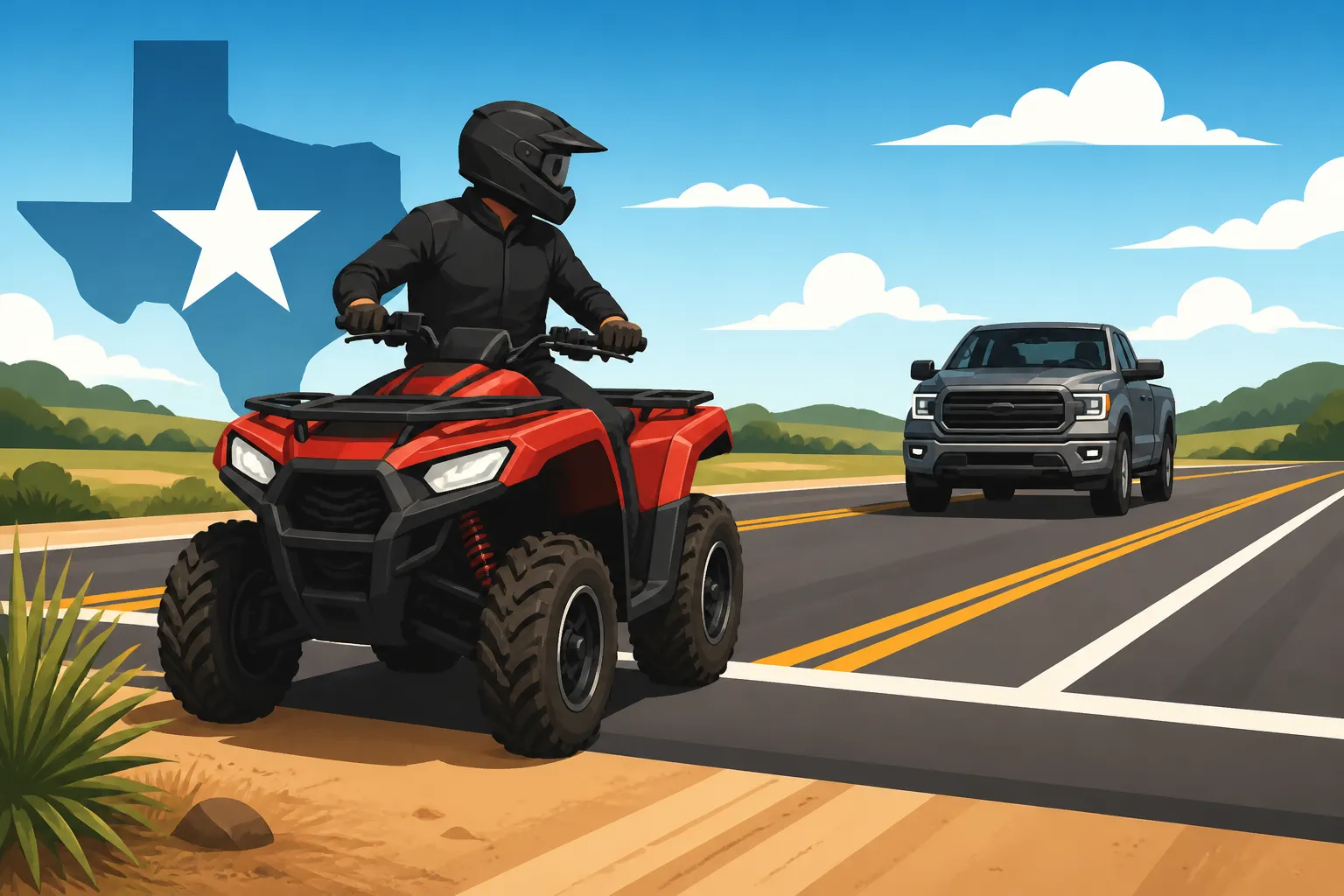
The safest and generally only legal way to cross a public road or highway on an OHV is at an intersection. This is not just a suggestion; it's a legal requirement designed to ensure predictability and visibility. When you approach a highway you need to cross, look for a designated intersection. This means a place where two or more roads join or cross each other, typically marked with signs, traffic lights, or at least clear ingress/egress points.
Before you even think about entering the intersection, you are legally required to come to a complete stop. This isn't a rolling stop or a hesitant pause; it's a full, unequivocal halt. You must stop before entering the main roadway, allowing you a clear view of oncoming traffic from all directions. This is the moment to be hyper-vigilant. Listen for approaching vehicles, scan left and right repeatedly, and make sure any vehicle that might be turning into the intersection sees you. This rule is absolute, regardless of whether there's a stop sign or traffic signal. [Crossing a Texas Road at an Intersection] details this critical step.
Once stopped, assess the traffic flow. You need to ensure you have ample time to cross completely and safely. Your ATV or UTV, while quick off the line, won't accelerate like a car, and its presence might be unexpected by other drivers. Only proceed when the path is clear and you can make it across without forcing other vehicles to brake or swerve.
Crossing Away From an Intersection
Generally speaking, crossing a highway away from a designated intersection is prohibited. The reason for this rule is simple: safety. Crossing in the middle of a road, or at a point not designed for merging traffic, creates an unpredictable situation for everyone involved. Drivers on the highway won't expect a slow-moving OHV to suddenly appear from the shoulder or a private drive. This significantly increases the risk of collision, as reaction times are drastically reduced.
While the agricultural and timber exemptions might allow you to operate on some public roads, these are typically lower-speed county or farm-to-market roads, not major highways. Even in those contexts, the preference is always for intersection crossings. The law prioritizes predictability and visibility. Trying to sneak across a highway between intersections, even if you think you have a clear line of sight, puts you and others at severe risk and will almost certainly result in a citation if caught. Law enforcement officers are particularly vigilant about this kind of illegal road use due to the inherent dangers. [Crossing a Texas Road Away From an Intersection] explains why this is largely forbidden.
There's no special trick or modification that makes an ATV or UTV safe or legal for mid-road crossings. Even with enhanced lighting or brightly colored flags, the fundamental problem of unexpected entry into traffic remains. It's a risk that Texas law simply doesn't permit.
Crossing at a Right Angle
When you do cross a highway, it must be done at a right angle to the main lanes of traffic. This means you should enter the roadway, proceed directly across, and exit on the opposite side without traveling longitudinally (parallel) along the highway for any significant distance. The goal is to minimize your exposure time on the main road.
Imagine you're at a four-way stop intersection. You would enter, go straight, and exit. You wouldn't turn left, drive a quarter-mile, and then make a U-turn to cross back. This "straight across" rule is crucial for maintaining safety and predictability. It ensures you are in the path of crossing traffic for the shortest possible duration. This is another area where rider judgment and caution are paramount. Don't try to merge with traffic or travel down the shoulder to get to a better crossing point; that's operating on the highway, which is generally illegal.
The "right angle" rule is often paired with the "full stop" rule. You stop, you look, and when it's clear, you accelerate across at a perpendicular angle to the flow of traffic. Any deviation, such as riding on the shoulder for any distance, even a short one, or attempting to turn and travel alongside the highway, will likely be seen as illegal operation on the public road and not merely a crossing. This is where many riders get into trouble, misinterpreting the allowance for crossing as permission for short stretches of travel. [Ninety Degrees and a Full Stop in Texas] reinforces these strict requirements.
Navigating Divided Highways and Intersections
Crossing a single-lane road is one thing, but dealing with divided highways—those with medians or barriers separating opposing directions of traffic—introduces additional complexities and safety considerations. These roads are typically higher speed and carry heavier traffic volumes, making OHV crossings even more hazardous.
Crossing Divided Highways
When approaching a divided highway, the same fundamental rules apply: you must use an intersection, come to a complete stop, and cross at a right angle. However, the presence of a median often means you are effectively making two separate crossings. You cross the first set of lanes, perhaps pause in the median (if it's wide and safe enough to accommodate your machine without obstructing traffic or being a hazard), and then cross the second set of lanes.
The key challenge with divided highways is managing the two distinct traffic flows. You'll need to assess traffic coming from one direction for the first set of lanes, and then traffic from the opposite direction for the second set. It's like making two separate decisions, each requiring full attention and a clear assessment of risk. Never assume that because one direction of traffic is clear, the other will be too. The median can sometimes obscure your view, so use extreme caution.
If the median is narrow and doesn't offer a safe space to pause, you might need to commit to crossing both sections in one continuous movement, provided the entire highway is clear. This requires even greater judgment and patience. If you're unsure, or if traffic is too heavy, it's always better to find an alternative route, even if it means a longer journey or trailering your machine. Your safety and legal compliance are not worth compromising. [Texas Rules for Crossing a Divided Highway] goes into depth on these considerations.
What About Frontage Roads?
Frontage roads, also known as service roads or access roads, run parallel to main highways and are typically used to access businesses, residences, or to merge onto the highway. The rules for OHV use on frontage roads can be a bit of a gray area, often depending on local ordinances and whether the frontage road itself has a posted speed limit of 35 mph or less and the local authority has permitted OHV use.
However, even if a frontage road falls under the low-speed exception, using it to travel alongside a highway is generally not considered a "crossing." If you need to cross the main highway, you must still adhere to the intersection and right-angle rules. Using a frontage road to travel a significant distance parallel to the highway, even at low speeds, can still be interpreted as illegal operation on a public road if the specific local ordinances don't explicitly permit it for OHVs.
Always verify local rules for frontage roads. What might be allowed for a golf cart in a specific city might not apply to your ATV or UTV, especially if it's not strictly within the bounds of an agricultural operation or a specially designated community. When in doubt, err on the side of caution and avoid using frontage roads for extended travel.
Safety First: Equipment and Rider Conduct
Even when operating under a legal exception, safety should be your absolute top priority. Texas law includes provisions for equipment and rider conduct that apply whenever an OHV is on a public road, even for a brief crossing. These rules are there to protect you and other motorists.
Required Equipment for Road Use
When crossing a highway, your ATV or UTV needs to be equipped for visibility. This often means having working headlights and taillights, even if it's broad daylight. Turn signals might not be explicitly required for all crossings, but hand signals are always a good idea. A brake light is also crucial. For utility-focused machines, an orange triangular slow-moving vehicle emblem mounted on the rear can also be a legal requirement and significantly improves visibility for other drivers.
While not always a legal requirement for simply crossing a road, having a horn can be a lifesaver for alerting others to your presence. Many riders also add aftermarket accessories for enhanced visibility, such as LED light bars or reflective decals. Companies like SuperATV offer a wide range of lighting solutions and other accessories designed for off-road use that can certainly boost your visibility during a quick crossing. Just remember, these enhancements improve safety but do not confer street-legal status.
For agricultural or timber operations, if you're traveling more than just a quick crossing, additional equipment like a 6-foot orange flag might be required, particularly if you are moving between separate pieces of land. The idea is that the more time you spend on the road, the more visible you need to be. [Texas Equipment Rules for an ATV on a Road] delves into these specifics.
Rider Conduct and Awareness
Your personal conduct and situational awareness are arguably even more critical than equipment. When preparing to cross a highway:
- Wear a Helmet: While Texas law has specific nuances regarding helmets for OHV riders (e.g., age, enclosed cabins), it is always safest to wear a helmet when operating on or near public roads, regardless of whether it's legally mandated for your specific situation. [Texas Helmet Law for ATV Riders] outlines the various requirements.
- Maintain Focus: Do not be distracted. Put away your phone, turn off the music, and give 100% of your attention to traffic and your surroundings.
- Signal Your Intentions: Use hand signals to indicate your intention to stop or turn, even if you have working turn signals. Over-communicating is always better than under-communicating.
- Choose Your Moment Wisely: Patience is key. Wait for a wide gap in traffic. Do not try to rush across in front of an approaching vehicle, even if you think you have time. Remember, your OHV accelerates differently than a car, and other drivers might misjudge your speed.
- Avoid Peak Hours: If possible, plan your crossings during off-peak traffic hours when roads are less busy. This reduces stress and risk.
- Be Predictable: Drive in a straight line across, don't weave, and maintain a consistent speed once you commit to crossing.
Common Misconceptions and What Doesn't Work
There's a lot of misinformation and wishful thinking out there about making ATVs and UTVs street legal or about how flexible Texas road laws are. It's important to set the record straight to avoid costly mistakes.
"Street Legal Kits" Don't Work
Many aftermarket companies sell "street legal kits" for ATVs and UTVs. These kits typically include mirrors, turn signals, a horn, a license plate bracket, and sometimes a windshield. While these components enhance safety and are certainly useful for off-road riding, they do not, by themselves, make your machine street legal in Texas.
The state's legal definition of a "motor vehicle" for general registration purposes, and what it requires in terms of design, safety features, and manufacturing standards, goes far beyond simply adding a few accessories. Texas law looks at the fundamental design and intended use of the vehicle. An ATV or UTV, even with all the bells and whistles from a company like SuperATV, is still fundamentally an off-highway vehicle in the eyes of the law. You cannot simply bolt on accessories and expect to qualify for a regular license plate and street registration. [Why an Altered Quad Still Cannot Be Plated] delves into why these modifications fall short.
The kits can be beneficial for making your machine safer and more visible where allowed (e.g., during agricultural use or in a permitted master-planned community), but they won't open up the highways for general cruising.
Assumption of Local Ordinances
Another common misconception is assuming that if you see others riding ATVs or UTVs on local streets, it must be legal. This is a dangerous assumption. Those riders might be operating under a specific, narrow exemption (like agricultural use), or they might simply be breaking the law and haven't been caught yet. Just because something is commonly done doesn't make it legal or safe.
As mentioned earlier, local ordinances vary wildly. A city or county might allow OHVs on certain low-speed roads, but their specific rules could be highly restrictive (e.g., only during daylight, only for golf course access, only on specific streets). What's permitted in a small rural county might be strictly forbidden in a bustling suburb. It's your responsibility as the operator to know the specific laws for every stretch of road you intend to use or cross. A quick phone call to the local county tax assessor-collector or sheriff's office can save you a lot of headache and potential fines.
Texas Will Not Register an OHV for the Road
This point bears repeating: Texas generally does not register ATVs, UTVs, or other OHVs for general road use. When you get a title for an ATV in Texas, it usually comes with an "Off-Highway Use Only" remark stamped on it. This is a clear indicator of its legal status. The only "plate" typically available for OHVs is the [Texas Off-Highway Vehicle License Plate], which is not a street-legal registration plate. It's an identification plate for machines operated in off-highway environments, particularly on certain public lands, and it explicitly states that it does not authorize road use.
This distinction is crucial. Many people confuse the OHV plate with a regular vehicle registration. They are fundamentally different and serve different purposes. The OHV plate confirms your machine has been titled and that you've paid certain fees, but it does not grant you the same privileges as a car or truck license plate.
| Feature | Texas Street-Legal Vehicle (Car/Truck) | Texas Off-Highway Vehicle (ATV/UTV) |
|---|---|---|
| Primary Use | On-road transportation | Off-road recreation/work |
| Registration | Required for road use, annual renewal | Generally not available for road use |
| License Plate | Regular "street legal" plate | [The Texas Off-Highway Vehicle License Plate] (Optional, not for street use) |
| Title Remark | None (street legal) | Often "Off-Highway Use Only" |
| Insurance | Required for liability | Optional for off-road use |
| Road Operation | General, with few exceptions | Highly restricted, specific exceptions only (ag/timber, specific local ordinances for low-speed roads) |
| Highway Crossing | Permitted as part of road travel | Very limited, at intersections only, with strict rules |
Penalties and Risks of Illegal Crossing
Ignoring Texas OHV road laws, even for a seemingly quick or harmless crossing, can lead to a host of unpleasant consequences. The state takes these regulations seriously, primarily for safety reasons. Understanding the potential downsides might help reinforce the importance of compliance.
Fines and Citations
The most immediate consequence of illegal road use or crossing on an ATV or UTV is a citation. Operating an OHV on a public road where it's not permitted is typically considered a Class C misdemeanor in Texas. While Class C misdemeanors are the lowest level, they still carry a fine. Depending on the county and the specific circumstances, these fines can range significantly, often starting in the hundreds of dollars. This is a far cry from the free ride you might have anticipated.
Moreover, if you are cited, it can appear on your driving record, even though you were operating an off-highway vehicle. This could potentially affect your insurance rates for your street-legal vehicles or even lead to points on your license, depending on how the violation is processed. It's simply not worth the risk for a shortcut.
Law enforcement officers are often well-versed in OHV laws, especially in rural areas where these machines are common. They are not likely to give you a pass just because you "didn't know" or "were just going a little way." Ignorance of the law is rarely a valid defense. [Texas Fines for Illegal ATV Road Use] explains the potential costs.
Vehicle Impoundment and Recovery Costs
In some cases, if you're caught operating an OHV illegally on a public road, law enforcement has the authority to impound your vehicle. This is particularly likely if the officer deems your operation to be reckless, a danger to yourself or others, or if you are uncooperative. Getting your machine back from impound can be a nightmare.
Impound fees, daily storage fees, and towing costs can quickly add up, easily surpassing the initial fine. You'll also likely need to arrange for a trailer or a proper tow service to retrieve your ATV or UTV, as you certainly won't be allowed to drive it off the impound lot. This can turn a simple crossing into an incredibly expensive and time-consuming ordeal. The inconvenience alone can be a major deterrent.
Imagine being miles from home, your machine impounded, and having to figure out how to get yourself and your OHV back. It's a logistical headache that can completely ruin your day, or even your entire weekend.
Accident Liability and Insurance Issues
Perhaps the most severe risk of illegal road use is the potential for an accident. OHVs are not designed for road speeds or interactions with cars, trucks, and 18-wheelers. If you are involved in a collision while illegally operating your ATV or UTV on a public road, the consequences can be catastrophic.
- Personal Injury: You are far more vulnerable on an ATV or UTV than in a car. Even a minor collision with a street-legal vehicle can result in serious injury or death.
- Property Damage: Your machine could be totaled, and you could be held liable for damages to other vehicles, public property, or even private property.
- Insurance Complications: While Texas does not require insurance for off-road OHV use, many riders choose to carry it for their machines. However, if you are operating your ATV or UTV illegally on a public road and get into an accident, your insurance policy might deny coverage. Most policies have exclusions for illegal activity or unauthorized road use. This means you could be personally responsible for all medical bills, property damage, and legal fees, which could amount to hundreds of thousands of dollars.
The financial and personal fallout from an accident during an illegal crossing can be devastating. This is why strict adherence to the law, even when frustrating, is paramount for your safety and financial well-being. Always prioritize safety over convenience.
Planning Your Routes and Alternatives
Given the strict regulations, smart planning is your best friend when it comes to navigating Texas roads with your ATV or UTV. Don't leave things to chance; a little foresight can save you a lot of hassle and risk.
Reconnaissance and Research
Before you head out on an unfamiliar trail or plan to move your machine between properties, do your homework. Use online maps to identify roads, intersections, and potential crossing points. More importantly, research local ordinances for the specific areas you'll be riding or crossing through.
- County and City Websites: Many local governments post their ordinances online. Look for sections related to "off-highway vehicles," "golf carts," or "low-speed vehicles."
- Call Local Authorities: A quick phone call to the county sheriff's department or city hall for the relevant jurisdiction can provide definitive answers. Ask specific questions about where and how OHVs are permitted.
- Consult Local Riders: While not a definitive legal source, local riding groups or forums can often offer practical insights into common practices and known legal riding areas. Just remember to verify any information they provide with official sources.
Understanding the terrain and the legal landscape beforehand will prevent surprises and ensure you stay within the bounds of the law. You might find that a seemingly short hop across a road requires a longer, legal detour or an entirely different approach.
Trailering as a Primary Option
For many, the most reliable and legally sound method for getting your ATV or UTV across a highway or between non-contiguous riding areas is trailering it. While it might seem inconvenient to load and unload for a short distance, it completely circumvents the complexities and risks of road operation.
Investing in a good ATV/UTV trailer and having a capable tow vehicle is often an essential part of the Texas OHV lifestyle, especially if you plan to explore various [Where to Ride an ATV in Texas] locations or frequently move between private lands. This ensures you can access any trail or property without worrying about illegal road use.
Consider the cost of a trailer and tow vehicle as part of the overall investment in your OHV hobby. It's a small price to pay compared to the fines, impound fees, or medical bills from an illegal road incident. Companies like SuperATV also offer various recovery and hauling accessories, such as winches, that can make loading and securing your machine on a trailer easier and safer.
Utilizing Private Land and Easements
When moving between properties, always explore whether you can utilize private roads, easements, or private land with permission. If you own or have permission to cross adjacent private land, that's often the safest and easiest way to avoid public roads altogether. This is particularly common in rural Texas where large ranches or farms might connect to each other.
- Get Permission in Writing: If you're crossing someone else's private property, always get explicit permission, ideally in writing. This protects you from trespass accusations.
- Map Out Private Paths: Work with landowners to identify clear, safe paths that avoid public road use.
- Consider Long-Term Solutions: If you frequently need to cross roads between properties, explore whether creating a designated private trail or path is feasible. This might involve clearing brush, building a culvert, or negotiating a formal easement with a neighbor.
Thinking creatively about your route, beyond just the public roads, can open up safe and legal avenues for enjoying your OHV.
Disclaimer
This article is for general informational purposes only and does not constitute professional advice. Laws, prices and regulations vary by location and change over time. Consult a qualified professional for guidance on your specific situation.