The Texas ATV Safety Certificate Explained
Texas riders can easily confuse an ATV safety certificate with the OHV decal, even though they serve different purposes and apply to different things. The certificate is tied to the rider, and age matters: younger riders may need a qualified adult with them rather than their own certificate. Here’s how to understand the requirement, prepare for a course, and avoid arriving at a trail without the right proof.
What the Texas ATV safety certificate is for
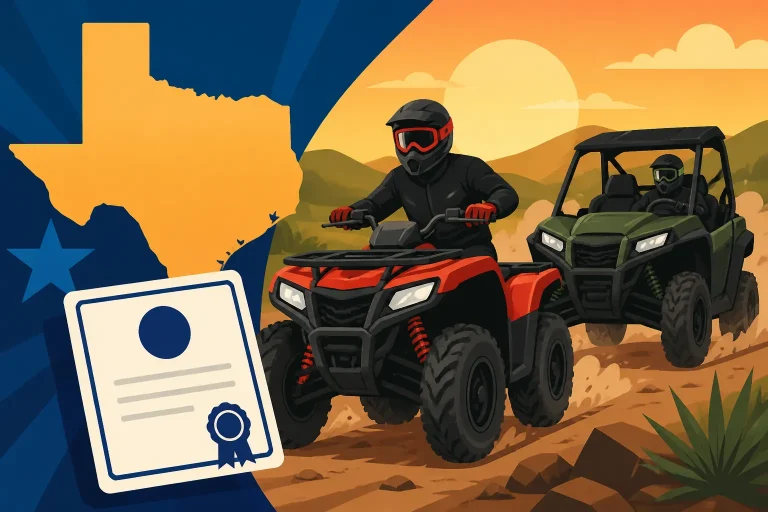
A Texas ATV safety certificate shows that a rider has completed an approved off-highway vehicle safety course. It is an operator credential, not proof that a machine is titled, and not permission to use every trail or public area. For OHV riding on Texas public land, riders generally need to meet the safety-training requirement, with a supervision exception for younger children.
The certificate’s purpose is practical: riders should understand basic vehicle control, safe riding decisions, and the rules that apply to off-highway use. A course is especially valuable for new riders, but completing one does not make a machine street legal or override a land manager’s rules.
The certificate is different from an OHV decal:
| Item | What it applies to | What it shows |
|---|---|---|
| Safety certificate | The rider | The rider completed an approved safety course |
| Texas OHV decal | The machine | The machine has the required decal for applicable public-land riding |
| Title | The machine and its ownership record | Ownership and vehicle identification details |
A certificate generally belongs to the person who completed the course. A decal is affixed to a particular machine and is not a substitute for the rider’s training. A title is a separate ownership document. Sorting out these three things before a trip can prevent a frustrating surprise at the trailhead.
The certificate also does not automatically grant access to public land. A riding area may require a decal, day-use payment, reservation, permit, or other proof. Check the rules for the specific place you plan to visit, as explained in Texas Rules for Riding Public Land and Where a Texas OHV Decal Is Required.
Private land is a different situation. Texas’s public-land training and decal rules do not automatically make every private ride subject to the same requirements, but a landowner, event organizer, or riding facility may set its own conditions. A private park can require training, safety equipment, or proof of age even when a particular state requirement does not apply. Before you unload, check both state rules and the property’s current policies.
Who needs a certificate, and what changes for riders under 14
Age is the key distinction for young riders. A rider who is old enough to complete the approved course should plan to obtain and carry their own certificate before riding on public land where the requirement applies. A child under 14 generally cannot obtain the certificate through the standard course pathway and may ride only under the applicable direct-supervision exception.
That does not mean a younger child can ride independently because an adult is somewhere nearby. The adult must meet the rule’s requirements, including the required age and safety-certificate status, and must supervise the child directly. The adult’s certificate is not transferred to the child; it is the adult’s qualification to supervise under the exception. For details on the age rule, see Texas Rules for Riders Under 14 and Why Texas Will Not Certify Below Fourteen.
A useful way to think about it is:
- Riders who can complete the course: Take the approved course and carry their own certificate when required.
- Riders under 14: Follow the direct-supervision exception and ride with a qualified adult who meets the applicable requirements.
- Adults supervising a child: Confirm that they hold the required certificate and can supervise the ride directly, rather than simply being present at the park.
- All riders: Follow the riding area’s rules for machines, routes, gear, and access.
Parents should not assume that a child’s age alone settles the question. A child’s machine, maturity, fit, and riding location matter too. A small youth quad may be an appropriate size for one rider and too powerful or heavy for another. The rider must be able to reach the controls, operate them properly, and stop the machine safely. Supervision cannot make an unsuitable machine safe.
Direct supervision is also different from ordinary adult oversight. Watching from a parking area, staying somewhere else on the trail system, or checking in by phone may not satisfy a rule that calls for direct supervision. If the child and adult are separated by terrain or riding different routes, the adult may not be in a position to supervise as required. Plan a route and pace that let the adult stay close enough to respond.
For a fuller explanation of the practical arrangement, read Riding Alongside Your Child Under Direct Supervision. If another adult will supervise, do not assume that any accompanying adult qualifies; check the rule and make sure that person has the required certificate. Letting Another Adult Supervise Your Child’s Ride covers that situation.
The certificate does not replace other age-related rules. A park may have its own minimum age for certain trails or machines, and a machine may not be suitable for a child even if the adult supervision requirement is met. Check the park’s policies before you book or travel, and do not treat a certificate as a waiver for safe judgment.
How to complete the course and get the certificate
For riders who need their own certificate, the important step is choosing a course that satisfies Texas’s OHV safety-training requirement. Do not assume that any online video, informal lesson, or general vehicle-safety class will qualify. Confirm that the course is approved for the Texas OHV certificate and that it covers the kind of machine the rider will operate.
Texas’s approved training pathway includes a hands-on RiderCourse. The course gives riders a chance to work through practical skills and safety concepts, rather than only reading material or watching a presentation. Course availability and arrangements can vary, so check the current listing and requirements before registering. Start with Where to Take a Texas ATV Safety Course or Texas ATV RiderCourse Locations.
A sensible enrollment process is:
- Check the rider’s age and eligibility. Riders under 14 generally use the supervision exception instead of earning the standard certificate.
- Find an approved course. Confirm that it is recognized for the Texas OHV safety certificate, not merely advertised as a general ATV class.
- Review the course details. Check what machine types are covered, what the rider must bring, and whether the provider has any prerequisites.
- Complete the required training. Take part in the hands-on instruction and satisfy the provider’s course requirements.
- Ask how proof is issued. Confirm whether the rider receives a physical card, a digital record, or both, and how to replace proof if it is lost.
- Carry the certificate when riding. Keep it accessible and make sure the rider—not only a parent or group leader—knows where it is.
The Texas Department of Licensing and Regulation is associated with the state’s OHV safety-training framework. Check the department’s current information when choosing a provider or resolving a question about a course. A course provider can explain its schedule and equipment requirements, but the state’s rules determine whether its training fulfills the certificate requirement. See The Texas Department of Licensing and Regulation for related information.
Course logistics deserve attention before the day of the class. Ask whether the rider must bring a machine, protective equipment, identification, or a signed permission form. If a child is taking part in any course or riding activity, confirm who must sign paperwork and whether the adult attending must remain on site. A class may have specific requirements that are separate from the general state rule.
A certificate is not a substitute for learning to ride a particular machine. The course gives the rider a foundation, but the machine’s controls, weight, braking, and handling may differ from those used in training. Before riding on a challenging trail, take time to become familiar with the specific ATV or UTV in a safe, controlled area. A passenger vehicle’s driving experience does not automatically prepare someone for off-road riding.
Do not leave course registration until the day before a trip. Hands-on sessions may have limited availability, and a rider who has not completed training may have to sit out. If the trip depends on a child riding under supervision, verify the adult’s certificate status well before departure.
Carrying proof and understanding reciprocity
A certificate is useful only if the rider can show it when asked. Carry the certificate or the accepted proof of completion while riding, and store it where it will not be ruined by rain, mud, or sweat. A waterproof pouch can help protect a physical card; a duplicate kept with trip documents may also be useful. If you prefer an inexpensive sleeve, Amazon is one possible place to look, but the key is that the proof remains readable and available.
If the certificate is digital, confirm whether the riding area accepts it and whether you will have access to it where you ride. Do not count on cellular service at a remote trailhead. Save or print proof in advance if the provider and land manager permit that form of documentation. A screenshot that does not show the rider’s name or completion details may not be enough to resolve a question.
The certificate should identify the rider and show that the appropriate course was completed. Keep the original details available, especially if the card becomes damaged or the rider’s name has changed. If proof is lost, contact the course provider or the agency responsible for the training record to ask about replacement. Do not assume that a parent’s paperwork, registration receipt, or OHV decal proves the rider completed training.
Out-of-state certificates may be accepted when they meet Texas’s recognition requirements. But “I took a safety class somewhere” is not the same as having a certificate Texas recognizes. Keep the document from the issuing state and verify that the course and proof are acceptable before making the trip. Why Texas Honors Out-of-State Certificates explains why recognition matters and what a visiting rider should check.
Reciprocity should not be confused with a blanket waiver of Texas rules. An accepted certificate does not automatically satisfy a separate decal requirement, a park entry condition, an age rule, or a local restriction. Likewise, a Texas certificate does not necessarily guarantee acceptance at every riding area outside the state. Confirm the destination’s rules rather than relying on the certificate alone.
Out-of-state visitors should also check the requirements for each machine and rider in the group. A visitor may need a Texas OHV decal for a machine used in a place where the decal is required, even if the rider’s safety certificate comes from another state. The decal and certificate answer different questions: one concerns the machine and the other concerns the operator. Read Does a Nonresident Need a Texas OHV Decal? for the decal issue.
Make a simple pre-ride document check for each rider:
- The rider’s safety certificate or other accepted proof, when required.
- The machine’s required Texas OHV decal, if applicable.
- Any park pass, reservation, or day-use proof required at the destination.
- Identification or parental permission documents required by the provider or land manager.
Carry the rider’s proof with the rider, not only in a vehicle at the entrance. A group leader may keep copies for planning, but each rider should know how to show their own certificate if asked. See Carrying the Certificate on a Texas Ride for a closer look at what to have available.
Avoiding common certificate and trailhead mistakes
The most common mistake is treating the certificate as a general permit. It is evidence of course completion, not a title, registration, road-use authorization, or park pass. Texas titles OHVs but does not provide ordinary road registration for them; a safety certificate does not change that. For the separate title question, see Why Texas Titles But Never Registers an OHV.
Another common mistake is assuming that a machine’s paperwork covers the rider. A parent may have the machine’s title and decal in hand, but that does not prove a teenager completed the safety course. Likewise, a rider’s certificate does not make a machine compliant with the riding area’s rules. Check both sides of the requirement: the operator and the vehicle.
A third mistake is relying on a vague memory of a course. Keep the actual proof. A course completion email, a card, or a record from the provider may be useful, but confirm which forms the riding area accepts. If a certificate is missing or difficult to read, resolve that before the trip rather than hoping staff will accept an explanation at the gate.
Families can avoid confusion by assigning one adult to check the paperwork and each rider to check their own gear and machine. The adult should verify that younger riders meet the supervision rule and remain close enough for direct supervision. Older riders who need their own certificate should carry it themselves, even if a parent also has a copy.
Before setting out, confirm the specific destination’s rules. Public land, a state or federal recreation area, a city-run park, and a private riding facility may have different entry procedures. Trail status, opening conditions, required decals, and acceptable documentation can change. Check the land manager’s current guidance, and contact the facility if the written rules leave a genuine uncertainty.
If you rent an ATV or UTV, ask the rental operator what the rider must provide. A rental shop may explain the machine, safety briefing, or facility procedures, but do not assume that renting includes the rider’s certificate or satisfies a public-land requirement. The responsibility for the rider’s qualifications may remain with the operator. See Texas Rules for a Rented Machine for the broader rental context.
Finally, do not treat a certificate as proof that a rider is ready for every trail. Training can improve judgment and handling, but conditions still matter. Wet soil, steep terrain, loose rock, deep sand, and poor visibility raise the difficulty. Choose a route that matches the rider’s experience and machine, use appropriate protective gear, and stop if the conditions exceed the group’s ability.
Frequently Asked Questions
Does every ATV or UTV need its own safety certificate?
No. The certificate is associated with the rider, not the machine. A rider who operates more than one machine does not need a separate certificate for each one, although the machine may have separate decal, title, or park-entry requirements.
Can a rider under 14 get the standard Texas certificate?
The standard course pathway generally does not issue a certificate to a rider under 14. The child may ride under the applicable direct-supervision exception, with an adult who meets the rule’s requirements. Review Texas Minimum Age for a Safety Certificate and confirm the current requirements before a ride.
Does an OHV decal replace the certificate?
No. The decal applies to the machine, while the certificate applies to the rider. Where both are required, the rider and machine must each meet their own requirement. The Texas OHV Decal Requirement Explained covers the decal side.
Will an out-of-state ATV safety certificate work in Texas?
It may, if the course and proof meet Texas’s recognition requirements. Carry the documentation and confirm acceptance before traveling; do not assume that every safety class qualifies.
Is a safety certificate enough to ride on any Texas public land?
No. It addresses the rider-training requirement, not every access condition. The location may also require a decal, fee, permit, reservation, or compliance with local trail rules.
Disclaimer
This article is for general informational purposes only and does not constitute professional advice. Laws, prices and regulations vary by location and change over time. Consult a qualified professional for guidance on your specific situation.