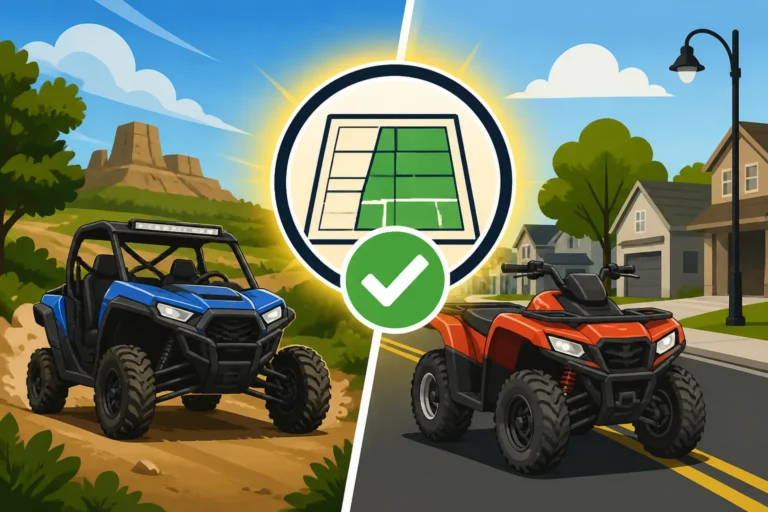
Ninety Degrees and a Full Stop in Texas
It can be incredibly frustrating to own an ATV or UTV in Texas, especially when you need to get from one part of your property to another, or simply across a rural road, and you're constantly worried about whether you're breaking the law. Texas is notoriously strict about off-highway vehicles (OHVs) on public roads, and it often feels like you're navigating a minefield of obscure regulations. This guide is here to cut through the confusion and explain exactly when and how you can legally cross a public roadway in Texas, focusing on the crucial "ninety degrees and a full stop" rule, so you can ride with confidence, not fear.
The Harsh Reality of Street Legality for OHVs in Texas
Let's get one thing straight right off the bat: for the vast majority of Texans, your ATV or UTV is not considered street legal. This isn't just a suggestion; it's deeply ingrained in Texas law. Many folks move here from other states or see videos online of riders tearing down suburban streets and assume it's the same everywhere. They quickly learn, often through a less-than-pleasant encounter with law enforcement, that Texas plays by its own rules. The intention behind owning an OHV in Texas is almost exclusively for off-road recreation, ranch work, or private land use. Anything beyond that usually requires a very specific exception. It’s a bitter pill to swallow for those who envision their side-by-side as a practical commuter vehicle for short hops, but understanding this fundamental difference is the first step to staying out of trouble.
Why Your ATV Isn't a Car
The legal distinction between an off-highway vehicle and a conventional motor vehicle is really at the heart of the matter. In Texas, an ATV or UTV is generally defined as a motor vehicle that is not designed by the manufacturer for operation on a public highway. This isn't just a minor technicality; it’s the bedrock of why you can't simply take your quad down Main Street. These machines lack many of the safety features required for highway use, such as proper turn signals, brake lights that meet highway standards, a windshield, and the necessary crashworthiness. The frame, suspension, and tires are all built for dirt, rocks, and mud, not asphalt. Because of this fundamental design difference, the state explicitly separates them from cars, trucks, and even golf carts or Neighborhood Electric Vehicles (NEVs), which have their own specific, albeit limited, road privileges. This distinction is so strong that Texas has a specific legal remark for OHV titles: [The Off-Highway Use Only Remark on a Texas Title] clearly states the vehicle's intended purpose.
Common Misconceptions About Making an OHV Street Legal
A common frustration for OHV owners is seeing aftermarket kits advertised that claim to make an ATV or UTV "street legal." While many companies, including brands like SuperATV, offer fantastic accessory upgrades for safety and functionality – things like turn signal kits, rearview mirrors, and horns – these additions alone do not magically transform your off-highway vehicle into a street-legal one in Texas. Many riders spend good money installing these modifications, only to find out they are still in violation if they venture onto public roads. The law looks at the original manufacturer's design and intent, not aftermarket modifications. Unless the state specifically provides a path for titling and registering your machine for highway use (which it generally doesn't for ATVs and UTVs), adding blinkers and a horn won't change its legal status. It’s a frustrating reality for owners who simply want to make their machines safer and more versatile, but the state's statutes are quite clear on this point. You can add all the bells and whistles you want, but without a change in the law or a specific exemption, it remains an off-highway vehicle in the eyes of Texas law.
Understanding the Exceptions: When Can You Cross a Road?
Now that we've established the general rule, let's talk about the specific exceptions that do exist. While you typically can't ride your ATV or UTV on a public road, Texas law does provide very narrow circumstances under which you can cross one. These exceptions are critical for anyone who owns land divided by a road, operates a ranch, or simply needs to move their machine from one side of a county road to the other without loading it onto a trailer. It’s not about giving OHVs free rein on the pavement, but rather allowing for practical, limited movement to facilitate their primary off-road purpose. Understanding these nuances is key to avoiding costly tickets and ensuring you’re operating within the bounds of the law.
The Critical "Ninety Degrees and a Full Stop" Rule
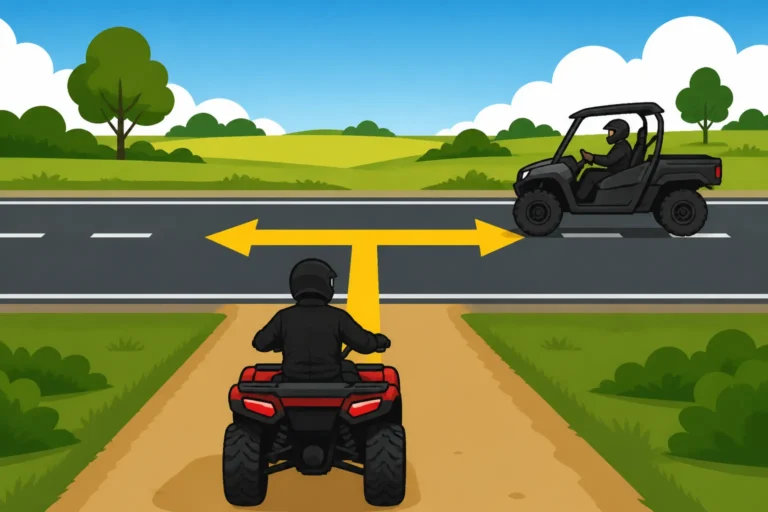
This is the golden rule when it comes to crossing public roads with your OHV in Texas. The law states that an off-highway vehicle may cross a public road if the operator brings the vehicle to a complete stop before crossing and crosses the road at an angle of approximately 90 degrees to the roadway. This means you can't just meander onto the road or follow it for a short distance before turning off. You must approach the road, come to a complete halt, look both ways (just like driving a car!), and then proceed directly across the road, perpendicular to the flow of traffic. The intent here is to minimize the time your OHV spends on the road and to make your intentions clear to any oncoming traffic. You're not "driving" on the road; you're simply passing over it. This rule applies even to seemingly deserted rural roads. Treat every crossing as if you're pulling out onto a busy highway – safety first, always. It’s a very specific, almost ceremonial, set of actions that ensures clarity and safety for all involved. [Crossing a Texas Road at an Intersection] or [Crossing a Texas Road Away From an Intersection] might seem simple, but these specific steps are crucial.
Crossing Intersections Versus Non-Intersection Crossings
The "ninety degrees and a full stop" rule applies generally, but it's important to consider if you're crossing at a designated intersection versus a random point on a road. When crossing at an intersection, especially one with traffic control devices, you still need to adhere to the full stop and 90-degree angle. However, you also must obey any traffic signals or stop signs that apply to motor vehicles. You cannot just blast through a red light because you're "only crossing." If you're crossing away from an intersection, perhaps to get from one pasture to another on your ranch, the 90-degree rule becomes even more critical. You're entering a flow of traffic where drivers might not expect a vehicle to suddenly appear and cross. Always yield to oncoming traffic, even if you technically have the "right" to cross under the law, because a collision with a car or truck will never end well for the OHV operator. Good judgment, clear visibility, and common sense are paramount, especially when there are no traffic signals to help guide you.
Divided Highways and Barriers
Crossing a divided highway presents an extra layer of complexity. If a highway has a median or a physical barrier separating the lanes of opposing traffic, your ability to cross might be further restricted. In many cases, you might only be able to cross one direction of traffic, make a full stop in the median (if it's wide and safe enough to accommodate your vehicle without obstructing traffic), and then cross the second direction of traffic. However, some divided highways might have continuous barriers that make a direct 90-degree crossing impossible or illegal. In such scenarios, you might need to seek out a specific designated crossing point, like a bridge or an underpass, or find a legitimate intersection where the median is broken to allow for full cross-traffic. Never attempt to breach or jump a median barrier with your OHV, as this is extremely dangerous and certainly illegal. It's a prime example of where the practicality of owning a larger UTV might be challenged, as squeezing a machine like a Polaris General or a Can-Am Defender into a narrow median could be difficult, even if it were legal. Always prioritize your safety and the safety of others, and if in doubt, find an alternative route or trailer your machine. [Crossing a Texas Road Away From an Intersection] and [Crossing a Texas Road at an Intersection] are distinct, and this becomes even more true on divided highways.
Conditions and Requirements for a Legal Crossing
It's not enough to simply know that you can cross; you also need to understand the conditions under which you can do so legally and safely. Texas law is specific about what you need to do to make that brief journey across the pavement legitimate. This isn't just about avoiding a ticket; it's fundamentally about preventing accidents and ensuring that all road users can anticipate your actions. Ignoring these requirements can turn a simple, necessary maneuver into a dangerous and costly mistake.
Lights, Flags, and Other Equipment
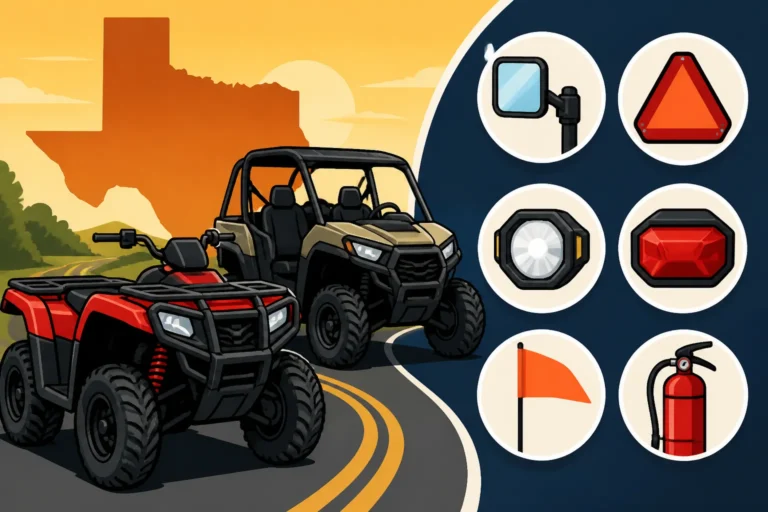
When you're crossing a road, even for a brief moment, visibility is key. While Texas generally does not mandate an extensive list of equipment for off-road use, certain items become vital when interacting with public roadways. The law doesn't explicitly require an orange safety flag for a simple road crossing on private property, but if you're operating on public lands or certain parks, a [The 6-Foot Orange Flag Texas Requires] is often mandatory and can significantly increase your visibility to other drivers, even for a quick crossing. Similarly, having functional headlights and taillights, even in broad daylight, is always a good practice. While the law might not strictly require them to be on during a daytime crossing, making yourself as visible as possible is just plain smart. Think of it this way: your ATV or UTV, especially a smaller model, can be harder to spot for a driver in a large truck. Any equipment that enhances your presence, such as upgraded LED lights (many of which are available from companies like SuperATV) or reflective tape, contributes to a safer crossing.
Driver Conduct and Safety Considerations
Beyond the physical equipment, your conduct as the operator is paramount. The "full stop" aspect of the rule cannot be overstated. This means a complete cessation of movement, not just a rolling stop. Before you proceed, you must look both ways, making sure the path is clear of oncoming traffic. Remember, OHVs are generally much slower to accelerate than cars, so estimating the speed and distance of approaching vehicles is crucial. Never assume another driver sees you or will yield. It's on you, the OHV operator, to ensure the crossing can be made safely without impeding traffic. For many OHV riders, particularly those in UTVs, seat belts are standard equipment; always use them. While [Texas Helmet Law for UTV Drivers] generally applies to those under 18, it's always advisable to wear a helmet, especially for the increased risk of interacting with road traffic. Eye protection is also a must, as debris from the road can be kicked up. These aren't just suggestions; they are fundamental safety practices that minimize risk during a fleeting, but potentially dangerous, crossing.
The Importance of a Complete Stop
Let's drill down on that "full stop" requirement. This isn't just a polite suggestion; it's a legal command. A "rolling stop," where you slow down but don't quite come to a standstill, is a violation. The purpose of this rule is to give you a moment to fully assess the traffic situation, account for any blind spots, and ensure you have ample time and space to complete your crossing. Imagine you're on a remote ranch road, and you need to cross a county highway to get to another pasture. You approach the highway, come to a complete stop, lower your window (if you're in a UTV), and scan for vehicles. Only when the coast is absolutely clear do you engage the throttle and cross at that precise 90-degree angle. This isn't just about legal compliance; it's about life and limb. A rolling stop can easily lead to misjudging traffic speed or missing a vehicle entirely, especially at night or in adverse weather conditions. The state wants absolute certainty that you've considered the potential danger before proceeding, and a complete stop enforces that moment of crucial assessment.
Other Limited Road Use Exceptions (Beyond Crossing)
While the focus here is on crossing roads, it's helpful to briefly understand that Texas does recognize a few other, very specific, and limited scenarios where OHVs can legally be on public roadways for short distances, separate from the crossing rule. These are generally tied to specific activities or locations, and they are by no means a license to treat your ATV or UTV as a regular road vehicle. Misunderstanding these exceptions is a common way riders run into legal trouble, so it’s essential to know their narrow scope.
Agricultural and Timber Operations
Texas recognizes the vital role ATVs and UTVs play in farming, ranching, and timber operations. Therefore, the law allows OHVs to be operated on public roads for agricultural or timber production purposes, but with very strict conditions. This generally applies when the OHV is being used to transport equipment, feed, or products between different parts of a farm or ranch, or for inspection of land or livestock. You might see a rancher driving a UTV down a county road with a sprayer attached, heading to another field. However, even these operations have limitations. The machine must be operated in daylight, at a reasonable speed, and the operator must be engaged in an agricultural or timber activity. There are specific requirements, such as displaying a slow-moving vehicle emblem, and sometimes even a [The 6-Foot Orange Flag Texas Requires] for increased visibility. This exemption is strictly for work; it doesn't mean you can run to the grocery store on your quad, even if you happen to live on a farm. You can delve deeper into [Riding an ATV for a Texas Agricultural Operation] for more details.
Emergency Services and Master Planned Communities
Two other very specific niches where OHVs might find themselves on public roads involve emergency services and certain residential communities. Volunteer firefighters, for instance, are often authorized to use OHVs on public roads when responding to emergencies, especially in rural areas where conventional vehicles might struggle. This is a matter of public safety and direct response. Separately, some [Texas Rules for Master Planned Communities] allow for limited OHV use on private streets within those developments, often governed by local ordinances and homeowners' association rules. These are typically designed communities with specific plats and private road networks. These are highly localized and depend on the specific community's rules and local government approvals. You won't find this allowance just anywhere. It's crucial to check with the specific municipality and HOA before assuming your UTV is permitted on community streets, even if they seem private. These are very much the exceptions that prove the rule that general street use is prohibited. For example, [Volunteer Firefighters on a Texas ATV] have a specific carve-out due to the nature of their duties.
Navigating Local Ordinances
It’s easy to get confused because Texas law, while generally restrictive, does allow for some local control. Specifically, the Transportation Code grants certain counties the authority to permit the operation of OHVs on public roads within their jurisdiction. However, this is not a widespread power. Only counties with a population of less than 37,000, or those bordering the Red River, or counties with a specific barrier island designation (like some along the Guadalupe River) have this option. Even then, it’s not an automatic allowance; the county commissioners' court must pass an ordinance specifically allowing it. What this means for you, the rider, is that you cannot simply assume your county permits OHV use on its roads. You must check with your specific county's clerk or commissioners' court to see if such an ordinance exists. Even if it does, these ordinances usually come with their own set of rules regarding speed limits, times of operation, and required equipment. Never rely on hearsay; verify directly with official sources. For a more comprehensive understanding, look into [What Texas Cities Can and Cannot Allow] and remember that these are truly rare exceptions.
The Risks of Non-Compliance: What Happens If You Don't Follow the Rules?
Ignoring Texas's OHV road rules, whether out of ignorance or intentional disregard, carries significant risks. It's not just about a minor inconvenience; the consequences can range from expensive fines to severe legal and financial liabilities. The state takes these regulations seriously because unauthorized OHV use on public roads poses a safety hazard to both the rider and other motorists. Understanding these potential repercussions is crucial for any responsible owner who wants to avoid turning a fun day of riding into a legal nightmare.
Penalties and Fines for Illegal Road Use
Operating an ATV or UTV on a public road in Texas without falling under one of the specific exemptions is generally a Class C misdemeanor. While this isn't a felony, a Class C misdemeanor can still result in a hefty fine, typically ranging from $25 to $500, plus court costs. And let's be realistic, it's rarely just a $25 ticket. Law enforcement officers are often less lenient when they perceive a rider as knowingly flouting the law. Beyond the base fine, you could also face additional citations for related offenses, such as reckless operation, not having proper safety equipment (if applicable to the specific situation), or even impeding traffic. These fines add up quickly, making a casual, illegal ride across town a very expensive proposition. It’s far cheaper and less stressful to trailer your machine or adhere strictly to the crossing rules. For context, you can research [Class C Misdemeanors Under Texas OHV Law] to understand the full scope of these penalties.
Insurance and Liability
This is where illegal road use can become truly financially devastating. Most standard ATV or UTV insurance policies are designed to cover off-road use, private property incidents, and perhaps limited transport liability. If you're involved in an accident while operating your OHV illegally on a public road, your insurance company might deny your claim entirely. This means you could be personally responsible for thousands, or even hundreds of thousands, of dollars in damages. This includes repairs to your own machine, medical bills for yourself and any passengers, and, critically, damages and medical expenses for any third parties involved in the collision. If you hit a car, you could be facing the cost of repairing their vehicle, their medical bills, lost wages, and potentially even pain and suffering. Without insurance coverage, a moment of poor judgment could lead to bankruptcy. Always remember, just because [Why Texas Exempts OHVs From Insurance] for off-road use, doesn't mean you're covered for illegal on-road activities. The financial risks far outweigh any perceived convenience of using your OHV on a public road.
Damage to the Reputation of OHV Riders
Beyond the personal legal and financial consequences, illegal road use also casts a shadow over the entire OHV community. When a rider is seen or reported illegally operating an ATV or UTV on public roads, it reinforces negative stereotypes about reckless, irresponsible riders. This perception makes it harder for responsible OHV enthusiasts to advocate for legal riding areas, fair regulations, and increased access to trails. It fuels public opposition to OHVs and gives legislators more reason to maintain strict bans or even impose new restrictions. Every time an OHV is illegally ridden on a street, it risks eroding the public's and policymakers' goodwill, which is vital for the future of off-road riding in Texas. As a community, it’s on all of us to demonstrate responsible behavior and respect for the law, ensuring that the passion for off-roading can continue to thrive.
Table: Conditions for Crossing a Road Legally in Texas
To help summarize the key requirements for crossing a public road with your OHV in Texas, here's a quick reference table. Remember, these are the minimum requirements, and additional safety measures are always recommended.
| Condition | Description | Legal Requirement | Safety Best Practice |
|---|---|---|---|
| Complete Stop | The OHV must come to a full, unequivocal stop before entering the roadway. No rolling stops. | Mandatory | Pause for several seconds, scan thoroughly. |
| Angle of Crossing | Cross the road at an angle of approximately 90 degrees to the roadway. | Mandatory | Maintain a straight path, minimize time on the road. |
| Visibility | Ensure you have a clear view of oncoming traffic in both directions. | Implied (Duty to avoid collision) | Mount a [The 6-Foot Orange Flag Texas Requires], turn on headlights/taillights, wear bright clothing. |
| Yield to Traffic | The OHV operator must yield the right-of-way to all vehicles lawfully on the public roadway. | Mandatory | Never assume other drivers see you or will stop; wait until path is completely clear. |
| Obey Traffic Controls | If crossing at an intersection with stop signs or traffic lights, obey all signals and signs as if operating a conventional motor vehicle. | Mandatory | Be extra cautious at busy intersections; consider an alternate crossing point if traffic is heavy. |
| Divided Highways | If a divided highway has a median or barrier, you may need to cross one direction, stop safely in the median (if allowed), then cross the other. Continuous barriers may prohibit crossing. | Laws vary; generally, crossing prohibited if barrier cannot be safely navigated | Seek designated breaks in the median or alternative routes; never jump barriers. |
| Driver Conduct | Operate the OHV responsibly, at a safe speed for the conditions, and avoid sudden movements. | Mandatory (Reckless operation laws apply) | Use seat belts (if available), wear a helmet and eye protection, even if not strictly required by law for adults. |
| Purpose of Crossing | The crossing should be for a legitimate purpose, such as accessing private land, or as part of an authorized agricultural/timber operation. | Mandatory (tied to specific exemptions) | Have a clear reason for crossing; generally, you cannot "drive" to a destination on the road, only cross it. |
Navigating Texas laws for ATVs and UTVs on public roads can feel overwhelming, but understanding these specific rules, especially the "ninety degrees and a full stop" requirement, empowers you to use your machine responsibly and legally. While the state is strict, it does provide carve-outs for essential activities like crossing roads or agricultural work. Always prioritize safety, stay informed about local ordinances, and ensure you're equipped to make your presence known to other drivers. By following these guidelines, you can enjoy your Texas off-road adventures without the added stress of legal worries.
Disclaimer
This article is for general informational purposes only and does not constitute professional advice. Laws, prices and regulations vary by location and change over time. Consult a qualified professional for guidance on your specific situation.