Texas ATV Insurance Requirement
Navigating the world of ATV and UTV ownership in Texas can sometimes feel like trying to untangle a plate of spaghetti. You've got titles, plates, decals, and then there's the big question that often leaves folks scratching their heads: "Do I actually need insurance for my off-highway vehicle in the Lone Star State?" It's a completely fair question, especially since we're so used to mandatory insurance for our cars and trucks. This guide is here to clear up that confusion, explain the ins and outs of ATV and UTV insurance in Texas, and help you decide what kind of coverage makes the most sense for your riding adventures.
The Core Truth: Is ATV Insurance Required in Texas?
Let's cut right to the chase, because this is usually the first thing everyone wants to know. When it comes to state law, Texas takes a different approach to ATVs and UTVs than it does to your typical passenger vehicle.
Off-Road Riding: No State Mandate
For the vast majority of ATV and UTV owners in Texas, who primarily ride off-road on private land, dedicated trails, or at sanctioned parks, there is no state law that mandates you carry insurance. Yep, you heard that right! Unlike cars, which require liability insurance by law to operate on public roads, your quad or side-by-side doesn't have the same blanket requirement.
This often comes as a surprise to many folks, especially those new to the off-road scene. You might have just bought your first UTV, maybe a powerful new side-by-side to tackle the mud in East Texas or climb rocks in the Hill Country, and naturally, you're thinking about insurance. The freedom from a state mandate can feel liberating, but it also places the responsibility squarely on your shoulders. While you might not get a ticket for not having insurance when you're roaring through a field on your own property, it doesn't mean you're immune to the financial consequences if something goes wrong. Imagine a scenario where you're out with friends, and through no fault of your own, another rider has an accident that damages your machine. Without your own coverage, you'd be looking at potentially footing the repair bill yourself, and that can add up quickly.
Exceptions to the Rule: When it Becomes Necessary
While the state might not demand it for every off-road machine, there are very specific and common situations where having ATV or UTV insurance isn't just a good idea, it's pretty much a requirement. Ignoring these exceptions can lead to significant headaches or even prevent you from enjoying your machine.
One of the biggest factors that often pushes riders into getting insurance is financing. If you've taken out a loan to purchase your ATV or UTV, your lender is almost certainly going to require you to carry full coverage insurance. From their perspective, that machine is their collateral, and they want to protect their investment against damage, theft, or total loss. They don't want to be left holding the bag if your brand-new quad gets stolen from your garage or takes a tumble down a rocky embankment. This is standard practice in the lending world, regardless of whether the state mandates it. So, if you're not paying cash for your machine, expect to factor insurance premiums into your monthly budget.
Another common scenario involves public riding areas and organized events. Many popular Texas OHV parks and recreational areas, such as [Barnwell Mountain Recreation Area] or [Hidden Falls Adventure Park at Marble Falls], might require proof of liability insurance to enter and ride their trails. They want to ensure that if you accidentally damage their property or injure another rider, there's a financial safety net in place. Similarly, if you participate in organized races, rallies, or even a local club ride, the event organizers might have their own insurance requirements. It's always a good idea to check the specific rules of any park or event before you load up your machine and head out. Showing up only to be turned away because you don't meet their insurance stipulations would be a real bummer.
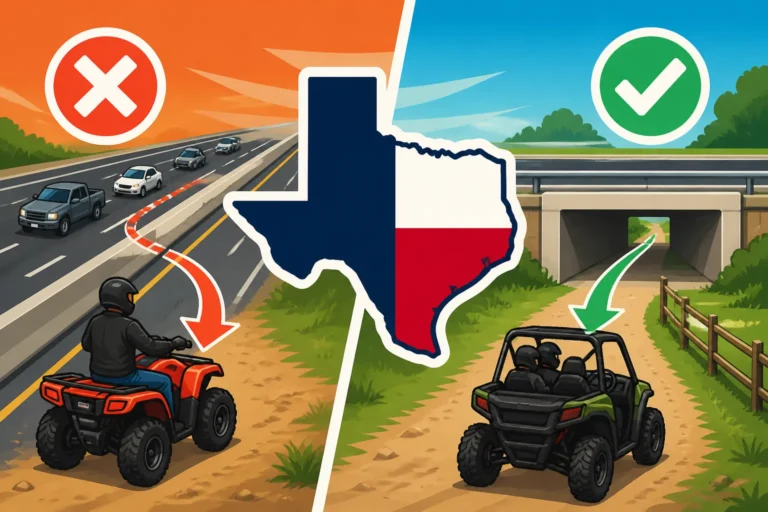
Finally, though Texas generally restricts ATVs and UTVs from public roads, there are a handful of limited exceptions for road use. These exceptions are very specific, like using a UTV for agricultural purposes on certain farm roads, crossing a public road at an intersection, or operating in certain master-planned communities or designated low-speed road areas. While these machines aren't registered for street use in the traditional sense, operating any vehicle on a public roadway, even briefly, opens you up to liability. If you're utilizing one of these exceptions, like riding your UTV on a [Texas Rules for Riding a Farm Road] or to a [Texas Rules for Riding a UTV to a Golf Course], and you're involved in an accident, you could still be held personally responsible for damages or injuries. While the state doesn't mandate insurance for the OHV itself in these specific limited-use scenarios, having liability coverage is a critical safeguard. Think of it as protecting your personal assets from a lawsuit should the unthinkable happen.
Understanding Different Types of ATV/UTV Insurance Coverage
Just like car insurance, off-road vehicle insurance comes in various flavors, each designed to protect you from different kinds of risks. Knowing what each type covers can help you build a policy that truly meets your needs and budget.
Liability Coverage: Protecting Others
This is the most fundamental type of insurance and, as mentioned, often the one required by parks or for limited road use. Liability coverage is all about protecting you financially if you're at fault for an accident that causes injury to another person or damage to their property. It's not about covering your own machine or your own medical bills; it's about what you owe to others.
Imagine you're navigating a tight trail at an OHV park, and you misjudge a turn, clipping another rider's brand-new quad and bending their axle. Or perhaps you're using your UTV to haul materials around your ranch and accidentally back into a neighbor's fence post while crossing their property with permission. In these scenarios, liability coverage would step in to pay for the repairs to the other rider's machine or the cost of replacing that fence. Without it, those costs would come directly out of your pocket, which could be a significant financial hit. It provides a crucial layer of protection against potential lawsuits and helps cover legal fees if you're sued.
Collision and Comprehensive: Protecting Your Machine
While liability coverage looks outward, collision and comprehensive coverage look inward, protecting your own ATV or UTV. These are the coverages that a lender will almost certainly demand if you're financing your machine, and they offer valuable peace of mind for any owner.
Collision coverage is pretty straightforward: it pays for damage to your own ATV or UTV if it collides with another vehicle, an object, or even if it just rolls over. Whether you hit a tree, another rider, or flip your machine trying to climb a steep incline, collision coverage helps cover the repair or replacement costs, minus your deductible. This is incredibly important for off-road riding, where spills and bumps are a common part of the adventure.
Comprehensive coverage is designed to protect your machine from pretty much everything else that isn't a collision. Think of it as protection against the unpredictable curveballs life throws at you. This includes theft (a very real concern for valuable off-road vehicles), vandalism, fire, natural disasters like floods or hail (a big one in Texas!), and even hitting an animal. If your prized quad gets stolen from your shed, or a severe hailstorm leaves dents all over your UTV, comprehensive coverage is what will help you recover the costs. It's often paired with collision coverage to provide robust protection for your investment.
Add-Ons and Specialized Coverage
Beyond the basics, many insurance providers offer additional coverages that can be incredibly useful for ATV and UTV owners. These "add-ons" allow you to customize your policy to fit your specific needs and the way you use your machine.
- Uninsured/Underinsured Motorist Coverage: This protects you if you're involved in an accident with another rider who is at fault but doesn't have insurance, or doesn't have enough insurance to cover your damages. It's like having a safety net for when the other guy drops the ball.
- Medical Payments/Personal Injury Protection (PIP): This coverage helps pay for your medical bills (and sometimes those of your passengers) if you're injured in an ATV/UTV accident, regardless of who was at fault. Off-road riding, by its nature, carries a higher risk of injury, so this can be a very valuable addition.
- Accessory Coverage: Let's be honest, few of us keep our ATVs or UTVs bone stock for long! We add light bars, winches, upgraded tires, lift kits (perhaps even a heavy-duty one from SuperATV), stereo systems, and custom seats. These accessories can add significant value to your machine, but they might not be fully covered under a standard comprehensive or collision policy. Accessory coverage specifically extends protection to these aftermarket additions, ensuring your investment in upgrades is also protected.
- Trailer Coverage: Many of us haul our ATVs and UTVs to riding spots. If your trailer is damaged or stolen while attached to your vehicle or even parked separately, this add-on can provide coverage.
- Riding Gear Coverage: High-quality helmets, boots, jackets, and other safety gear can be surprisingly expensive. If your gear is damaged in an accident, this coverage can help with replacement costs.
Navigating Insurance Options and Costs in Texas
Even though it might not be a state requirement for everyone, most experienced riders will tell you that carrying some form of insurance for your ATV or UTV is a smart move. So, how do you go about getting it, and what can you expect in terms of cost?
Where to Get Coverage: Specialized vs. Bundled
When you're ready to explore insurance options, you'll generally find two main avenues:
- Specialized Off-Road Vehicle Insurers: Many insurance companies, or specific divisions within larger companies, specialize in recreational vehicles like ATVs, UTVs, motorcycles, and snowmobiles. These providers often have a deeper understanding of the unique risks associated with off-road riding and may offer policies tailored specifically for these machines. They might also have more robust options for accessory coverage or specialized roadside assistance.
- Bundling with Existing Policies: A very common and often cost-effective strategy is to bundle your ATV/UTV insurance with your existing auto, home, or renters insurance policy from the same provider. Many insurance companies offer multi-policy discounts, which can lead to significant savings. It also simplifies things by keeping all your insurance under one roof. It's definitely worth checking with your current insurance agent to see what they offer and if bundling makes sense for you.
When choosing a provider, don't just go with the first quote you get. It pays to shop around and compare coverage options and prices from several different companies. What one company considers standard, another might offer as an add-on, and prices can vary widely.
Factors Influencing Your Premium and Deductibles
Insurance premiums aren't a one-size-fits-all figure. Several factors will influence how much you pay for your ATV or UTV policy in Texas:
- Type of Machine: A high-performance sport quad or a large, powerful UTV will generally cost more to insure than a smaller, less powerful utility ATV. The value of the machine and its repair costs play a big role. For example, insuring a heavily modified side-by-side with a turbo kit might be pricier than a basic youth quad.
- Rider's Age and Experience: Younger, less experienced riders (especially those under 25) typically face higher premiums, just like with car insurance, due to perceived higher risk. A clean riding record will also help keep costs down.
- Your Location: Where you live in Texas can affect your rates. Areas with higher theft rates or more frequent natural disasters (like coastal areas prone to hurricanes) might have higher comprehensive coverage costs.
- How and Where You Ride: If you primarily ride on private land, your rates might be different than if you frequently visit public parks or engage in competitive events. Some policies might have exclusions for racing or commercial use, so always be transparent with your insurer about how you intend to use your machine.
- Storage Location: Insurers often want to know how you store your ATV or UTV. Keeping it securely garaged or in a locked shed can result in lower comprehensive premiums compared to parking it outdoors and uncovered.
- Deductibles: This is the amount you pay out-of-pocket before your insurance coverage kicks in. Choosing a higher deductible (e.g., $1,000 instead of $500) will generally lower your premium, but means you'll pay more upfront if you file a claim. It's a balance between monthly cost and potential out-of-pocket expenses.
What to Consider When Choosing a Policy
Making the right insurance choice involves a bit of self-reflection and understanding your personal risk tolerance. Since Texas doesn't mandate it for most off-road use, it's truly a personal decision.
Start by evaluating your risk tolerance. Are you comfortable potentially paying thousands out of pocket if your machine is stolen or severely damaged? Or would you rather pay a regular premium for peace of mind? Next, consider the value of your machine and any accessories. If you've invested heavily in a high-end UTV and countless SuperATV upgrades, protecting that investment with collision and comprehensive coverage makes a lot of financial sense.
Think about how and where you ride. If you're frequently riding challenging trails where accidents are more likely, or if you're often out with groups where incidents with other riders are possible, robust liability and collision coverage become more important. If your machine rarely leaves your private ranch, your concerns might shift more towards theft or natural disaster. Always be sure to read the fine print of any policy. Understand any exclusions, such as those for racing, commercial use, or modifications not explicitly covered by accessory riders. What might seem like a great deal could have hidden limitations that leave you exposed. Finally, don't hesitate to get multiple quotes from different providers. This is the best way to ensure you're getting competitive rates and the right coverage for your Texas ATV or UTV adventures.
| Coverage Type | Purpose | Texas State Mandate (Generally) | Recommended For |
|---|---|---|---|
| Liability | Pays for damages/injuries you cause to others or their property. | No | Everyone, especially if riding in parks, with groups, or on limited public access roads. |
| Collision | Pays for damage to your ATV/UTV from an accident. | No | Any owner with a valuable machine, or those financing. |
| Comprehensive | Pays for damage to your ATV/UTV from theft, fire, vandalism, natural disaster. | No | Any owner, especially for valuable machines or those in areas with high theft/weather risks, or those financing. |
| Uninsured/Underinsured Motorist | Protects you if another at-fault rider has insufficient or no insurance. | No | Any rider who wants extra protection from others' lack of coverage. |
| Medical Payments/PIP | Covers your medical bills (and passengers') after an accident. | No | Riders concerned about high medical costs from off-road injuries. |
| Accessory Coverage | Covers aftermarket parts and customizations. | No | Owners with significant investments in upgrades like lift kits, winches, lights, etc. |
Texas Rules on Limited Road Use and Liability
We've touched on this a bit already, but it's a critical point that deserves its own section. The distinction between an ATV/UTV as an "off-highway vehicle" and a "motor vehicle" (like your truck) is paramount in Texas, and it directly impacts insurance considerations.
The Nuance of Limited Public Road Access
Texas law is very clear: ATVs and UTVs are generally not street legal for operation on public roads. There's no process to register an ATV or UTV to make it street legal in the same way you would a car or motorcycle. However, the law does carve out specific, limited exceptions where these machines can temporarily or conditionally operate on public roadways. These exceptions are often for things like agricultural use, utility work, emergency services, or brief road crossings. For example, a rancher might be able to use a UTV on a [Texas Agricultural Exemption for ATVs on Roads] for certain tasks, or a rider might briefly cross a two-lane road at a ninety-degree angle to get to another trail section. Certain cities or counties may also have ordinances allowing limited use on specific, low-speed roads under particular conditions, sometimes related to master-planned communities or designated recreational areas.
Even in these limited scenarios, your ATV or UTV is not considered a "motor vehicle" for general registration and mandatory insurance purposes. You won't be getting a standard vehicle registration or specific state-mandated liability coverage that applies to your OHV for these fleeting moments on public asphalt. This legal gap is precisely why many riders, wisely, choose to carry liability insurance even when not explicitly required by state law for their off-highway machine. The machine's legal classification doesn't absolve you of responsibility for your actions.
Why Liability Matters Even Without a Mandate
This is where the rubber meets the road, quite literally. While the state might not force you to have insurance for your ATV or UTV if you're riding strictly off-road or making legal, limited road crossings, it doesn't mean you're immune to the financial repercussions of an accident. Accidents happen, and they don't always respect legal classifications.
Imagine a situation: you're operating your UTV legally on a 35 mph road as part of an allowed [Texas Rules for Riding on a 35 mph Road] exception in a small county. You accidentally swerve to avoid a pothole and clip a parked car, causing damage. Or perhaps you're crossing a rural highway to access your deer lease, and another vehicle misjudges your speed, leading to a collision that causes injuries to the other driver. In these scenarios, even if you were operating your OHV within the bounds of legal exceptions, you could still be found at fault and held personally liable for property damage, medical expenses, lost wages, and pain and suffering for the other parties involved.
Without liability insurance, you would be on the hook for those costs directly. This could mean draining your savings, liquidating assets, or even facing wage garnishments for years. A personal injury lawsuit can be financially devastating. Having liability coverage for your ATV or UTV, even if it's not mandated by Texas law, provides a critical shield. It's about protecting your financial future and ensuring that a fun day of riding doesn't turn into a life-altering financial burden. The peace of mind that comes from knowing you're protected, even for the smallest mishap, is invaluable.
Disclaimer
This article is for general informational purposes only and does not constitute professional advice. Laws, prices and regulations vary by location and change over time. Consult a qualified professional for guidance on your specific situation.