Texas Rules for Crossing a Divided Highway
Navigating Texas roads on an ATV or UTV can be a real head-scratcher, especially when you encounter something as daunting as a divided highway. Many riders feel a knot in their stomach wondering if they're even allowed to cross, let alone how to do it safely and legally. This guide aims to untangle that confusion, providing clear, actionable steps and a deep dive into Texas law so you can confidently (and legally) cross a divided highway on your off-highway vehicle without fear of a ticket or, worse, an accident.
Deciphering the Divided Highway in Texas for OHV Riders
Before we even talk about crossing, let's make sure we're all on the same page about what a "divided highway" truly means in the eyes of Texas law and how it impacts your off-highway vehicle (OHV) adventures. It’s not just a big road; it has specific characteristics that define its legal status and the rules surrounding it.
What Constitutes a Divided Highway in Texas Law?
In Texas, a divided highway is essentially any road, street, or public way that is separated into two or more distinct roadways by a physical barrier or a clearly defined median strip. Think about those big multi-lane roads with a grassy area, concrete barrier, or even a raised curb separating traffic flowing in opposite directions. This isn't just a painted double yellow line; it's a physical divide designed to keep opposing traffic completely separate. The law treats these roads differently because of the inherent speed and volume of traffic they typically carry, and the distinct dangers that arise when trying to cross them.
For an OHV rider, this distinction is critical because while Texas generally frowns upon riding ATVs and UTVs on public roads, certain specific allowances are made for crossing these roads, including divided highways, under very strict conditions. The presence of that physical median means you're dealing with two separate traffic flows, essentially two distinct roadways, and your crossing procedure must account for both. It’s a lot to consider, especially if you’re used to just cruising on trails or private land.
The Unique Challenges OHVs Face on These Roads
Let's be real: ATVs and UTVs are not designed for highway speeds or for blending seamlessly with passenger cars and 18-wheelers. This creates a host of unique challenges when contemplating even a quick crossing of a divided highway. First off, visibility is a huge concern. Your machine, while mighty on the trails, is relatively small compared to other vehicles on a busy highway. You sit lower, and your lights, even if upgraded with brighter LED kits from a company like SuperATV, might not command the same attention as a car's headlights from a distance. Drivers on a divided highway are usually traveling at high speeds, often expecting only other high-speed vehicles.
Secondly, the acceleration and top speed of most ATVs and UTVs are simply not adequate for merging with highway traffic, which is why the law doesn't allow it. Even a short dash across lanes requires quick, decisive movement that your machine might not be able to deliver, especially if you're pulling a small trailer or carrying gear. The risk of misjudging the speed of oncoming traffic, or of other drivers not seeing you until it's too late, is significantly amplified on these types of roads. This isn't just about legality; it's about pure, unadulterated safety for yourself and everyone else on the road.
The Core Rules for Crossing a Divided Highway in Texas
Okay, so you've got a handle on what a divided highway is and why it's a big deal for OHVs. Now, let's get down to the brass tacks: how do you actually cross one without breaking the law or, more importantly, without putting yourself in harm's way? Texas law is quite specific about this, laying out rules that are designed to minimize risk.
Identifying Legal Crossing Points
You can't just pick any spot on a divided highway and decide that's where you're going to cross. That's a recipe for disaster and a guaranteed ticket. Texas law stipulates that if you're going to cross a divided highway, it must be done at an intersection. This is the golden rule. An intersection is typically where traffic lights or stop signs regulate the flow, or at least where other roads or driveways meet the main highway, providing a designated break in the median. Attempting to cross a divided highway by driving across a median where there is no designated opening or intersection is absolutely forbidden and incredibly dangerous.
Think of it this way: the law wants you to use points where other vehicles are already accustomed to traffic entering or crossing the main flow. These points often have better sight lines and slower traffic speeds due to turns or signals. If you're out exploring a new area, always plan your route with these intersection rules in mind. Sometimes, it means taking a slightly longer path to get to a legal crossing point, but that extra bit of travel is always worth the safety and legal compliance. Remember, safety first, convenience second. You can learn more about general road crossings in [Crossing a Texas Road at an Intersection] and [Crossing a Texas Road Away From an Intersection].
The "Ninety Degrees and a Full Stop" Mandate
This is arguably the most critical piece of legal advice when it comes to crossing any public road in Texas with an OHV, and it applies with even greater emphasis to a divided highway. When you approach the road you intend to cross, you must come to a complete and full stop. Not a rolling stop, not a slow crawl, but a full, undeniable stop. This gives you precious moments to fully assess traffic conditions in both directions.
Once you’ve stopped, you must cross the roadway at a ninety-degree angle to the pavement. This means you drive straight across, perpendicular to the flow of traffic, not at an angle that mimics merging or turning. The goal is to minimize the time you spend exposed to fast-moving traffic. You enter the lane, cross it, and exit it as directly as possible. This rule is designed to make your presence on the main road as brief and predictable as possible for other drivers. It’s a quick dart, not a leisurely traverse. For a deeper dive into this specific mandate, check out [Ninety Degrees and a Full Stop in Texas].
Required Equipment for Road Crossings
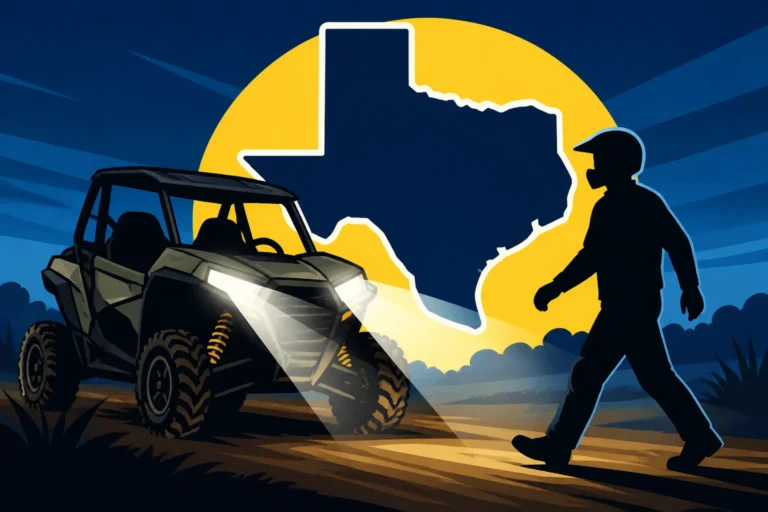
Even for a quick dash across a divided highway, your OHV isn't entirely exempt from certain equipment requirements if it's going to touch a public road. While Texas doesn't register ATVs or UTVs for continuous road use (see [Why Texas Will Not Register an ATV for the Road]), specific provisions exist for incidental crossings. Your machine must have working headlights and taillights. This isn't just a suggestion; it's a must. These lights are crucial for making you visible, especially if conditions are less than ideal, such as at dawn, dusk, or in bad weather. Think about upgrading your stock lights to something brighter from a vendor like SuperATV if you anticipate needing to cross roads frequently.
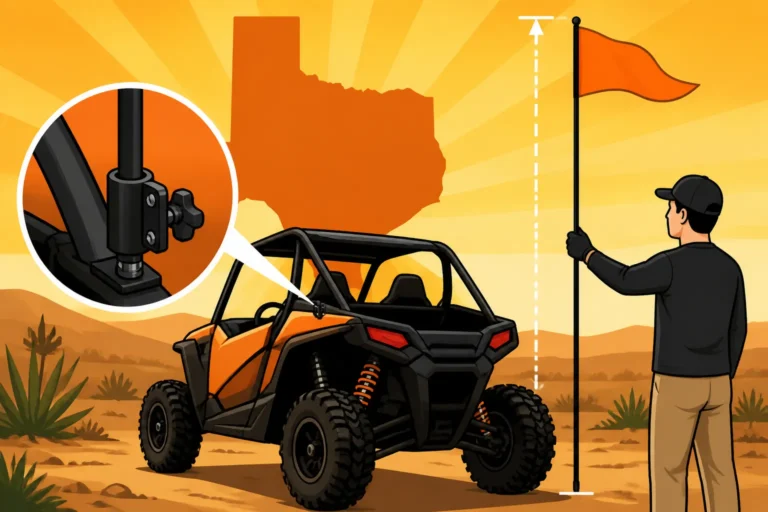
Beyond lights, ensure your brakes are in excellent working order, and your tires are properly inflated. While Texas law doesn't explicitly demand turn signals or rearview mirrors for a crossing-only scenario, these are smart additions that significantly enhance your safety. The more visible and predictable you are to other drivers, the better. Consider a bright flag mounted high on your machine; anything that increases your profile and makes you stand out is a plus. For a comprehensive look at equipment, refer to [Texas Equipment Rules for an ATV on a Road] and [Texas Lighting Requirements for OHVs].
Speed and Right-of-Way During Crossing
When crossing a divided highway, you must always yield the right-of-way to vehicles already on the highway. This is non-negotiable. You are the one entering their path, and they have the priority. Take your time to carefully check for traffic in both directions, especially on a divided highway where there are multiple lanes moving at speed. Do not attempt to cross unless you have an ample, safe gap in traffic. Rushing will only put you in danger.
Once you commit to crossing, do so decisively but safely. You’re not trying to set a land speed record; you’re trying to minimize your exposure. Your machine's speed should be consistent and controlled. While you want to cross quickly, never do so recklessly or in a way that would require other vehicles to swerve or brake suddenly to avoid you. The emphasis here is on a swift, controlled, and safe crossing, always deferring to the vehicles already occupying the main thoroughfare.
Practical Scenarios and Best Practices for Safe Crossings
Understanding the law is one thing, but applying it in real-world situations can be another. Let's walk through some common scenarios and best practices to ensure your divided highway crossings are as safe and stress-free as possible.
Crossing at Uncontrolled Intersections
Not every intersection on a divided highway has traffic lights or stop signs governing all directions. Sometimes, you’ll encounter an "uncontrolled" intersection where cross-traffic might have a stop sign, but the highway traffic does not. This scenario demands extreme caution. In such cases, the rules of yielding the right-of-way become even more critical. You must stop completely, as dictated by the "ninety degrees and a full stop" rule, and then patiently wait for a substantial gap in traffic from both directions on both sides of the divided highway.
Imagine you're trying to cross State Highway 21, a divided road, from a small county road that has a stop sign. You'll stop, look left, look right, then cross the first set of lanes. You'll then likely be in the median. From the median, you must again stop, look for traffic coming from the opposite direction on the second set of lanes, and then cross. Treat each section of the divided highway as its own separate crossing. Never assume you have enough time just because you made it across the first lanes. This isn't a race; it's a calculated move.
Crossing a Road While on an Agricultural Exemption
Texas law does provide some flexibility for ATVs and UTVs used for agricultural operations. If you're actively engaged in farming, ranching, or timber production, and your OHV is being used for legitimate agricultural purposes, you might have certain allowances. For example, a farmer might need to cross a divided highway to get from one section of their land to another, or to access an irrigation ditch. While the core "ninety degrees and a full stop" rule still applies, and you still need to yield to traffic, the reason for your presence on the road might fall under an exemption that generally allows incidental road use without a plate.
Even with an agricultural exemption, common sense and safety still prevail. You should ensure your machine is equipped with a high-mounted orange flag (at least six feet above ground level) and that your lights are on, even during the day. While the agricultural exemption allows for certain uses, it does not waive the fundamental safety requirements or the need to respect traffic laws. Your purpose may be agricultural, but your machine is still an OHV, and highway drivers still expect a certain level of visibility and predictability. For more details, consult [Riding an ATV for a Texas Agricultural Operation] and [Texas Agricultural Exemption for ATVs on Roads].
When to Avoid Crossing Altogether
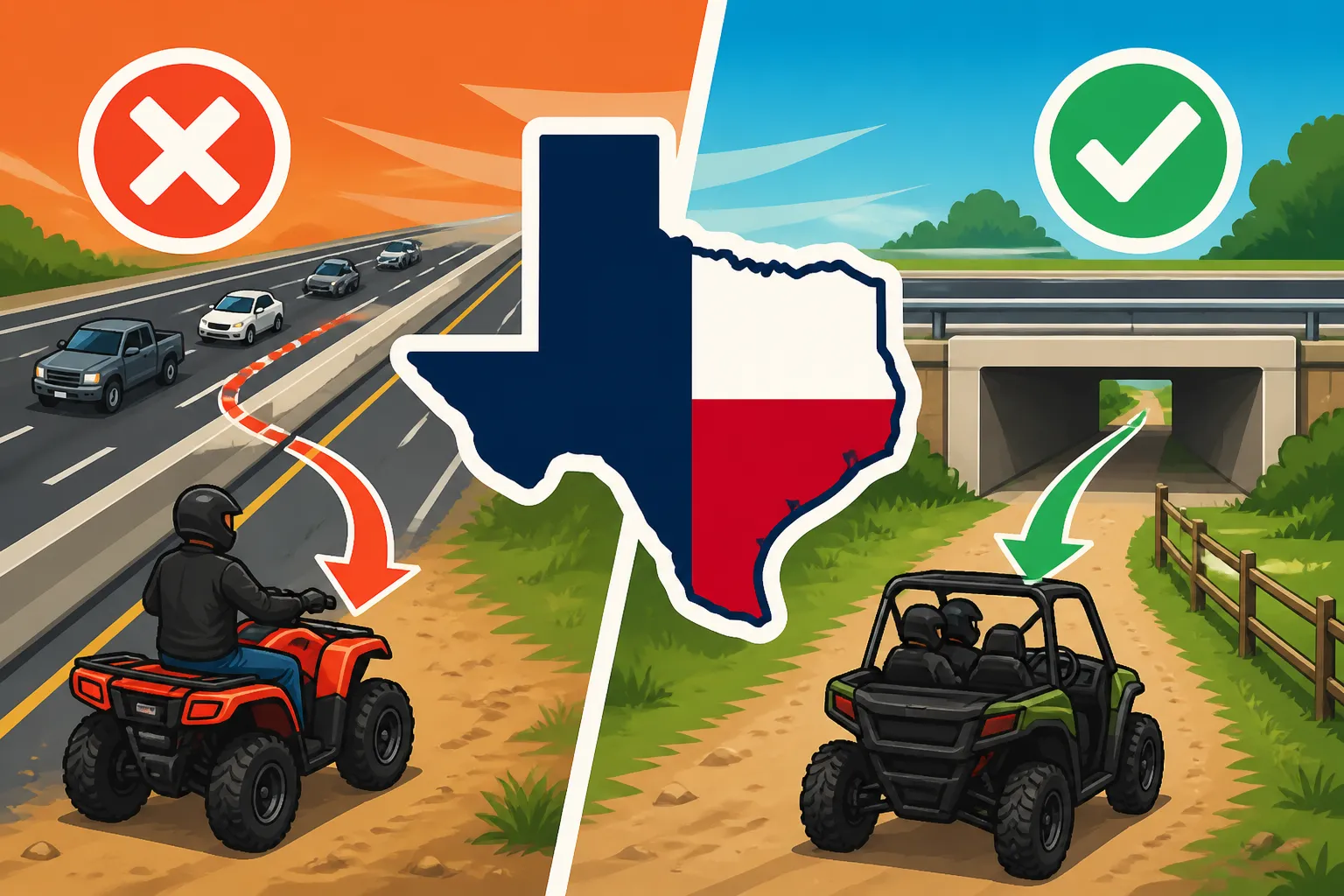
Sometimes, the safest and smartest decision is simply not to cross. If traffic is too heavy, if visibility is poor due to fog, rain, or darkness, or if you're not absolutely confident you can make the crossing safely, find an alternative route. This might mean driving several miles out of your way to find an overpass or an underpass, or even trailering your machine to the other side. A small inconvenience is always preferable to a serious accident or a citation.
Always err on the side of caution. If you feel hesitant, or if conditions aren't perfect, trust your gut. No amount of time saved is worth the risk of a collision with a vehicle traveling at 70 mph. Moreover, if your machine isn't in peak condition (e.g., dim lights, sputtering engine), don't even think about attempting a highway crossing. Make sure your ATV or UTV is always well-maintained, and if you need reliability, consider parts from reputable brands.
Consequences of Illegal Divided Highway Crossings
It might seem like a minor infraction to quickly zip across a highway, but Texas law takes these rules seriously. The consequences for illegal crossings can range from financially painful fines to severe personal injury, or worse. It’s imperative to understand the risks involved beyond just the legal text.
Potential Fines and Legal Repercussions
Operating an OHV on a public road, including an illegal crossing of a divided highway, is generally a Class C Misdemeanor in Texas. A Class C Misdemeanor can carry a fine of up to a few hundred dollars. While it might not seem like a massive penalty compared to some other offenses, that money could easily go towards maintenance, gear, or even more trail riding. Beyond the fine, you might also face court costs and potentially higher insurance premiums if the incident is reported to your insurer, though OHV insurance is not mandatory in Texas.
More importantly, repeated offenses or reckless behavior could lead to more serious charges, especially if property damage or injury occurs. The state isn't just trying to make money off fines; these laws are in place to protect riders and the general public from preventable accidents. Ignorance of the law is rarely an acceptable defense, and a simple mistake could cost you significant time and money. For further reading on legal consequences, check out [Class C Misdemeanors Under Texas OHV Law].
Safety Risks and Accident Liability
Let’s be brutally honest: the biggest consequence isn't a fine; it's the very real risk of a collision. When you pit an ATV or UTV against a full-sized vehicle, especially one traveling at highway speeds, your off-highway vehicle and its occupants are at a severe disadvantage. The potential for serious injury, paralysis, or even fatality is incredibly high. Even a "minor" accident could total your machine and leave you with lifelong injuries.
Beyond your personal safety, there's the question of liability. If you are found to be illegally operating your OHV on a public road and cause an accident, you could be held financially responsible for damages to other vehicles, medical bills for injured parties, and other associated costs. This could quickly amount to hundreds of thousands of dollars, a financial burden that most people cannot easily bear. Even if you've done everything right in terms of safety gear, like wearing a helmet (as discussed in [Texas Helmet Law for ATV Riders]) and eye protection, the sheer physics of an OHV versus a truck is unforgiving. These are not trivial risks; they are life-altering possibilities that every rider must consider before attempting any road crossing.
Crossing a divided highway on your Texas ATV or UTV is not something to be taken lightly. It's an exception to the rule, not a right, and it comes with very strict conditions and significant risks if not executed perfectly. By understanding Texas law, meticulously following the rules, and always prioritizing safety, you can navigate these challenges with confidence and keep enjoying the trails for years to come.
| Crossing Element | Rule for Divided Highway Crossing | Notes |
|---|---|---|
| Location | Must be at a legal intersection, no median cuts. | Plan your route to reach a designated crossing point. |
| Stop Requirement | Full and complete stop before crossing each roadway. | Essential for assessing traffic. |
| Crossing Angle | Ninety degrees (perpendicular) to the roadway. | Minimizes time exposed to traffic; no angled merging. |
| Right-of-Way | Always yield to traffic already on the highway. | Highway traffic has priority; wait for clear gaps. |
| Required Equipment | Functional headlights and taillights. | Crucial for visibility; consider upgrades. |
| Visibility Enhancements | Consider high-mounted orange flag, bright clothing. | Extra measures increase safety; e.g., products from SuperATV. |
| Speed | Decisive but controlled; do not rush recklessly. | Aim for quick exposure, but maintain control. |
| Agricultural Use | Specific exemptions may apply, but safety rules remain paramount. | Still requires caution, flag, and lights; check [Texas Agricultural Exemption for ATVs on Roads]. |
| Risk Assessment | If in doubt (heavy traffic, poor visibility), do not cross. | Prioritize safety over convenience; find an alternative. |
| Legal Consequences | Class C Misdemeanor for illegal crossing, potential fines. | Legal and financial repercussions. |
| Safety Consequences | High risk of severe injury, fatality, and liability in a collision. | The most critical risk; exercise extreme caution. |
Disclaimer
This article is for general informational purposes only and does not constitute professional advice. Laws, prices and regulations vary by location and change over time. Consult a qualified professional for guidance on your specific situation.