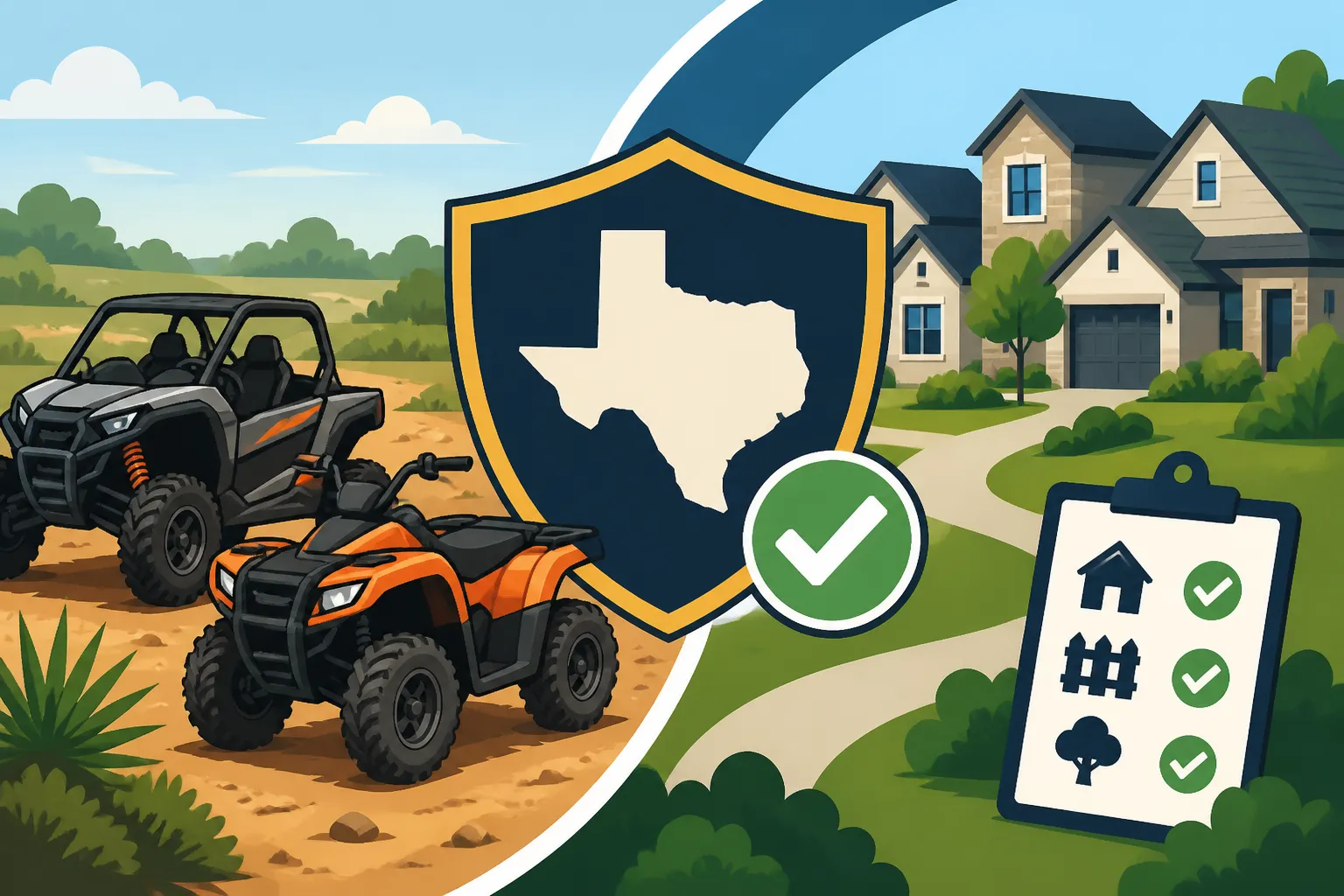
Master Planned Communities and Uniform Covenants
Navigating the rules for riding your ATV or UTV in Texas can feel like trying to solve a riddle, especially when you live in a master-planned community. Many folks invest in these vehicles for utility, recreation, or just getting around their acreage, only to find themselves scratching their heads over whether they can even drive it down the street to a neighbor’s house, let alone take it to the community pool. This guide is here to shed light on the often-conflicting layers of state law, city ordinances, and homeowners association covenants that dictate ATV and UTV use within Texas's unique master-planned communities, helping you understand your rights and responsibilities without the headache.
Understanding Master Planned Communities in Texas
Master-planned communities (MPCs) are a distinctive feature of the Texas landscape, offering a lifestyle that often promises amenities, security, and a certain aesthetic. But along with those benefits come rules, and sometimes, those rules can feel like they're directly at odds with how you want to use your off-highway vehicle (OHV). It’s crucial to understand what truly defines an MPC and why their internal governance structure has such a heavy hand in what you can and cannot do with your ATV or UTV.
What Defines an MPC?
A master-planned community isn't just a big subdivision. These are typically large-scale residential developments that are designed and built with a holistic vision, often including a mix of housing types, commercial spaces, schools, parks, and extensive recreational facilities. Think of a place like The Woodlands or Cinco Ranch outside of Houston, or Stone Oak in San Antonio – they're essentially self-contained towns or very large neighborhoods within a larger city or county. They often have their own distinctive entryways, common areas, and a carefully curated environment that sets them apart.
What truly distinguishes them, beyond their physical layout, is their governance. MPCs are almost universally overseen by a Homeowners Association (HOA), sometimes referred to as a Property Owners Association (POA). This HOA isn't just a casual club; it's a legal entity responsible for enforcing the community's rules and maintaining its common property. These rules are usually laid out in a comprehensive set of legal documents, with the Declarations of Covenants, Conditions, and Restrictions (CC&Rs) being the most prominent. These documents are often more restrictive than city or county ordinances, especially when it comes to things like vehicle appearance, storage, and operation within the community's boundaries.
Why Covenants Matter So Much Here
In a master-planned community, the CC&Rs—the "covenants" everyone talks about—are the foundational legal document that establishes the rules for property owners. When you buy a home in an MPC, you legally agree to abide by these covenants, whether you've read every line or not. These aren't suggestions; they are legally binding agreements that affect everything from the color you can paint your house to the types of fences you can erect, and critically for us, the vehicles you can operate on community roads and even store on your property.
Unlike a typical city where public roads are governed solely by state and local traffic laws, many roads within an MPC are considered private. This distinction is vital because it means the HOA's covenants can dictate vehicle usage on these private roads far beyond what state or municipal law might address. For example, while Texas state law has very specific and generally prohibitive rules about [Street Legal ATVs in Texas: The Short Answer], a master-planned community might have its own clauses prohibiting any off-road vehicle from being driven on its private streets, even for short distances, or might restrict them to utility-only tasks with specific permits. It's this layer of private regulation that often catches ATV and UTV owners off guard.
The Role of Uniform Covenants and Restrictions
The phrase "uniform covenants and restrictions" is key to understanding life in a master-planned community. These are the rules that apply consistently to all properties and residents within the community, designed to maintain property values, aesthetic harmony, and a desired quality of life. For ATV and UTV owners, these covenants are often the biggest hurdle, overriding what might otherwise be permitted by public law.
How Covenants Restrict Vehicle Use
It's common for MPC covenants to include explicit restrictions on off-highway vehicles. These restrictions can manifest in several ways:
- Outright Prohibitions: Many covenants simply forbid the operation of ATVs, UTVs, or any "off-road vehicles" on community streets, sidewalks, or common areas. The reasoning often boils down to safety concerns for pedestrians and other vehicles, noise pollution, and potential damage to roads or landscaping. Imagine the chaos if every resident decided to take their loud, knobby-tired UTV for a spin down the perfectly manicured main street – it doesn't align with the quiet, residential feel many MPCs strive for.
- Storage Restrictions: Beyond operation, covenants might also dictate where you can store your OHV. Many communities prohibit visible storage of recreational vehicles, including ATVs and UTVs, in driveways or yards. They often require that these vehicles be stored out of sight, typically in an enclosed garage or a dedicated storage area. This helps maintain the community's aesthetic standards. So, even if you never plan to ride it on community roads, merely owning one and keeping it on your property might fall under covenant scrutiny.
- Noise and Emissions: Even if limited utility use is allowed, covenants might impose strict noise limits or emission standards that could impact modified vehicles. If you've upgraded your UTV with a performance exhaust system, for example, it might violate these rules, regardless of whether it passes state inspection (which isn't usually required for OHVs anyway).
- Permitted Uses with Caveats: In some rare cases, covenants might permit OHV use for specific, limited purposes, such as maintenance or security operations within the community, or for transporting golf clubs directly to the golf course clubhouse. However, these permissions are usually very narrow, require special permits from the HOA, and come with strict conditions regarding speed, time of day, and areas of operation.
The bottom line is that these covenants are designed to protect the collective interests of the community and maintain property values, which often means limiting activities that could be perceived as disruptive or unsightly. If you're considering buying an ATV or UTV and live in an MPC, your first step should always be to thoroughly review your community's specific CC&Rs.
Enforcement and Penalties
HOAs have real teeth when it comes to enforcing their covenants. They aren't just polite suggestions; they are legally binding rules. If you violate a covenant related to your ATV or UTV, the HOA can take several actions, escalating based on the severity and frequency of the infraction:
- Warning Letters: Often, the first step is a written warning. This gives you a chance to correct the issue without immediate penalty. Perhaps you left your UTV visible in your driveway for too long, or took a quick spin on a prohibited street.
- Fines: Most HOAs have a schedule of fines for covenant violations. These fines can accumulate if the violation persists. For example, a "no visible recreational vehicle" rule might come with a daily fine until the ATV is moved into a garage. These fines can be significant and can quickly add up, becoming a real financial burden.
- Suspension of Privileges: In some communities, repeated violations might lead to the suspension of your access to community amenities, such as pools, clubhouses, or fitness centers. This is often an effective way to encourage compliance, as residents value these perks.
- Legal Action: In extreme or persistent cases, an HOA can initiate legal action against a homeowner. This could involve filing a lawsuit to force compliance, seeking injunctions, or even placing a lien on your property to recover unpaid fines and legal fees. Nobody wants to end up in court with their HOA over a recreational vehicle, but it’s a very real possibility if you disregard the covenants.
It’s important to remember that HOA boards are typically made up of your neighbors. While they aim for consistency and fairness, they are also protecting their own property values and the community's character. Understanding the enforcement mechanisms can help you make informed decisions about your OHV use and avoid unnecessary friction or financial penalties.
Amending Covenants
While covenants are legally binding, they aren't necessarily set in stone forever. It is possible to amend them, though it's typically a challenging and lengthy process. Amending CC&Rs usually requires a supermajority vote of the homeowners—often 60% or 75% approval—not just a simple majority. This high threshold is designed to protect the original intent and stability of the community.
If you believe a restriction on ATVs or UTVs is unduly harsh or no longer serves the community's best interests, you could try to gather support to amend the covenants. This would involve:
- Understanding the Amendment Process: Review your specific CC&Rs for the exact procedure to propose and pass an amendment.
- Building a Coalition: You would need to rally significant support from your neighbors. This means educating them on why the current rules are problematic and how an amendment could be beneficial, perhaps by allowing limited, responsible utility use or golf cart access.
- Proposing Specific Language: You'd need to draft clear, specific language for the proposed amendment that addresses your concerns while still being acceptable to the wider community.
- Campaigning for Votes: This often requires significant effort to get enough homeowners to vote in favor.
Amending covenants is a heavy lift, and it's much more likely to succeed if the proposed change is minor or addresses an unforeseen issue, rather than a wholesale reversal of a core community value like vehicle restrictions. For example, getting an amendment passed to allow [Golf Carts and Their Own Texas Plate] on community streets might be more feasible than allowing full-blown ATVs, as golf carts are often seen as less disruptive.
Texas State Law vs. Local Rules in MPCs
The legal framework surrounding ATVs and UTVs in Texas is complex, with state laws setting a baseline, cities adding their own layers, and master-planned communities often imposing yet another set of rules. For OHV owners in MPCs, navigating this hierarchy is essential, as the most restrictive rule usually takes precedence.
The Limits of State OHV Road Use Laws
At the state level, Texas law is generally quite clear and restrictive regarding the use of off-highway vehicles on public roads. For the most part, ATVs and UTVs are not considered street legal. The Texas Transportation Code defines what constitutes a "motor vehicle" and what is an "off-highway vehicle," and the latter generally cannot be operated on highways, public streets, or rights-of-way. This often comes as a surprise to new owners, who assume that if they can drive it on their ranch, they can take it on a quick trip down a paved road. [Why Texas Will Not Register an ATV for the Road] explains this in detail.
There are limited exceptions carved out in state law, primarily for:
- Agricultural Operations: When operating the OHV on a public road for specific agricultural purposes, such as moving equipment between fields. [Texas Agricultural Exemption for ATVs on Roads]
- Utility or Emergency Services: Authorized personnel using OHVs for utility work or emergency response.
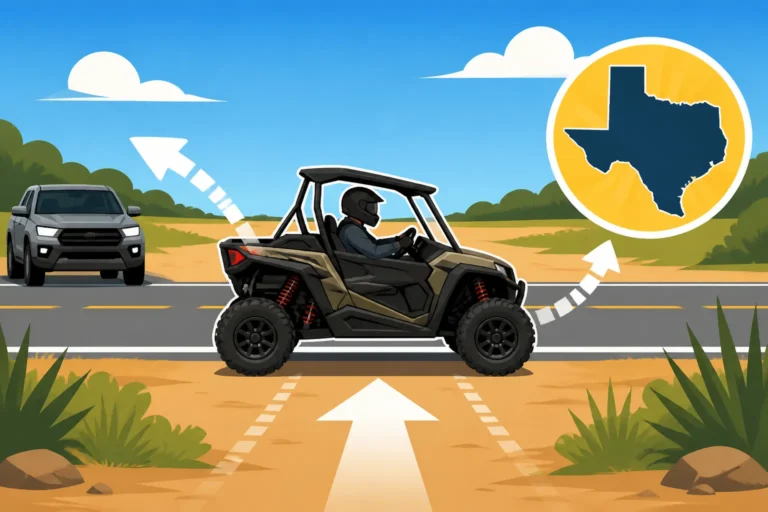
- Crossing Public Roads: Briefly crossing a public road at an intersection, but only when crossing at a right angle and making a full stop. [Crossing a Texas Road at an Intersection]
- Very Short Distances: In some limited scenarios, riding on a public road for a very short distance (usually no more than 2 miles) to access private property, but these are rare and highly specific.
Crucially, these state-level exceptions primarily apply to public roads. They do not automatically grant you permission to operate your OHV on the private roads within a master-planned community. Even if state law might allow a brief crossing of a public street that borders your MPC, that doesn't mean your HOA permits it on the internal community roads. The state doesn't typically delve into the specific vehicle regulations of private communities, deferring that authority to the community's own governance documents.
How City Ordinances Interact with Covenants
This is where the layers get particularly tricky. While state law generally restricts OHVs from public roads, Texas law does allow cities and counties to pass ordinances permitting certain low-speed vehicles, including UTVs (often called Side-by-Sides), on roads with a posted speed limit of 35 mph or less. So, a city like Galveston, for instance, might have an ordinance allowing UTVs on its slower public streets, particularly if they meet certain equipment requirements like headlights, taillights, and turn signals. [Texas Cities That Can and Cannot Allow] delves into this.
However, here's the critical distinction for MPC residents:
- City Ordinance Applies to Public Roads: A city ordinance that allows UTVs on streets posted 35 mph or less only applies to public roads within that city's jurisdiction. If your master-planned community has truly private roads (which most do), that city ordinance does not automatically override your HOA's covenants that might prohibit OHVs on those private roads. The HOA's rules will likely take precedence on its private property.
- Approved Plat and Community Roads: The concept of an "approved plat" is important. When an MPC is developed, a plat is filed with the city or county. This plat details the layout of the community, including roads. Some communities' plats might designate certain internal roads as "private" or "common elements" owned by the HOA, while others might dedicate some roads to the public, even if they are internal to the community. [What an Approved Plat Means for Street Riding] can be a complex read. If a road is truly public, then a city ordinance could apply. But many internal MPC roads are not public.
- The Most Restrictive Rule Wins: In general, when you have state law, city ordinances, and HOA covenants, the most restrictive rule is usually the one that applies. So, if the city says UTVs are okay on some public roads, but your HOA covenants say "no off-road vehicles on any community roads," the HOA's stricter rule typically governs within the private confines of the MPC.
This means you can't just assume that because a nearby city allows UTVs on some streets, you can drive yours within your master-planned community. You must consult your specific HOA documents and understand the designation of the roads within your neighborhood.
Navigating ATV/UTV Use in Your MPC
So, you're in a master-planned community and you own an ATV or UTV. What do you do? The key is proactive research and communication. Don't assume anything, and certainly don't just "try it and see what happens." That's a surefire way to invite fines or worse.
Checking Your HOA Documents
This is the absolute first and most crucial step. Before you even think about starting your engine or buying an OHV, you need to pore over your community's official documents. These typically include:
- Declarations of Covenants, Conditions, and Restrictions (CC&Rs): This is the master document. Look for sections related to "vehicles," "recreational vehicles," "motorized vehicles," "off-road vehicles," "nuisance," "storage," or "common areas."
- Bylaws: These outline how the HOA operates, but sometimes contain vehicle-related rules too.
- Rules and Regulations: The HOA board often establishes additional, more specific rules and regulations that clarify or expand upon the CC&Rs. These are sometimes easier to find and are more frequently updated.
- Architectural Guidelines: If there are rules about vehicle storage, they might be found here, particularly regarding visible storage.
When reviewing these documents, look for explicit prohibitions or permissions. Pay close attention to definitions. Does "off-road vehicle" specifically include ATVs and UTVs, or is it a broader term? Is there any mention of "golf cart" specific rules, which might indirectly shed light on other small vehicles? Take notes, highlight relevant sections, and don't be afraid to read them multiple times. If the language is ambiguous, that's a red flag that needs clarification.
If you don't have a physical copy of these documents, your HOA is legally required to provide them upon request. They are often available on the community's official website or through the property management company.
Seeking Clarification or Variance
After reviewing the documents, you might still have questions, or you might find an outright prohibition that you wish to challenge or get an exception for. This is where communication with your HOA comes in.
- Formal Inquiry: The best approach is to submit a formal, written inquiry to your HOA board or property management company. Clearly state your question: "Are ATVs/UTVs permitted for [specific use, e.g., transporting yard waste, accessing a private back lot, limited recreational use] on private community roads within [Your Community Name]?" Cite any specific sections of the CC&Rs or rules that you found ambiguous or relevant. This creates a paper trail and ensures you get an official response.
- Attending Board Meetings: Attending HOA board meetings can be invaluable. It allows you to hear discussions firsthand, ask questions (during designated resident comment periods), and gauge the board's sentiment on such issues. You might learn about past rulings or discussions related to OHVs. It also shows you are an engaged resident, which can help if you later need to seek a variance.
- Requesting a Variance (Exception): If the rules are prohibitive but you have a compelling, specific reason for OHV use (e.g., you have a large property backing onto a natural area and need a UTV for land maintenance, or you have mobility issues and a UTV is your primary way to access a remote part of your property within the community), you might be able to request a variance. This is essentially asking for a formal exception to a rule. You'll need to present a strong case, demonstrating why your situation is unique, how you will mitigate any negative impacts (noise, safety), and why granting the variance won't set a problematic precedent. Be prepared for this to be a difficult process, as HOAs are often reluctant to grant variances that could undermine the uniformity of their rules.
Remember, always get any permissions or variances in writing. A verbal agreement with a single board member may not hold up if the board changes or another resident complains.
Practical Considerations for MPC Residents
Living in a master-planned community with an ATV or UTV isn't just about reading rules; it's also about practical realities, safety, and maintaining good relationships with your neighbors and the HOA. Even if you find an avenue for limited use, there are other factors to consider.
Insurance and Liability
One critical aspect that's often overlooked is insurance. Even if your HOA or a city ordinance somehow allows for limited ATV or UTV use on community roads, your standard homeowner's insurance policy likely won't cover incidents involving your OHV, especially if it's being operated on a "road" (even a private community road).
- Dedicated OHV Insurance: You absolutely need a separate insurance policy specifically for your ATV or UTV. This policy should cover liability for property damage and bodily injury in case of an accident. It should also include coverage for theft, fire, and collision. Imagine hitting a neighbor's mailbox or, worse, injuring someone on a community path – without proper insurance, you could be facing substantial out-of-pocket expenses.
- HOA Liability: Understand that if your HOA permits any OHV use, they likely have significant liability concerns. This is why their rules are often so strict. If an accident occurs, questions about their responsibility for allowing the vehicle, or for the condition of their private roads, could arise.
- Personal Responsibility: Even with insurance, you are personally liable for your actions. Operating an OHV, especially where it's generally restricted, carries inherent risks. Always prioritize safety, especially in areas with pedestrians, children, or other vehicles.
Many residents forget that [Texas ATV Insurance Requirement] is typically waived for off-road use on private property. However, once you venture onto community roads, even if private, the dynamics shift, and liability becomes a very real concern. It's always best to be over-insured rather than under-insured.
Modifications and Equipment
If you've managed to secure permission for limited ATV or UTV use within your MPC, or if you're exploring modifications for allowed uses (like utility work), consider how those changes might still fall under covenant scrutiny.
Some residents enjoy customizing their machines for enhanced performance or appearance. Companies like SuperATV offer a vast range of aftermarket parts, from lift kits and larger tires to custom lighting and enclosures. While these modifications can improve a vehicle's utility or look, they might conflict with community standards. For example:
- Noise Levels: A custom exhaust, while legal off-road, might violate an HOA's noise ordinances if operated on community paths.
- Aesthetics: A highly modified, lifted UTV with aggressive tires might be deemed an "eyesore" or not in keeping with the community's aesthetic standards, even if it's legally operated.
- Safety Features: If an MPC does allow UTVs, they might require specific safety equipment beyond what's typically needed for off-road use, such as turn signals, mirrors, or even specific types of tires (less aggressive than typical off-road knobbies) to minimize road damage. You might need to equip your UTV with these features to comply.
Before making any significant modifications to your ATV or UTV, especially if you plan to use it within your MPC, check if these changes could trigger new covenant violations. It’s not uncommon for an HOA to have rules about the "appearance" of vehicles, even if they aren't explicitly about off-road machines.
Community Harmony and Responsible Riding
Ultimately, living in an MPC is about shared space and mutual respect. Even if you have the "right" to ride your ATV or UTV based on a variance or specific covenant clause, consider the impact on your neighbors.
- Noise: OHVs can be loud. Be mindful of operating hours, especially early mornings or late evenings. Avoid revving engines unnecessarily.
- Dust and Emissions: Riding on unpaved community paths can kick up dust. Be aware of wind direction and proximity to homes.
- Speed and Safety: Adhere strictly to any posted speed limits within the community, and drive defensively. Remember that children and pets might be present, and they won't always be watching for vehicles. Even if the state rules for [Helmet Rules for Texas Riders] for OHVs don't apply to your private community road, wearing one is always a good idea for personal safety and sets a responsible example.
- Maintain Your Vehicle: A well-maintained, clean OHV is less likely to draw negative attention than a loud, dirty, or visibly damaged one.
Table: Comparison of ATV/UTV Rules in Texas
| Rule Aspect | Texas State Law (Public Roads) | City Ordinances (Public Roads, if applicable) | HOA Covenants (Private MPC Roads) |
|---|---|---|---|
| General Operation | Generally prohibited on public roads/highways. | May permit UTVs on roads 35 mph or less, with specific equipment. | Often prohibits all ATVs/UTVs. Some may allow specific golf cart use. |
| Exceptions | Ag use, utility, emergency, brief crossings (specific conditions). | Varies by city; usually specific vehicle types (UTVs, not ATVs) and areas. | Very rare; may allow utility/maintenance with explicit, narrow permits. |
| Storage | No state law on private property. | City ordinances might exist for junk vehicles; generally not recreational. | Often prohibits visible storage in driveways/yards; requires enclosed. |
| Equipment | Spark arresters for public land; no specific road equipment required (as not street legal). | May require lights, signals, mirrors, horn, seatbelts for street use. | May have specific requirements if any use is permitted. |
| Enforcement | State Highway Patrol, local law enforcement. | City Police, local law enforcement. | HOA Board, property management; fines, privilege suspension, legal action. |
| Precedence | Baseline. Most restrictive rule (city/HOA) usually applies. | Can override state law on specific public roads if passed. | Most restrictive for private community roads, even if city allows. |
Being a good neighbor and a responsible OHV owner will go a long way in ensuring that even if you can navigate the rules, you don't create unnecessary friction within your community. This harmony is a core promise of master-planned community living, and your actions contribute to it.
Disclaimer
This article is for general informational purposes only and does not constitute professional advice. Laws, prices and regulations vary by location and change over time. Consult a qualified professional for guidance on your specific situation.