Booking a Hands-On RiderCourse
Booking a hands-on ATV RiderCourse in Texas can be confusing if you are unsure which part to complete first or whether training changes the rules for riding public land. The key is to finish the ATV Safety Institute’s online e-Course, then enroll in the corresponding hands-on s-Course. Here’s how to approach registration and what to check before you ride.
How to book the hands-on course
The hands-on class is the practical portion of the ATV Safety Institute’s RiderCourse. It is not the first step: according to the Texas Department of Licensing and Regulation, you must complete the ASI online e-Course before registering for the corresponding hands-on s-Course through ASI’s official enrollment system.
Use this order:
- Complete the online e-Course. Follow the ASI course instructions and finish the required online portion before trying to book the practical session.
- Open ASI’s official enrollment system. Use it to look for an s-Course that corresponds to the e-Course you completed.
- Check the session details. Confirm the course location, date, enrollment requirements, and any instructions from the provider. Session availability and practical arrangements can differ, so rely on the details shown for the specific course.
- Register for the hands-on s-Course. Make sure the enrollment is for the hands-on portion, not just another online course.
- Follow the provider’s preparation instructions. Confirm what you need to bring and whether the provider gives directions about equipment or the machine used during training. Do not assume these details are identical at every location.
- Keep proof of completion. After you finish, retain the certificate or other completion record and check that it identifies the training you completed.
If you are unsure whether a session is the right course or whether your online completion has been recorded, resolve that before traveling. Check the enrollment system and contact the course provider if its instructions do not answer your question.
| Booking point | What to do | Why it matters |
|---|---|---|
| Online prerequisite | Complete the ASI e-Course first | The hands-on s-Course is the corresponding practical course |
| Enrollment | Use ASI’s official enrollment system | This is the stated route for registering for the hands-on portion |
| Session details | Confirm the location and provider instructions | Practical arrangements may vary |
| Completion record | Keep your certificate or completion proof | You may need to show valid safety certification while riding public land |
For more on what the certificate is meant to establish, see The Texas ATV Safety Certificate Explained. To look into local options, use Texas ATV RiderCourse Locations and Finding a School Near You. Treat any directory or listing as a starting point and confirm the session details through the official enrollment system or with the provider.
What the course means for public-land riding
Completing the hands-on course can provide a safety certificate recognized for riding in Texas, but the certificate is only one part of the rules. The Texas Parks and Wildlife Department recognizes certificates showing successful completion of the ATV Safety Institute’s ATV RiderCourse, including hands-on training, as well as equivalent safety training certificates issued under the authority of Texas or another state. Texas Parks and Wildlife Department guidance also says an operator on public lands must hold a safety training certificate issued by the Texas Department of Public Safety or an equivalent certificate issued under another state’s authority.
The course does not remove the separate age and supervision requirements. According to the Texas Legislature, a person under 14 operating an ATV on public land must be accompanied by and under the direct supervision of a parent, guardian, or authorized adult. A certificate does not replace that supervision rule. According to the Texas Legislature, an operator aged 14 or older may ride without adult supervision only if they hold a safety certificate or are under the direct supervision of a certificate holder.
That makes the course especially useful for riders who need a certificate to ride without a supervising certificate holder. It is not permission to ride anywhere, and it does not make a rider exempt from safety, equipment, land-access, or vehicle rules. If the rider is younger than 14, review Texas Rules for Riders Under 14 before making plans.
When riding on public land in Texas, the certificate must be carried and shown upon request, according to the Texas Parks and Wildlife Department. Keep it accessible during the ride rather than assuming that a photo, an enrollment confirmation, or proof of having started the online course will count as the completed certificate. The rules call for a valid safety certification.
A completed course also does not replace the OHV decal when one is required. According to the Texas Parks and Wildlife Department, riders must display a valid Texas OHV decal when operating in Texas state parks, and the decal program is administered by that department. The department says a Texas OHV decal is not required when an ATV or UTV is operated exclusively on private property. For the broader distinction between training and the decal, see The Texas OHV Decal Explained and Where a Texas OHV Decal Is Required.
Visitors from another state should not assume that a home-state decal substitutes for a Texas decal. According to the Texas Parks and Wildlife Department, Texas has no reciprocity agreement for out-of-state OHV registrations or decals, so non-residents riding on public lands or grant-funded venues must purchase a Texas OHV decal. Training-certificate recognition is a separate issue from decal reciprocity; check both requirements for the land where you plan to ride.
Before enrolling, confirm the course fits your situation
The hands-on course named in the enrollment process is the ASI ATV RiderCourse. If you are enrolling for a particular rider, vehicle, or riding purpose, make sure the course information matches what you need. For example, if the machine is a UTV rather than an ATV, do not assume an ATV course or certificate automatically answers every question about the rider’s requirements. Check with the course provider and the Texas Parks and Wildlife Department if the certificate’s applicability is unclear.
This is also a good time to check the rider’s age and supervision arrangements. The certificate may change whether an operator aged 14 or older needs an adult supervisor, but it does not override the supervision rule for a rider under 14. Plan the ride around the rider’s actual situation rather than treating course enrollment as a general authorization.
Before booking, confirm:
- The online e-Course is the required prerequisite for the hands-on session you plan to take.
- The enrollment is for the corresponding s-Course, rather than an online-only class.
- The course and certificate are appropriate for the rider and the type of riding planned.
- You understand the provider’s instructions for attending and completing the practical session.
- You know how you will retain and carry proof of the completed certificate.
The provider’s listing is the best place to check its own course arrangements. For questions about whether a certificate is recognized for Texas public-land riding, consult the Texas Parks and Wildlife Department’s requirements rather than relying only on informal advice or an old course listing. The Hands-On RiderCourse Texas Requires and What the RiderCourse Covers can help clarify what the practical portion is intended to address.
Keep the certificate, decal, and riding rules separate
It is easy to treat every requirement as one permit. In practice, the training certificate, OHV decal, and rules for operating the vehicle address different things. The certificate concerns rider safety training; the decal is an OHV requirement for applicable public riding areas; and equipment and conduct rules still apply during the ride.
For example, according to the Texas Parks and Wildlife Department, ATV operators and passengers on public lands must wear a helmet that meets United States Department of Transportation standards. The department also requires seat belts to be worn in UTVs on public lands when the vehicle is equipped with them. According to the Texas Legislature, OHVs operating on public property or public lands must have a United States Forest Service-qualified spark arrester that has not been removed or modified.
Night and low-visibility operation has separate equipment requirements too. According to the Texas Parks and Wildlife Department, an ATV or UTV on public property must display a lighted headlight and taillight from one-half hour after sunset to one-half hour before sunrise, and whenever visibility is reduced. The department also says OHVs must display a valid Texas OHV decal when operated in state parks. A RiderCourse certificate does not substitute for these requirements.
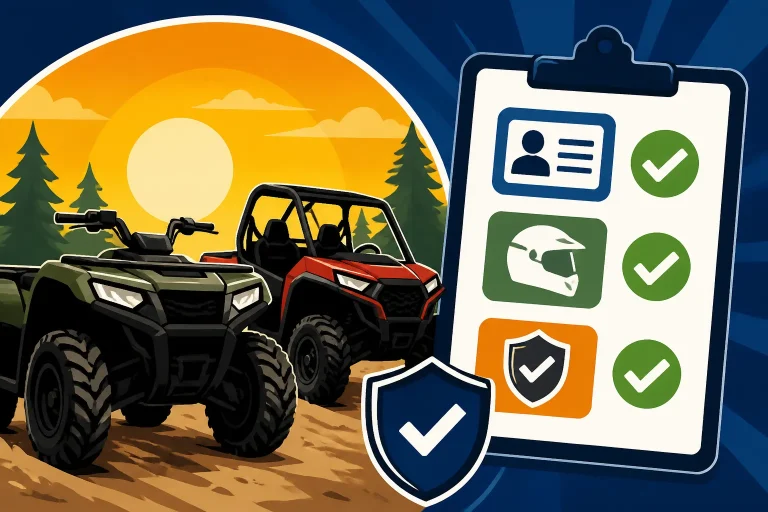
Before the first ride after training, use a simple checklist:
- Carry the completed safety certificate and be ready to show it if requested.
- Check whether the riding area requires a Texas OHV decal and display it as directed.
- Confirm that the vehicle meets applicable equipment requirements.
- Follow the age and supervision rules for the operator.
- Check the specific property’s access conditions and riding restrictions.
If you are uncertain about a public trail’s requirements, verify them with the land manager before setting out. Requirements can depend on where you ride, and completing a course does not establish that a trail is open or that a machine is permitted there. For practical certificate-carrying details, see Carrying the Certificate on a Texas Ride; for the broader public-land rules, see Texas Rules for Riding Public Land.
Frequently Asked Questions
Do I book the hands-on course before the online course?
No. According to the Texas Department of Licensing and Regulation, complete the ASI e-Course first, then register for the corresponding hands-on s-Course through ASI’s official enrollment system.
Does course completion let a rider under 14 ride without an adult?
No. According to the Texas Legislature, anyone under 14 operating an ATV on public land must be accompanied by and under the direct supervision of a parent, guardian, or authorized adult.
Does the safety certificate replace the Texas OHV decal?
No. The certificate and decal serve different purposes. According to the Texas Parks and Wildlife Department, a valid Texas OHV decal is required for operation in state parks, while the department does not require the decal for ATVs and UTVs operated exclusively on private property.
Can an out-of-state decal be used instead of a Texas decal?
No. According to the Texas Parks and Wildlife Department, Texas has no reciprocity agreement for out-of-state OHV registrations or decals. Non-residents riding on public lands or grant-funded venues must purchase a Texas OHV decal.
Sources
- Texas Legislature — Transportation Code Title 7, Chapter 663. Certain Off-Highway Vehicles (checked November 2, 2026)
Disclaimer
This article is for general informational purposes only and does not constitute professional advice. Laws, prices and regulations vary by location and change over time. Consult a qualified professional for guidance on your specific situation.