Bringing a New Mexico Safety Certificate to Texas
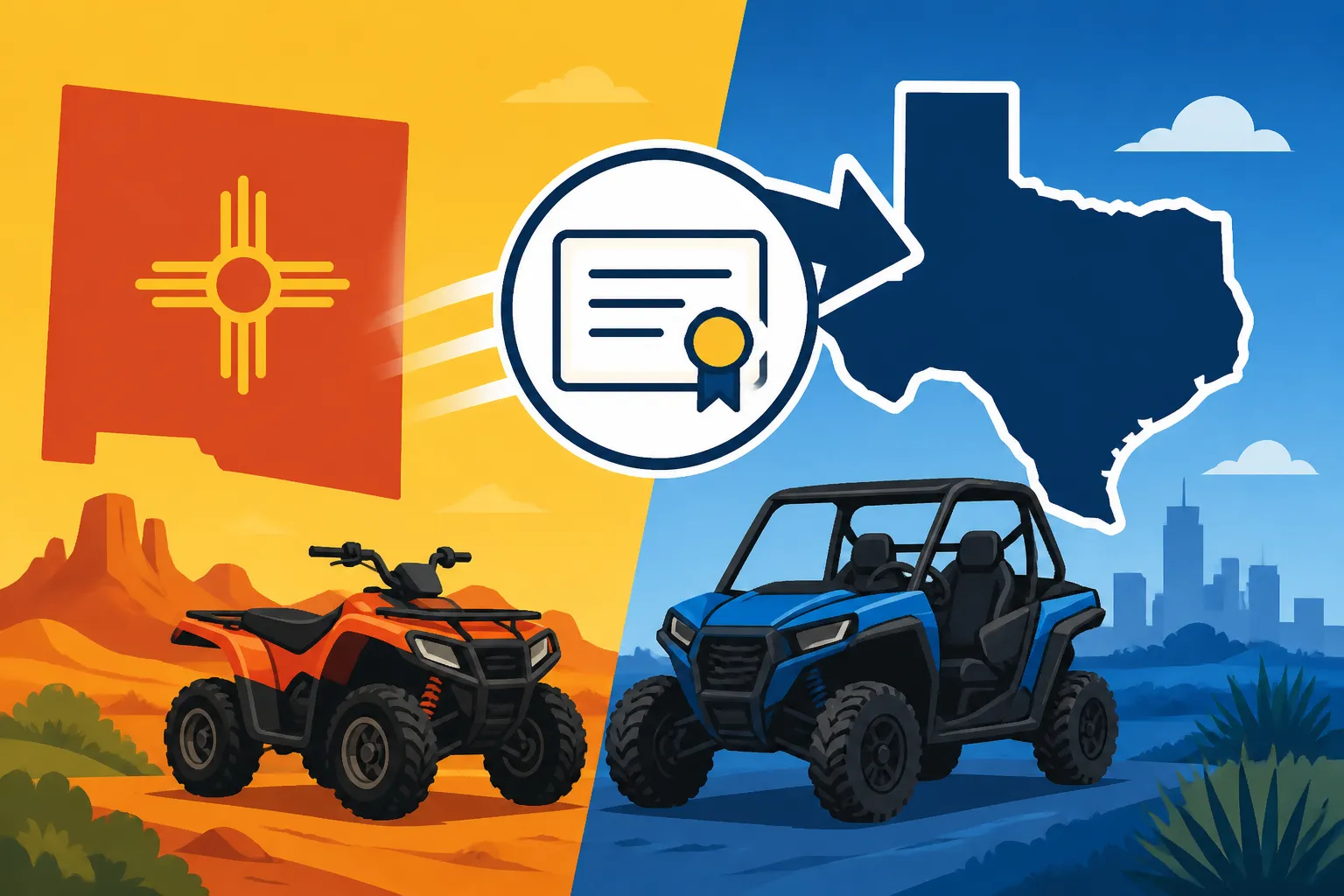
A New Mexico ATV safety certificate may be accepted for riding in Texas, but an out-of-state certificate and an out-of-state OHV decal are not treated the same way. The key is whether your training certificate meets Texas’s requirements and whether you have the separate Texas decal required for the place you plan to ride.
Does Texas accept a New Mexico ATV safety certificate?
Texas recognizes qualifying safety training certificates issued under the authority of another state. That means a New Mexico certificate can meet Texas’s ATV safety-training requirement if it documents training equivalent to the course Texas accepts. Having a card from another state does not, by itself, guarantee that it qualifies.
The Texas Parks and Wildlife Department recognizes certificates showing successful completion of the ATV Safety Institute’s ATV RiderCourse, including hands-on training, or equivalent safety training certificates issued under the authority of Texas or another state. The important questions are what training the certificate represents, whether it shows successful completion, and whether it was issued under the authority of a state.
This is different from simply having a registration card, vehicle title, online information sheet, or proof that you have ridden before. Those documents do not establish that you completed qualifying safety training. If your New Mexico paperwork is unclear about the course or issuer, check with the Texas Parks and Wildlife Department or the public land manager before traveling.
For a closer look at the general requirement, see Texas OHV Safety Certificates. The state-to-state question is covered in Certificates Issued by Another State and Does Texas Accept an Out-of-State Safety Certificate?.
Check what the certificate actually says
Before you leave, review the certificate rather than relying on memory or a course confirmation email. Look for clear information identifying you, the training completed, and the organization or state authority that issued the certificate. Keep any supporting course-completion record with it if the card itself does not make the training clear.
If you took the ATV RiderCourse, confirm that your certificate reflects successful completion of the course, including the hands-on training component. If you completed a different course in New Mexico, do not assume that any safety class is automatically equivalent. Ask the Texas Parks and Wildlife Department or the riding area whether the document meets Texas’s standard.
A practical check is to contact the office before your trip and describe the certificate accurately. You can ask whether the named course and issuer meet the requirement for your planned riding area. If the land is managed by a federal agency, a park, or another public land manager, confirm any site-specific rules with that manager too. A certificate accepted for Texas’s state requirement does not necessarily replace other rules a riding area may impose.
Who needs the certificate?
Texas’s age and supervision rules matter, especially when a family is traveling with a young rider. According to the Texas Legislature, anyone under 14 operating an ATV on public land must be accompanied by and under the direct supervision of a parent, guardian, or authorized adult. According to the Texas Legislature, an operator aged 14 or older may ride without adult supervision if the operator holds a safety certificate or is under the direct supervision of a certificate holder.
The certificate is not a substitute for supervision when a rider is under the age specified in the rule. Nor does being supervised make a rider of any age exempt from every other requirement at the riding area. Check the rules for the specific trail system, including any age, vehicle, or passenger restrictions.
The requirements discussed here concern ATV safety certification. Do not assume that an ATV certificate answers every training or access question for a UTV. Ask the land manager which requirements apply to the machine and rider you are bringing.
The certificate is not a Texas OHV decal
A New Mexico safety certificate and a Texas OHV decal serve different purposes. The certificate shows that a rider completed qualifying training. The decal is an access requirement for covered riding on Texas public lands and grant-funded venues. Carrying one does not replace the other.
Texas does not offer reciprocity for out-of-state OHV decals or registrations. So even if your New Mexico machine displays a decal or registration, that does not take the place of the Texas OHV decal where Texas requires one. This is the main distinction to keep straight: Texas may recognize qualifying safety training from another state, while an out-of-state OHV decal is not a substitute for the Texas decal.
The Texas Parks and Wildlife Department administers the Texas OHV decal program. The department says nonresidents operating ATVs on public lands or grant-funded venues in Texas must purchase a Texas OHV decal. Texas state parks also require riders to display a valid Texas OHV decal when operating an OHV. For more on where the sticker fits into a trip, see The Texas OHV Decal Explained.
Texas’s OHV decal fee is $16.00 per fiscal year, according to the Texas Parks and Wildlife Department as of November 2026. Check the department for current details before buying. If you have purchased the decal but it has not arrived, the Texas Parks and Wildlife Department says proof of purchase or a receipt must be readily available. The department also says riders must carry their valid safety certification and show it upon request.
| What you have | What it proves or does | Is it a substitute for the other item? |
|---|---|---|
| Qualifying New Mexico safety certificate | Shows completion of accepted ATV safety training | No. It does not replace a Texas OHV decal |
| New Mexico OHV decal or registration | May satisfy requirements in the state that issued it | No. Texas does not accept it in place of its OHV decal |
| Texas OHV decal | Meets the Texas decal requirement where it applies | No. It does not prove that you completed safety training |
| Receipt for a purchased Texas decal | Serves as proof of purchase if the decal has not arrived | No. You still need to carry qualifying safety certification |
The decal requirement does not apply to ATVs and recreational off-highway vehicles operated exclusively on private property, according to the Texas Parks and Wildlife Department. But a machine that is normally used on private land may still need a decal when taken to a public riding area or grant-funded venue. Confirm the status of the specific location instead of assuming that a ranch, lease, or privately owned park follows the same rules as a public trail system.
What to carry and check before riding in Texas
Treat the certificate, decal, and riding-area rules as separate checks. Before leaving, make sure your certificate clearly documents qualifying training, arrange the Texas decal if your destination requires it, and review the land manager’s rules for the machine and rider.
A straightforward pre-trip process helps avoid confusion at the trailhead:
- Confirm that your destination is covered by the Texas decal requirement. Check with the park or land manager, especially if the area is privately operated or receives public OHV grant funding.
- Check that your certificate documents qualifying training. If the course or issuing authority is not clear, ask the Texas Parks and Wildlife Department or the riding area whether it will be accepted.
- Get the Texas OHV decal if required. Do not rely on a New Mexico decal or registration to satisfy Texas’s requirement.
- Carry both forms of proof. Keep the safety certificate with you, and have the Texas decal displayed or its purchase receipt readily available if the decal has not arrived.
- Review the riding rules for the location. A valid certificate and decal do not grant permission to ride anywhere or override equipment, supervision, or trail restrictions.
There are other requirements to consider once you reach public land. For example, the Texas Parks and Wildlife Department requires operators and passengers on ATVs on public lands to wear safety helmets that comply with United States Department of Transportation standards. According to the Texas Parks and Wildlife Department, UTV occupants must wear seat belts when the UTV is equipped with them.
Lighting and equipment rules can also affect the trip. According to the Texas Parks and Wildlife Department, an ATV or UTV operated on public property must display a lighted headlight and taillight from one-half hour after sunset to one-half hour before sunrise, and whenever visibility is reduced. The Texas Legislature requires OHVs on public property or public lands to have a qualified United States Forest Service spark arrester that has not been removed or modified. Check the complete requirements for your destination in Texas Rules for Riding Public Land.
Remember that a Texas OHV decal is not a road registration. Texas residents are required to title their off-highway vehicles, including ATVs and UTVs, but those vehicles are not eligible for standard motor vehicle registration, according to the Texas Department of Motor Vehicles. A title, registration document from another state, or safety certificate should not be treated as permission to ride on public roads. For help separating access rules from road-use rules, see Does a Texas ATV Need Registration? and Are ATVs Street Legal in Texas?.
If the certificate is for a child or a group ride, check supervision and passenger rules before loading the machines. According to the Texas Legislature, a person operating an ATV on public property may not carry a passenger unless the manufacturer designed the ATV to transport one. The Texas Legislature also restricts children riding ATVs on public land and in state parks according to age and vehicle engine size. Requirements can depend on the rider and machine, so confirm the details for the specific trip.
A useful final check is to call the site you plan to visit and ask two separate questions: whether your New Mexico certificate is accepted as equivalent training, and what proof of a Texas decal the site requires. Keeping those questions separate makes it less likely that an accepted training card will be mistaken for an access decal, or that a decal will be mistaken for proof of training.
Sources
- Texas Legislature — Transportation Code Title 7, Chapter 663. Certain Off-Highway Vehicles (checked November 2, 2026)
- Texas Parks & Wildlife Department — OHV FAQ — Texas Parks & Wildlife Department (checked November 2, 2026)
Disclaimer
This article is for general informational purposes only and does not constitute professional advice. Laws, prices and regulations vary by location and change over time. Consult a qualified professional for guidance on your specific situation.