Texas Supervision Rules for Young Riders
Texas’s supervision rule can be easy to misunderstand: being a parent, riding in the same park, or holding a safety certificate does not automatically satisfy every requirement. The key questions are the young rider’s age, whether the riding area is public land, and whether a qualified adult can supervise directly. Here’s how to plan a ride without confusing supervision with other rules.
The Texas rule for riders under 14
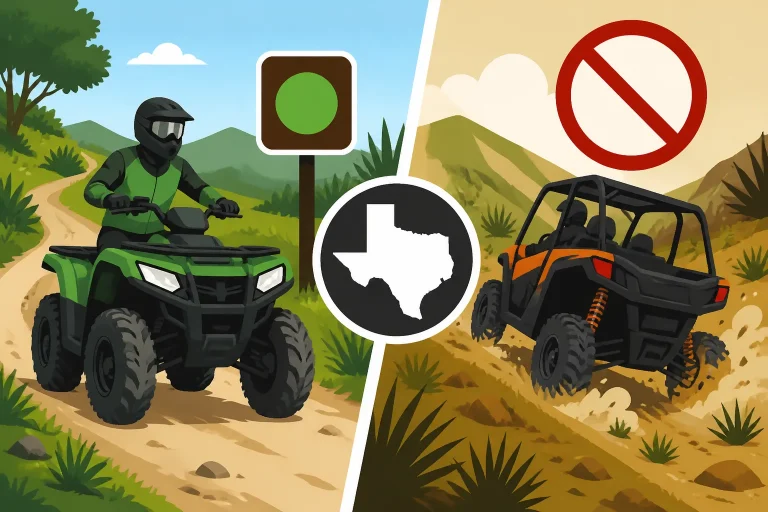
On public land where Texas OHV safety-certificate rules apply, a rider younger than 14 must be accompanied by an adult who is at least 18 and holds an approved OHV safety certificate. The young rider cannot take the place of that certificate by having a parent’s permission or by completing some other safety activity.
The certificate is a qualification for the supervising adult; it does not turn the adult into a substitute driver or make a particular machine suitable for a child. The adult needs to be present and able to supervise the child’s riding, not simply available by phone or somewhere else on the property. For an overview of the certificate requirement, see Texas OHV Safety Certificates and Direct Supervision by a Texas Certificate Holder.
The under-14 rule is not the same as a blanket statement that children may ride any machine, on any land, so long as an adult is nearby. It is a condition for riding in places covered by the state’s public-land safety requirements. A park, forest, or other land manager may have additional rules about ages, vehicle types, routes, equipment, and supervision. The supervising adult should check those rules before unloading.
| Situation | What to plan for |
|---|---|
| Rider younger than 14 on covered public land | An accompanying adult must be at least 18 and hold an OHV safety certificate |
| Rider 14 or older on covered public land | Check whether the rider needs their own certificate and follow the land manager’s requirements |
| Riding on private property | The public-land certificate rule may not apply, but the owner’s rules and safe adult oversight still matter |
| Riding at a managed park or trail system | Check the site’s age, vehicle, helmet, and supervision rules; they may add requirements |
| Borrowed or rented machine | Confirm who is allowed to operate it and whether the park or rental provider sets age restrictions |
Texas does not issue an OHV safety certificate to children younger than 14. The supervision requirement is the alternative for this age group, not a temporary certificate a child can earn. See Why Texas Will Not Certify Below Fourteen and Texas Minimum Age for a Safety Certificate for related details.
The rule also does not set a universal minimum age at which every child can operate every kind of ATV or UTV. A child’s age, size, experience, and ability to control the machine matter, and a land manager or vehicle owner may set more restrictive limits. Before choosing a machine, check the guidance in What Texas Requires of Riders Under 14 and the rules for the place where you plan to ride.
What direct supervision should look like
The practical standard is active oversight. The adult should be close enough to keep the child in view, follow what is happening, and respond quickly if the rider loses control, approaches a hazard, or leaves the permitted route. Being in the same general riding area is not a dependable supervision plan if terrain, trees, distance, or other riders block the adult’s view.
Plan the ride so the adult can actually do this. On a single-seat quad, for example, the child cannot carry the supervising adult as a passenger. The adult may need to use a separate machine or supervise from an appropriate nearby location, depending on the site’s rules. If the child is riding a UTV with a passenger seat, do not assume that putting an adult in the passenger seat solves every problem: the adult still needs to meet the certificate requirement, and the vehicle must have a seat intended for that passenger.
A sensible supervision setup usually includes these steps:
- Choose the supervising adult before the trip. Confirm that the person is at least 18 and has the required safety certificate. Do not assume another adult in the group has one.
- Keep the certificate available. Carry the card or other accepted proof in the manner required by the land manager. If the park asks to see it, the supervising adult should be able to produce it.
- Agree on boundaries and signals. Explain which trail or area the child may use, where to stop, and how to get the adult’s attention.
- Ride at a pace that allows oversight. Do not send the child ahead where the adult cannot see them or follow so far behind that help would be delayed.
- Reassess when conditions change. Dust, crowds, rain, low light, steep terrain, or a mechanical problem can make it harder to keep a child in view or respond quickly.
A certified adult who stays at camp while the child rides elsewhere is not providing direct supervision. Nor is a group ride automatically supervised simply because several adults are present. Agree on one responsible certificate holder, and make sure that person can maintain effective oversight throughout the ride.
The rule is about supervision, not just paperwork. A certificate does not guarantee that an adult knows the child’s skill level or that the selected trail is appropriate. An adult who is managing another rider, navigating unfamiliar terrain, or dealing with a machine problem may not be able to supervise a child at the same time. When that happens, pause the child’s ride until the adult can focus again.
For practical examples of staying alongside a young rider, see Riding Alongside Your Child Under Direct Supervision. If the adult is not the child’s parent or guardian, use Letting Another Adult Supervise Your Child’s Ride to think through who is responsible and what to agree on beforehand.
Where the rule applies and what it does not replace
The supervision requirement is tied to public-land OHV safety rules. That makes the location important. A ride at a public trail system may involve state certificate requirements as well as rules set by the agency or operator. A ride on private property may be treated differently under the state certificate requirement, but that does not mean every private ride is unrestricted.
On private land, get the landowner’s permission and follow any conditions they set. A private park or commercial riding area may also have its own operating rules. If you are unsure whether a property is public land or what rules apply there, ask the land manager before the ride rather than relying on a map label or an assumption about who owns the land.
Supervision also does not replace other requirements. Depending on the property and activity, the group may need to address:
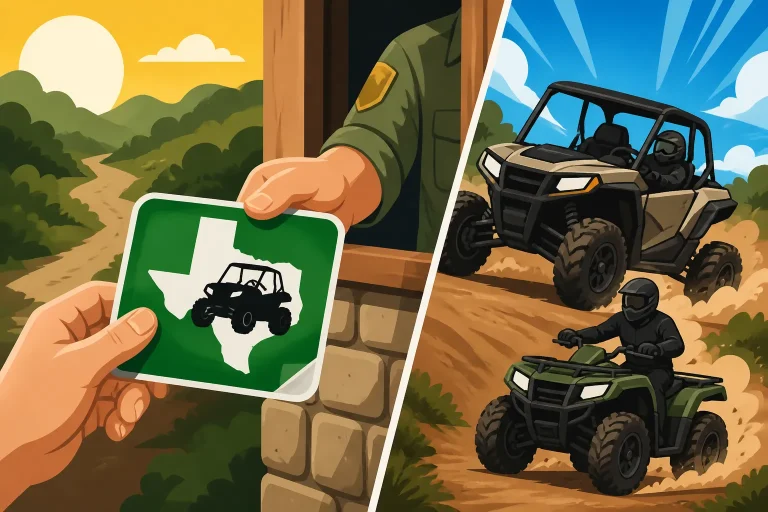
- A Texas OHV decal or other land-use requirement. A safety certificate is not a riding decal, and a decal does not prove that an adult holds a safety certificate. Check The Texas OHV Decal Requirement Explained and the specific site’s entry instructions.
- A park’s admission or day-use rules. A state OHV decal does not necessarily cover every fee or permit required by a particular riding area.
- Vehicle and passenger rules. A machine must be designed for the number of people riding on it. Do not carry a child on a single-seat ATV or improvise a passenger seat.
- Protective equipment and operating rules. Follow applicable helmet, clothing, lighting, route, and speed requirements. A parent’s decision to supervise does not waive them.
- Age limits set by the site or rental provider. A location may restrict which machines a child can ride, even when a qualified adult is supervising.
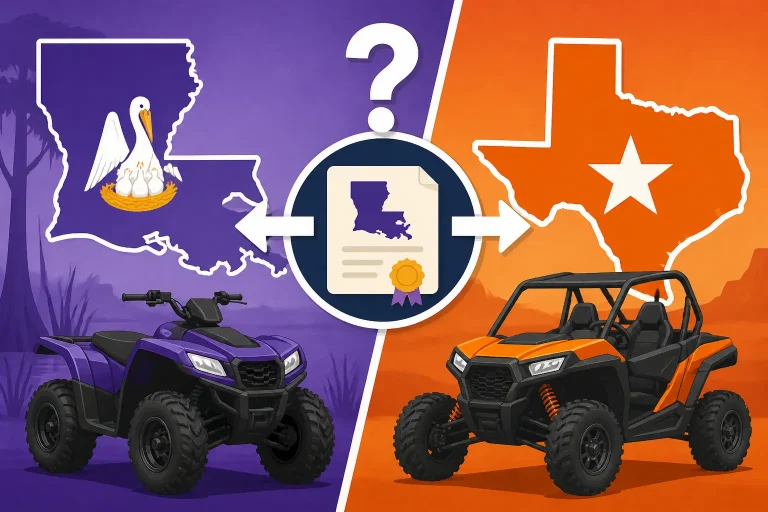
The same distinction matters if the supervising adult has a certificate from another state. Texas may recognize qualifying out-of-state certificates, but do not assume that any card, online course, or unrelated training meets the requirement. Confirm that the certificate is accepted for the ride and that the land manager recognizes it. Certificates Issued by Another State covers that question.
If your child is 14 or older, do not assume the under-14 supervision rule is the only rule worth checking. The rider may need to meet the applicable certificate requirement personally, and a park can have separate rules for minors. Start with Texas Rules for Riders Under 14 for the age distinctions, then confirm the current requirements with the land manager.
A pre-ride plan that works for families
The easiest way to avoid a problem at the trailhead is to settle the details before the trip. Start with the exact riding location, not just the general region. Find out whether the land is public or private, which authority manages it, and whether the route is open to the type of machine your child will ride. Then ask what proof of certification, decal, permission, or admission the group needs.
Next, choose the rider’s machine based on control and fit rather than age alone. A young rider should be able to reach and operate the controls, understand how to stop, and manage the machine’s weight and power. If the child cannot operate it calmly in a safe practice area, a more difficult trail is not the place to find out whether they can handle it.
Before leaving, make a simple supervision plan:
- Name the adult who will supervise and confirm the adult meets the age and certificate requirements.
- Decide whether the adult will ride alongside the child or supervise from another permitted position.
- Choose a route where the adult can maintain sight of the rider and respond without being separated by terrain or traffic.
- Set a clear stopping point and a rule for what the child should do if the group becomes separated.
- Check the park’s requirements for minors, passengers, helmets, and permitted machines.
- Carry the certificate and any other required documentation, and make sure everyone knows where it is.
Gear should fit properly and be appropriate for the machine and conditions. If shopping through Amazon or another marketplace, check sizing, safety markings, and return terms carefully; a product listing alone does not establish that gear is suitable for a particular ride. The park or land manager may specify equipment requirements, so use those rules as the baseline.
During the ride, keep the child within an area where the supervising adult can monitor them continuously. Stop if the adult loses sight of the rider, if visibility deteriorates, or if the child is tired or overwhelmed. A short break or an easier route is a better choice than trying to keep up with a group moving at a pace the child cannot safely manage.
A pre-ride check is useful even on familiar property. Confirm that the child understands how to stop, where the boundaries are, and what to do if something goes wrong. The adult should also know the route and have a way to contact park staff or emergency services if needed. Supervision is most effective when it is planned, visible, and adjusted to the rider’s ability.
The main takeaway is straightforward: on public land covered by Texas OHV safety rules, a rider younger than 14 needs an accompanying adult who is at least 18 and holds the required safety certificate. The adult must be able to supervise in practice, not just meet the paperwork requirement. Confirm the land manager’s rules as well, because certificate supervision does not replace age limits, equipment rules, decals, or safe machine selection.
Disclaimer
This article is for general informational purposes only and does not constitute professional advice. Laws, prices and regulations vary by location and change over time. Consult a qualified professional for guidance on your specific situation.