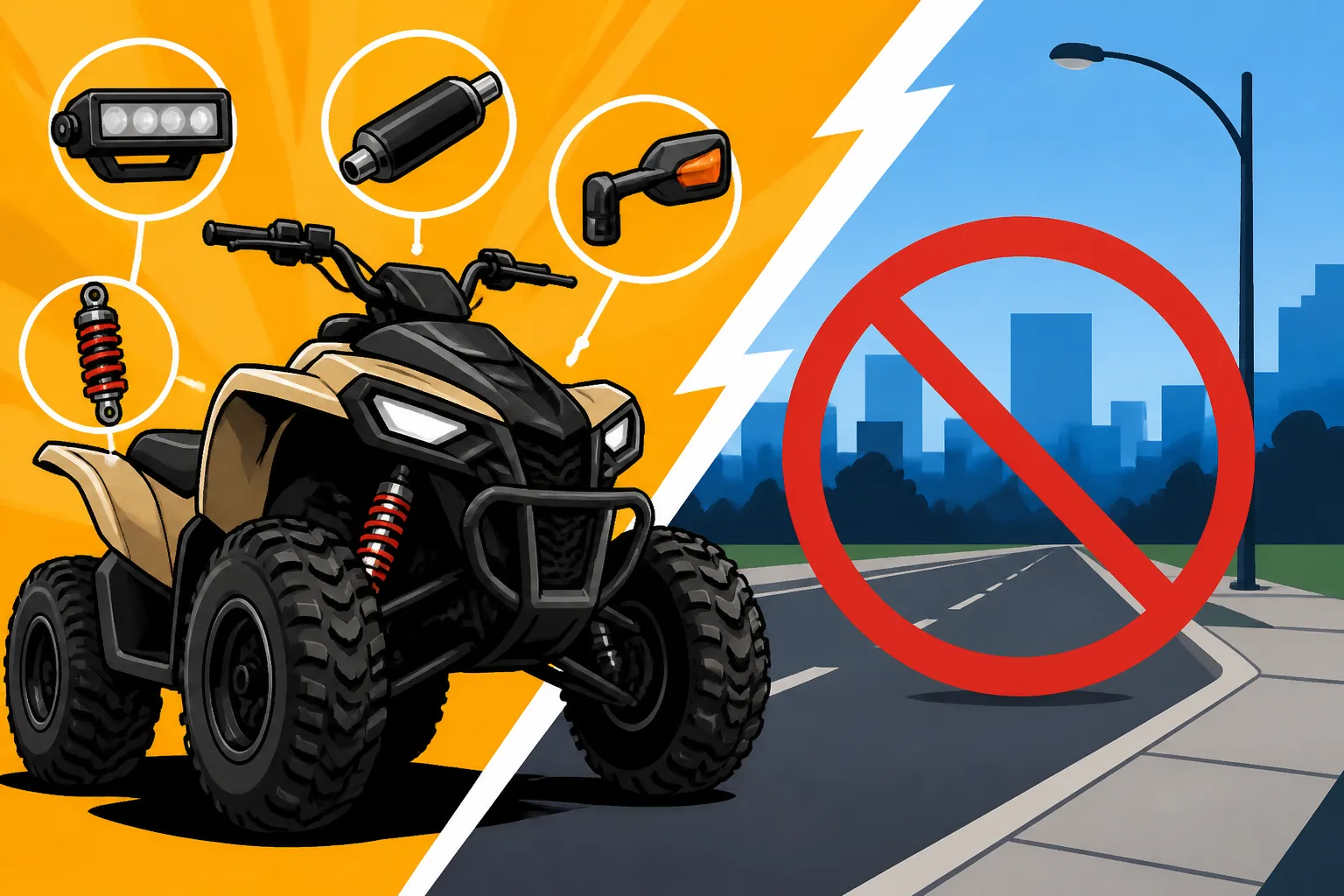
Why Modifying an ATV Will Not Make It Street Legal
One of the biggest frustrations for many ATV and UTV owners in Texas is the burning desire to make their beloved off-road machines street legal. You've probably seen folks in other states cruising down country roads in their side-by-sides, and it's easy to wonder why that can't be you. This guide is here to help you understand the core reasons why simply adding lights and turn signals won't cut it in the Lone Star State, and what the law actually allows.
The Fundamental "Off-Highway Use Only" Designation in Texas
It's tempting to think that if you just slap on a few key pieces of equipment, your ATV or UTV will magically transform into a street-legal vehicle. Many states have specific provisions for "street legal" conversions, leading to a lot of confusion for Texans. However, Texas has a very clear, and some might say rigid, definition and classification system for off-highway vehicles that makes this dream nearly impossible for most traditional ATVs and UTVs. It's not about what you add to the machine; it's about what the machine is in the eyes of Texas law.
What the Law Says About OHVs
In Texas, an Off-Highway Vehicle (OHV) is explicitly defined by law as a motor vehicle that is not designed or manufactured for use on a public highway. This is a critical distinction that forms the bedrock of why modifications don't lead to street legality. The Texas Transportation Code, specifically Chapter 663, outlines this definition. It covers vehicles like all-terrain vehicles (ATVs), recreational off-highway vehicles (ROVs or UTVs), sand rails, and even dirt bikes, provided they meet certain criteria like being primarily designed for off-highway use, having four or more low-pressure tires (for ATVs/UTVs), and not being wider than 80 inches.
This legislative definition isn't just bureaucratic jargon; it's the fundamental reason why your quad or side-by-side isn't meant for the pavement. The very nature of its design – its suspension, gearing, tire type, and lack of certain safety features required for highway speeds and traffic – places it firmly in the "off-highway" category. Attempting to force it into a "street legal" box through aftermarket additions is like trying to make a racehorse into a plow horse by changing its saddle. It just doesn't change its core design and purpose, or its legal classification. This distinction is also key to understanding [What Texas Counts as an Off-Highway Vehicle].
The Title's Permanent Mark
One of the most concrete pieces of evidence of your machine's off-highway status is its title. When you title an ATV or UTV in Texas, the state isn't just creating a record of ownership; it's also formally classifying the vehicle. And here's the kicker: your Texas title will almost certainly bear a distinctive phrase: "Off-Highway Use Only." This isn't a suggestion or a temporary status; it's a permanent stamp that dictates the vehicle's legal use.
This "Off-Highway Use Only" remark is more than just a note; it's a legal barrier. It signifies that the vehicle, by its very nature and design, is restricted from operation on public roadways. No matter how many mirrors you bolt on or how bright your new headlights are, that remark on the title remains. It means that even if a law enforcement officer saw your perfectly equipped UTV, the title itself would immediately indicate its non-street-legal status. This designation applies to all future owners as well; it doesn't just disappear when the vehicle changes hands. For a deeper dive into this, check out [The Off-Highway Use Only Remark on a Texas Title]. It's a clear indicator that [Why Texas Will Not Register an ATV for the Road] is a deep-seated legal reality.
Common Modifications and Why They Fall Short
The market is flooded with aftermarket parts and "street legal kits" that promise to transform your off-road beast into a pavement-pounder. It's easy to get caught up in the excitement of these products, especially when you see them advertised so widely. However, it's crucial to understand that while these modifications might make your ATV or UTV look more like a street vehicle, they don't change its fundamental legal classification in Texas. The problem isn't a lack of equipment; it's a lack of a proper vehicle designation.
Adding Lights, Signals, and Mirrors
The most common modifications people consider are adding turn signals, brake lights, a horn, and mirrors. Many owners think, "If a car has these, and my UTV has these, then my UTV should be street legal!" This line of thinking is perfectly logical if you're only considering the physical equipment. For instance, you can buy a really comprehensive kit from a company like SuperATV that includes everything from LED turn signals to a functioning horn and rear-view mirrors. These kits are often well-made and genuinely enhance safety when you're riding off-road, making you more visible to other riders or during certain limited road crossings.
However, in Texas, merely adding these components does not magically change an OHV into a street-legal vehicle. The law doesn't just require specific equipment; it requires the vehicle itself to be designed and manufactured for highway use, and to be titled and registered as such. An ATV or UTV, even with all these additions, is still legally an "Off-Highway Use Only" vehicle. Law enforcement isn't just checking for lights; they're checking your vehicle's registration and title, and that's where the "Off-Highway Use Only" designation permanently blocks the path to street legality. You could have the brightest LEDs and the biggest mirrors, but it won't override the fundamental legal classification.
The "Street Legal Kit" Misconception
This brings us to the common misconception surrounding "street legal kits." These kits, which often include a full suite of lights, signals, and safety equipment, are incredibly popular. Companies like SuperATV offer robust options that promise to equip your side-by-side or quad with everything needed to make it compliant. And, to be fair, these kits do make your machine compliant with the equipment requirements for street use in many other states. Some states have specific laws that allow for the conversion of OHVs to street-legal status, provided they meet certain equipment standards.
But Texas isn't one of those states, at least not in the same way. In Texas, the issue isn't a lack of suitable aftermarket parts; it's the state's stringent legal framework that classifies OHVs. A "street legal kit" might make your UTV meet 90% of a car's equipment needs, but it won't change the crucial 10% – the foundational legal designation and the inability to register it for general highway use. The state simply does not provide a pathway to re-classify an OHV as a street-legal vehicle through modifications. It’s why [Why an Altered Quad Still Cannot Be Plated] remains a fact of life for Texas riders. The vehicle's original manufacturing design and its initial titling designation are paramount, and no kit can circumvent that.
Texas's Limited Exceptions for OHV Road Use (Not Street Legal)
While the dream of a fully street-legal ATV or UTV in Texas might be out of reach for general highway cruising, it's important to understand that the law isn't entirely black and white. There are very specific, highly limited circumstances under which an OHV can be operated on public roads. It's crucial to distinguish these exceptions from true street legality. These are not pathways to make your machine registered for daily commutes; they are narrowly defined allowances for specific, short-term uses under strict conditions.
Agricultural and Timber Operations
One of the most common and widely utilized exceptions for OHV road use in Texas is for agricultural and timber operations. If you're a rancher, farmer, or involved in timber production, you might be able to use your ATV or UTV on public roads that are adjacent to your property or connect different parts of your operation. This exception is incredibly practical for moving equipment, checking fences, or transporting tools across public thoroughfares that divide your land.
However, this isn't a free pass to cruise. There are strict requirements. The vehicle must be used primarily for agricultural or timber purposes, not for recreation. You'll often need to display a slow-moving vehicle emblem or an orange safety flag, and operate it only during daylight hours, usually within a certain distance from your primary operation. This means your UTV might be allowed to travel a few miles down a county road to get to the back pasture, but not to go into town for groceries. It’s a functional exemption, not a general allowance for personal street use. For more details on this, you can look up [Texas Agricultural Exemption for ATVs on Roads].
Crossing Public Roads
Even if you can't ride on public roads, Texas law generally allows for the crossing of public roads at intersections or at other points, under specific conditions. This is a common necessity for off-road enthusiasts who might be connecting trails on either side of a highway or needing to move from one private property to another that's bisected by a road.
When crossing, safety is paramount, and the law mandates specific actions. You must come to a complete stop before entering the roadway. You should cross at a right angle to the flow of traffic, proceed directly across, and always yield to oncoming traffic. It's vital to ensure clear sightlines in both directions before you even consider entering the paved surface. This is a quick maneuver, not an extended drive. It’s about minimizing your time on the road to prevent accidents. These rules are detailed in places like [Crossing a Highway on an ATV in Texas], emphasizing caution and brevity during such crossings.
Specific Local Ordinances and Master Planned Communities
In very rare and localized instances, certain Texas counties or specific master-planned communities might have adopted ordinances that allow for limited OHV use on certain public roads within their jurisdiction. These are highly specific, isolated allowances, often found in rural counties with low traffic volumes or in meticulously planned residential areas with low-speed streets designed with recreational vehicles in mind.
It's crucial to understand that these are exceptions to the rule and are not statewide or even county-wide mandates. They are often restricted to roads with speed limits of 35 mph or less, and may come with additional requirements for safety equipment, daylight-only operation, or specific permits. Before assuming your OHV is allowed on any road, even in a community where you've seen others riding, you must verify the exact local ordinance. What's permitted in one planned community near Houston, for example, might be strictly forbidden in another. This type of local regulation is unique and specific, as highlighted in topics like [Texas Rules for Riding in a Master Planned Community], and does not indicate a general shift towards statewide street legality for OHVs.
What Texas Does Allow for Road Use (Other Vehicle Types)
Given the restrictions on ATVs and UTVs, you might be wondering why you sometimes see other types of small, open-air vehicles legally cruising Texas streets. The key here is classification. Texas law has distinct categories for different types of vehicles, and some are indeed designed and legally permitted for road use, unlike traditional Off-Highway Vehicles. Understanding these distinctions is crucial, as they are often confused with OHVs.
Low-Speed Vehicles (LSVs) and Neighborhood Electric Vehicles (NEVs)
If you've seen small, golf cart-like vehicles with proper license plates driving on roads with speed limits of 35 mph or less, you've likely encountered a Low-Speed Vehicle (LSV) or a Neighborhood Electric Vehicle (NEV). These are not ATVs or UTVs; they are purpose-built for street use. By definition, an LSV is a four-wheeled vehicle with a top speed of 20 to 25 miles per hour, designed to transport people or property. NEVs are a specific type of LSV that are typically electric.
The critical difference is that LSVs and NEVs are manufactured with federal safety standards for low-speed street use, including seatbelts, headlights, tail lights, stop lights, turn signals, mirrors, and a vehicle identification number (VIN) that allows them to be titled and registered for road use. They carry standard vehicle titles and are registered with a license plate, much like a car, but their use is restricted to lower-speed roads. This distinction is fundamental: they are designed for the street, whereas ATVs and UTVs are not. This is why [Why a NEV Is Titled and Registered in Texas] while an ATV is not.
Golf Carts and Their Specific Rules
Golf carts occupy another unique space in Texas law regarding road use. While often confused with LSVs or even small UTVs, traditional golf carts are generally designed for golf courses or private property. However, Texas law does provide limited exceptions for golf cart operation on public roads under very specific circumstances.
Typically, a golf cart can only be operated on public roads with a posted speed limit of 35 mph or less, and usually only within two miles of a golf course, or within a master-planned community that has specifically allowed their use. They often require certain safety equipment like headlights, tail lights, reflectors, and a slow-moving vehicle emblem. They also have their own distinct titling and registration requirements, which are different from those for OHVs. It's a very narrow allowance tied to their primary purpose and specific locations, not a general street-legal status. For a more in-depth look at these distinctions, [Texas Golf Cart Titling Rules] offers valuable insights into how these vehicles are regulated differently from OHVs.
The Legal and Financial Consequences of Illegal Road Use
Ignoring Texas's clear laws regarding off-highway vehicles on public roads can lead to a host of unpleasant and expensive consequences. It’s not just about getting pulled over; it’s about the legal and financial liabilities that can arise from operating an unregistered, non-street-legal vehicle in an area where it simply doesn’t belong. This isn't just a minor infraction; it can escalate quickly.
Penalties for Illegal Operation
If you’re caught operating your ATV or UTV on a public road in Texas outside of the very limited exceptions discussed earlier, you could face significant penalties. Typically, this falls under a Class C misdemeanor. While a Class C misdemeanor might sound minor, it can still result in a hefty fine. The actual dollar amount can vary depending on the county and the specific circumstances, but it’s definitely enough to put a damper on your riding budget.
Beyond the immediate fine, there’s the potential for your vehicle to be impounded. Imagine having your prized side-by-side towed away, incurring impound fees, storage fees, and the hassle of trying to retrieve it. This adds insult to injury and significantly increases the financial burden. Repeat offenses can lead to even more severe penalties, potentially escalating beyond a Class C misdemeanor. Understanding these potential fines is critical, and you can learn more about them in articles like [Class C Misdemeanors Under Texas OHV Law]. It's a stark reminder that even a short, seemingly harmless cruise down a paved road can have serious repercussions.
Insurance and Liability Risks
Perhaps even more concerning than fines and impoundment are the insurance and liability risks associated with operating an OHV illegally on public roads. Most standard ATV or UTV insurance policies are designed to cover accidents and damages that occur during off-road use, on private property, or within designated riding parks. These policies typically do not extend coverage to incidents that happen on public streets and highways where the vehicle is not legally permitted to be.
This means that if you're involved in an accident on a public road, even if it's not your fault, your insurance company could deny coverage. This leaves you personally liable for any damages to your vehicle, any medical expenses for yourself or others involved, and any property damage to other vehicles or infrastructure. The cost of a serious accident can easily run into tens or even hundreds of thousands of dollars, a financial burden that could be devastating. Given that [Texas ATV Insurance Requirement] is optional for off-road use, many riders don't have comprehensive coverage, making the risk of illegal road use even greater. It’s a gamble that most financially responsible riders wouldn't take, as the potential consequences far outweigh the convenience of a short street ride.
Comparison of Texas Vehicle Types and Road Use
| Feature | Off-Highway Vehicle (OHV) (ATV/UTV) | Low-Speed Vehicle (LSV)/NEV | Golf Cart | Passenger Car/Truck |
|---|---|---|---|---|
| Primary Design Use | Off-road recreation, utility | Low-speed street travel | Golf course, private property | Highway travel, daily commuting |
| Street Legal Status | No (except limited exceptions) | Yes (limited to low speed roads) | Conditional (specific ordinances) | Yes |
| Texas Title Remark | "Off-Highway Use Only" (for OHVs) | Standard (for LSVs/NEVs) | May vary (often not titled for road) | Standard |
| Texas Registration | Not available for general road use | Required | Optional, sometimes restricted | Required |
| License Plate | OHV plate available (not for road use) | Standard vehicle plate | Special plate or none | Standard vehicle plate |
| Max Speed | Varies widely (often 40-70+ mph) | 20-25 mph | Typically under 20 mph | Varies, designed for highway speeds |
| Required Equipment | Spark arrestor, lights (off-road use) | Headlights, brake lights, turn signals, mirrors, seatbelts, VIN | Varies by ordinance (lights, reflector) | Full DOT safety equipment, VIN |
| Insurance Req. | Optional for OHV use | Required | Optional (varies by use/location) | Required |
| Highway Access | No (except specified crossings/exemptions) | Limited to roads <= 35 mph | Limited to roads <= 35 mph, specific zones | Full highway access |
Disclaimer
This article is for general informational purposes only and does not constitute professional advice. Laws, prices and regulations vary by location and change over time. Consult a qualified professional for guidance on your specific situation.