Why Adding Lights and Mirrors Changes Nothing
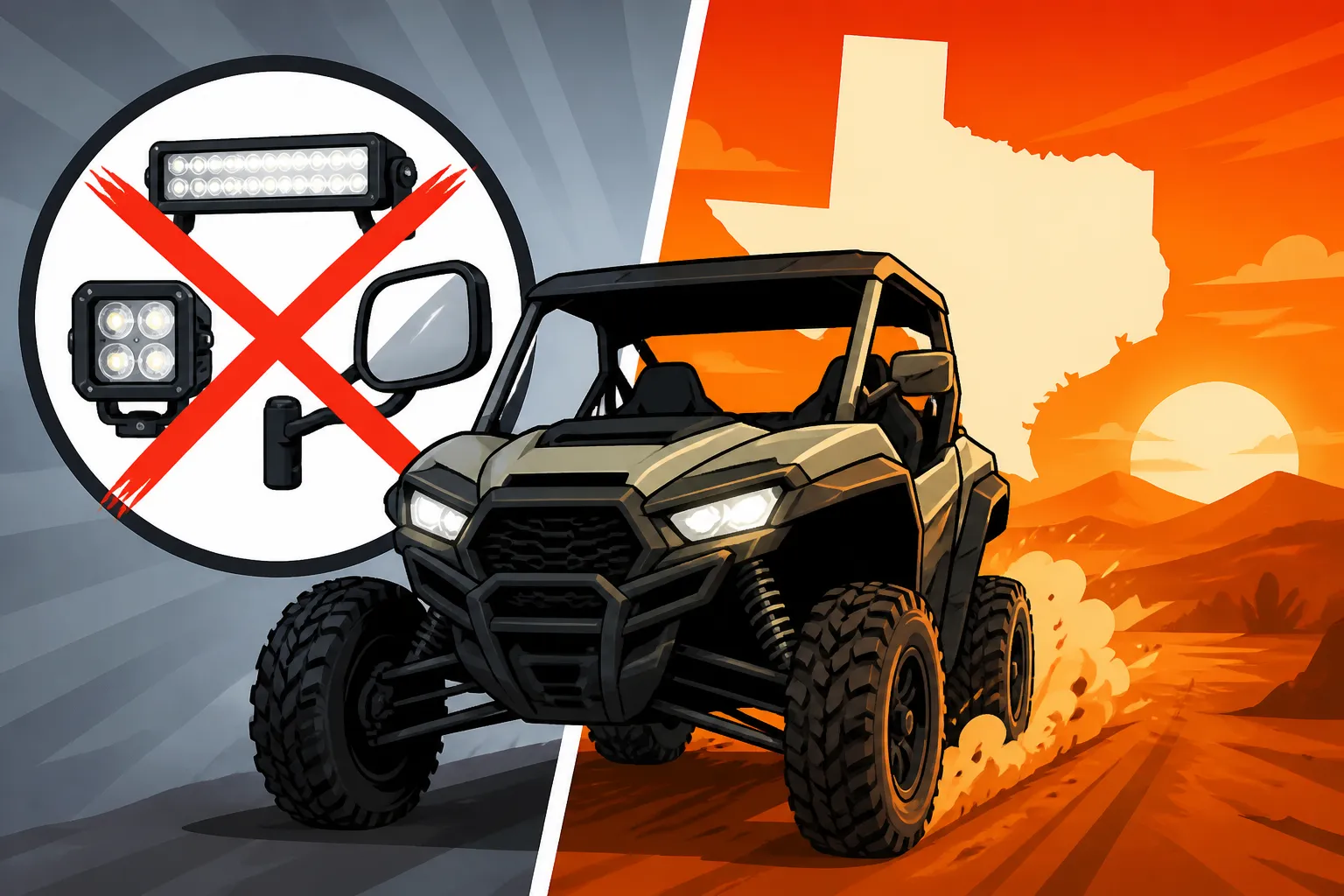
It's a common dream for many ATV and UTV owners in Texas: making that trusty off-road machine street legal so you can just hop on and ride to the store or a friend's house. You might see other vehicles out there with lights and mirrors and think, "Hey, I can add those!" But the truth is, simply bolting on a set of turn signals, a horn, or even side mirrors won't change your vehicle's fundamental status in the eyes of Texas law. This guide will dive deep into why these common modifications, while good for off-road safety, don't unlock street legality for your ATV or UTV in the Lone Star State.
The Fundamental "Off-Highway Use Only" Barrier
The biggest hurdle for getting your ATV or UTV on Texas roads isn't about what you add to it, but what it inherently is according to the state's legal definitions. Texas has a very clear stance on what constitutes an "off-highway vehicle," and that definition doesn't leave much room for improvisation when it comes to street use. It's frustrating, I know, especially when your machine feels perfectly capable of handling a paved road. But the law looks at the vehicle's original design and purpose, not your good intentions or clever modifications.
What the Texas Law Says About OHVs on Roads
In Texas, an off-highway vehicle (OHV) is defined as a motor vehicle that is not designed by the manufacturer for general use on public highways. This includes all-terrain vehicles (ATVs), recreational off-highway vehicles (ROVs, which include most UTVs or side-by-sides), and even dirt bikes. The crucial phrase here is "not designed by the manufacturer for general use on public highways." It doesn't say "not modified by the owner for general use" or "not equipped with certain accessories." It's about the factory intent, the foundational engineering. When you get a title for your ATV or UTV in Texas, you'll often see the remark [The Off-Highway Use Only Remark on a Texas Title] prominently displayed. This isn't just a suggestion; it's a legal classification that dictates where and how your machine can be operated.
This fundamental classification means that no matter how many road-legal components you bolt onto your quad or side-by-side, you're not changing its core identity as an off-highway vehicle. You could install a full suite of LED lights, DOT-approved tires, a windshield, and even a fancy horn from SuperATV, but the vehicle's original manufacturer certificate of origin (MCO) and subsequent title will still reflect its off-highway status. Texas law views these machines as built for the trails, the ranch, or the hunting lease, not for cruising down Main Street. The entire regulatory framework for motor vehicles is built around this distinction, and OHVs simply don't fit into the "street legal" box in most scenarios.
Why Lights and Mirrors Aren't Enough for Street Legality
It’s easy to look at a street-legal vehicle and break down its visible components: headlights, taillights, turn signals, brake lights, mirrors. Naturally, you might think adding these items to your OHV is the key. But for a vehicle to be truly street legal, it must meet a complex web of federal motor vehicle safety standards (FMVSS) and state-specific regulations. These standards cover everything from crashworthiness, emissions, and braking performance to specific tire ratings and vehicle identification number (VIN) formats. ATVs and UTVs are simply not engineered to pass these rigorous tests. Their suspension, frame, steering, and even their occupant restraint systems are designed for off-road conditions, not for high-speed impacts or sustained highway travel.
Consider the brakes, for example. While an ATV's brakes are perfectly adequate for off-road use, they might not meet the stopping distance requirements mandated for street-legal vehicles at highway speeds. The tires, designed for grip on loose terrain, might not have the necessary DOT rating for public roads, or they might wear out dangerously fast on pavement. And emissions? Many off-road vehicles don't have the same catalytic converters or emissions controls found on cars and trucks. Even if you found a complete street-legal kit from a company like SuperATV that includes turn signals, a horn, and mirrors, these accessories only address a fraction of the requirements. The core problem remains: the vehicle itself was never certified for on-road use by its manufacturer, and Texas law largely respects that original classification. This is why [Why Texas Will Not Register an ATV for the Road] is such a firm reality.
Understanding Texas's Strict Road Restrictions for OHVs
Texas lawmakers are very clear: off-highway vehicles are generally prohibited from public roads. This isn't just an arbitrary rule; it's rooted in safety concerns and the distinct design purpose of these machines. While it can feel restrictive, especially if you just want to get to the next trail segment or run a quick errand, the state has drawn a firm line. Trying to find loopholes or assume that a few aftermarket parts will grant you unrestricted access is a risky gamble, both legally and financially.
The Very Limited Exceptions for OHV Road Use
While the general rule is a resounding "no," Texas law does provide a handful of very specific, narrowly defined exceptions where an OHV may be operated on a public road. It's critical to understand that these are exceptions to a ban, not invitations for general street use. One of the most common exceptions is for agricultural purposes. If you're actively engaged in farming or ranching, you might be able to operate your ATV or UTV on a public road for a limited distance to perform agricultural tasks, like moving between fields or hauling feed. Even then, there are often requirements, such as driving only during daylight hours, not exceeding a certain speed, and displaying a flag. You'll find more details about this in guides like [Texas Rules for Riding a Farm Road]. Similarly, Texas allows OHVs to cross a public road, but only at a 90-degree angle, after coming to a complete stop, and when safe to do so. This is a quick crossing, not a ride along the road.
Another exception allows certain local jurisdictions, particularly some rural counties or master-planned communities, to pass ordinances permitting limited OHV use on specific roads. However, these are rare, highly localized, and come with their own set of rules and limitations. They almost always involve low-speed limits, specific operating hours, and often require additional safety equipment beyond what your OHV might already have. It's never a statewide free pass. These exceptions are meant to accommodate specific needs, not to transform your machine into a daily commuter. Attempting to interpret these exceptions broadly can quickly lead to trouble, as police officers enforce the letter of the law. You cannot simply assume that because some vehicles can use some roads, your modified ATV automatically qualifies.
The Difference Between an ATV/UTV and a Low-Speed Vehicle (LSV)
It’s easy to confuse a UTV with a Low-Speed Vehicle (LSV) or a golf cart that has been "street-legalized." However, these are fundamentally different classes of vehicles. An LSV, by definition, is a four-wheeled vehicle with a top speed of 20 to 25 mph, designed for operation on roads with speed limits of 35 mph or less. Crucially, LSVs are manufactured and certified to meet specific federal safety standards for road use, including headlamps, taillamps, stop lamps, turn signal lamps, reflectors, mirrors, a parking brake, a VIN, and safety belts. They come from the factory ready for the road, albeit restricted by speed and road type. [Texas Golf Cart Titling Rules] touches on similar distinct classifications.
Your ATV or UTV, even if you add every accessory imaginable, is not an LSV unless it was manufactured and certified as one from the outset. You cannot simply modify an off-highway UTV to become an LSV in the eyes of the law. The certification process is complex and originates with the manufacturer. While you might find a UTV that looks similar to an LSV, the underlying engineering, safety certifications, and legal classifications are distinct. Trying to register an ATV or UTV as an LSV will likely be a non-starter at the county tax office because it won't have the necessary manufacturer's documentation proving it meets LSV standards. This is why you often see dedicated "street legal UTVs" or "Neighborhood Electric Vehicles" (NEVs) being sold – they are designed and certified differently from traditional off-road UTVs.
The Reality of Modifications and Enforcement
So, you've invested in some fantastic accessories from a company like SuperATV – maybe a full LED light bar, rock lights, a turn signal kit, and some beefy mirrors for better visibility on the trails. These are incredibly useful for increasing safety and awareness when you're out exploring off-road, navigating a busy hunting camp, or performing tasks on your ranch. But here's the hard truth: while these modifications enhance your off-road experience, they don't magically change your vehicle's legal classification for public road use in Texas.
Why Aftermarket Parts Don't Change Legal Classification
Aftermarket parts, even those designed to mimic street-legal features like turn signals, horns, and mirrors, are intended to improve the utility and safety of your OHV within its intended operating environment. For instance, a SuperATV street legal kit for a UTV provides a horn, turn signals, and side mirrors – excellent for communicating with other riders on a busy trail or when crossing a private access road. It makes your off-road machine safer and more visible in situations where those features are beneficial. However, the installation of such a kit does not transform the UTV itself into a federally compliant motor vehicle designed for public highways. The state looks at the vehicle's original manufacturing certificate, its VIN, and its inherent design. [Why an Altered Quad Still Cannot Be Plated] reinforces this concept.
Imagine a high-performance race car. It might have incredible brakes, powerful lights, and even mirrors. But without crash testing, airbags, emissions controls, and all the other regulations that go into a road-legal passenger car, it can't just drive on public streets. The same principle applies to your ATV or UTV. The state isn't just looking for a checklist of accessories; it's looking for a vehicle designed and certified from the ground up for road use. Your local law enforcement officer isn't going to pull out a tape measure and an engineering diagram to verify if your custom braking system meets federal standards. They're going to look at your vehicle, see an ATV or UTV, and know that it's fundamentally an off-highway vehicle, regardless of the fancy accessories you've added.
Consequences of Operating a Non-Street-Legal OHV on Public Roads
Operating an ATV or UTV on a Texas public road without meeting one of the very narrow legal exceptions can lead to significant legal and financial headaches. The most immediate consequence is typically a citation for a Class C misdemeanor, which can result in fines ranging from [Texas Fines for Illegal ATV Road Use] plus court costs. Beyond the fine, your vehicle could be impounded, adding towing and storage fees to your woes. Imagine trying to explain to a police officer why your SuperATV lighting kit makes your side-by-side legal when the vehicle itself is clearly marked for off-highway use. It's a tough sell.
Even more concerning are the risks associated with accidents. If you're involved in a collision while operating a non-street-legal OHV on a public road, your insurance coverage could be completely voided. Most standard ATV/UTV insurance policies are designed for off-road use, not for liability on public highways. This means you could be personally liable for property damage, medical expenses, and even wrongful death claims, potentially bankrupting you. It's not worth the risk for a quick ride to the corner store. It’s always best to trailer your OHV to designated riding areas or stick strictly to private property. Remember, the law is there for a reason, and ignoring it, even with the best intentions and the coolest accessories, can have severe consequences.
Here's a quick comparison to highlight the fundamental differences:
| Feature/Requirement | ATV/UTV (Off-Highway Vehicle) | LSV (Low-Speed Vehicle) / Street-Legal Car |
|---|---|---|
| Primary Design | Off-road recreation/work | Public road use (restricted speed) / General road use |
| Manufacturer Cert. | Off-highway use only | Federally certified for road use |
| VIN Status | OHV VIN (not always conforming to FMVSS) | FMVSS-compliant VIN |
| Road Legal Status | Generally prohibited on public roads | Legal on roads 35 mph or less |
| Safety Standards | Designed for off-road impacts | Meets federal crash, braking, emissions standards |
| Required Equipment (Beyond basics) | Spark arrester, often a whip flag for parks | Headlights, taillights, brake lights, turn signals, horn, mirrors, seat belts, windshield, DOT tires, parking brake |
| Titling/Registration | [Titling an ATV in Texas], OHV plate available on request | Standard motor vehicle title/registration, specific LSV plates sometimes |
| Insurance | Off-road liability, often optional for private land | Mandatory liability for public road use |
Disclaimer
This article is for general informational purposes only and does not constitute professional advice. Laws, prices and regulations vary by location and change over time. Consult a qualified professional for guidance on your specific situation.