Texas National Forest Permits
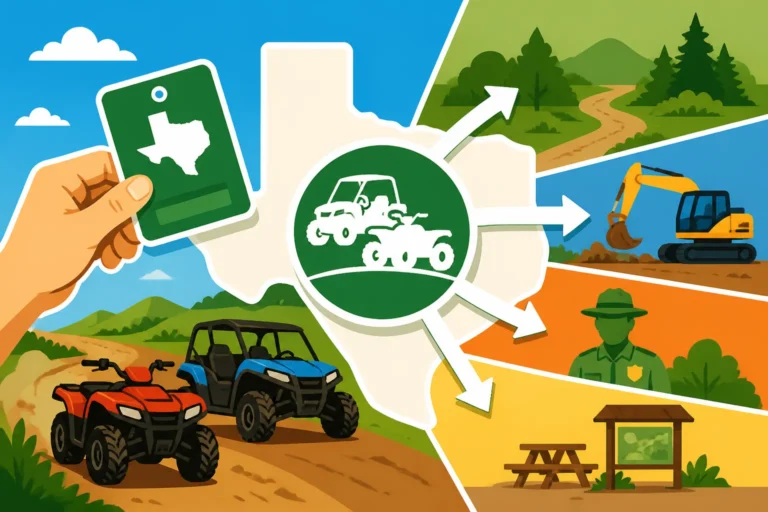
A Texas national forest ride can involve more than one permission, and none of them automatically covers the others. The confusing part is knowing whether you need a state OHV decal, a Forest Service recreation fee or pass, a safety certificate, or all three. This guide explains what each requirement does, where it applies, and what to check before you load up.
What a Texas national forest permit actually covers
There is no single permit called a “Texas national forest ATV permit” that grants blanket permission to ride anywhere in a national forest. Depending on where you plan to ride, you may need to satisfy separate state and federal requirements.
The easiest way to think about it is as three different questions:
- Is this route open to my machine? That is an access and land-management question.
- Do I need to pay a recreation fee or display a pass? That is a federal fee question.
- Do I need a Texas OHV decal or rider certificate? Those are state requirements.
A pass or decal answers only the question it was issued to address. Paying a Forest Service fee does not make a closed road legal to ride. A Texas OHV decal does not pay a federal day-use fee. And a safety certificate does not provide access to land where motorized riding is prohibited.
The state decal is commonly called the Texas OHV decal. It supports the state’s off-highway vehicle program and may be required when riding on public land covered by the state requirement. Check the current rules for the specific site and machine before you go. The decal is not a license plate, title, road registration, or substitute for a federal recreation pass. The Texas OHV Decal Explained
Federal fees are separate. A Forest Service site may use a day-use fee, an annual pass, a self-pay station, or another payment arrangement. Some federal passes cover certain recreation fees, but a pass is not automatically accepted for every service or at every location. Confirm what the specific forest or recreation area accepts. Does an OHV Decal Cover the Forest Day-Use Fee?
A rider certificate is different again. Texas rules may require certain young riders to hold a safety certificate when operating an OHV in covered settings. A certificate is about rider training and eligibility, not access or payment. [Texas OHV Safety Certificate Requirements]
The three-part check
Before a trip, confirm each item separately:
| Question | What to check | What it does not do |
|---|---|---|
| Is my route open to an OHV? | The forest’s current motor-vehicle map, trail status, closures, and local rules | A fee receipt cannot make an unauthorized route legal |
| Is a recreation fee or pass required? | The specific trailhead or recreation site’s current fee instructions | A federal pass does not replace a Texas OHV decal |
| Is a Texas decal required? | Texas OHV rules and the land manager’s guidance | A decal does not allow riding outside designated areas |
| Does the rider need a certificate? | Texas rules for the rider’s age and circumstances | A certificate is not a permit to enter land |
| Does the machine fit the trail? | Width, vehicle type, and posted trail restrictions | Having all paperwork does not make an oversized machine suitable |
If you are unsure which fee applies, ask the land manager about the exact trailhead and the exact machine you plan to ride. “I’m going to the national forest” is often too broad to get a reliable answer because different forests, recreation sites, and routes can have different conditions.
Where you can ride in a Texas national forest
A national forest is not one large open riding area. It contains roads, trails, developed recreation sites, wildlife habitat, private inholdings, and areas with different vehicle rules. The fact that a route appears on a phone map—or that another rider has used it—does not prove that it is open to your ATV or UTV.
Use the official Forest Service motor-vehicle information for the forest you intend to visit. Look for the current motor-vehicle use map, often called an MVUM, and read its legend. The map identifies routes open to motorized use and may show vehicle classes, seasonal restrictions, or other conditions. A route can be open to some motor vehicles but not to the machine you have.
Pay attention to the map’s details:
- Route type: A road open to highway vehicles may not be an OHV trail, and an OHV trail may not be open to a full-size UTV.
- Vehicle width: Narrow trails may have a maximum width that rules out many side-by-sides.
- Seasonal dates: A route may be open only during a particular part of the year.
- Temporary closures: Fire danger, maintenance, weather, or resource protection can close a trail even if it appears on a printed map.
- Parking and unloading: The legal route may start at a designated trailhead, not at the nearest pull-off.
- Private parcels: Public forest land can be interspersed with private property. Do not assume a route continues across every parcel.
- Posted signs: Follow signs at the site, especially when they indicate a closure or a more specific restriction.
A GPS app can be useful for orientation, but it should not be your authority for access. Apps may show an old track, a route created by another user, or a road that is not open to your vehicle. Download official information before leaving home, and keep a copy you can read without cellular service.
Sam Houston National Forest
The Sam Houston National Forest is the Texas national forest most commonly associated with a designated OHV trail system. Its trail information, vehicle-width limits, payment method, and closures should be checked directly before a visit. The network is not permission to ride every forest road or unmarked track nearby. Sam Houston National Forest’s 85-Mile OHV Trail
Sam Houston’s OHV trail is often discussed as a route for narrower machines. That makes checking your actual machine width important, especially if you have added wider tires, wheel spacers, fenders, or other modifications. A UTV that fits on a trailer may still be too wide for the trail. Measure the machine at its widest point and compare that measurement with the current posted limit. Do not rely only on the brochure description for the model.
The forest may also close trails when soil conditions are too wet. Riding on saturated soil can damage the trail and surrounding land, and a route that was open last weekend may be closed after rain. Check the forest’s current status close to departure, not only when you first plan the trip. When the Sam Houston Trail Shuts for Wet Soil
Other national forests in Texas are not interchangeable with Sam Houston. Do not assume that because one forest has a designated OHV trail, another forest’s roads are open to recreational ATV riding. Confirm the rules for the specific forest and route. For a practical overview of the Sam Houston trail area, see Riding the Sam Houston Trail.
Follow the route, not just the destination
A trailhead sign may show where riding begins, but it does not necessarily explain every route restriction. Before unloading, confirm that your intended trail is open to your vehicle and that you understand where the marked trail begins and ends. If the official map and a trail sign seem to conflict, ask the local office or follow the more restrictive direction until you have clear guidance.
Do not use an old track to create a shortcut around a gate or closure. A closed route remains closed even if there are fresh tire marks. Likewise, riding around a barricade can damage resources and may lead to a citation or loss of access.
State decals, federal fees, and annual passes
The main source of confusion is that riders often call every sticker, receipt, or pass a “permit.” It helps to use the correct name when asking questions.
The Texas OHV decal
A Texas OHV decal is a state program requirement that can apply to machines used on covered public lands. It is separate from the title and plate process. Texas may title an OHV without registering it for ordinary road use, and a title or plate should not be treated as proof that the machine has met every public-land riding requirement. Why Texas Titles But Never Registers an OHV
The decal applies to the machine, not simply to the rider’s group. If several machines are going, check whether each machine needs its own decal. A friend’s decal does not automatically cover your borrowed quad, and a decal on a different machine is not a group pass. Every Machine in the Group Needs Its Own Decal
Check where the current decal must be displayed and whether the decal is valid for the planned visit. If you ride at more than one public site, do not assume that a sticker purchased for one place replaces another land manager’s fee or local permit. The state decal and the site’s federal payment requirement can apply at the same time.
A nonresident should not assume that an out-of-state plate, registration, or state sticker replaces a Texas requirement. Reciprocity depends on the specific rule. Confirm the current treatment of nonresident machines before traveling. Does a Nonresident Need a Texas OHV Decal?
Forest Service recreation fees
A federal recreation fee is tied to the site or service. At some OHV trailheads, visitors may be expected to pay a day-use charge using a self-pay station or another posted method. At other places, the fee arrangement may differ. Follow the signs and payment instructions at the exact recreation site.
Do not assume that a payment made online, at a different recreation area, or for a different activity covers the trailhead you are visiting. If a pass is accepted, check whether it must be displayed on the vehicle, carried by the pass holder, or shown in another way. Keep the receipt until the ride is over.
An annual federal recreation pass may cover eligible fees at participating sites, but coverage depends on the type of fee and the location. It may not cover camping, special services, reservations, or other charges. Before counting on an annual pass, confirm that it applies to the specific OHV day-use fee. What a $25 National Forest Annual Pass Buys
A practical way to avoid paying for the wrong thing
When you contact an office, describe your trip in concrete terms:
- Name the forest and the trailhead.
- Say whether you have an ATV, dirt bike, or UTV.
- Give the machine’s approximate width if the route has a width limit.
- Ask whether there is a state decal requirement.
- Ask whether there is a separate federal fee.
- Ask how the fee must be paid and whether a pass is accepted.
- Ask whether the trail is currently open.
This is more useful than asking, “Do I need a permit for the national forest?” The answer may differ depending on which forest and which route you mean.
What to bring and how to confirm your requirements
A little preparation at home is easier than trying to solve a paperwork or payment problem at a remote trailhead. Create a short trip file that includes the official route information, payment instructions, and any documents you may need to show.
Before leaving home
- Choose the exact forest and trailhead. Avoid planning around a broad region. Verify the address or access road and check for gates, seasonal access, and road conditions.
- Download the official motor-vehicle map. Save the current map offline or print it. Mark the route you intend to use and identify any vehicle-width restrictions.
- Check the latest trail status. Look for wet-weather closures, fire-related restrictions, maintenance notices, and other temporary changes.
- Confirm the fee arrangement. Find out whether the site uses a day-use fee, accepts a pass, or requires payment at a self-service station.
- Check your Texas decal. Confirm that the machine has the required decal for the land and that it is displayed as instructed.
- Check rider qualifications. If a young rider is coming, review the applicable certificate and supervision requirements. Do not rely on age assumptions passed along by another family.
- Measure the machine. For a width-limited trail, measure the actual vehicle rather than relying on the manufacturer’s model name or a seller’s description.
- Bring proof of payment. Keep a receipt, confirmation, or pass available in the format the site requires.
- Plan for weak service. Store maps and important phone numbers offline. Trailheads may have limited or no cellular coverage.
If you need a replacement decal or are not sure where to obtain one, check the current state instructions before travel. A park gate may sell decals at some locations, but availability and any gate procedures can vary. Do not count on buying one at the trailhead without confirming first.
At the trailhead
Read every sign before unloading. Trailhead notices may provide current information that is more specific than a general website, including a temporary closure, a trail-width restriction, or a payment direction. If a self-pay station is provided, follow its instructions and retain the receipt.
Display a pass or payment proof exactly as directed. If the requirement is to carry a pass rather than place it on the vehicle, keep it accessible. If a ranger or other authorized staff member asks for proof, be prepared to show it without leaving the riding area to search through a trailer.
The Texas OHV decal, a federal pass, and a fee receipt are not interchangeable documents. Keep them separate so you can quickly show the one that applies to the question being asked.
For clothing and equipment, plan for the conditions rather than just the paperwork. Carry water, basic repair supplies, and protective gear appropriate for the machine and trail. If you order small accessories such as a map sleeve or flag mount through Amazon, check the dimensions and construction carefully; the product listing does not establish that an item meets a particular land manager’s rule. Confirm any required flag, helmet, lighting, or other equipment with the current site rules.
Keep evidence of payment
A paper receipt can fade, get wet, or blow out of a vehicle. Take a clear photo as a backup, but do not assume a photo replaces a displayed permit or pass when the site requires one. Keep the original in a safe, accessible place.
If the payment machine is out of service, do not assume that means payment is waived. Follow any alternate instructions posted at the station. If there are none, contact the managing office when possible and document what you found. A screenshot of an unrelated website or an old receipt from another visit is not proof that the current fee has been paid.
Reciprocity and out-of-state riders
“Reciprocity” can mean different things in different OHV programs. It may refer to whether Texas recognizes another state’s safety certificate, whether an out-of-state decal satisfies a local requirement, or whether a federal pass is accepted at a particular site. Do not treat all three questions as one.
Out-of-state safety certificates
Texas may recognize certain out-of-state OHV safety certificates under its rules, but recognition is not the same as a blanket exemption from every requirement. Check what proof is accepted, whether the certificate must be carried, and whether the rider’s age or circumstances affect the rule. Certificates Issued by Another State
A course-completion card from another state may be relevant to rider qualification, but it does not pay a forest fee and does not establish that a route is open. Keep the certificate accessible during the ride if the rule requires the rider to carry or show it. If a child is riding, confirm the supervision requirements as well; a certificate and adult supervision are separate matters. Riding Alongside Your Child Under Direct Supervision
Out-of-state machines and decals
A nonresident machine may still be subject to Texas public-land decal requirements. Do not assume that the machine’s home-state registration or decal makes it exempt in Texas. Ask the state program or land manager about the exact machine and use. Texas Reciprocity and Why It Is One-Sided
A federal annual pass is also distinct from state reciprocity. Its acceptance depends on the federal site and the fee being charged. If you are traveling from outside Texas, verify the decal requirement before you leave home and confirm the forest’s accepted payment methods separately.
Riders visiting from another state
For a short trip, the practical sequence is:
- Check whether your machine needs a Texas OHV decal.
- Check whether your certificate is recognized and what proof to carry.
- Verify that your machine fits the route.
- Confirm whether the trailhead has a separate recreation fee.
- Check the current trail status and any local equipment rules.
A dealer’s statement, an online forum, or another rider’s experience can be a useful lead, but it is not a substitute for the current rule. Requirements can differ between Texas public lands, federal recreation sites, and private riding parks.
Fees, access problems, and common mistakes
The most common trouble at a trailhead is not a complicated legal issue. It is a small assumption that turns out to be wrong: the rider has a pass but not the required decal, the trail is closed after rain, the UTV is too wide, or the payment station only accepts a method the group did not bring.
Mistakes to avoid
Assuming one pass covers everything. A federal pass, state decal, fee receipt, and rider certificate serve different purposes. Check each one separately.
Riding a route because it is visible on a map app. Use the official motor-vehicle map and current local notices. Unofficial tracks can be outdated or unauthorized.
Assuming every national forest road is open to OHVs. National forest land includes routes with different rules. Ride only where your vehicle is allowed.
Relying on last year’s information. Fees, payment methods, trail conditions, and seasonal rules can change. Confirm details close to the trip.
Assuming the trail fits because the UTV is marketed as compact. Accessories and modifications can change the machine’s total width. Measure the actual vehicle.
Treating a closed trail as a suggestion. Wet-weather, fire, and maintenance closures protect both riders and the trail. Do not go around a barrier.
Leaving payment until arrival. A remote self-pay station may not have the payment option you expected. Check the posted method in advance and bring an acceptable backup if permitted.
Assuming a private-land rule applies in a national forest. Permission from a landowner is not the same as permission to use federal land. Likewise, a forest pass does not grant access across private land.
If you cannot confirm a route’s status, choose a route you can verify or postpone the ride. A few minutes spent checking can prevent a long drive to a closed trail or an avoidable enforcement problem.
When you cannot find a clear answer
Use the official forest or recreation-site contact information. Ask a specific question and, if possible, keep a note of the answer and when you received it. For trail status, check the designated status channel before departure and again if weather changes.
If a sign at the site gives a more restrictive instruction than an older map or page, follow the sign and ask the land manager for clarification. Do not use uncertainty as a reason to ride past a closure or onto an unmarked route.
For the Sam Houston trail, current operating conditions and fee details deserve particular attention. Review the trail information and local notices before setting out, especially after heavy rain. Calling the Trail Status Line
A simple trip checklist
Use this checklist the evening before your ride and again at the trailhead.
The evening before
- Confirm the forest, trailhead, and legal route.
- Check the current official map and download it for offline use.
- Verify the machine’s width and the trail’s vehicle limits.
- Check for seasonal restrictions, wet-weather closures, and fire-related notices.
- Confirm whether a Texas OHV decal is required and displayed correctly.
- Confirm the federal fee or pass requirement for that trailhead.
- Check the rider certificate and supervision rules for any young riders.
- Pack proof of payment, certificates, water, and required riding equipment.
- Make sure your payment method will work at the site.
At the trailhead
- Read current signs before unloading.
- Pay the posted fee or follow the site’s pass instructions.
- Keep your receipt or proof of pass available.
- Stay on designated routes and obey vehicle restrictions.
- Turn around if a closure or condition makes the route unsafe or unlawful.
- Leave gates, signs, and barriers as you found them.
A national forest ride is straightforward once you separate the pieces: route access, federal recreation payment, state decal requirements, and rider qualifications. Confirm all four for the specific place you are visiting. For broader information on the federal fee side of a Texas OHV trip, see Texas National Forest OHV Fee.
Disclaimer
This article is for general informational purposes only and does not constitute professional advice. Laws, prices and regulations vary by location and change over time. Consult a qualified professional for guidance on your specific situation.