Texas Rules for Riding a UTV to a Golf Course
There’s nothing quite like the convenience of hopping into your UTV, loading up your clubs, and zipping down to the local golf course for a round. It sounds idyllic, doesn't it? But if you live in the Lone Star State, you’ve probably heard whispers, conflicting stories, or outright warnings about taking your off-highway vehicle (OHV) onto public roads. The thought of getting a ticket or, worse, causing an accident because you misunderstood the rules is a real concern. This guide is here to cut through the confusion and explain exactly what Texas law says about driving your UTV to the golf course, outlining the specific conditions under which it might be permissible.
The General Rule: Why Texas Limits UTVs on Roads
Let's just get this out of the way upfront: generally speaking, Texas law is pretty clear that UTVs, along with ATVs, dirt bikes, and other off-highway vehicles, are not meant for public roads. This isn't just some arbitrary rule; it's rooted in how these machines are designed and regulated. They’re built for challenging terrain, trails, and open fields, not the asphalt jungles and traffic of public highways. The state wants to keep everyone safe, and a UTV, with its different handling characteristics and lack of traditional safety features found in cars, simply isn't considered a road-worthy vehicle under most circumstances.
Texas's Strict Off-Highway Vehicle Definition
Texas has a very specific way of defining what an off-highway vehicle is, and UTVs (or ROVs, recreational off-highway vehicles, as they're often called in the statutes) fall squarely into this category. Essentially, if it’s designed primarily for off-road use, has a non-straddle seat, and isn't registered as a traditional motor vehicle, it’s an OHV. This classification means it's automatically excluded from general road use. The state recognizes these machines are incredibly useful for work and recreation, but their purpose is defined by their off-road capability. This definition is the foundation for why [Are ATVs Street Legal in Texas?] is often met with a resounding "no" for general street use.
Why Street Legal Conversion Kits Aren't Enough
Many UTV owners, understandably frustrated by the road restrictions, look to aftermarket solutions. You might see all sorts of "street legal kits" available from companies like SuperATV, offering turn signals, horns, mirrors, and even DOT-approved tires. And while these components are absolutely crucial for safety and for meeting the equipment requirements of certain exceptions, they don't magically change your UTV's fundamental classification in Texas. The issue isn't just about having the right lights; it's about the vehicle's original design intent and its lack of full compliance with federal motor vehicle safety standards that regular cars and trucks must meet. Texas law focuses on the vehicle's primary design, not what accessories you bolt onto it. This is why when people ask, [Can You Make a UTV Street Legal in Texas?], the short answer is typically "not for general road use."
The Golf Course Exception: Specific Rules for UTVs
Now, for the good news – or at least, the nuanced news – regarding golf courses! Texas law does carve out specific exceptions for UTVs (and golf carts, which have their own distinct rules) to be operated on public roads under very limited circumstances, and one of the most relevant for many of us is accessing a golf course. This isn't a free pass to drive your UTV all over town, but it does acknowledge the practical need for players to get their gear to the greens.
Distance Limitations for Golf Course Access
The primary restriction for taking your UTV on a public road to a golf course is the distance. You can only operate your UTV on a public street or highway if you are within two miles of the place where the vehicle is usually parked or stored and you are traveling to or from a golf course. This is a pretty strict limit. Imagine your UTV is parked in your garage; you can only drive it on public roads for up to two miles in any direction to reach the golf course. It’s designed for those living in or very close to a golf course community, not for folks who live across town. This is the essence of [2 Miles From Where the Machine Is Parked]. If your favorite course is further than that, you'll still need to trailer your UTV.
Daylight Only Operation
Another critical part of the golf course exception is that your UTV use on public roads must be strictly during daylight hours. Forget those early morning tee times before sunrise or those twilight rounds that stretch into dusk if you're planning to drive your UTV on the road. The law is clear: from sunrise to sunset, you're good (within the distance limits), but once the sun dips below the horizon, your UTV needs to be off public thoroughfares. This stipulation is explicitly detailed in [Daylight Only Under the Texas Golf Course Rule] and is a key safety measure, given that UTVs often have less visible lighting than traditional cars.
Understanding Your Local Ordinances
While state law provides the overarching framework, local cities and counties sometimes have their own ordinances that further refine or even restrict UTV use. For example, some cities might have stricter rules about which specific streets can be used, or they might require a special local permit even if you meet the state's criteria. It's absolutely crucial to check with your local city hall or county clerk's office before you assume you're in the clear. What’s perfectly fine in a rural county might get you a ticket in a more densely populated municipality. This is especially true for golf course communities where the lines between private roads and public streets can sometimes feel a bit blurry. Always verify the specifics with your local authorities, as they can impose additional requirements not covered by state law.
Equipment and Safety Requirements
Even when operating your UTV under an exception, like traveling to a golf course, you can't just roll onto the road without certain equipment and safety precautions. These requirements are in place to minimize risk for both the UTV operator and other road users. It's about making sure that if you are on the road, your machine is as visible and controllable as possible.
Essential Safety Gear for UTV Operation
While Texas doesn't have a universal helmet law for all ATV/UTV riding, when you're operating a UTV on a public road under an exception, safety gear becomes even more critical. Generally, if your UTV is equipped with a roll cage and seat belts, you'll be expected to use those seat belts. However, for those riding ATVs (which often lack roll cages), or in certain UTV situations, wearing a helmet is highly recommended and can even be legally required depending on the specific circumstances. Eye protection, such as goggles or a face shield, is also crucial, especially if your UTV doesn't have a full windshield, to protect against debris and wind. Always consult [Texas Helmet Law for UTV Drivers] for the most current information regarding specific requirements.
Required Vehicle Equipment for Road Use
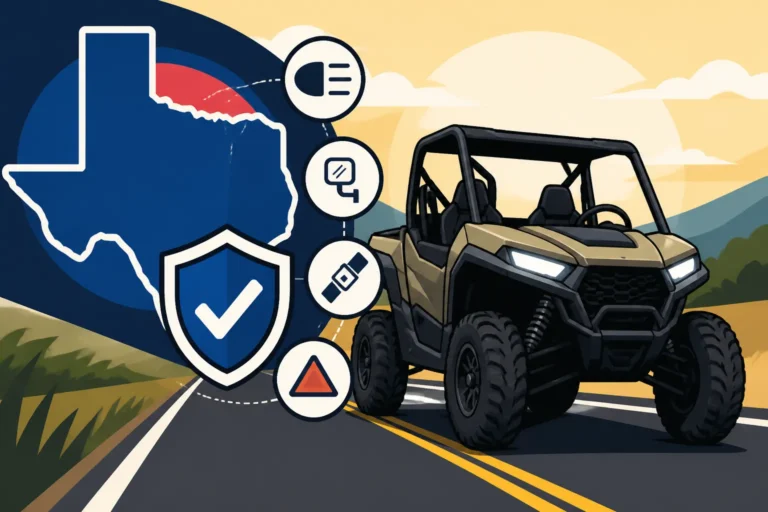
Just like any vehicle sharing the road, your UTV needs certain functional equipment to be legal, even under an exception. This isn't about making your UTV "street legal" in the full sense, but about equipping it for the limited road use allowed. You’ll need:
- Brakes: Fully functional brakes on all wheels.
- Headlights: At least one, but preferably two, that emit a white light visible from a certain distance.
- Taillights: At least one red taillight visible from a specified distance.
- Brake Lights: To signal when you're slowing down or stopping.
- Reflectors: Red reflectors on the rear of the vehicle.
- Rearview Mirror: Essential for seeing traffic behind you.
- Horn: A working horn to signal other drivers.
- Muffler and Spark Arrester: To keep noise levels down and prevent sparks.
- Safety Flag: If operating on specific public lands or areas (though not strictly for golf course access, it's good practice for general visibility).
Many of these items, like mirrors, horns, and lights, can be purchased as aftermarket upgrades from companies like SuperATV. While adding them won't make your UTV street legal for general use, they are often necessary to meet the basic equipment standards for any road operation, even under a limited exception. Always check [Texas Equipment Rules for an ATV on a Road] to ensure your UTV meets all the current requirements for any form of road use.
| Feature | General UTV Road Use (Prohibited) | Golf Course Exception (Limited) | Other Exceptions (e.g., Ag Use) |
|---|---|---|---|
| Purpose | Recreation/Off-Road | Accessing Golf Course | Farming/Ranching/Specific Tasks |
| Distance Limit | N/A | Max 2 Miles from Storage | Varies (e.g., 10 miles for Ag) |
| Time of Day | N/A | Daylight Only | Varies (Daylight for Ag) |
| Local Ordinances | N/A | May Apply / Vary | May Apply / Vary |
| Headlights | Required for exceptions | Required | Required |
| Taillights | Required for exceptions | Required | Required |
| Brake Lights | Required for exceptions | Required | Required |
| Horn | Required for exceptions | Required | Required |
| Mirrors | Required for exceptions | Required | Required |
| Turn Signals | Not always required by state law | Recommended, but not explicit | Not explicit |
| License Plate | Not required for OHV status | No specific plate for this use | [The Texas Off-Highway Vehicle License Plate] might apply for other uses |
| Insurance | Not legally required for OHVs | Not legally required | Not legally required |
Other Limited Road Use Scenarios for UTVs
While getting to the golf course is a specific and common question, it’s worth noting that Texas law does provide a few other specific, narrowly defined instances where UTVs can legally operate on public roads. Understanding these can help you avoid unintended violations in other situations. These exceptions are never about general commuting or joyriding on public streets, but rather about facilitating necessary activities where a UTV is the most practical tool.
Master Planned Communities and Their Own Rules
Texas law also allows for UTVs to be operated on public roads within master planned communities, if the community's covenants and restrictions permit it and the local authority (city or county) has authorized such use. These communities are often designed with a specific lifestyle in mind, sometimes incorporating golf courses, and may have lower speed limits and less through-traffic. The key here is that it requires explicit permission at both the community and governmental level. If you live in such a community and want to use your UTV on its roads, you'll need to dig into the community's bylaws and check with your city or county. This complex area is further detailed in [Texas Rules for Master Planned Communities].
Agricultural and Ranch Operations
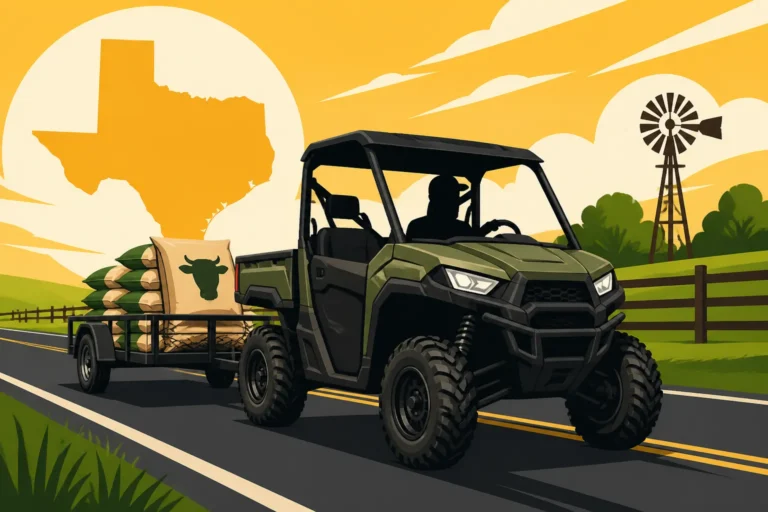
Perhaps one of the most common and widely understood exceptions for UTVs on Texas roads is for agricultural purposes. Farmers and ranchers frequently use UTVs as work vehicles to traverse their land, move equipment, or tend to livestock. Texas law permits UTVs to be operated on public roads for up to 10 miles from the point of origin to the destination, strictly for agricultural purposes. This includes hauling feed, checking fences, or moving between fields. There are specific requirements for lighting, safety flags, and sometimes even the type of road. This exception doesn't mean you can run all your personal errands with your ranch UTV, but it acknowledges the integral role these machines play in Texas's agricultural industry. You can learn more about this specific exemption in [Texas Agricultural Exemption for ATVs on Roads].
Always remember that these exceptions are just that—exceptions to a general prohibition. They are not invitations to make your UTV your primary mode of transportation. Heed the rules, respect the spirit of the law, and prioritize safety above all else when you consider taking your UTV anywhere near a public road in Texas.
Disclaimer
This article is for general informational purposes only and does not constitute professional advice. Laws, prices and regulations vary by location and change over time. Consult a qualified professional for guidance on your specific situation.